| Bournemouth | |
|---|---|
| Town | |
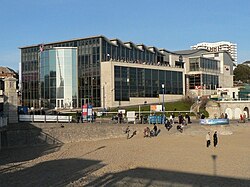
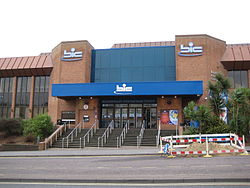
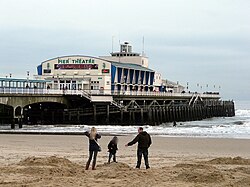
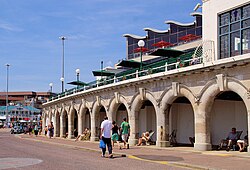 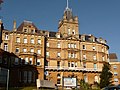 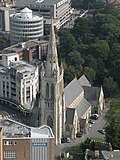 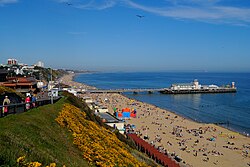 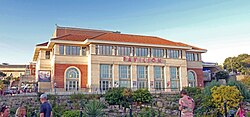 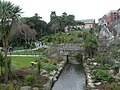 Top to bottom, left to right: The seafront, the town hall, St. Peter's Church, Bournemouth Pier, the Pavilion Theatre and Bournemouth Gardens | |
 | |
Bournemouth Location within Dorset | |
| Area | 15.54 sq mi (40.2 km2) |
| Population | 196,455 (built-up area, 2021)1 |
| • Density | 12,642/sq mi (4,881/km2) |
| OS grid reference | SZ086912 |
| Civil parish |
|
| Unitary authority | |
| Ceremonial county | |
| Region | |
| Country | England |
| Sovereign state | United Kingdom |
| Post town | BOURNEMOUTH |
| Postcode district | BH1-11 |
| Dialling code | 01202 |
| Police | Dorset |
| Fire | Dorset and Wiltshire |
| Ambulance | South Western |
| UK Parliament | |
| Website | Town Council |
Bournemouth (/ˈbɔːrnməθ/ ⓘ BORN-məth) is a coastal resort town and civil parish in the Bournemouth, Christchurch and Poole unitary authority area, in the ceremonial county of Dorset, on the south coast of England. At the 2021 census, the built-up area had a population of 196,455, making it the largest town in Dorset.
Previously an uninhabited heathland, visited only by fishermen and occasional smugglers, a health resort was founded in the area by Lewis Tregonwell in 1810. After the Ringwood, Christchurch and Bournemouth Railway opened in 1870, Bournemouth grew into an important resort town, which today attracts over five million visitors annually for its coastline and nightlife.
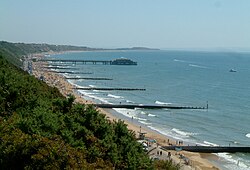
The town is a population centre within the South East Dorset conurbation and is known for its seven-mile stretch of golden sand, with well-known spots including Alum Chine Beach, Durley Chine Beach, and Bournemouth Central Beach. The shoreline continues westward and gradually merges into the affluent Sandbanks area and Poole. Alongside tourism, financial services now play a significant role in the local economy.
The town centre is notable for its Victorian architecture. St Peter's Church features a 202-foot (62 m) spire and is one of three Grade I listed churches in the borough. The town has an events venue and a concert hall, the Bournemouth International Centre (BIC) and Pavilion Theatre respectively. Bournemouth is also home to the Premier League football club, AFC Bournemouth, and to Bournemouth University, which has a growing reputation in fields such as media, business and health.
Toponymy
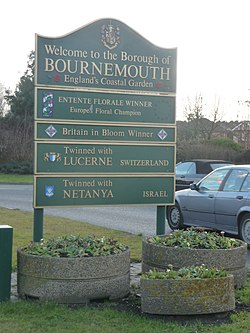
The first mention of Bournemouth comes in the Christchurch cartulary of 1406, where a monk describes how a large fish ("uni magno piscis"), 18 feet (5.5 metres) long, was washed up at "La Bournemothe" in October of that year and taken to the Manor of Wick; six days later, a portion of the fish was collected by a canon from Christchurch Priory and taken away as tithe.2 "La Bournemowthe" was purely a geographic reference to the uninhabited area around the mouth of the small river which drained the heathland between the towns of Poole and Christchurch.345
The word bourne, meaning a small stream, is a derivative of burna, Old English for brook.46 From the latter half of the 16th century "Bourne Mouth" seems to be preferred, being recorded as such in surveys and reports of the period, but this appears to have been shortened to "Bourne" after the area had started to develop.45 A travel guide published in 1831 calls the place "Bourne Cliffe" or "Tregonwell's Bourne" after its founder.7
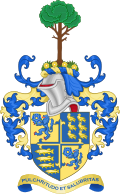
The Spas of England,8 published ten years later, calls it simply "Bourne"9 as does an 1838 edition of the Hampshire Advertiser.10 In the late 19th century "Bournemouth" became predominant. Its two-word form appears to have remained in use up until at least the early 20th century, turning up on a 1909 ordnance map.311 The Coat of arms of Bournemouth was granted in March 1891.
History
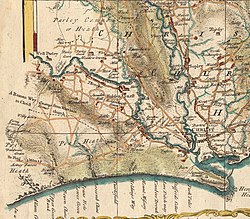
There were some prehistoric settlements in the area, notably along the River Stour, including Longham where a skull thought to be 5,500 years old was found in 1932. Bronze Age burials near Moordown, and the discovery of Iron Age pottery on the East Cliff in 1969, suggest there may have been settlements there during that period. Hengistbury Head, added to the borough in 1932, was the site of a much older Palaeolithic encampment.121314
In the 12th century, the region around the mouth of the River Bourne was part of the Hundred of Holdenhurst. The hundred later became the Liberty of Westover when it was extended to include the settlements of North Ashley, Muscliff, Muccleshell, Throop, Iford, Pokesdown, Tuckton and Wick, and incorporated into the Manor of Christchurch.15 Although the Dorset and Hampshire region surrounding it had been the site of human settlement for thousands of years, Westover was largely a remote and barren heathland before 1800.16 In 1574, the Earl of Southampton said that the area was "Devoid of all habitation". As late as 1795, the Duke of Rutland recorded that "... on this barren and uncultivated heath there was not a human to direct us".417
During the latter half of the 16th century James Blount, 6th Baron Mountjoy, began mining for alum in the area, and at one time part of the heath was used for hunting, although by the late 18th century little evidence of either event remained.1819 No-one lived at the mouth of the Bourne river and the only regular visitors to the area before the 19th century were a few fishermen, turf cutters and gangs of smugglers.20
19th century
Prior to the Christchurch Inclosures Act 1802 (42 Geo. 3. c. 43 Pr.), more than 70% of the Westover area was common land. The act, together with the Inclosure Commissioners' Award of 1805, transferred 5,000 acres (2,000 ha) into the hands of five private owners, including James Harris, 1st Earl of Malmesbury, and Sir George Ivison Tapps.2122
In 1809, the Tapps Arms public house was built on the heath. In 1812, the first official residents, retired army officer Lewis Tregonwell and his wife, moved into their new home built on land purchased from Tapps. The area was well known to Tregonwell who, during the Napoleonic Wars, spent much of his time searching the heath and coastline for French invaders and smugglers.23
Rise of beach culture
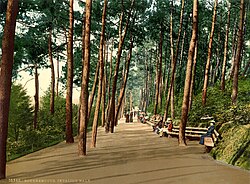
Anticipating that people would come to the area to indulge in the newly fashionable pastime of sea-bathing, an activity with perceived health benefits, Tregonwell built a series of villas on his land between 1816 and 1822, which he hoped to let out.2425 The common belief that pine-scented air was good for lung conditions, and in particular tuberculosis, prompted Tregonwell and Tapps to plant hundreds of pine trees. These early attempts to promote the town as a health resort meant that by the time Tregonwell died in 1832, Bournemouth had grown into a small community with a scattering of houses, villas and cottages.2426 The town ultimately grew around the scattered pines and tree-lined walk to the beach, later to become known as the Invalids' Walk.2728
After the death of Tapps in 1835, his son Sir George William Tapps-Gervis inherited his father's estate. He hired the young local architect Benjamin Ferrey to develop Bournemouth Gardens along the coastal area on the east side of the stream.29 Bournemouth's first hotel, later to become part of the Royal Bath Hotel, opened in 1838 and is one of the few buildings designed by Ferrey still standing2629 and operating. Bournemouth grew at a fast rate, with Tapps-Gervis developing the area similarly to the south coast resorts of Weymouth and Brighton. Despite enormous investment, the town's share of the market remained modest.27
In 1841, Tapps-Gervis invited the physician and writer Augustus Granville to stay. Granville was the author of The Spas of England, which described health resorts around the country, and as a result of his visit, he included a chapter on Bournemouth in the second edition of his book.8 The publication of the book, and the increase in visitors seeking the medicinal use of seawater and the pine-scented air, helped the town to grow and establish itself as an early tourist destination.3031
In the 1840s Benjamin Ferrey was replaced by Decimus Burton, whose plans for Bournemouth included the construction of Bournemouth Gardens alongside the Bourne stream, an idea first mooted by Granville. The fields south of the road crossing, later Bournemouth Square, were drained and laid out with shrubberies and walks. Many of these paths, including the Invalids' Walk, remain in the town today.3132 A second suggestion of Granville's, a sanatorium, was completed in 1855 and greatly raised Bournemouth's profile as a place for recuperation.33
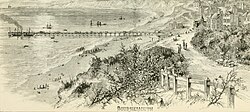
At a time when the most convenient way to arrive in the town was by sea, a pier was considered to be a necessity. The Holdenhurst parish vestry was reluctant to find the money, and an attempt to raise funds privately in 1847 only succeeded in financing a small 100-foot (30 m) jetty.34 The Bournemouth Improvement Act 1856 (19 & 20 Vict. c. xc) granted greater financial autonomy to the town and a pier was approved that year. A number of wooden structures were built before an 838 feet (255 m) cast iron design by Eugenius Birch was completed in 1880.3435 Under the Act, a board of 13 Commissioners was established to build and organise the expanding infrastructure of the town, such as paving, sewers, drainage, street lighting and street cleaning.36
Introduction of railways and mass tourism
In 1870, the arrival of the railways precipitated a massive growth in seaside and summer visitors to the town, especially from the Midlands and London. In 1880, Bournemouth had a population of 17,000. In 1900, when railway connections to Bournemouth were at their most developed, the town's population had risen to 60,000 and it had become a favourite location for visiting artists and writers.24
Bournemouth was greatly improved during this period through the efforts of Sir Merton Russell-Cotes, the town's mayor and a local philanthropist, who helped to establish improved's first library and museum. The Russell-Cotes Art Gallery & Museum was housed in his mansion. After his death, it was given to the town.37 Bournemouth became a municipal borough in 1890 and a county borough in 1900.36
20th century
As Bournemouth's growth increased in the early 20th century, the town centre spawned theatres, cafés, two art deco cinemas, and more hotels. Bournemouth Corporation Tramways was established in 1902, becoming the town's first public transport system. In 1908, a deadly tram crash in the town gardens killed seven people. Other new buildings constructed included the war memorial in 1921 and the Bournemouth Pavilion, the town's concert hall and grand theatre, finished in 1925.
The Bournemouth Blitz saw heavy damage to the town during the Second World War despite initially escaping heavy bombing. A raid by German fighter bombers on 23 May 1943 killed 131 people and damaged 3,359 buildings, with two large hotels being completely destroyed. It is believed that the large number of RAF airmen billeted in the town may have been the reason for the attack.38 The seafront incurred damage when it was fortified against invasion.39 The cast iron lampposts and benches along the beach were removed and melted down for munitions, as was much of the superstructure from both Bournemouth and Boscombe piers, before they were breached to prevent their use by enemy ships.39 The large amounts of barbed wire and anti-tank obstacles along the beach, and the mines at the foot of the chines, took two years to remove when peace was achieved.40
The Royal National Lifeboat Institution stationed an inshore lifeboat at Bournemouth between 1965 and 1972. Coverage for the area has otherwise been provided from Poole Lifeboat Station.41 In 1984, the Bournemouth International Centre (BIC), a large conference and exhibition centre, was constructed near the seafront.42 In 1985, Bournemouth was the first town in the United Kingdom to introduce and use CCTV cameras for public street-based surveillance.26
In August 1993, the IRA orchestrated a terrorist attack in the town centre. The only injuries sustained were minor, but over £1 million in damage was caused.43
21st century
From 2000 to 2001 the Tesco bomb campaign hit the town with a plot to extort money from Supermarket giant Tesco. Visitors to the town plummeted during the campaign, especially after a bomb exploded at an elderly woman's home after she opened a letter sent by the bomber. During the eight months, over seven bombs were found by Dorset Police, ranging from small letter bombs, to pipe bombs and parcel bombs. The culprit was found to be Robert Edward Dyer, he was sentenced to 12 years in prison.44
In 1998, the Waterfront complex, which was intended to hold an IMAX cinema, was constructed on the seafront.45 The 19-metre-high (62-foot) concrete and smoked glass building featured a wavy roof design, but was despised by residents and visitors alike because it blocked views of the bay and the Isle of Purbeck.4546 In 2005, it was voted the most hated building in England in a 10,000-person poll conducted by the Channel 4 programme Demolition, and was pulled down in spring 2013.4547
Bournemouth was twice unsuccessful in its bids for city status, first at the Diamond Jubilee of Elizabeth II in 2012,48 and again in the Platinum Jubilee Civic Honours in 2022.49
Governance
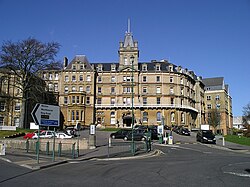
The unitary authority for the area is Bournemouth, Christchurch and Poole Council, which is based at the Civic Centre, formerly known as Bournemouth Town Hall, on Bourne Avenue in Bournemouth. As of April 2026, Bournemouth Town Council is in the process of being established.50 The civil parish was formed on 1 April 2026.51
Administrative history
The area that is now Bournemouth was historically mostly within the ancient parish of Christchurch in Hampshire. A chapel of ease was established at Holdenhurst to serve the west of the parish. From medieval times, the chapelry of Holdenhurst came to be treated as a separate civil parish.52
When the development of Bournemouth began in 1810, the site straddled the parishes of Holdenhurst and Christchurch. In 1845, an ecclesiastical parish of Bournemouth was created, but for civil purposes there was no change.53 In 1856, a body of improvement commissioners was established to provide local government services in the town.54
In 1890, Bournemouth was incorporated as a municipal borough. In 1900, it was elevated to the status of a county borough, making it independent from Hampshire County Council, whilst remaining part of the geographical county of Hampshire. The borough boundaries were enlarged on several occasions. In 1901, it absorbed Pokesdown, Southbourne and Winton. In 1931, it absorbed Holdenhurst and Kinson. Kinson was transferred from Dorset to Hampshire on its absorption into Bournemouth.55 In 1921, the borough council bought the former Mont Dore Hotel on Bourne Avenue, which had been completed in 1885, and converted into the Town Hall.56
On 1 April 1974, the county borough of Bournemouth was reconstituted as a non-metropolitan district under the Local Government Act 1972. The district kept the same boundaries, but was transferred from Hampshire to Dorset, it being considered desirable that the whole of the South East Dorset conurbation should be in the same county.3657 No successor parish was formed so it became unparished.58 Bournemouth's borough status was transferred to the new district, allowing the council to take the name Bournemouth Borough Council and giving the chair of the council the title of mayor, continuing Bournemouth's series of mayors dating back to 1890.59
In April 1997, Bournemouth Borough Council became a unitary authority, taking over the provision of county council functions from Dorset County Council.60
In April 2019, the nine councils of Dorset were merged into two. Bournemouth became part of a unitary authority with Christchurch and Poole, known as BCP.61 For the purposes of Lieutenancy it remains part of the ceremonial county of Dorset. When Bournemouth Borough Council was abolished 2019, it has had charter trustees, being the BCP councillors representing wards in the former borough of Bournemouth. The trustees preserved the town's civic charters and traditions, including appointing one of their number each year to serve as mayor.62
In October 2024, BCP Council resolved to conduct a community governance review which could lead to the creation of town and parish councils in its area. An initial draft recommended creation of a Bournemouth parish which would elect a town council, alongside creation of parish councils in the surrounding area and a town council for Poole.6364 Establishment of Bournemouth Town Council was approved in October 2025, with the first elections to be held in May 2026.65
Parliamentary representation
Bournemouth is represented by two parliamentary constituencies in the House of Commons, Bournemouth East and Bournemouth West.66 In the 2024 general election, Bournemouth East was won for Labour by Tom Hayes with 40.8% of the vote. Bournemouth West was won for Labour by Jessica Toale with 36.4%.67 Both had previously been considered Conservative safe seats.68 In 2022, both of the town's Conservative MPs – Conor Burns and Tobias Ellwood – had the whip withdrawn, forcing them to sit as Independents.6970
Geography
Bournemouth is about 94 miles (151 km) southwest of London.71 The town borders the neighbouring towns of Poole and Christchurch to the west and east respectively. Poole Bay lies to the south.7273 The River Stour forms a natural boundary to the north and east, terminating at Christchurch Harbour.7374 The River Bourne rises in Poole and flows through the middle of Bournemouth town centre, into the English Channel.75 The towns of Poole, Bournemouth and Christchurch form the South East Dorset conurbation with a combined population of over 400,000. Bournemouth is both a retail and commercial centre.76 Areas within Bournemouth include: Boscombe, Kinson, Southbourne, Springbourne, Throop, Westbourne, Winton and Pokesdown.77
The area's geology has little variety, comprising almost entirely of Eocene clays which, prior to urbanisation, supported a heathland environment.7879 Patches of the original heath still remain, notably Turbary Common, a 36-hectare (89-acre; 0.14 sq mi; 0.36 km2) site, much of which is designated a Site of Special Scientific Interest.80 This heathland habitat is home to all six species of native reptile, the Dartford warbler and some important flora such as sundew and bog asphodel. Small populations of Exmoor pony and Shetland cattle help to maintain the area.81
Bournemouth is directly north of Old Harry Rocks which mark the easternmost end of the Jurassic Coast, 96 miles (155 km) of coastline designated a World Heritage Site in 2001.82 Bournemouth's coastline stretches from Sandbanks to Christchurch Harbour and is mainly sandy beaches backed by gravel and sandy clay cliffs. These cliffs are cut by a number of chines, which provide natural access to the shore.83 At the easternmost point lies Hengistbury Head, a narrow peninsula that forms the southern shore of Christchurch Harbour. It is a local nature reserve and the site of a Bronze Age settlement.8485
Climate
Like all of the UK, Bournemouth has a temperate oceanic climate with moderate variation in annual and daily temperatures, mild summers, and cool winters. From 1991 to 2020 the annual mean temperature was 10 to 11 °C (50 to 52 °F).86 The warmest months are July and August, which have an average temperature range of 12 to 22 °C (54 to 72 °F). The coolest months are January and February, which have an average temperature range of 2 to 9 °C (36 to 48 °F).8788 Average rainfall in Bournemouth is around 34.4 inches (875 mm) annually, well below the national average of 45.8 inches (1,163 mm). It records both higher and lower temperatures than would be expected for its coastal location.89
Since 1957, temperature extremes as measured at Bournemouth Hurn Airport have ranged from 34.1 °C (93.4 °F) in August 1990,90 down to −13.4 °C (7.9 °F) in January 1963.91 The lowest temperature recorded in recent years was −10.4 °C (13.3 °F) in December 2010.92 The February and winter month record high was broken in 2019, with a temperature of 17.8 °C (64.0 °F).93
| Climate data for Bournemouth Airport 33 feet (10 metres) asl, 1991–2020,a Extremes 1957– | |||||||||||||
|---|---|---|---|---|---|---|---|---|---|---|---|---|---|
| Month | Jan | Feb | Mar | Apr | May | Jun | Jul | Aug | Sep | Oct | Nov | Dec | Year |
| Record high °C (°F) | 14.7 (58.5) |
17.8 (64.0) |
21.0 (69.8) |
25.0 (77.0) |
28.5 (83.3) |
33.8 (92.8) |
33.9 (93.0) |
34.1 (93.4) |
29.5 (85.1) |
25.2 (77.4) |
17.7 (63.9) |
16.0 (60.8) |
34.1 (93.4) |
| Mean daily maximum °C (°F) | 8.7 (47.7) |
9.1 (48.4) |
11.4 (52.5) |
14.2 (57.6) |
17.4 (63.3) |
20.1 (68.2) |
22.2 (72.0) |
22.0 (71.6) |
19.6 (67.3) |
15.6 (60.1) |
11.8 (53.2) |
9.2 (48.6) |
15.1 (59.2) |
| Daily mean °C (°F) | 5.3 (41.5) |
5.4 (41.7) |
7.1 (44.8) |
9.3 (48.7) |
12.4 (54.3) |
15.2 (59.4) |
17.2 (63.0) |
17.0 (62.6) |
14.6 (58.3) |
11.5 (52.7) |
8.0 (46.4) |
5.6 (42.1) |
10.7 (51.3) |
| Mean daily minimum °C (°F) | 1.8 (35.2) |
1.6 (34.9) |
2.8 (37.0) |
4.3 (39.7) |
7.3 (45.1) |
10.2 (50.4) |
12.1 (53.8) |
12.0 (53.6) |
9.6 (49.3) |
7.4 (45.3) |
4.1 (39.4) |
2.0 (35.6) |
6.3 (43.3) |
| Record low °C (°F) | −13.4 (7.9) |
−11 (12) |
−10.2 (13.6) |
−5.7 (21.7) |
−3.6 (25.5) |
0.4 (32.7) |
2.6 (36.7) |
2.1 (35.8) |
−1.4 (29.5) |
−6.4 (20.5) |
−9.6 (14.7) |
−10.5 (13.1) |
−13.4 (7.9) |
| Average precipitation mm (inches) | 96.0 (3.78) |
67.2 (2.65) |
62.4 (2.46) |
57.9 (2.28) |
49.0 (1.93) |
53.4 (2.10) |
49.5 (1.95) |
59.6 (2.35) |
69.3 (2.73) |
100.7 (3.96) |
107.6 (4.24) |
104.2 (4.10) |
876.7 (34.52) |
| Average precipitation days (≥ 1.0 mm) | 13.3 | 10.7 | 10.1 | 9.5 | 8.2 | 8.0 | 8.0 | 8.1 | 9.5 | 12.7 | 13.6 | 13.5 | 125.3 |
| Mean monthly sunshine hours | 67.2 | 83.7 | 127.5 | 187.9 | 222.7 | 230.4 | 234.3 | 208.5 | 163.5 | 113.0 | 78.9 | 61.1 | 1,778.8 |
| Source 1: Met Office87 | |||||||||||||
| Source 2: Starlings Roost Weather94 | |||||||||||||
| Jan | Feb | Mar | Apr | May | Jun | Jul | Aug | Sep | Oct | Nov | Dec | Year |
|---|---|---|---|---|---|---|---|---|---|---|---|---|
| 9.6 °C (49.3 °F) | 9.1 °C (48.4 °F) | 8.7 °C (47.7 °F) | 9.9 °C (49.8 °F) | 11.4 °C (52.5 °F) | 13.4 °C (56.1 °F) | 15.2 °C (59.4 °F) | 16.6 °C (61.9 °F) | 17.3 °C (63.1 °F) | 16.2 °C (61.2 °F) | 14.3 °C (57.7 °F) | 11.8 °C (53.2 °F) | 12.8 °C (55.0 °F) |
Green belt
Bournemouth lies at the centre of a green belt region that extends into the wider surrounding counties. It is in place to reduce urban sprawl, prevent the towns in the South East Dorset conurbation from further convergence, protect the identity of outlying communities, and preserve nearby countryside. This is achieved by restricting inappropriate development within the designated areas, and imposing stricter conditions on permitted building.96
Bournemouth has small areas of green belt within its district to the north and east, mostly along the fringes of the shared border with the Christchurch and East Dorset districts. These cover landscape features and greenfield facilities including the River Stour, Stour Valley Way, Millhams Mead and Stour Valley nature reserves and arboretum, Hengistbury Head, and the small communities of Throop and Holdenhurst.96 Turbary Park is a heathland which is a protected Site of Special Scientific Interest.97
Demography
| Religious demography, 2011.98 | |||||||
|---|---|---|---|---|---|---|---|
| Religion | % Population | Religion | % Population | Religion | % Population | ||
| Christian | 57.1 | Buddhist | 0.7 | Hindu | 0.7 | ||
| Jewish | 0.7 | Muslim | 1.8 | Sikh | 0.1 | ||
| Other religion | 0.7 | No religion | 30.5 | Not stated | 7.8 | ||
In 2011 the population was 183,491, with 91,386 males and 92,105 females, which equates to 49.8% and 50.2% of the population respectively.99100 In 2011, the mean average age was 40 years.101 With 4,000 residents per square kilometre, Bournemouth has the highest population density of any authority in the South-West region, and is the eighth most populated.102
In 2011, 83.8% of the population described their ethnicity as 'White British'. Other white groups accounted for 8.1%. Asian groups; Indian, Pakistani, Bangladeshi, Chinese and other Asian, made up 3.9%. Black British, Black African, Black Caribbean and other Black groups were 1.0% of the population. Those of Mixed race were 2.3% of the population, and 0.9% were from other ethnic groups.103
In 2011, Christians were 57.1% of the population. 30% of residents said they had no religion and 7.8% declined to say whether they were religious or not. Muslims were 1.8%. Buddhists, Hindus and Jews each had a 0.7% share, Sikhs were 0.1%. and other religions made up 0.7%.98
| Historical population of Bournemouth | |||||||
|---|---|---|---|---|---|---|---|
| Year | Population | Year | Population | Year | Population | ||
| 1801 | 726 | 1871 | 13,160 | 1941 | 128,099 | ||
| 1811 | 738 | 1881 | 18,725 | 1951 | 144,531 | ||
| 1821 | 877 | 1891 | 34,098 | 1961 | 149,106 | ||
| 1831 | 1,104 | 1901 | 52,981 | 1971 | 153,906 | ||
| 1841 | 1,605 | 1911 | 82,424 | 1981 | 140,216 | ||
| 1851 | 2,029 | 1921 | 96,741 | 1991 | 158,711 | ||
| 1861 | 7,594 | 1931 | 113,557 | 2001 | 163,441 | ||
| Historical population figures are for an area that equates to the modern Unitary Authority of Bournemouth104 Source: GIS / University of Portsmouth, A Vision of Britain through Time.105 | |||||||
In 2011, of Bournemouth residents aged 16 or over, 19.1% had no qualifications at all. 35% said they had between one and four O-levels, CSEs, GCSEs or equivalent. 36.5% have more than five O-level equivalents (grade C and above), an A-level or two to three AS-levels. 8.0% of residents had a NVQ level 1. 15.2% had a level 2 NVQ, a City and Guilds craft certificate, BTEC or general diploma. Just over 20% of residents had two or more A-levels, four or more AS-Levels or an advanced diploma.106
15.8% possessed a degree, such as a BA or BSc or a higher degree such as an MA or PhD. An NVQ level 4 or 5, HNC, HND, higher BTEC or higher diploma, is held by 4.2%. A professional qualification is held by 13.9% of residents. An apprenticeship has been completed by 6.3% of the population. 16.9% have some other work-related or vocational qualification. 8.3% hold a foreign qualification.106
Historically, Bournemouth has had negative rates of natural increase and has relied on immigration to maintain population growth. In 2007, births exceeded deaths for the first time, and this trend has continued through to 2011. This, coupled with a substantial increase in people moving into the area, has led to a sharp rise in the resident population since 2001.102107
Of the population, 3.3% are 85 or over, compared to 2.2% nationally. The largest group of people moving into the area are students in the 16–24-year age group. 9% of the current population are between 20 and 24. In England this age group accounts for 7%.107 In 2016, Bournemouth's population had the third highest average resident age, among 63 large towns and cities in the UK, at 42.8 years.108
Economy
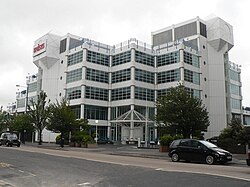
Similarly to the rest of Dorset, Bournemouth's economy is primarily in the service sector, which employed 95% of the workforce in 2010.109 This was 10% higher than the average employment in the service sector for Great Britain and 11% higher than the South West.109 Of particular importance are the financial and public service sectors which through 2011 continued to show sustained growth. Compared to the rest of the country, Bournemouth performed well in these two areas but under performed in transport and communications.110
The smallest geographical region for which gross value added information is available is the NUTS3 area, Bournemouth and Poole. In 2009, the Bournemouth and Poole area enjoyed the strongest annualised growth in the South-West region.111112 In 2009, the South West Regional Accounts showed that the Financial Services sector in Bournemouth was worth £1,031.8 million in Gross Value Added. Important employers in this sector include JPMorgan, Nationwide Building Society, and the Liverpool Victoria, Tata Consultancy Services (formerly Unisys), and RIAS insurance companies.112 The manufacturing sector is predominantly based in neighbouring Poole, and employed 2% of the workforce in 2010 and 2.6% in 2011.109113b Notable employers in this sector include Escor Toys and Parvalux.
Tourism is important to the local economy. In 2011, domestic and overseas visitors made more than 5.6 million trips to the town and spent over £460 million between them. Tourism supported 8,531 full-time jobs, accounting for 15% of employment in Bournemouth.114 Bournemouth seafront is one of the UK's biggest attractions, with 4.5 million visitors in 2011.115 RNLI lifeguards provide seasonal coverage of Bournemouth's beaches.116
With a third of all town centre businesses in the leisure industry, Bournemouth has a booming nightlife economy and is a popular destination for stag and hen parties.117118 These party-goers contribute £125 million a year to the economy and support 4,000 jobs. In 2010, Bournemouth was awarded a Purple Flag for providing a wide variety of night-time activities while maintaining the safety of both residents and visitors.118 An independent report published in 2012 indicates there has been a rise in antisocial behaviour which it attributes to the increase in nightlife.117
Those of working age make up approximately 65% of Bournemouth's population. Of these, 74.6% are economically active, although not necessarily employed within the Bournemouth area.112 In 2011, the Bournemouth economy employed more than 76,400 people, but not all of these were Bournemouth residents.113 Of those employed in Bournemouth based industries, 29.32% were employed in the public administration, education and health sector. This compares favourably with Dorset, the South-West region, and the country as a whole. Distribution, hotels & restaurants employed 29.06%. Banking, finance and insurance employed 24.48%.119
In 2011, 37.2% of Bournemouth's resident population were employed full-time. 13.3% were employed part-time. 7.1% full-time workers are self-employed, and 3.1% are self-employed part-time. Full-time students with jobs were 5.3%. 3.8% were unemployed.119
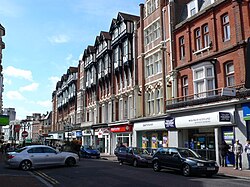
The shopping streets are mostly pedestrianised with modern shopping malls, Victorian arcades and a large selection of bars, clubs, and cafés. Westover Road in central Bournemouth has been referred to in local press as the "Bond Street of Bournemouth" due to the shops there, one of which has been present since 1909,120 selling predominantly high-end goods.121 North of the centre there is an out-of-town shopping complex called Castlepoint. The 41-acre (17 ha) site has 40 units and was the largest shopping centre in the UK when it opened it 2003.122 Other major shopping areas are in the districts of Westbourne and Boscombe.
| Employment by sector (2011)113 | |||||||||
|---|---|---|---|---|---|---|---|---|---|
| Agriculture & Fishing | Energy & Water | Manufacturing | Construction | Distribution, Hotels & Restaurants | Transport & Communication | Banking, Finance & Insurance | Public admin, Education & Health | Other Industry | |
| Bournemouth | 0.00%* | 0.52% | 2.62% | 3.14% | 29.06% | 6.28% | 24.48% | 29.32% | 4.58% |
| Dorset | 0.38%* | 1.14% | 11.16% | 6.66% | 27.58% | 5.20% | 13.51% | 29.55% | 4.82% |
| South West region | 2.91% | 1.25% | 9.20% | 4.92% | 25.12% | 7.16% | 18.20% | 27.25% | 4.01% |
| England & Wales | 1.55% | 1.12% | 8.59% | 4.72% | 22.96% | 8.51% | 21.40% | 26.56% | 4.59% |
| *Figures exclude farm agriculture | |||||||||
Culture
Bournemouth is a tourist and regional centre for leisure, entertainment, culture and recreation. Local author and former mayor, Keith Rawlings, suggests that Bournemouth has a thriving youth culture due to its large university population and many language school students.123124 In recent years, Bournemouth has become a popular nightlife destination with UK visitors and many clubs, bars and restaurants are located within the town centre.124125 In a 2007 survey by First Direct, Bournemouth was found to be the happiest place in the UK, with 82% of people questioned saying they were happy with their lives.126
Major venues for concerts include BIC, Pavilion Theatre and O2 Academy.127 Built in 1984, the BIC is also a popular place for party political conferences and has been used by all three major political parties.128 Its four auditoria make it the largest venue on the south coast.129 The O2 and Pavilion are older and are both Grade II listed buildings. The O2, which opened in 1895 as the Grand Pavilion Theatre, was initially used as a circus and later for music hall theatre. The Pavilion opened in 1929 as concert hall and tea room while providing a venue for the municipal orchestra. It continues to provide traditional entertainment today, presenting West End stage shows, ballet and operas.130131132
The Palace Court Theatre opened in 1931, was later used as a Christian centre, and has recently been bought and reopened as a theatre by Arts University Bournemouth.133 Bournemouth has more than 200 listed buildings, mainly from the Victorian and Edwardian eras, including three Grade I listed churches:132 St Peter's (largely by the architect G. E. Street),134 St Clement's (the first major church by J. D. Sedding)135 and St Stephen's (considered a masterpiece of J. L. Pearson's).136
The Russell-Cotes Museum is a Grade II* listed villa completed in 1901. It houses artefacts and paintings collected by the Victorian philanthropist Merton Russell-Cotes and his wife during their extensive travels around the world.137 The four art galleries display paintings by William Powell Frith, Edwin Landseer, Edwin Long, William Orchardson, Arthur Hughes, Albert Moore and Dante Gabriel Rossetti.138 It was Russell-Cotes who successfully campaigned to have a promenade built; it runs continuously along the Bournemouth and Poole shoreline.139
The Lower, Central and Upper Gardens are Grade II* public parks, leading for several miles down the valley of the River Bourne through the centre of the town to the sea.140 Bournemouth has a further 425 acres (172 ha) of parkland. Initially serving to compensate for the loss of common rights after common land was enclosed in 1802, it was held in trust until 1889 when ownership passed to Bournemouth Corporation and the land became five public parks: King's Park, Queen's Park, Meyrick Park, Seafield Gardens and Redhill Common.7141
The detailed Land Use Survey by the Office for National Statistics in 2005 noted that the local authority area of Bournemouth had the third-highest proportion of land taken up by domestic gardens, 34.6%, of the 326 districts in England; narrowly less than the London Boroughs of Harrow and Sutton at the time with 34.7% and 35.1%.142
One of Bournemouth's most noted cultural institutions is Bournemouth Symphony Orchestra which was formed in 1893 under Dan Godfrey.143144 It became the first municipal orchestra in the country when in 1896, Bournemouth Borough Council took control and Godfrey was appointed musical director and head of the town's entertainments.143145 Originally playing three concerts a day during the summer season, in the great glass palm house known as the Winter Gardens;144146 the orchestra is now based in Poole and performs around 130 concerts a year across Southern England.147
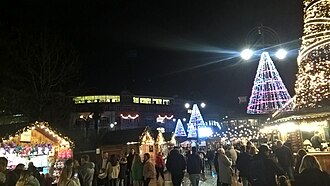
Bournemouth is host to a number of festivals. Bournemouth Food and Drink Festival is a ten-day event which combines a market with live cookery demonstrations.148 The Arts by the Sea Festival is a mix of dance, film, theatre, literature, and music149 which was launched in 2012 by the local university, the Arts University Bournemouth, and is set to become an annual event.150 The Bourne Free carnival is held in the town each year during the summer. Initially a gay pride festival, it has become a celebration of diversity and inclusion.151
Since 2008, Bournemouth has held its own air festival over four days in August.152 This has featured displays from the Red Arrows as well as appearances from the Yakovlevs, Blades, Team Guinot Wing-Walkers, Battle of Britain Memorial Flight including Lancaster, Hurricane, Spitfire and also the last flying Vulcan. The festival has also seen appearances from modern aircraft such as the Eurofighter Typhoon.153 The air festival attracts up to a million people over the four-day event.154155 Bournemouth 7s Festival is a sports and music festival taking place in May each year. Hosting rugby, netball, hockey, dodgeball and volleyball tournaments, the event was launched in 2008.
Bournemouth was especially rich in literary associations during the late 19th century and earlier 20th century. P. C. Wren author of Beau Geste, Frederick E. Smith, writer of the 633 Squadron books, and Beatrice Webb, later Potter, all lived in the town.156 Paul Verlaine taught at a Bournemouth preparatory school157158 and the writer J. R. R. Tolkien, spent 30 years taking holidays in Bournemouth, staying in the same room at the Hotel Miramar. He eventually retired to the area in the 1960s with his wife Edith, where they lived close to Branksome Chine. Tolkien died in September 1973 at his home in Bournemouth but was buried in Oxfordshire. The house was demolished in 2008.159
Sir Percy Shelley, 3rd Baronet, lived at Boscombe Manor, a house he had built for his mother, Mary Shelley, the writer and author of the Gothic horror novel Frankenstein. Mary died before the house was completed but she was buried in Bournemouth, in accordance with her wishes. The family plot in St Peter's churchyard also contains her parents William Godwin and Mary Wollstonecraft, and the heart of her husband, Percy Bysshe Shelley.160
Robert Louis Stevenson wrote The Strange Case of Dr. Jekyll and Mr. Hyde and most of his novel Kidnapped from his house "Skerryvore" on the west cliff, Westbourne.161 A novel of Stevenson's life while residing in Westbourne was written by Adelaide A. Boodle, who had met him there.162 Henry James, already acquainted with Stevenson through correspondence, and residing in Bournemouth in 1885 in large part because his invalid sister Alice lived there, visited Stevenson most evenings.163
Vladimir Chertkov established a Tolstoyan publishing house with other Russian exiles at Tuckton, and under the 'Free Age Press' imprint, published the first edition of several works by Leo Tolstoy.156 In Roald Dahl's 1983 children's dark fantasy novel The Witches, the international conference of witches is set in a luxury hotel in Bournemouth.164 Author Bill Bryson worked for a time with the Bournemouth Echo newspaper and wrote about the town in his 1995 work Notes from a Small Island.165
-
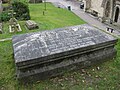 The grave of Mary Shelley and her parents, including Mary Wollstonecraft, in St. Peter's Church, Bournemouth
 -
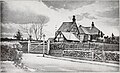 Robert Louis Stevenson's house Skerryvore in Westbourne
 -
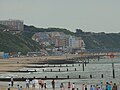 Colourful houses on Undercliff Drive
Landmarks
Bournemouth has many historic landmarks, mainly dating from the Victorian and Edwardian era.
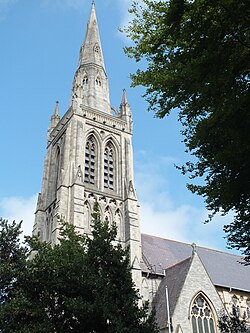
Bournemouth has three grade I listed churches, St Peter's and St Stephen's in the town centre and St Clement's in Boscombe.132 St Peter's was the town's first church, completed in 1879 and designed by George Edmund Street.166 In his 1999 book, England's Thousand Best Churches, Simon Jenkins describes the chancel as "one of the richest Gothic Revival interiors in England". The 202 feet (62 m) spire dominates the surrounding skyline.167168 When the architect, John Loughborough Pearson designed St Stephen's, his aim was to "bring people to their knees". It has a high stone groined roof, twin aisles and a triforium gallery, although the tower lacks a spire.169170 Other listed churches include the Victorian St Mark's Church in the historic Talbot Village and the 12th-century St. Andrew's Church in Kinson.171
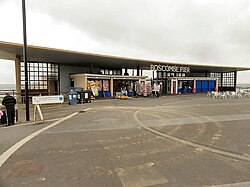
The borough has two piers: Bournemouth Pier, close to the town centre, and the shorter but architecturally more important Boscombe Pier. Designed by the architect Archibald Smith, Boscombe Pier opened in 1889 as a 600 feet (180 m) structure. It was extended to 750 feet (230 m) in 1927 when a new head was constructed.172 Added in 1958, the boomerang-shaped entrance kiosk and overhanging concrete roof is now a grade II listed building. In 1961 a theatre was added. This was demolished in 2008 when the rest of the pier was renovated.172173 In 2009, fashion designer Wayne Hemingway described Boscombe Pier as "Britain's coolest pier". It was voted Pier of the Year 2010 by the National Piers Society.174
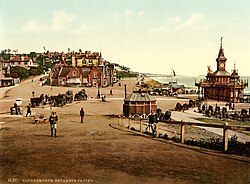
In 1856, Bournemouth Pier was a simple, wooden jetty. This was replaced by a longer, wooden pier five years later, and a cast-iron structure in 1880.35 Two extensions to the pier in 1894 and 1905, brought the total length to 305 metres (1,001 feet). After World War II, the structure was strengthened to allow for the addition of a theatre, constructed in 1960. This survived until the 2000s when it was turned into a climbing adventure centre. Between 1979 and 1981, a £1.7 million redevelopment programme, saw a great deal of reconstruction work, and the addition of a large two-storey, octagonal-shaped entrance building.35
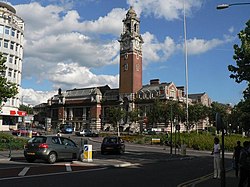
Built as the Mont Dore Hotel in 1881, Bournemouth Town Hall was designated a grade II listed building in 2001. Designed by Alfred Bedborough in the French, Italian and neo-classical styles, the foundation stone was laid by King Oscar II of Sweden and Norway and the hotel opened in 1885.175176177 The buff brick exterior features Bath stone dressings and terracotta friezes. The main entrance is sited within a projected façade that reaches to the eaves and is topped with a pediment, while above sits a belvedere with turrets and a pavilion roof.176 During the First World War the hotel was used as a hospital for British and Indian soldiers and after as a convalescent home. It never opened as a hotel again and was purchased by Bournemouth Borough Council in 1919.178 Other Victorian hotels in Bournemouth include the Royal Bath Hotel in the Town Centre and the Norfolk Royale Hotel in Richmond Hill.
Built in the Art Deco style in 1929, situated close to the seafront, the Pavilion Theatre was at the time said to be the biggest ever municipal enterprise for the benefit of entertainment.179 Built from brick and stone, the frontage features square Corinthian columns.175 Still a popular venue, it is today a grade II listed building.179
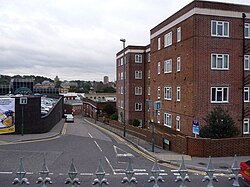
The Bournemouth Eye was a helium-filled balloon attached to a steel cable in the town's lower gardens. The spherical balloon was 69 metres (226 feet) in circumference and carried an enclosed, steel gondola. Rising to a height of 150 metres (490 feet), it provided a panoramic view of the surrounding area for up to 28 passengers.180 181 After the balloon suffered damage in 2016, the Bournemouth Borough Council, Lower Central Gardens Trust and S&D Leisure announced in 2017 that the contract for operating the Bournemouth Eye would not be renewed due to "increased operating costs."182
Bournemouth is known for having only one "street". This is Orchard Street, now a small alley between Commercial Road and Terrace Road. Originally named because it led to an orchard, it pre-dates the build up of the modern town. The 19th century developers thought that names such as road, avenue and drive would be more suitable names, with street associated with poorer areas of existing towns and cities.183
Sport
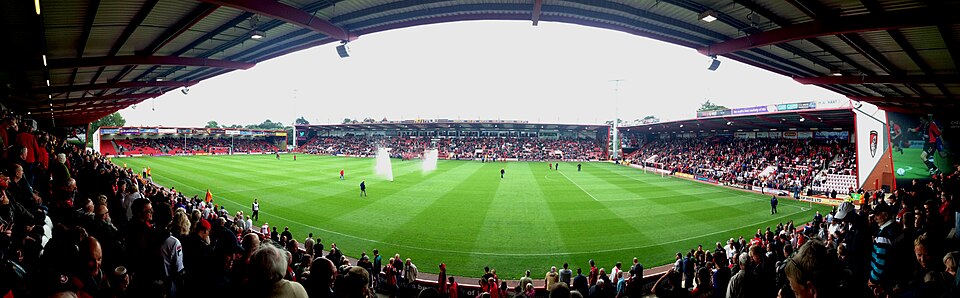
The town has a professional football club, AFC Bournemouth, which plays in the Premier League. Known as the Cherries, they play at Dean Court stadium near Boscombe in Kings Park, 2 miles (3 km) east of the town centre.184
Bournemouth Rugby Club, which competes in the National League Division Two South, has its home at Bournemouth Sports Club; it is sited next to Bournemouth Airport. It hosts an annual Bournemouth 7s Festival, the world's largest sport and music festival, combining Rugby sevens, netball, hockey, dodgeball and crossfit tournaments with festival entertainment.185186187 Oakmeadians RFC is the oldest RFU accredited rugby club in Bournemouth, established in 1963. They train and play at Meyrick Park, competing in the South West Division.188
Bournemouth Cricket Club also plays at Bournemouth Sports Club and is reported to be one of the biggest cricket clubs in the country. Its first team plays in the Southern Premier League.189 Dean Park is a former county cricket ground, once home to Hampshire County Cricket Club and later Dorset County Cricket Club. Today it is a venue for university cricket.190
The BIC has become a venue for a round of the Premier League Darts Championship, organised by the Professional Darts Corporation.191
The Bournemouth Rowing Club is the town's coastal rowing club. Established in 1865, as Westover and Bournemouth Rowing Club, it is reported to be the oldest sporting association in the county. The club regularly competes in regattas organised by the Hants and Dorset Amateur Rowing Association, which take place on the south coast of England between May and September.192
Other watersports popular in Poole Bay include sailing and surfing; there are a number of local schools for the beginner to learn either sport.193 Bournemouth has the third largest community of surfers in the UK and, in 2009, an artificial surf reef, one of only four in the world, was constructed there.194 The reef failed to deliver the promised grade 5 wave, suffered a series of delays and ran over budget, finally costing £3.2 million.195196
The town is home to Bournemouth and Southampton Octopush Club, otherwise known as underwater hockey.197 They train at Ringwood Leisure Centre, as well as Totton Health and Leisure Centre in Southampton. In the 2023 Nautilus Tournament, Bournemouth and Southampton OC finished 7th (out of 7) in Division 2.198
Transport
Railway
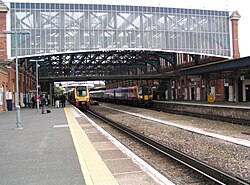
Bournemouth is the main railway station that serves the town. Pokesdown also serves its eastern suburbs and Branksome the west. All three stations lie on the South West Main Line between Weymouth and London Waterloo.
South Western Railway operates a comprehensive service along this line, which also serves Southampton, Winchester and Basingstoke to the east, with Poole, Wareham and Dorchester South to the west.199
Before its closure in 1966, Bournemouth was also served by the Somerset & Dorset Joint Railway, which provided direct access to Somerset and the Midlands.200
Cross Country trains also serve Bournemouth with an hourly service operating to Manchester Piccadilly serving Reading, Oxford, Birmingham New Street, Macclesfield & Stockport.
Road
The principal route to the town centre is the A338 spur road, a dual carriageway that connects to the A31 close to the Hampshire border. The A31 joins the M27 at Cadnam and, from there, the M3 to London and the A34 to the Midlands and the North can be accessed.201
The main road west is the A35 to Honiton in Devon which runs through the South East Dorset Conurbation and continues east as far as Southampton, albeit as a non-primary route.202 The A350 in the neighbouring borough of Poole provides the only northern route out of the conurbation.203
Buses and coaches
Bus services are operated by Morebus, who run all local services around the town and to Christchurch, Lymington, New Milton, Poole and Ringwood.204
Yellow Buses ceased operating in August 2022. It was the former Bournemouth Council-owned company and successor to Bournemouth Corporation Transport which began operating trams in 1902.205206
National Express coaches serve Bournemouth Travel Interchange and Bournemouth University. There are frequent departures to London, Gatwick Airport, Poole and Weymouth.207
Air
Originally an RAF airfield, Bournemouth Airport was transferred to the Civil Aviation Authority in 1944 and was the UK's only intercontinental airport before the opening of Heathrow Airport in 1946.208 Acquired by the Manchester Airports Group in 2001, the airport underwent a £45 million phased expansion programme between 2007 and 2011.209210
Situated near the village of Hurn in Christchurch, Dorset, the airport is 4.5 miles (7.2 km) from Bournemouth town centre and serves around 600,000 passengers annually.211 There are direct flights to 23 international destinations in nine countries: Cyprus, Finland, Greece (3 destinations), Italy (4), Malta, Portugal, Spain (10), Switzerland and Turkey.212
Education
The Bournemouth local education authority was first set up in 1903 and remained in existence until local government was reorganised in 1974 when Bournemouth lost its County Borough status and became part of the county of Dorset. Under the later reforms of 1997, Bournemouth became a unitary authority and the Bournemouth local education authority was re-established.213214
The local council operates a traditional two-tier system whereby pupils attend one of the 26 primary schools in the borough before completing their education at secondary school.215 Bournemouth is one of the minority of local authorities in England still to maintain selective education, with two grammar schools (one for boys, one for girls) and ten secondary modern/non-selective schools.216 There are a small number of independent schools in the town.217
Bournemouth and Poole College offers further education, higher education and community courses. Bournemouth has two universities: Bournemouth University and Arts University Bournemouth, both of which are across the boundary in neighbouring Poole.218 They are home to AECC University College219220 formally known as Anglo European College of Chiropractic,221 which is on Parkwood Road in Bournemouth.
In 2012, 60.7% of the borough's school leavers gained 5 GCSEs of grade C or above. This was slightly better than the national average of 59.4% and above the average for the rest of Dorset, with 58.8% of pupils from the local authority of Poole, and 54.1% from the remainder of the county, managing to do likewise.222
Religion

The 2011 census revealed that 57.1% of the borough's population are Christian. With all other religions combined only totalling 4.7%, Christianity is by far the largest religious group.98 40% of the borough falls within the Church of England Diocese of Salisbury.223 The remainder, to the east, belongs to the Diocese of Winchester.224 The Roman Catholic Diocese of Portsmouth incorporates most of Bournemouth with the exception of two small parishes to the west which are covered by the Diocese of Plymouth.225226
The borough has several notable examples of Victorian church architecture132 including the previously mentioned St. Peter's, the churchyard of which contains the grave of the author Mary Shelley;227 St Stephen's Church, completed in 1898 for services under the influence of the Oxford Movement168228 and St Clement's, one of the first churches to be designed by John Dando Sedding, built in Boscombe in 1871.229
To serve a rapidly expanding population a third church was built in the town centre in 1891. St Augustin's Church was commissioned by Henry Twells who was 'priest-in-charge' there until 1900.230231 The largest church in the town is the Richmond Hill St Andrew's Church, part of the United Reformed Church. Built in 1865 and enlarged in 1891, it has a seating capacity of 1,100 and is unusually ornate for a non-conformist church.232233
Holy Trinity Church was built, at 161, Old Christchurch Road, in 1868-9 in Italian Romanesque style, designed by Cory & Ferguson of Carlisle. A tower was added in 1878. It was deconsecrated in 1973, and burnt down in 1979. The site now has a modern office building named "Trinity".234235

Few purpose-built places of worship exist in the borough for faiths other than Christianity, although with a higher proportion of Jewish residents than the national average, there are three synagogues.236 Chabad-Lubavitch of Bournemouth is a branch of the worldwide movement. The Bournemouth Reform Synagogue, formerly known as Bournemouth New Synagogue, is a Reform Jewish synagogue with over 700 members.237238 The architecturally notable Bournemouth Hebrew Congregation synagogue was built in 1911 with an Art Nouveau take on the Moorish Revival style.239 There are two Christadelphian meeting halls in the town.240
The Bournemouth Islamic Centre and Central Mosque provides information, support and a place of worship for the Islamic community.241
Naming conventions
The word 'Bournemouth' is often used loosely to describe the South East Dorset conurbation, which also contains the neighbouring towns of Poole, Christchurch, Wimborne Minster, and Verwood.76 As a result, "Bournemouth" is used in the following terms:
- Although it has a significant presence in Bournemouth town centre, Bournemouth University's main campus is in Poole, on the boundary with Bournemouth.242
- Bournemouth Airport is near Hurn in the borough of Christchurch, and was originally named RAF Hurn.243
- "Bournemouth Bay" is sometimes used for Poole Bay.244
- The Bournemouth Symphony Orchestra is based in Poole.245
Notable people

A number of famous people came from Bournemouth. Tony Hancock246247 lived for most of his early life in hotels in Bournemouth run by his parents.
A number of actors came from Bournemouth, including Juliette Kaplan248 from the BBC comedy Last of the Summer Wine, Ray Lonnen249 from the series The Sandbaggers (1978–80), Alison Newman, actress who played Hazel Bailey250 in Footballers' Wives and DI Samantha Keeble251 in EastEnders. Jack Donnelly (born 1985) actor, played the role of Jason252 in the BBC series Atlantis and Sophie Rundle (born 1988) actress, portrayed Ada Shelby253 in the BBC One series Peaky Blinders and Ben Hardy (born 1991) actor, played Peter Beale254 in EastEnders. Renowned actors Christian Bale255256 and Millie Bobby Brown257 both lived in Bournemouth for parts of their childhood.
Women's rights and temperance campaigner Emily Langton Massingberd (1847–1897) built and sometime lived in the Red House, now the Langtry Manor Hotel in Bournemouth.258 Authors Radclyffe Hall (1880–1943)259 poet and author, who wrote The Well of Loneliness a groundbreaking work in lesbian literature came from Bournemouth and Dilys Powell (1901–1995)260 journalist, film critic of The Sunday Times for over fifty years went to school there. Primatologist and anthopologist Jane Goodall (1934-2025) lived in later life in Bournemouth.261
Patrick Ensor (1946–2007)262 editor of Guardian Weekly from 1993 to 2007 also came from Bournemouth.
Bournemouth has been home to a number of musicians, including Andy Summers, the guitarist from the globally acclaimed band, The Police, who was born on 31 December 1942, and spent his formative years in Bournemouth. Summers discovered his passion for music there and honed his skills on the guitar playing with local bands. His musical journey led him to The Police, where his intricate guitar work became iconic. Summers later enjoyed a successful solo career, blending rock, jazz, and world music in his solo albums. Collaborations with fellow Bournemouth native Robert Fripp showcased his virtuosity and artistic prowess that also spans other artistic disciplines – film composing, writing, film making, and photography. Max Bygraves (1922–2012)263264 comedian, singer, actor and variety performer. The composer Sir Hubert Parry (1848–1918) was born in Bournemouth. One of Britain's most prolific composers of choral music he is probably best known for his setting to William Blake's words of Jerusalem.265 Alex James, best known as the bassist of the rock band Blur, attended Bournemouth School before moving to London.266 The rock band King Crimson included many musicians from Bournemouth267 including brothers Michael Giles (drums) and Peter Giles (bass).
Bournemouth has been the home of sporting world champions: Freddie Mills (1919–1965), who won the World Light Heavyweight title in 1948.268269 Another famous sportsman, the athlete Charles Bennett (1870–1948), lived in the town after he retired.270 Bennett, was the first British track and field athlete to become Olympic Champion, winning two gold medals and a silver at the Paris Games in 1900. The tennis player and Wimbledon Championships winner Virginia Wade was born in Bournemouth.265271 Colonel Edmond Cotter, a runner-up player for the Royal Engineers team in the inaugural 1872 FA Cup Final, and later in life an Irish Republican, died at Bournemouth in 1934.272
Three recipients of the Victoria Cross (VC) came from Bournemouth. Frederick Charles Riggs (1888–1918),273 Cecil Noble (1891–1915),274 and Lieutenant Colonel Derek Anthony Seagrim (1903–1943),275276 Five recipients of the VC died in Bournemouth - General Sir Reginald Hart (1848–1931), Royal Navy Staff-Surgeon William Job Maillard (1863–1903), Second-Lieutenant Alfred Oliver Pollard (1893–1960), Joseph John Davies (1889–1976) and James Welch (1889–1978).277
A distinguished resident of Bournemouth was Sir Donald Coleman Bailey, (1901–1985) a civil engineer who invented the Bailey bridge.278 Bailey was knighted in 1946 for his bridge design when he was living in Southbourne in Bournemouth.

The heart of Percy Bysshe Shelley, together with Mary Shelley and her mother Mary Wollstonecraft and father William Godwin, are all buried at St Peter's Church, Bournemouth. Percy's and Mary's son, Sir Percy Shelley, 3rd Baronet, lived at Boscombe Manor, now the Shelley Manor Medical Centre, and is also buried in the same vault at St Peter's.279
Twin towns
Bournemouth is twinned with:280
Freedom of the Borough
The following people and military units have received the Freedom of the Borough of Bournemouth.
Individuals
- Frederick Roberts, 1st Earl Roberts: 22 October 1902283
- Sir Winston Churchill
- Sir Geoffrey Hurst
- Sir Christopher Hoy
- Bob Geldof
- Eddie Howe: 5 March 2019284285
Military Units
- The Royal Hampshire Regiment: 13 September 1945286
- HMS Phoebe (F42): 8 May 1989
Notes
Notes
- In accordance with World Meteorological Organization (WMO) recommendations, the Met Office maintains long-term averages of the UK climate, based on standard 30-year periods. The latest 30-year period is for 1991–2020.
- Agriculture data is excluded from ONS figures at a sub-regional level, therefore an estimate has been made using DEFRA 2010 data. As there is little farming within the Bournemouth area, this has a minimal effect.
References
References
- "Towns and cities, characteristics of built-up areas, England and Wales: Census 2021". Census 2021. Office for National Statistics. Archived from the original on 21 November 2023. Retrieved 8 August 2023.
- A. McKinstry, The Village of Tuckton, 35,000 BC - 1926 (Christchurch: Natula Publications, 2015), p. 12.
- Ashley and Ashley (p.52)
- Edwards (p.24)
- Andrews & Henson (p.7)
- Ashley & Ashley (p.51)
- Ashley & Ashley (p.9)
- Granville, A. B. (1971). Spas of England and principal sea-bathing places ([1st ed. reprinted] ed.). Bath: Adams and Dart. ISBN 0-239-00085-4. OCLC 539370.
- Edwards (p.39)
- Edwards (p.32)
- Andrews and Henson (p.7)
- Ashley and Ashley (p.7)
- Edwards (pp.1–3)
- Stannard, Michael (1999). The Makers of Christchurch: A Thousand Year story. Natula Publications. p. 223. ISBN 978-1-897887-22-6.
- Page, William, ed. (1912). "The liberty of Westover: with Holdenhurst and Bournemouth". A History of the County of Hampshire. Vol. 5. Constable & Co. pp. 133–137. Archived from the original on 3 November 2012. Retrieved 17 September 2012.
- Edwards (pp. 1–2)
- Cave (p.4)
- Ashley and Ashley (p.31)
- Edwards (pp.2 & 27)
- Edwards (pp.4 & 38)
- Andrews & Henson (p.8)
- Ashley and Ashley (pp.18–19)
- John Walker (March 2010). "The Beginnings of Bournemouth". Dorset Life Magazine. Archived from the original on 22 January 2012. Retrieved 23 October 2012.
- Ashley & Ashley (p.6)
- Edwards (p.28)
- "Bournemouth, Garden by the Sea" (PDF). Diamond Jubilee Civic Honours Bid. Bournemouth County Council. May 2011. p. 3. Archived from the original (PDF) on 20 June 2013. Retrieved 9 September 2012.
- Edwards (pp.31–32)
- Ashley & Ashley (p.17)
- Emery (p.16)
- Edwards (pp.38–40)
- Ashley & Ashley (pp.10–11)
- Edwards (pp.70–71)
- Emery (p.21)
- Emery (p.24)
- "History of Bournemouth Pier". National Piers Society. 2012. Archived from the original on 13 January 2012. Retrieved 12 October 2012.
- Ashley and Ashley (p.28)
- Ashley and Ashley (p.22)
- Churchill, Nick (April 2014). "A minute of intense devastation – Bournemouth's bloodiest air raid". www.dorsetlife.co.uk. Dorset Life Magazine. Archived from the original on 27 January 2022. Retrieved 27 January 2022.
- Emery (p.100)
- Emery (p.102)
- Denton, Tony (2009). Handbook 2009. Shrewsbury: Lifeboat Enthusiasts Society. p. 59.
- Ashley and Ashley (p.24)
- "South Coast alert after attack on resort: Bomb found under Bournemouth". 13 August 1993. Archived from the original on 29 August 2016. Retrieved 19 August 2016.
- "Tesco blackmail 'bomber' jailed". BBC News. 11 June 2001. Archived from the original on 19 October 2021. Retrieved 27 January 2022.
- Steven Morris (20 January 2010). "England's most hated building to be demolished". The Guardian. Archived from the original on 2 October 2013. Retrieved 10 February 2013.
- "Work to lower height of Dorset's Imax building starts". BBC Dorset. 18 March 2011. Archived from the original on 4 May 2011. Retrieved 10 February 2013.
- "Cinema to be demolished to restore famous view". The Telegraph. 21 January 2010. Archived from the original on 28 December 2013. Retrieved 10 February 2013.
- Slade, Darren (14 March 2012). "Bournemouth loses bid for city status". Bournemouth Echo. Archived from the original on 29 November 2014. Retrieved 6 April 2012.
- "'City status bid for Bournemouth is ludicrous in the extreme'". Bournemouth Echo. 18 November 2021. Archived from the original on 24 May 2022. Retrieved 22 March 2022.
- "About the town council". Bournemouth Town Council. Retrieved 22 April 2026.
- "The Bournemouth, Christchurch and Poole Council (Reorganisation of Community Governance) (Bournemouth) Order 2025" (PDF). Local Government Boundary Commission for England. Retrieved 12 May 2026.
- Youngs, Frederic (1979). Guide to the Local Administrative Units of England: Volume 1. London: Royal Historical Society. p. 210. ISBN 0901050679.
- Youngs, Frederic (1979). Guide to the Local Administrative Units of England: Volume 1. London: Royal Historical Society. p. 199. ISBN 0901050679.
- "Bournemouth Improvement Act 1856". legislation.gov.uk. The National Archives. Archived from the original on 29 June 2024. Retrieved 29 June 2024.
- "Bournemouth Municipal Borough / County Borough". A Vision of Britain through Time. GB Historical GIS / University of Portsmouth. Archived from the original on 19 April 2024. Retrieved 29 June 2024.
- Historic England. "Former Town Hall, BCP Civic Centre, Bourne Avenue (Grade II) (1389612)". National Heritage List for England.
- "The English Non-metropolitan Districts (Definition) Order 1972", legislation.gov.uk, The National Archives, SI 1972/2039, retrieved 29 June 2024
- "Bournemouth Registration District". UKBMD. Archived from the original on 6 November 2024. Retrieved 16 May 2026.
- "District Councils and Boroughs". Parliamentary Debates (Hansard). 28 March 1974. Archived from the original on 25 December 2012. Retrieved 4 December 2021.
- "The Dorset (Boroughs of Poole and Bournemouth) (Structural Change) Order 1995", legislation.gov.uk, The National Archives, SI 1995/1771, retrieved 29 June 2024
- "History of Bournemouth". Bournemouth County Council. Archived from the original on 10 September 2011. Retrieved 13 December 2011.
- "Bournemouth's Charter Trustees". Bournemouth, Christchurch and Poole Council. Archived from the original on 25 June 2024. Retrieved 25 June 2024.
- "Community Governance Review Consultation". Have Your Say Bournemouth, Christchurch and Poole. Archived from the original on 1 April 2025. Retrieved 4 April 2025.
- Gayen, Deb (2 April 2025). "BCP Council launches consultation on new town and parish councils". Bournemouth Echo. Archived from the original on 3 April 2025. Retrieved 4 April 2025.
- Woodward, Amy (11 April 2026). "Bournemouth Town Council candidates revealed ahead of elections". Bournemouth Echo. Retrieved 22 April 2026.
- "Find your MP". UK Parliament. Retrieved 24 August 2013.
- "UK election results 2024 | Constituency map". BBC News. Archived from the original on 6 July 2024. Retrieved 6 July 2024.
- "These seats have long voted Tory. That might be about to change". BBC News. 2 July 2024. Retrieved 6 July 2024.
- "Conor Burns sacked after being seen 'touching young man's thigh', witness says". the Guardian. 8 October 2022. Retrieved 13 October 2022.
- "Tobias Ellwood MP stripped of Tory party whip after abstaining in confidence vote". LBC. 19 July 2022. Archived from the original on 13 October 2022. Retrieved 13 October 2022.
- Straight line distances from:Daft Logic. "Google Maps Distance Calculator". Archived from the original on 26 July 2010. Retrieved 30 July 2010.
- "Rural Atlas". Disadvantaged Districts. Department of Environment, Food and Rural Affairs. Archived from the original on 30 August 2011. Retrieved 27 November 2012.
- "A picture of Bournemouth – Overview" (PDF). Wards and ward profiles. Bournemouth Borough Council. p. 3. Archived from the original (PDF) on 3 October 2013. Retrieved 27 November 2012.
- Stuart Clarke. "River Path". The Stour in Bournemouth. England in Particular. Archived from the original on 16 February 2012. Retrieved 27 November 2012.
- "About the Bourne Stream". Bourne Stream Partnership. 2012. Archived from the original on 7 August 2013. Retrieved 5 September 2013.
- "Final First Detailed Proposals for RSS Sub-Regional Policies for South East Dorset". South East Dorset Joint Study Area Reports. Bournemouth, Poole and Dorset County Councils. November 2005. p. 2. Archived from the original on 1 October 2011. Retrieved 18 November 2012.
- "A picture of Bournemouth – Overview" (PDF). Wards and ward profiles. Bournemouth Borough Council. p. 2. Archived from the original (PDF) on 3 October 2013. Retrieved 7 September 2013.
- "Geology of Britain Viewer". British Geological Survey. Archived from the original on 16 January 2013. Retrieved 27 September 2013.
- Wightman, R. (1983). Portrait of Dorset. London: Robert Hale. pp. 22–25. ISBN 0-7090-0844-9.
- "Turbary Common". Dorset For You. 2011. Archived from the original on 5 September 2012. Retrieved 29 November 2012.
- "Turbary Common Local Nature Reserve". Bournemouth Borough Council. 2011. Archived from the original on 9 September 2012. Retrieved 29 November 2012.
- "Dorset and East Devon Coast" (web page). UNESCO World Heritage Centre. 2001. Archived from the original on 24 October 2012. Retrieved 16 March 2015.
- "Seafront Strategy 2007–2011" (PDF). Bournemouth Borough Council. p. 10. Archived (PDF) from the original on 9 November 2013. Retrieved 7 September 2013.
- "Hengistbury Head Management Plan" (PDF). Bournemouth Borough Council. 2005. pp. 15 & 27. Archived (PDF) from the original on 9 November 2013. Retrieved 4 December 2012.
- "Hengistbury Head and its Antiquities". Pastscape. English Heritage. 2005. Archived from the original on 9 November 2013. Retrieved 4 December 2012.
- "Mean Temperature Annual Average". Met Office. 2010. Archived from the original on 7 October 2022. Retrieved 17 December 2021.
- "Hurn Climatic Averages 1991–2020". Met Office. December 2021. Archived from the original on 2 October 2013. Retrieved 17 December 2021.
- "Bournemouth Airport (United Kingdom)". ogimet.com. Archived from the original on 27 December 2020. Retrieved 10 October 2018.
- "Mean Annual Rainfall Average". Met Office. 2010. Archived from the original on 28 September 2013. Retrieved 25 August 2013.
- "1990 temperature". KNMI. Archived from the original on 27 September 2013. Retrieved 25 August 2013.
- "1963 temperature". KNMI. Archived from the original on 27 September 2013. Retrieved 25 August 2013.
- "2010 temperature". UKMO. 26 December 2010. Archived from the original on 2 October 2013. Retrieved 25 August 2013.
- "Synop Report – Bournemouth Airport February 2019". Archived from the original on 27 December 2020. Retrieved 19 April 2019.
- "Monthly Temperature Extremes".
- Bournemouth average sea temperature Archived 6 July 2015 at the Wayback Machine - seatemperature.org
- "Bournemouth Local Plan: Core Strategy – Bournemouth Borough Council Adopted October 2012" (PDF). www.bournemouth.gov.uk. Archived (PDF) from the original on 19 February 2018. Retrieved 19 February 2018.
- "Turbary Common". www.bournemouth.gov.uk. Archived from the original on 9 October 2020. Retrieved 6 October 2020.
- "Religious group, local authorities in England and Wales". 2011 Census. Office for National Statistics. Archived from the original on 26 January 2013. Retrieved 7 April 2013.
- "Male usual resident population by five-year age group, local authorities in the United Kingdom". 2011 Census. Office for National Statistics. Archived from the original on 29 November 2014. Retrieved 6 April 2013.
- "Female usual resident population by five-year age group, local authorities in the United Kingdom". 2011 Census. Office for National Statistics. Archived from the original on 29 November 2014. Retrieved 6 April 2013.
- "Age structure, local authorities in England and Wales". 2011 Census. Office for National Statistics. Archived from the original on 14 October 2013. Retrieved 6 April 2013.
- "Population trends in Bournemouth" (PDF). Bournemouth Borough Council. October 2012. Archived (PDF) from the original on 20 June 2013. Retrieved 21 April 2013.
- "Ethnic group, local authorities in England and Wales". 2011 Census. Office for National Statistics. Archived from the original on 24 February 2016. Retrieved 7 April 2013.
- "Population". A Vision of Britain Through Time. Archived from the original on 29 November 2014. Retrieved 25 April 2013.
- "Historical population of Bournemouth". A Vision of Britain Through Time. Archived from the original on 29 November 2014. Retrieved 16 April 2013.
- "Highest qualification, local authorities in England and Wales". 2011 Census. Office for National Statistics. Archived from the original on 15 September 2013. Retrieved 15 April 2013.
- "Health and Wellbeing in Bournemouth: Strategic Assessment" (PDF). Joint Strategic Needs Assessment. Bournemouth Borough Council. 2012. Archived (PDF) from the original on 20 June 2013. Retrieved 21 April 2013.
- "Centre for Cities". BBC News. 2016. Archived from the original on 1 April 2019. Retrieved 17 March 2019.
- "Key Facts – Economy". Dorset For You. 2011. Archived from the original on 27 September 2013. Retrieved 7 September 2013.
- "Economy". Bournemouth Statistics. Bournemouth Borough Council. 2011. Archived from the original on 2 May 2013. Retrieved 23 February 2013.
- "Economic Performance, State of the South West 2011". South West Observatory. 2011. Retrieved 10 April 2013.
{{cite web}}: CS1 maint: deprecated archival service (link) - "Current Local Economic Overview" (PDF). Bournemouth Economic Bulletin. Bournemouth Borough Council. February 2012. Archived from the original (PDF) on 20 June 2013. Retrieved 25 February 2013.
- "Employment by Sector" (PDF). Bournemouth Statistics – Economy. Bournemouth Borough Council. 2011. Archived from the original (PDF) on 20 June 2013. Retrieved 29 March 2013.
- "Bournemouth" (PDF). Value of Tourism. South West Research Company. 2011. Archived from the original (PDF) on 13 May 2013. Retrieved 27 February 2013.
- "Economy Tourism Scrutiny Panel Minutes" (PDF). Bournemouth Borough Council. 5 October 2011. Archived from the original (PDF) on 29 November 2014. Retrieved 10 March 2013.
- "RNLI: Bournemouth West Beach". Archived from the original on 8 October 2015. Retrieved 16 January 2016.
- Rebecca Wearn (10 January 2013). "Bournemouth shines light on night time economy". BBC. Archived from the original on 21 March 2013. Retrieved 28 March 2013.
- "Statement of Licensing Policy" (PDF). Bournemouth Borough Council. 1 March 2011. Archived (PDF) from the original on 20 June 2013. Retrieved 12 March 2013.
- "Economic activity, local authorities in England and Wales". 2011 Census. Office for National Statistics. Archived from the original on 29 November 2014. Retrieved 13 April 2013.
- "Our story". Archived from the original on 21 January 2025. Retrieved 17 December 2024.
- "The changing face of Bournemouth's Westover Road". Bournemouth Echo. 13 April 2021. Archived from the original on 13 December 2024. Retrieved 11 December 2024.
- "Centre may be shut over Christmas". BBC. 1 December 2005. Archived from the original on 18 February 2006. Retrieved 12 March 2013.
- "Bournemouth, Garden by the Sea" (PDF). Diamond Jubilee Civic Honours Bid. Bournemouth County Council. May 2011. pp. 9 & 10. Archived from the original (PDF) on 20 June 2013. Retrieved 9 September 2012.
- Rawlings (p.145)
- "Bournemouth's Stag Culture". BBC Dorset. 26 October 2012. Archived from the original on 28 October 2012. Retrieved 11 December 2012.
- "Bournemouth happiest town in UK". BBC News. 8 March 2007. Archived from the original on 24 September 2007. Retrieved 6 September 2007.
- "Cinemas and theatres". Dorset For You. Dorset County Council. Archived from the original on 29 June 2011. Retrieved 21 May 2011.
- "Bournemouth venue marks 25 years". BBC Dorset. Archived from the original on 2 October 2013. Retrieved 20 December 2012.
- "About the BIC". BIC and Pavilion Theatres. Archived from the original on 23 January 2013. Retrieved 23 May 2015.
- "About the O2 Academy". Academy Music Group. Archived from the original on 12 January 2013. Retrieved 20 December 2012.
- "The Lively Old Lady". Dorset Life Magazine. Archived from the original on 2 July 2013. Retrieved 20 December 2012.
- "Bournemouth's listed buildings" (PDF). Bournemouth County Council. Archived from the original (PDF) on 20 June 2013. Retrieved 8 September 2012.
- "Palace Court Theatre". Arts University Bournemouth. Archived from the original on 8 September 2024. Retrieved 29 July 2024.
- Historic England. "Church of St Peter (1153014)". National Heritage List for England. Retrieved 3 February 2025.
- Historic England. "Church of St Clement (1324751)". National Heritage List for England. Retrieved 3 February 2025.
- Historic England. "Church of St Stephen (1324756)". National Heritage List for England. Retrieved 3 February 2025.
- "Background". Russell-Cotes Art Gallery and Museum. 2008. Archived from the original on 1 November 2010. Retrieved 4 January 2013.
- "The collections". Russell-Cotes Art Gallery and Museum. 2008. Archived from the original on 16 October 2008. Retrieved 5 January 2013.
- Rawlings (p.25)
- "Bournemouth, Garden by the Sea" (PDF). Diamond Jubilee Civic Honours Bid. Bournemouth County Council. May 2011. p. 2. Archived from the original (PDF) on 20 June 2013. Retrieved 9 September 2012.
- Rawlings (p.10)
- Physical Environment: Land Use Survey 2005 Archived 11 February 2003 at the Wayback Machine Published with the 2011 census.
- Rawlings (p.39)
- Ashley & Ashley (p.59)
- Ashley & Ashley (pp.59–60)
- Rawlings (pp.39–40)
- "Orchestra". Bournemouth Symphony Orchestra. Archived from the original on 19 February 2006. Retrieved 25 August 2009.
- Findley, Nick (1 July 2012). "Bournemouth Food and Drink Festival is hot stuff". Dorset Echo. Archived from the original on 15 May 2013. Retrieved 29 January 2013.
- "Bournemouth Arts Festival by the Sea". Official Tourist Guide. Bournemouth Borough Council. Retrieved 29 January 2013.
{{cite web}}: CS1 maint: deprecated archival service (link) - "AUCB helps launch Arts by the Sea Festival". The Arts University College at Bournemouth. Archived from the original on 19 January 2013. Retrieved 29 January 2013.
- "Bournemouth pride parade award is tribute to organiser". BBC News Dorset. 6 July 2011. Archived from the original on 25 September 2013. Retrieved 29 January 2013.
- "Bournemouth Air Festival 2008". Bournemouth Echo. 2008. Archived from the original on 26 September 2013. Retrieved 6 January 2013.
- "Plane fascinating – Bournemouth Air Festival factfile". Bournemouth Echo. 2012. Archived from the original on 1 June 2012. Retrieved 6 January 2013.
- "Bournemouth Air Festival 2012". Bournemouth Echo. 2012. Archived from the original on 16 October 2012. Retrieved 6 January 2013.
- "One million people at air show". BBC Dorset. 2009. Archived from the original on 2 October 2013. Retrieved 29 September 2013.
- Rawlings (pp.131–132)
- Delahave, Ernst (22 May 2010). "Biography of Paul Verlaine". The Left Anchor. Archived from the original on 12 May 2013. Retrieved 11 January 2013.
- Rawlings (p.132)
- Legg, Rodney (November 2009). "Tolkien in Bournemouth and Dorset". Dorset Life Magazine. Archived from the original on 21 December 2013. Retrieved 12 January 2013.
- "Mary Shelley's Bournemouth legacy". BBC Dorset. 4 February 2010. Archived from the original on 2 October 2013. Retrieved 12 January 2013.
- Rawlings (p.131)
- Boodle, Adelaide. "R.L.S. and his sine qua non : flashlights from Skerryvore". HathiTrust Digital Library. HathiTrust. Archived from the original on 4 June 2020. Retrieved 4 June 2020.
- O’Hagan, Andrew (21 May 2020). "Bournemouth". London Review of Books. 42 (10): 9 ff. Archived from the original on 3 June 2020. Retrieved 4 June 2020.
- "World Book Day 2019: Roald Dahl's 10 best children's books, from Matilda to The Twits". The Independent. Archived from the original on 4 November 2019. Retrieved 6 September 2023.
- "Notes from a Small Island | Bill Bryson | Chapter Seven". Read Free Online Publishing. 8 May 1947. Archived from the original on 1 April 2013. Retrieved 26 March 2013.
- "Who We Are". St Peter's Church, Bournemouth. Archived from the original on 28 September 2012. Retrieved 29 July 2012.
- Jenkins, Simon, 'England's Thousand Best Churches', Allen Lane, 1999, p.148
- Ashley & Ashley (p.45)
- "Internal Architecture". St Stephen's Church, Bournemouth. Archived from the original on 15 June 2012. Retrieved 29 July 2012.
- "External Architecture". St Stephen's Church, Bournemouth. Archived from the original on 2 May 2012. Retrieved 29 July 2012.
- "CHURCH OF ST ANDREW, Non Civil Parish - 1324727 | Historic England". historicengland.org.uk. Archived from the original on 17 October 2021. Retrieved 17 October 2021.
- "Boscombe pier". National Piers Society. 2013. Archived from the original on 2 February 2014. Retrieved 3 July 2013.
- "Neck or Entrance building at Boscombe Pier". National Heritage List for England. English Heritage. 2011. Archived from the original on 9 October 2013. Retrieved 3 July 2013.
- "Britain's coolest pier". Bournemouth Borough Council. 2011. Archived from the original on 3 October 2013. Retrieved 3 July 2013.
- Ashley & Ashley (p.43)
- "The Town Hall". National Heritage List for England. English Heritage. 2011. Archived from the original on 28 September 2013. Retrieved 17 September 2013.
- Edwards (p.42)
- Edwards (p.43)
- "Bournemouth Pavilion". Local Histories. BBC Dorset. 2009. Archived from the original on 30 October 2009. Retrieved 8 September 2012.
- "Bournemouth Balloon Facts". S&D Leisure. 2012. Archived from the original on 20 August 2013. Retrieved 8 July 2013.
- "About Us". S&D Leisure. 2012. Archived from the original on 20 August 2013. Retrieved 8 July 2013.
- "Bournemouth balloon axed after damage". BBC News. 2017. Archived from the original on 23 June 2018. Retrieved 21 July 2018.
- "10 things you probably didn't know about Bournemouth". Great British Life. 6 February 2020. Retrieved 21 August 2023.
- "New sponsor deal for Cherries stadium". Bournemouth Echo. 2012. Archived from the original on 11 November 2013. Retrieved 16 July 2013.
- "Rugby Sevens". 2012. Archived from the original on 7 September 2014. Retrieved 17 July 2013.
- "National League Tables". National Clubs Association. 2012. Archived from the original on 7 September 2014. Retrieved 17 July 2013.
- "Bournemouth Rugby Club". Pitchero Rugby Union Network. 2013. Archived from the original on 25 September 2013. Retrieved 7 September 2013.
- "Oakmeadians RFC Rugby Club Website". Oakmeadians RFC Rugby Club. 17 October 2017. Archived from the original on 17 October 2017. Retrieved 17 October 2017.
- "Bournemouth cricket club (about)". Bournemouth Cricket Club. Archived from the original on 7 September 2014. Retrieved 9 August 2013.
- "Dean Park Cricket Ground". Bournemouth University. Archived from the original on 17 August 2013. Retrieved 9 August 2013.
- "Premier League Darts 2013 Dates and Venues". Live Darts. Archived from the original on 29 March 2016. Retrieved 9 August 2013.
- "About". Westover and Bournemouth Rowing Club. 2013. Archived from the original on 8 August 2013. Retrieved 10 August 2013.
- "Watersports in Bournemouth". Watersporty. Archived from the original on 18 August 2013. Retrieved 7 September 2013.
- "Boscombe's Surf Reef Project". British Broadcasting Corporation. 2 November 2009. Archived from the original on 13 October 2009. Retrieved 23 July 2011.
- "Rectifying Boscombe's Surf Reef". Daily Echo. Archived from the original on 28 September 2011. Retrieved 23 July 2011.
- "Boscombe surf reef 'should be demolished'". BBC News. 29 May 2012. Archived from the original on 25 May 2013. Retrieved 29 September 2013.
- "Bournemouth & Southampton - Home Page". Archived from the original on 18 January 2024. Retrieved 16 February 2024.
- "Nautilus 2023 Results". Archived from the original on 12 February 2024. Retrieved 16 February 2024.
- "Timetables". South Western Railway. 2 June 2024. Archived from the original on 1 March 2022. Retrieved 24 July 2024.
- "Somerset and Dorset Joint Railway History". Somerset and Dorset Joint Railway Trust. 2002. Archived from the original on 2 October 2013. Retrieved 29 September 2013.
- "A338 Bournemouth Spur Road – Major Scheme Business Case". Dorset for You. 2013. Archived from the original on 1 October 2013. Retrieved 15 June 2013.
- "Protest pensioner halts A35 traffic in Dorset". BBC News. 2013. Retrieved 14 June 2013.
- "North Dorset MP, Robert Walter, to the House". Parliamentary Debates (Hansard). 2003. Archived from the original on 2 October 2013. Retrieved 15 June 2013.
- "Stops in Bournemouth". Bustimes.org. Retrieved 24 July 2024.
- "Public Transport". Bournemouth Borough Council. 2013. Archived from the original on 23 May 2013. Retrieved 15 June 2013.
- "Yellow Buses – History". Yellow Buses. 2013. Archived from the original on 28 September 2013. Retrieved 16 June 2013.
- "Explore our timetables". National Express. Archived from the original on 24 July 2024. Retrieved 24 July 2024.
- "Our History". Bournemouth International Airport Limited. 2013. Archived from the original on 24 April 2011. Retrieved 30 September 2013.
- "Bournemouth airports terminal on course". Bournemouth Echo. 2010. Archived from the original on 30 April 2015. Retrieved 30 June 2013.
- "Bourne Again – New terminal unveiled". Bournemouth International Airport Limited. 2013. Archived from the original on 27 May 2013. Retrieved 30 June 2013.
- "Bournemouth Airport Facts & Figures". Bournemouth International Airport Limited. 2013. Archived from the original on 1 September 2013. Retrieved 26 June 2013.
- "A-Z list of destinations - Bournemouth Airport". Bournemouth Airport. Bournemouth International Airport Limited. Archived from the original on 31 March 2016. Retrieved 2 April 2016.
This is a comprehensive list of all the destinations served by charter or scheduled flights from Bournemouth Airport. Alicante; Corfu; Dalaman; Faro; Geneva; Girona; Gran Canaria; Ibiza; Ivalo; Lanzarote; Mahon, Menorca; Malaga; Malta; Murcia; Naples; Palma, Majorca; Paphos; Rhodes; Skiathos; Tenerife; Turin; Venice; Verona
- Ashley & Ashley (p.50)
- Edwards (pp.85–87)
- "A Picture of Bournemouth" (PDF). Bournemouth Borough Council. 2011. pp. 11–12. Archived from the original (PDF) on 3 October 2013. Retrieved 21 November 2012.
- Edwards (p.87)
- "A Picture of Bournemouth" (PDF). Bournemouth Borough Council. 2011. p. 12. Archived from the original (PDF) on 3 October 2013. Retrieved 21 November 2012.
- "A Picture of Bournemouth" (PDF). Bournemouth Borough Council. 2011. p. 13. Archived from the original (PDF) on 3 October 2013. Retrieved 21 November 2012.
- Anglo-European College of Chiropractic
- "AECC University College". AECC University College. 5 September 2017. Archived from the original on 17 October 2017. Retrieved 17 October 2017.
- "We built a University College". AECC University College. 5 September 2017. Archived from the original on 17 October 2017. Retrieved 17 October 2017.
- "Regional Picture: GCSE Results 2012". BBC. 2013. Archived from the original on 11 September 2013. Retrieved 16 September 2013.
- "Diocese". Diocese of Salisbury. 2012. Archived from the original on 21 January 2011. Retrieved 27 July 2012.
- "Archdeaconry of Bournemouth". Diocese of Winchester. 2012. Retrieved 27 July 2012.
{{cite web}}: CS1 maint: deprecated archival service (link) - "Portsmouth Diocese Directory". Roman Catholic Diocese of Portsmouth. 2012. Archived from the original on 16 February 2013. Retrieved 2 August 2012.
- "Plymouth Diocese Directory". Roman Catholic Diocese of Plymouth. 2012. Archived from the original on 8 August 2012. Retrieved 2 August 2012.
- "Frankenstein author Mary Shelley's Bournemouth legacy". BBC Dorset. 2012. Archived from the original on 20 October 2011. Retrieved 29 July 2012.
- "Origins". St Stephen's. Bournemouth Town Centre Parish. 2013. Archived from the original on 11 December 2013. Retrieved 21 August 2013.
- "Church of St Clement". Listed Buildings. English Heritage. 2013. Archived from the original on 9 October 2013. Retrieved 21 August 2013.
- - available on this Saint Mary Magdalene Church, Enfield website: Joy Heywood, The Twells Family Archived 7 June 2012 at the Wayback Machine Retrieved 15 February 2012
- "Who we are". St Augustin's. Bournemouth Town Centre Parish. 2013. Archived from the original on 25 July 2013. Retrieved 21 August 2013.
- "A Christian service at the heart of Bournemouth". Richmond Hill St. Andrews Church. 2013. Archived from the original on 23 July 2013. Retrieved 22 August 2013.
- "History". About Us. Richmond Hill St. Andrews Church. 2013. Archived from the original on 12 January 2014. Retrieved 22 August 2013.
- "Holy Trinity Church, Old Christchurch Road, Bournemouth, Dorset". 18 July 2017. Archived from the original on 9 June 2023. Retrieved 9 June 2023.
- "Bournemouth (Holy Trinity), Hampshire". 2 January 2001. Archived from the original on 9 June 2023. Retrieved 9 June 2023.
- "Religion". Neighbourhood Statistics. Office for National Statistics. 2013. Archived from the original on 1 May 2015. Retrieved 15 August 2013.
- Ruth Pauline Goldschmidt-Lehmann (1973). Anglo-Jewish Bibliography, 1937–1970. Jewish Historical Society of England.
- David Soetendorp (2003). "A Generation Confronting the Loss of Community". European Judaism. 36.
- Sharman Kadish, Jewish Heritage in England : An Architectural Guide, English Heritage, 2006, pp. 80–81
- "History". Find your local Christadelphians - Dorset. ukchristadelphians.org.uk. 2017. Archived from the original on 23 November 2016. Retrieved 29 January 2018.
- "Faith". BBC Dorset. 2012. Archived from the original on 24 September 2015. Retrieved 23 August 2013.
- "10 Reasons to Choose BU". Bournemouth University. 2013. Archived from the original on 27 September 2013. Retrieved 22 September 2013.
- "Contact Details". Cobham Aviation. Archived from the original on 27 September 2013. Retrieved 22 September 2013.
- "Bournemouth Bay Run". British Heart Foundation. 2014. Archived from the original on 27 September 2013. Retrieved 22 September 2013.
- "BSO Our Vision". Bournemouth Symphony Orchestra. Archived from the original on 20 September 2013. Retrieved 22 September 2013.
- Birmingham City Council Website Archived 29 September 2017 at the Wayback Machine retrieved 28 September 2017
- The Tony Hancock Archives website Archived 2 November 2017 at the Wayback Machine retrieved 28 September 2017
- Juliette Kaplan website, autobiography Archived 29 September 2017 at the Wayback Machine retrieved 28 September 2017
- The Guardian website Archived 29 September 2017 at the Wayback Machine retrieved 28 September 2017
- Metro website Archived 29 September 2017 at the Wayback Machine retrieved 28 September 2017
- Digital Spy website Archived 29 September 2017 at the Wayback Machine retrieved 28 September 2017
- Metro website Archived 2 February 2017 at the Wayback Machine retrieved 28 September 2017
- Birmingham Mail website Archived 29 September 2017 at the Wayback Machine retrieved 28 September 2017
- Digital Spy website Archived 29 September 2017 at the Wayback Machine retrieved 28 September 2017
- "Dorset celebrities". BBC News. 24 September 2014. Archived from the original on 16 April 2021. Retrieved 8 June 2021.
- Riley, Jenelle (26 November 2013). "Christian Bale: Reluctant Movie Star Talks 'Furnace', 'Hustle'". Variety. Archived from the original on 31 July 2020. Retrieved 5 June 2021.
- Miller, Gregory E. (15 September 2017). "At 13, 'Stranger Things' star Millie Bobby Brown is an icon in the making". New York Post. Archived from the original on 4 December 2017. Retrieved 4 December 2017.
- Camp, Anthony J. Additions and Corrections to Royal Mistresses and Bastards: Fact and Fiction 1714–1936 (2007) Archived 6 February 2016 at the Wayback Machine. AnthonyJCamp.com. Retrieved 22 December 2015.
- Your Dictionary website Archived 29 November 2016 at the Wayback Machine retrieved 28 September 2017
- The Independent website; Obituary, Dilys Powell Archived 16 April 2015 at the Wayback Machine retrieved 28 September 2017
- "Jane Goodall, conservationist and chimpanzee expert, dies aged 91". Al Jazeera English. 1 October 2025. Archived from the original on 3 October 2025. Retrieved 2 October 2025.
- The Guardian website Archived 29 September 2017 at the Wayback Machine retrieved 28 September 2017
- The Guardian website Archived 29 September 2017 at the Wayback Machine retrieved 28 September 2017
- The Glasgow Herald, Aug 10, 1974 Archived 6 May 2016 at the Wayback Machine retrieved 28 September 2017
- Walker, John (2009). Bournemouth 1810-2010: Bicentennial Special. pp. C-4.
- Blackledge, Richard (13 January 2023). "Blur's Alex James goes back to his old school and gets a big surprise". dorsetlive. Archived from the original on 22 June 2023. Retrieved 22 June 2023.
- AllMusic website, Biography by Bruce Eder Archived 29 September 2017 at the Wayback Machine retrieved 28 September 2017
- Bournemouth Echo website Archived 29 July 2017 at the Wayback Machine retrieved 28 September 2017
- Bournemouth Council website Archived 20 June 2013 at the Wayback Machine retrieved 28 September 2017
- Bournemouth Athletic Club & Wimborne Athletic Club Archived 29 September 2017 at the Wayback Machine retrieved 28 September 2017
- Official Website of Virginia Wade Archived 13 March 2016 at the Wayback Machine retrieved 28 September 2017
- Warsop, Keith (2004). The Early F.A. Cup Finals and the Southern Amateurs. Soccer Data. p. 69. ISBN 1-899468-78-1.
- Burgum Family History Society Journal; Summer 1998 Archived 21 April 2011 at the Wayback Machine retrieved 28 September 2017
- The London Gazette, 27 April 1915 Archived 6 October 2017 at the Wayback Machine retrieved 28 September 2017
- The London Gazette, 11 May 1943 Archived 6 October 2017 at the Wayback Machine retrieved 28 September 2017
- Lieutenant Colonel D.A. Seagrim" by Sax, 1943. Pencil and charcoal The National Archive Archived 29 September 2017 at the Wayback Machine retrieved 28 September 2017
- Location of grave and VC medal (Dorset). Date retrieved 5 July 2023.
- Website of Mabey Bridge and Shore retrieved 28 September 2017
- Rabbitts, Paul; Gordon, Liz (2020). "11. Shelley Theatre". Bournemouth in 50 Buildings. Stroud, Gloucestershire: Amberley Publishing. ISBN 978-1445696157.
- "Dorset Twinning Association List". The Dorset Twinning Association. Archived from the original on 21 June 2012. Retrieved 1 August 2013.
- "Netanya – Twin Cities". Netanya Municipality. Archived from the original on 1 February 2013. Retrieved 1 August 2013.
- "Partnerstädte der Stadt Luzern". Stadt Luzern (in German). Archived from the original on 21 June 2013. Retrieved 1 August 2013.
- "Lord Roberts at Bournemouth". The Times. No. 36906. London. 23 October 1902. p. 6.
- "Eddie Howe to be given Freedom of Bournemouth". BBC News. Archived from the original on 1 April 2019. Retrieved 31 March 2019.
- "Eddie Howe to receive Freedom of the Borough". Bournemouth.gov.uk. 25 February 2019. Archived from the original on 6 March 2019. Retrieved 4 March 2019.
- "Local History - The Royal Hampshire Regiment Museum". Royalhampshireregiment.org. Archived from the original on 1 April 2019. Retrieved 31 March 2019.
Bibliography
Bibliography
- Andrews, Ian; Henson, Frank (2004). Images of England – Bournemouth. Stroud, Glos: Tempus Publishing Ltd. ISBN 0-7524-3065-3.
- Ashley, Harry W.; Ashley, Hugh (1990). Bournemouth 1890–1990 (a brief history of Bournemouth over the last 100 years). Bournemouth: Bournemouth Borough Council.
- Cave, Paul (1986). A History of the Resort of Bournemouth. Southampton: Paul Cave Publications Ltd. ISBN 0-86146-039-1.
- Edwards, Elizabeth (1981). A History of Bournemouth. Chichester: Phillimore & Co Ltd. ISBN 0-85033-412-8.
- Emery, Andrew (2008). A History of Bournemouth Seafront. Stroud, Glos: Tempus Publishing Ltd. ISBN 978-0-7524-4717-9.
- Rawlings, Keith (2005). Just Bournemouth. Wimborne: Dovecote Press. ISBN 1-904349-39-0.