Bollezeele | |
|---|---|
 A view within Bollezeele | |
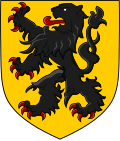 Coat of arms | |
 Location of Bollezeele | |
Bollezeele Bollezeele | |
| Coordinates: 50°51′55″N 2°19′29″E / 50.8653°N 2.3247°E / 50.8653; 2.3247 | |
| Country | France |
| Region | Hauts-de-France |
| Department | Nord |
| Arrondissement | Dunkirk |
| Canton | Wormhout |
| Intercommunality | Hauts de Flandre |
| Government | |
| • Mayor (2020–2026) | Pierre Marle1 |
Area 1 | 17.54 km2 (6.77 sq mi) |
| Population (2023)2 | 1,445 |
| • Density | 82.38/km2 (213.4/sq mi) |
| Time zone | UTC+01:00 (CET) |
| • Summer (DST) | UTC+02:00 (CEST) |
| INSEE/Postal code | 59089 /59470 |
| Elevation | 2–52 m (6.6–170.6 ft) (avg. 44 m or 144 ft) |
| 1 French Land Register data, which excludes lakes, ponds, glaciers > 1 km2 (0.386 sq mi or 247 acres) and river estuaries. | |
Bollezeele (French pronunciation: [bɔlzɛl]; from Dutch; Bollezele in the modern Dutch spelling) is a commune in the Nord department in northern France.3
It is 17 km (11 mi) south of Dunkirk and also 20 km (12 mi) west of the Belgian border. The river Yser runs through Bollezeele.
Language
Bollezeele's local speech is traditionally a Flemish dialect, similar to that spoken on the other side of the border with Belgium; this led to the town's being included in the Atlas Linguarum Europae as one of the Germanic dialects in France (the others were all in either Alsace or Moselle).4
Population
| Year | Pop. | ±% p.a. |
|---|---|---|
| 1968 | 1,389 | — |
| 1975 | 1,328 | −0.64% |
| 1982 | 1,500 | +1.76% |
| 1990 | 1,476 | −0.20% |
| 1999 | 1,382 | −0.73% |
| 2009 | 1,391 | +0.06% |
| 2014 | 1,432 | +0.58% |
| 2020 | 1,424 | −0.09% |
| Source: INSEE5 | ||
Heraldry
|
The arms of Bollezeele are blazoned : Or, a lion sable armed and langued gules. ('Flanders' and the communes of Thourotte, Crépy-en-Valois, Bollezeele, Feignies, Flines-lez-Raches and Wormhout use the same arms.)
|
References
References
- "Répertoire national des élus: les maires". data.gouv.fr, Plateforme ouverte des données publiques françaises (in French). 2 December 2020.
- "Populations de référence 2023" (in French). National Institute of Statistics and Economic Studies. 18 December 2025.
- INSEE commune file
- Eder, Birgit (2003). Ausgewählte Verwandtschaftsbezeichnungen in den Sprachen Europas. Frankfurt am Main: Peter Lang. p. 299. ISBN 3631528736.
- Population en historique depuis 1968, INSEE