| Tibeto-Kanauri | |
|---|---|
| Bodic, Bodish–Himalayish Western Tibeto-Burman | |
| (proposed) | |
| Geographic distribution | Nepal, Tibet, Northeast India and other neighboring areas |
| Linguistic classification | Sino-Tibetan
|
| Subdivisions |
|
| Language codes | |
| Glottolog | bodi1256 |
The Tibeto-Kanauri languages, also called Bodic, Bodish–Himalayish, and Western Tibeto-Burman, are a proposed intermediate level of classification of the Sino-Tibetan languages, centered on the Tibetic languages and the Kinnauri dialect cluster. The conception of the relationship, or if it is even a valid group, varies between researchers.
Conceptions of Tibeto-Kanauri
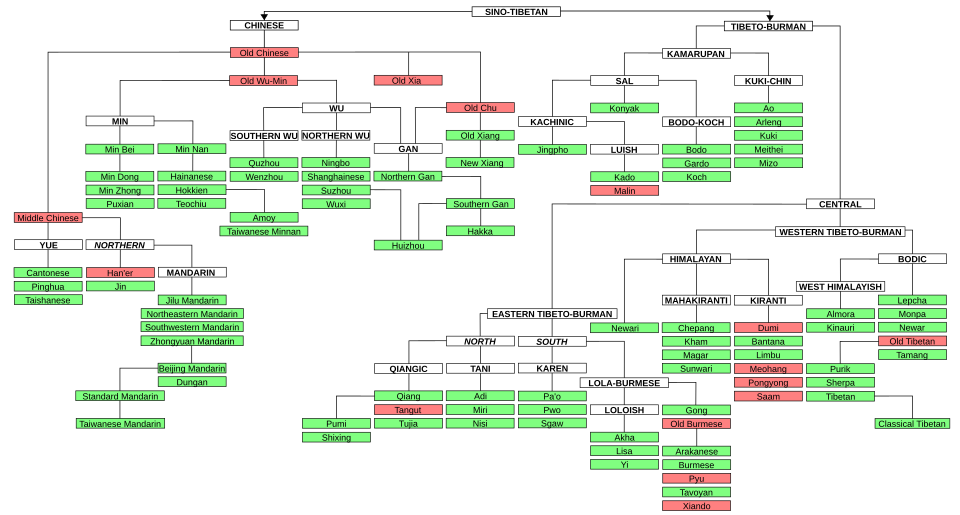
Benedict (1972) originally posited the Tibeto-Kanauri aka Bodish–Himalayish relationship, but had a more expansive conception of Himalayish than generally found today, including Qiangic, Magaric, and Lepcha. Within Benedict's conception, Tibeto-Kanauri is one of seven linguistic nuclei, or centers of gravity along a spectrum, within Tibeto-Burman languages. The center-most nucleus identified by Benedict is the Jingpho language (including perhaps the Kachin–Luic and Tamangic languages); other peripheral nuclei besides Tibeto-Kanauri include the Kiranti languages (Bahing–Vayu and perhaps the Newar language); the Tani languages; the Bodo–Garo languages and perhaps the Konyak languages); the Kukish languages (Kuki–Naga plus perhaps the Karbi language, the Meitei language and the Mru language); and the Burmish languages (Lolo-Burmese languages, perhaps also the Nung language and Trung).2
Matisoff (1978, 2003) largely follows Benedict's scheme, stressing the teleological value of identifying related characteristics over mapping detailed family trees in the study of Tibeto-Burman and Sino-Tibetan languages. Matisoff includes Bodish and West Himalayish with the Lepcha language as a third branch. He unites these at a higher level with Mahakiranti as Himalayish.34
Van Driem (2001) notes that the Bodish, West Himalayish, and Tamangic languages (but not Benedict's other families) appear to have a common origin.5
Bradley (1997) takes much the same approach but words things differently: he incorporates Bodish, Tshangla, and West Himalayan as constituting a single branch, which thus becomes close to Tibeto-Kanauri. This and his other branch containing both Central Himalayan and Kiranti constitute his Bodic family.6
References
References
- Thurgood, Graham; LaPolla, Randy J. (ed.s) (2003). Sino-Tibetan Languages. London: Routledge. ISBN 0-7007-1129-5.
- Benedict, Paul K. (1972). Sino-Tibetan: a Conspectus. Princeton-Cambridge Studies in Chinese Linguistics. Vol. 2. CUP Archive. pp. 4–11.
- Matisoff, James A. (1978). Variational semantics in Tibeto-Burman: The "Organic" Approach to Linguistic Comparison. Occasional papers, Wolfenden Society on Tibeto-Burman Linguistics. Vol. 6. Institute for the Study of Human Issues. ISBN 0-915980-85-1.
- Matisoff, James A. (2003). Handbook of Proto-Tibeto-Burman: System and Philosophy of Sino-Tibetan Reconstruction. University of California Publications in Linguistics. Vol. 135. University of California Press. pp. 1–9. ISBN 0-520-09843-9.
- van Driem, George (2001). Languages of the Himalayas: an Ethnolinguistic Handbook of the Greater Himalayan Region: Containing an Introduction to the Symbiotic Theory of Language. Handbuch der Orientalistik. Zweite Abteilung, Indien. Vol. 10. BRILL. ISBN 90-04-10390-2.
- Bradley, David (1997). Tibeto-Burman Languages of the Himalayas. Occasional Papers in South-East Asian linguistics. Dept. of Linguistics, Research School of Pacific and Asian Studies, Australian National University. ISBN 0-85883-456-1.
Further reading
Further reading
- Bradley, David (2002). "The subgrouping of Tibeto-Burman". In Christopher I. Beckwith (ed.). Medieval Tibeto-Burman languages: proceedings of a symposium held in Leiden, June 26, 2000, at the 9th Seminar of the International Association of Tibetan Studies. Brill's Tibetan studies library. Vol. 1. BRILL. pp. 73–112. ISBN 978-90-04-12424-0.
- Hale, Austin (1982). "Review of Research". Research on Tibeto-Burman languages. Trends in Linguistics. Vol. 14. Walter de Gruyter. pp. 30–49 passim. ISBN 978-90-279-3379-9.
- Singh, Rajendra (2009). Annual Review of South Asian Languages and Linguistics: 2009. Trends in Linguistics, Studies and Monographs. Vol. 222. Walter de Gruyter. pp. 154–161. ISBN 978-3-11-022559-4.