| Pixiu | |||||||||||||||||||
|---|---|---|---|---|---|---|---|---|---|---|---|---|---|---|---|---|---|---|---|
 Pixiu | |||||||||||||||||||
| Chinese name | |||||||||||||||||||
| Chinese | 貔貅 | ||||||||||||||||||
| |||||||||||||||||||
| Alternative Chinese name | |||||||||||||||||||
| Chinese | 辟邪 | ||||||||||||||||||
| |||||||||||||||||||
| Vietnamese name | |||||||||||||||||||
| Vietnamese alphabet | tỳ hưu | ||||||||||||||||||
| Chữ Hán | 貔貅 | ||||||||||||||||||
| Korean name | |||||||||||||||||||
| Hangul | 비휴 | ||||||||||||||||||
| Hanja | 豼貅 | ||||||||||||||||||
| Japanese name | |||||||||||||||||||
| Kanji | 貔貅 | ||||||||||||||||||
| Hiragana | ひきゅう | ||||||||||||||||||
| |||||||||||||||||||
The pixiu ([pʰǐ.ɕjóʊ]; Chinese: 貔貅) is a Chinese mythological hybrid creature, depicted as a winged, lion-bodied beast with the head of a Chinese dragon.1 Pixiu are regarded as powerful protectors associated with good fortune and are found in tomb-guardian sculpture, decorative arts, and Chinese folk religion.2 It is closely related to two other guardian chimera, the bixie (辟邪, "warding off evil") and the tianlu (天祿, "heavenly emolument"), which were among the most distinctive monumental sculptures of the Han dynasty.1
Etymology
Sinologist Axel Schuessler notes that in early Chinese texts pí (貔) referred to large panther-like cats.3 Minimally reconstructing 貔's Old Chinese pronunciation as *bi, Schuessler compares it to Tibetan: དབྱི།, Wylie: dbyi "lynx" and proposes a probable Sino-Tibetan etymology.3 He also notes possible cognacy with པི (pi) and བྱི (byi) in Tibetan words for "cat", namely པི་ཤི (pi shi) and བྱི་ལ (byi la).3
Xu Ke (徐珂) in the Qing-period Qingbai leichao describes the 貔貅; pixiu as resembling either tigers or bears with ashen-white fur, with the 貔; pi being male and the 貅; xiu female.4
Bixie, tianlu, and the Han guardian chimera
The bixie (辟邪) and tianlu (天祿) are winged, lion-like chimera that first appear as monumental stone tomb-guardian sculptures in the Eastern Han dynasty (25–220 AD), set along the "spirit road" (神道) leading to imperial and aristocratic tombs.5 The third-century commentator Meng Kang, glossing the Book of Han, distinguished the two creatures by their horns: the single-horned beast was the tianlu ("heavenly emolument") and the double-horned beast the bixie ("warding off evil"). The Tang dynasty commentator Yan Shigu added that the bixie was believed to defend against demons and malign spirits.5 Both creatures, and the combined term pixiu, became synonymous with fierce martial prowess and were used as symbols on battle flags and banners in ancient China.1
The winged feline form was derived in part from Western and Central Asian prototypes, transmitted through trade and cultural exchange, and was widely reproduced in Han-period bronze mirrors, lacquer objects, and personal ornaments.6 The best-preserved monumental bixie and tianlu pairs are those flanking the tombs of Southern Qi (479–502 AD) rulers near Nanjing.5
Characteristics
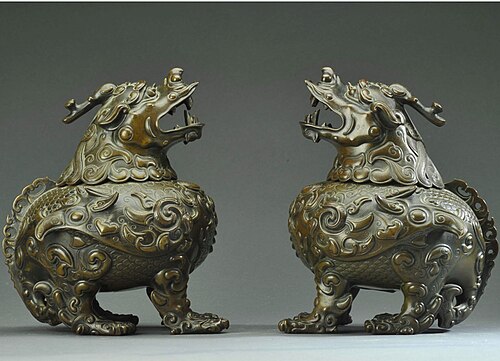
Pixiu are most often depicted as muscular, winged beasts with a dragon's head, a lion's body, protruding eyes, and prominent fangs. Han-period sources distinguish a single-horned (male, tianlu) and a double-horned (female, bixie) variant.7 In modern popular depictions, the creature is usually shown with a single horn, paralleling the way the Chinese phoenix came to be depicted as a single-gender bird.5 The presence of feathered wings distinguishes the pixiu from both the stone lion and the qilin.2
Imperial pixiu figures produced during the Qing dynasty tended towards a more rotund body, symbolically suggesting an inexhaustible capacity for wealth.8
Mythology
One popular story tells that the pixiu violated a heavenly regulation by defecating in Heaven, for which the Jade Emperor sealed its rectum as punishment. This is presented in folk tradition as the mythological origin of the creature's role as a symbol of wealth accumulation: it can consume gold and silver but cannot expel them.9
Another tradition identifies the pixiu as the loyal son of the Dragon King, transformed into an animal as punishment for accidentally breaking the Dragon King's seal; in this version the sealing of its rectum also originates from a paternal decree.8
History

The creatures that later coalesced into the combined term pixiu appear to have their origin in the Han dynasty (206 BC–220 AD), where related creatures called Táo bá are found in the Book of Han, chapter 96. An annotation ascribed to the commentator Meng Kang describes the male (tianlu) as having one antler and the female (bixie) as having two.5
The word pixiu, interpreted as meaning "fierce beast" and applied to brave warriors, was used as a symbol on battle flags and banners.8
In ancient China, stone statues of bixie and tianlu served as tomb guardians of Han-dynasty emperors and aristocrats. The motif spread into decorative arts — bronze mirrors, seals, and personal ornaments — across the Han and subsequent periods.6
Feng shui and folk religion
In Chinese folk religion and modern feng shui, pixiu are considered auspicious creatures associated with the attraction and retention of wealth. Statues of this creature are commonly used as decorative objects thought to bring good fortune, and are a popular design on jade pendants and jewellery.1
Gallery
-
-
 A Chinese Pixiu, (Chinese: 貔貅; pinyin: píxiū; Wade–Giles: P'i-hsiu) head of a Chinese dragon, body of a lion and with a pair of feathered wings, at the tomb of Emperor Wu of Southern Qi (Xiao Ze) in Danyang (near Nanjing, China).
 -
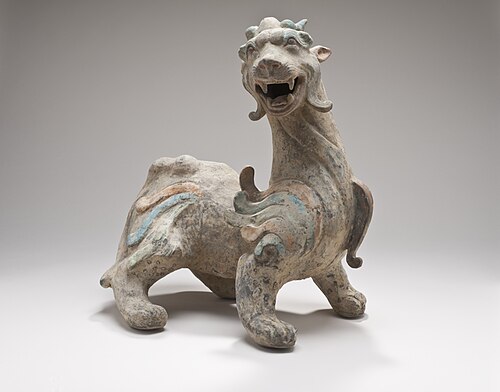 A sculpture of a Chinese Pixiu "Bìxié" — a female pixiu with two antlers. Los Angeles County Museum of Art (LACMA)
 -
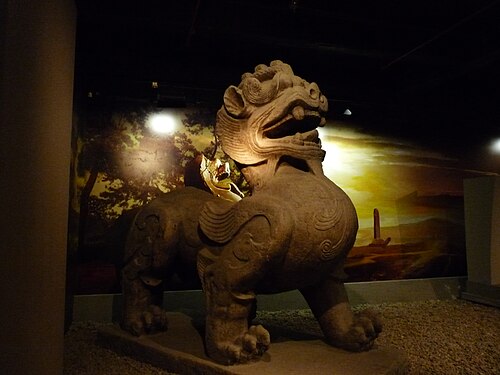 A Chinese pixiu, part Chinese dragon, part lion and with feathered wings, in Chaotian Palace, Nanjing
 -
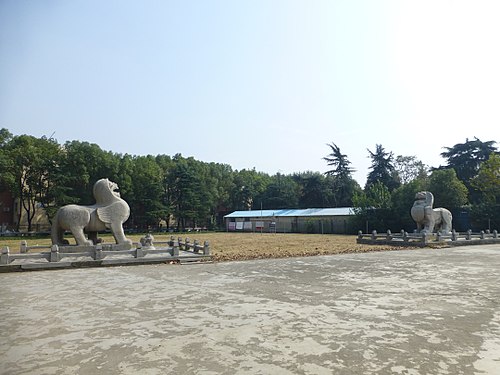 A very large pair of winged, stone pixiu guarding a tomb in China
 -
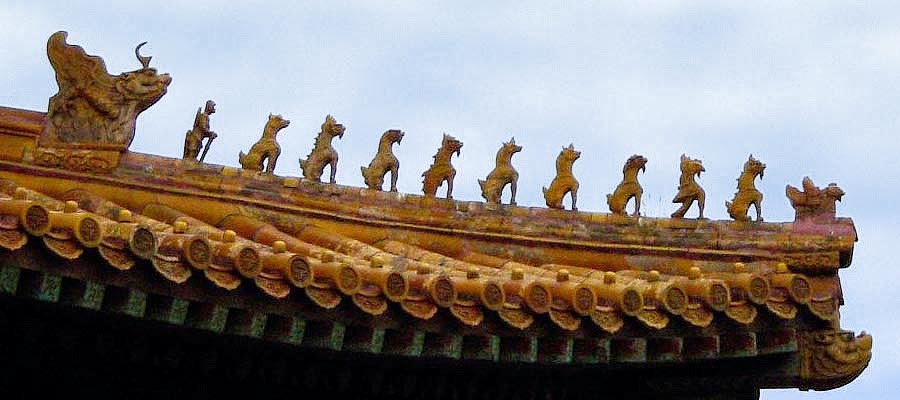 Ceramic figures decorating the Hall of Supreme Harmony at the Imperial Palace Museum. The 9 mystical beasts indicate the highest status in the empire for this building.
In popular culture
In Mulan, a pixiu is featured as a design on the sword of Fa Mulan.
In DuckTales of 2017, a Pixiu serves as a minor antagonist.
In American Born Chinese, Shiji Niangniang has a pet Pixiu that was turned into a dog.
In the video game Overwatch, a Pixiu costume is available for the character Zenyatta.
See also
See also
References
References
- Yang & An 2005, pp. 128–130.
- Yang & An 2005, p. 128.
- Schuessler 2007, p. 412.
- Xu Ke (1917). "Chapter 98: Animals (動物類), section "Pixiu (貔貅)". Categorized anthology of petty matters from the Qing period 清稗類鈔. 貔貅。形似虎。或曰似熊。毛色灰白。遼東人謂之白羆。雄者曰貔。雌者曰貅。故古人多連舉之。
- Yang & An 2005, p. 129.
- Birrell 1993, p. 135.
- Yang & An 2005, pp. 128–129.
- Yang & An 2005, p. 130.
- Lim, SK (2010). Origins of Chinese Auspicious Symbols. Singapore: Asiapac Books. pp. 23–24. ISBN 978-981-229-980-2.
Sources
Sources
- Birrell, Anne (1993). Chinese Mythology: An Introduction. Johns Hopkins University Press. ISBN 978-0-8018-4595-6.
- Schuessler, Axel (2007). ABC Etymological Dictionary of Old Chinese. University of Hawaii Press. ISBN 978-0-8248-2975-9.
- Yang, Lihui; An, Deming (2005). Handbook of Chinese Mythology. ABC-CLIO. ISBN 978-1-57607-806-8.
{{cite book}}: CS1 maint: ref duplicates default (link)