  | |
| Observation data Epoch J2000.0 Equinox J2000.0 (ICRS) | |
|---|---|
| Constellation | Sextans |
| Right ascension | 10h 30m 17.48029s1 |
| Declination | −00° 38′ 13.3145″1 |
| Apparent magnitude (V) | 5.072 |
| Characteristics | |
| Evolutionary stage | Main sequence3 |
| Spectral type | B6 V4 or B5 IV/V5 |
| U−B color index | −0.512 |
| B−V color index | −0.142 |
| Variable type | α2 CVn6 |
| Astrometry | |
| Radial velocity (Rv) | 11.6±2.87 km/s |
| Proper motion (μ) | RA: −39.290 mas/yr1 Dec.: −23.582 mas/yr1 |
| Parallax (π) | 8.8899±0.1477 mas1 |
| Distance | 367 ± 6 ly (112 ± 2 pc) |
| Absolute magnitude (MV) | −0.388 |
| Details | |
| Mass | 4.01±0.073 M☉ |
| Radius | 3.009 R☉ |
| Luminosity | 3303 L☉ |
| Surface gravity (log g) | 4.2110 cgs |
| Temperature | 13,8703 K |
| Metallicity [Fe/H] | 0.1910 dex |
| Rotational velocity (v sin i) | 85±410 km/s |
| Age | 21611 Myr |
| Other designations | |
| β Sex, 30 Sextantis, BD+00°2663, FK5 2841, HD 90994, HIP 51437, HR 4119, SAO 13760812 | |
| Database references | |
| SIMBAD | data |
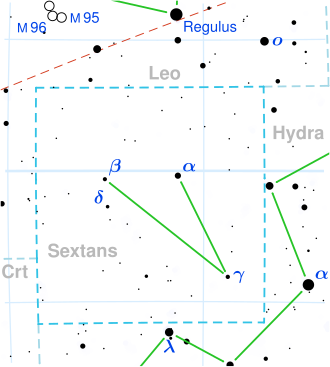
Beta Sextantis, Latinized from β Sextantis, is a variable star in the equatorial constellation of Sextans. With an apparent visual magnitude of 5.07,2 it is faintly visible to the naked eye on a dark night. According to the Bortle scale, it can be viewed from brighter lit suburban skies. The distance to this star, based upon an annual parallax shift of 8.89 mas,1 is around 367 light years.

This star served as a primary standard in the MK spectral classification system with a stellar classification of B6 V,4 indicating that it is a B-type main sequence star. However, Houk and Swift (1999) list a classification of B5 IV/V, suggesting it may be transitioning into a subgiant star.5 Stellar evolution models support this is a main sequence star.3 It has served as a uvby photometric standard, but is also categorized as an Alpha2 Canum Venaticorum variable6 with a suspected period of 15.4 days. This lengthy a period conflicts with a relatively high projected rotational velocity of 85 km/s, leaving the explanation for the variance unresolved.104
References
References
- Vallenari, A.; et al. (Gaia collaboration) (2023). "Gaia Data Release 3. Summary of the content and survey properties". Astronomy and Astrophysics. 674: A1. arXiv:2208.00211. Bibcode:2023A&A...674A...1G. doi:10.1051/0004-6361/202243940. S2CID 244398875. Gaia DR3 record for this source at VizieR.
- Crawford, D. L.; et al. (1971). "Four-color, H-beta, and UBV photometry for bright B-type stars in the northern hemisphere". The Astronomical Journal. 76: 1058. Bibcode:1971AJ.....76.1058C. doi:10.1086/111220.
- Zorec, J.; Royer, F. (2012). "Rotational velocities of A-type stars. IV. Evolution of rotational velocities". Astronomy and Astrophysics. 537: A120. arXiv:1201.2052. Bibcode:2012A&A...537A.120Z. doi:10.1051/0004-6361/201117691.
- Mathys, G.; et al. (March 1986). "Photometric variability of some early-type stars". Astronomy and Astrophysics Supplement Series. 63 (3): 403–416. Bibcode:1986A&AS...63..403M.
- Houk, N.; Swift, C. (1999). "Michigan catalogue of two-dimensional spectral types for the HD Stars". Michigan Spectral Survey. 5. Ann Arbor, Michigan: Department of Astronomy, University of Michigan. Bibcode:1999MSS...C05....0H.
- Kholopov, P. N.; et al. (April 1989). "The 69th Name-List of Variable Stars". Information Bulletin on Variable Stars. 3323 (3323): 1. Bibcode:1989IBVS.3323....1K.
- de Bruijne, J. H. J.; Eilers, A.-C. (October 2012). "Radial velocities for the HIPPARCOS-Gaia Hundred-Thousand-Proper-Motion project". Astronomy & Astrophysics. 546: 14. arXiv:1208.3048. Bibcode:2012A&A...546A..61D. doi:10.1051/0004-6361/201219219. S2CID 59451347. A61.
- Anderson, E.; Francis, Ch. (2012). "XHIP: An extended hipparcos compilation". Astronomy Letters. 38 (5): 331. arXiv:1108.4971. Bibcode:2012AstL...38..331A. doi:10.1134/S1063773712050015. XHIP record for this object at VizieR.
- McDonald, I.; Zijlstra, A. A.; Watson, R. A. (2017-10-01). "Fundamental parameters and infrared excesses of Tycho-Gaia stars". Monthly Notices of the Royal Astronomical Society. 471: 770–791. arXiv:1706.02208. Bibcode:2017MNRAS.471..770M. doi:10.1093/mnras/stx1433. ISSN 0035-8711.
- Hempel, M.; Holweger, H. (September 2003). "Abundance analysis of late B stars. Evidence for diffusion and against weak stellar winds". Astronomy and Astrophysics. 408 (3): 1065–1076. Bibcode:2003A&A...408.1065H. doi:10.1051/0004-6361:20030889.
- Gontcharov, G. A. (2012). "Dependence of kinematics on the age of stars in the solar neighborhood". Astronomy Letters. 38 (12): 771. arXiv:1606.08814. Bibcode:2012AstL...38..771G. doi:10.1134/S1063773712120031.
- "bet Sex". SIMBAD. Centre de données astronomiques de Strasbourg. Retrieved 2016-12-13.
- "MAST: Barbara A. Mikulski Archive for Space Telescopes". Space Telescope Science Institute. Retrieved 27 August 2024.