  | |
| Observation data Epoch J2000.0 Equinox J2000.0 | |
|---|---|
| Constellation | Circinus1 |
| Right ascension | 15h 17m 30.84945s2 |
| Declination | −58° 48′ 04.3453″2 |
| Apparent magnitude (V) | 4.071 |
| Characteristics | |
| Spectral type | A3 Va3 |
| U−B color index | +0.094 |
| B−V color index | +0.088±0.0071 |
| Astrometry | |
| Radial velocity (Rv) | 9.6±25 km/s |
| Proper motion (μ) | RA: −97.182 mas/yr2 Dec.: −136.055 mas/yr2 |
| Parallax (π) | 35.8205±0.2515 mas2 |
| Distance | 91.1 ± 0.6 ly (27.9 ± 0.2 pc) |
| Absolute magnitude (MV) | +1.641 |
| Details | |
| Mass | 1.96+0.03 −0.016 M☉ |
| Radius | 1.927 R☉ |
| Luminosity | 191 L☉ |
| Surface gravity (log g) | 4.2818 cgs |
| Temperature | 8676±336 K |
| Metallicity [Fe/H] | 0.161 dex |
| Rotational velocity (v sin i) | 594 km/s |
| Age | 370–5006 Myr |
| Other designations | |
| β Cir, Beta Circini, Beta Cir, CPD−58 5875, FK5 561, GC 20526, GJ 580.1,, GJ 9516, HD 135379, HIP 74824, HR 5670, SAO 242384, PPM 3435909 | |
| Database references | |
| SIMBAD | data |
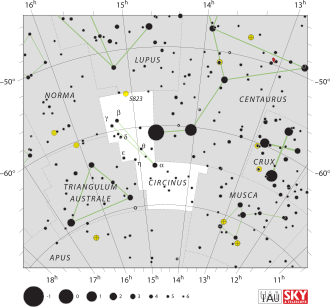
Beta Circini is the second-brightest star in the constellation of Circinus. Its name is a Bayer designation that is Latinized from β Circini, and abbreviated Beta Cir or β Cir. The star has an apparent visual magnitude of approximately 4.07,1 which is bright enough to be viewed with the naked eye. Based upon an annual parallax shift of 35.8 mas as seen from the Earth, it is located at a distance of 91.1 light-years (27.9 pc) from the Sun.
With a stellar classification of A3 Va,3 this is an A-type main-sequence star fusing atoms of hydrogen into helium at its core. It is between 370 and 500 million years old6 and is spinning with a projected rotational velocity of 59 km/s.4 The star has 1.966 times the mass of the Sun and around 1.97 times the Sun's radius. The star is radiating 191 times the Sun's luminosity from its photosphere at an effective temperature of 8,676 K.6 It has one known sub-stellar companion.
Substellar companion
Beta Circini b is a distant brown dwarf companion orbiting the host star at a distance of 6,656 AU. It was detected as a proper motion companion to Beta Circini in 2015 by L.C. Smith and collaborators. Using BHAC15 isochrones, its mass is estimated at 0.056 M☉, or 59 MJ. It has a stellar classification of L1 and a temperature of 2,084 K (1,811 °C).6
| Companion (in order from star) |
Mass | Semimajor axis (AU) |
Orbital period (days) |
Eccentricity | Inclination (°) |
Radius |
|---|---|---|---|---|---|---|
| b | 58.7±7.3 MJ | 6,656 | — | — | — | — |
References
References
- Anderson, E.; Francis, Ch. (2012). "XHIP: An extended hipparcos compilation". Astronomy Letters. 38 (5): 331. arXiv:1108.4971. Bibcode:2012AstL...38..331A. doi:10.1134/S1063773712050015. XHIP record for this object at VizieR.
- Vallenari, A.; et al. (Gaia collaboration) (2023). "Gaia Data Release 3. Summary of the content and survey properties". Astronomy and Astrophysics. 674: A1. arXiv:2208.00211. Bibcode:2023A&A...674A...1G. doi:10.1051/0004-6361/202243940. S2CID 244398875. Gaia DR3 record for this source at VizieR.
- Gray, R. O.; et al. (2006). "Contributions to the Nearby Stars (NStars) Project: Spectroscopy of Stars Earlier than M0 within 40 pc-The Southern Sample". The Astronomical Journal. 132 (1): 161–170. arXiv:astro-ph/0603770. Bibcode:2006AJ....132..161G. doi:10.1086/504637. S2CID 119476992.
- Hoffleit, D.; Warren, Jr., W. H. "HR 5670, database entry". The Bright Star Catalogue (5th Revised Ed. (Preliminary Version) ed.). CDS. ID V/50. Retrieved September 5, 2008.
- Evans, D. S (1967). "The Revision of the General Catalogue of Radial Velocities". Determination of Radial Velocities and Their Applications. 30: 57. Bibcode:1967IAUS...30...57E.
- Smith, L. C.; et al. (2015). "Discovery of a brown dwarf companion to the A3V star β Circini". Monthly Notices of the Royal Astronomical Society. 454 (4): 4476–4483. arXiv:1509.09226. Bibcode:2015MNRAS.454.4476S. doi:10.1093/mnras/stv2290. hdl:2299/16835. S2CID 18570256.
- Cotten, Tara H.; Song, Inseok (2016-07-01). "A Comprehensive Census of Nearby Infrared Excess Stars". The Astrophysical Journal Supplement Series. 225 (1): 15. arXiv:1606.01134. Bibcode:2016ApJS..225...15C. doi:10.3847/0067-0049/225/1/15. ISSN 0067-0049. Beta Circini's database entry at VizieR.
- Song, Inseok; et al. (February 2001). "Ages of A-Type Vega-like Stars from uvbyβ Photometry". The Astrophysical Journal. 546 (1): 352–357. arXiv:astro-ph/0010102. Bibcode:2001ApJ...546..352S. doi:10.1086/318269. S2CID 18154947.
- "* bet Cir". SIMBAD. Centre de données astronomiques de Strasbourg. Retrieved September 5, 2008.