 | |
 | |
| Names | |
|---|---|
| Preferred IUPAC name
Benzenehexol1 | |
| Other names
Benzene-1,2,3,4,5,6-hexol
Hexahydroxybenzene 2,3,4,5,6-pentahydroxyphenol 1,2,3,4,5,6-hexahydroxybenzene Hexaphenol Fenolão | |
| Identifiers | |
| |
3D model (JSmol)
|
|
| ChemSpider |
|
| ECHA InfoCard | 100.204.877 |
PubChem CID
|
|
| UNII | |
CompTox Dashboard (EPA)
|
|
| |
| |
| Properties | |
| C6H6O6 | |
| Molar mass | 174.108 g·mol−1 |
Except where otherwise noted, data are given for materials in their standard state (at 25 °C [77 °F], 100 kPa).
| |


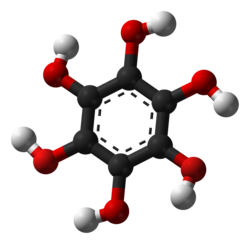
Benzenehexol, also called hexahydroxybenzene, is an organic compound with formula C6H6O6 or C
6(OH)
6. It is a six-fold phenol of benzene.23 The product is also called hexaphenol,4 but this name has been used also for other substances.5
Benzenehexol is a crystalline solid soluble in hot water,4 with a melting point above 310°.2 It can be prepared from inositol (cyclohexanehexol). Oxidation of benzenehexol yields tetrahydroxy-p-benzoquinone (THBQ), rhodizonic acid, and dodecahydroxycyclohexane.6 Conversely, benzenehexol can be obtained by reduction of sodium THBQ salt with SnCl2/HCl.7
Benzenehexol is a starting material for a class of discotic liquid crystals.7
Benzenehexol forms an adduct with 2,2'-bipyridine, with 1:2 molecular ratio.8
Benzenehexolate
Like most phenols, benzenehexol can lose the six H+ ions from the hydroxyl groups, yielding the hexaanion C
6O6−
6. The potassium salt of this anion is one of the components of Liebig's so-called "potassium carbonyl", the product of the reaction of carbon monoxide with potassium. The hexaanion is produced by trimerization of the acetylenediolate anion C
2O2−
2 when heating potassium acetylenediolate K
2C
2O
2.9 The nature of K
6C
6O
6 was clarified10 by Rudolf Nietzki and Theodor Benckiser in 1885, who found that its hydrolysis yielded benzenehexol.1112
The lithium salt of this anion, Li6C6O6 has been considered for electric battery applications.13
Esters
Hexahydroxy benzene forms esters such as the hexaacetate C
6(-O(CO)CH3)6 (melting point 220 °C) and ethers like hexa-tert-butoxybenzene C
6(-OC(CH3)3)6 (melting point 223 °C).9
References
References
- "Front Matter". Nomenclature of Organic Chemistry : IUPAC Recommendations and Preferred Names 2013 (Blue Book). Cambridge: The Royal Society of Chemistry. 2014. p. 693. doi:10.1039/9781849733069-FP001. ISBN 978-0-85404-182-4.
- Fatiadi, Alexander J.; Sager, William F. "Hexahydroxybenzene (Benzenehexol)". Organic Syntheses. Retrieved 2023-01-28.
- Leston, Gerd (2000-12-04), "(Polyhydroxy)benzenes", in John Wiley & Sons, Inc. (ed.), Kirk-Othmer Encyclopedia of Chemical Technology, Hoboken, NJ, USA: John Wiley & Sons, Inc., pp. 1615122512051920.a01, doi:10.1002/0471238961.1615122512051920.a01, ISBN 978-0-471-23896-6, retrieved 2023-01-28
- Codagan, J.I.G.; Buckingham, John; MacDonald, Finlay J.; Rhodes, P. H. (1996). Dictionary of Organic Compounds, 6th edition. London: Chapman & Hall; CRC Press. ISBN 9780412540905. OCLC 35716592.
- "Hexaphenol (CAS: 1506-76-9)". www.chemicalbook.com. Retrieved 2009-07-05.
- Fatiadi, Alexander J.; Isbell, Horace S.; Sager, William F. (March–April 1963). "Cyclic Polyhydroxy Ketones. I. Oxidation Products of Hexahydroxybenzene (Benzenehexol)" (PDF). Journal of Research of the National Bureau of Standards Section A. 67A (2): 153–162. doi:10.6028/jres.067A.015. PMC 6640573. PMID 31580622. Archived from the original (PDF) on 2009-03-25. Retrieved 2009-07-05.
- Kumar, Sandeep (2006). "Self-organization of disc-like molecules: chemical aspects". Chemical Society Reviews. 35 (1): 83–109. doi:10.1039/b506619k. PMID 16365644.
- Cowan John A., Howard Judith A. K., Leech Michael A., Puschmann Horst, Williams Ian D. (2001). "Hexahydroxybenzene—2,2'-bipyridine (1/2)". Acta Crystallographica Section C. 57 (10): 1194–1195. doi:10.1107/S0108270101011350. PMID 11600782. S2CID 25797464.
{{cite journal}}: CS1 maint: multiple names: authors list (link) - Serratosa Fèlix (1983). "Acetylene Diethers: A Logical Entry to Oxocarbons". Acc. Chem. Res. 16 (5): 170–176. doi:10.1021/ar00089a004.
- R. Nietzki; Th. Benckiser (1885). "Ueber Hexaoxybenzolderivate und ihre Beziehungen zur Krokonsäure und Rhodizonsäure". Berichte der Deutschen Chemischen Gesellschaft. 18 (1): 499–515. doi:10.1002/CBER.188501801110. ISSN 0365-9496. Wikidata Q56853054.
- Ludwig Mond (1892), On metallic carbonyls. Proceedings of the Royal Institution, volume 13, pages 668-680. Reprinted in The Development of Chemistry, 1789-1914: Selected essays edited by D. Knight (1998). ISBN 0-415-17912-2 Online version at books.google.com, accessed on 2010-01-15.
- Büchner Werner, Weiss E (1964). "Zur Kenntnis der sogenannten "Alkalicarbonyle" IV[1] Über die Reaktion von geschmolzenem Kalium mit Kohlenmonoxid". Helvetica Chimica Acta. 47 (6): 1415–1423. doi:10.1002/hlca.19640470604.
- Chen Haiyan, Armand Michel, Courty Matthieu, Jiang Meng, Grey Clare P., Dolhem Franck, Tarascon Jean-Marie, Poizot Philippe (2009). "Lithium Salt of Tetrahydroxybenzoquinone: Toward the Development of a Sustainable Li-Ion Battery". J. Am. Chem. Soc. 131 (25): 8984–8988. doi:10.1021/ja9024897. PMID 19476355.
{{cite journal}}: CS1 maint: multiple names: authors list (link)