| Founded | c. 1875 |
|---|---|
| Founder | John A. Benson |
| Named after | John A. Benson |
| Founding location | San Francisco, California |
| Years active | 1875–1898 |
| Territory | Western United States |
| Membership | At least 40 known members in California |
| Leader | John A. Benson |
| Activities | Land survey fraud, forgery, conspiracy |
| Notable members | Theodore Wagner (California Surveyor General) |
The Benson Syndicate was a 19th-century criminal organization in the western United States that obtained contracts from the United States General Land Office (GLO) to perform cadastral land surveys of the public lands, then fraudulently executed or entirely fabricated the work.1 It was led by, and named after, John A. Benson (1845–1910), originally from Illinois, who served as a US deputy surveyor in California.2
The Syndicate operated across the western United States from the Rocky Mountains to the Pacific, but was most active in California and headquartered in San Francisco.1 Its tenure ran from an uncertain origin in the mid-1870s to 1898, with peak activity from 1880 to 1885.3 In California alone, at least 40 individuals were known to be involved.1 Government estimates later indicated that nearly a thousand townships may have been affected, comprising approximately 20 million acres — roughly 20 percent of all land in California.4
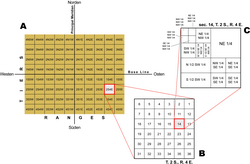
The group's modus operandi was to generate false demand for public land surveys from supposedly interested "settlers" (see Public Land Survey System) using fictitious applications for surveys of specified townships.1 Two successive California Surveyors General, who were part of the ring, then awarded surveying contracts to Benson associates for the surveys.1 These were then fraudulently executed, ranging in quality from skeletal surveys based on minimal data to outright fabrications of all data and maps. The required survey output — official notes and plat maps — were forged to make the surveys appear legitimate on paper.1 The scheme persisted for at least five years because no ground-based inspections were conducted prior to survey approval; the group's downfall began when such inspections were instituted in mid-1885.1
The surveys were officially contracted to individual deputy surveyors other than Benson himself, some of whom were unaware that contracts existed in their names, having been induced to sign blank papers later converted into legal documents without their knowledge.1 At other times, people with minimal surveying experience performed the work without the contracted surveyor being present, which was also illegal. In the worst cases, entire contracted areas were fabricated at Benson's San Francisco office with no fieldwork at all, as documented in GLO annual reports.1
Extent of operations
Benson's organization infiltrated very high levels of the government; members in governmental positions and in Congress made the group's schemes possible.1 In California, two Surveyors General in the 1880s approved numerous fraudulent survey results and requests for payment that were 200 to 700 percent of the originally estimated cost, which the government paid.1
Theodore Wagner was especially notorious in this regard, and his appointment as California Surveyor General coincided with a large increase in the group's activities.3 Others approved contracts that had originally been rejected after inspection by independent government examiners, without evidence that the surveys had been corrected.1 At least one examiner in California was part of the syndicate, attempting to gain payment for rejected surveys via bogus field examinations, which were themselves later rejected.1 Banks were also involved, providing the deposits and performance bonds required by the government in exchange for a share of the profits; these banks later paid for the syndicate's defense attorneys.5

Extracts from Annual Reports of the Commissioner of the General Land Office
Detailed information on the Syndicate's history remains sparse, but substantive descriptions appear in two Annual Reports of the Commissioner of the General Land Office, from 1887 and 1888.
The 1887 Annual Report summarises its schemes:
In April last the United States grand jury at San Francisco returned forty one indictments for perjury and conspiracy in connection with fraudulent surveys of the public lands...The operations of this syndicate were not confined to California, but extended to the States of Nevada, Oregon and Colorado, and the Territories of Arizona, New Mexico, Idaho, Montana, Utah, and Washington. Its purpose was to control all surveying contracts in these States and Territories under the deposit system, to manufacture settlers' applications for surveys, to file in the offices of the surveyors-general fictitious field notes of surveys and alleged surveys, and to draw from the Treasury of the United States large sums of money on fraudulent surveying accounts.
The principal portion of the contracts were let in the names of thirty-four alleged deputy surveyors, of whom three were "dummies", two were intimately connected with the surveyor-general who approved the bulk of the contracts, and the remainder were relatives, partners, associates, or employees of the head of the syndicate. There was paid to the order or purported order, of these thirty-four pretended deputy surveyors upwards of $1,000,000, all of which went into the treasury of the syndicate, the parties used as tools being paid stated salaries by the syndicate for the use of their names and services. Three of the alleged deputies, to whom upwards of $190,000 appears from official records to have been paid, have sworn that their names were used without their knowledge, that they never had a surveying contract, and never received the amounts shown as paid them, and one swears that he never did a day's work in his life at land surveying and knows nothing of the business.
Every expedient known to legal ingenuity has been resorted to by defendants and their confederates to avoid and defeat trials on the indictments found, but it is hoped and expected that at the next term of the court the trial and merited conviction of guilty parties to this stupendous scheme of fraud, perjury, and public robbery which has been developed, will be secured.
— United States General Land Office, Annual Report of the Commissioner for the Year 1887, Annual Report of the Commissioner (1887), pp. 25–26
The 1888 Annual Report describes a fictitious survey of three townships in the high Sierra Nevada, southeast of what is now Yosemite National Park:
Township 7 South, Range 25 East and Township 8 South, Ranges 24 and 25 East, Mount Diablo Meridian: These townships are very rough, intersected by deep canyons and very steep, almost impassable mountains, in part covered with dense chaparral. Six weeks before the deputy claims to have commenced his surveys, all the people who live there in the summer are driven out by the snows, all business is suspended, and the mountain country abandoned. A comparison of the original field notes, transcript notes, plats and report of the examiner, shows that at the season of the year (from December 1, 1884, to January 3, 1885) when the deputy pretends to have made the surveys, the deep snows made the survey at that time impossible; that in the original notes (which are now in this office) much is omitted that is found in the transcripts and data supplied from memory, or rather made up; that disregarding clerical errors the transcripts are not in any sense copies of the original notes; that triangulations omitted in originals are audaciously given in detail in the transcripts, just as if they had really been made in the field, that the high speed, more than 6 miles per day, at which it is pretended the work was executed, surpasses belief when we take into consideration the nature of the ground, and bear in mind that the surveying was done during the shortest days of the year; that the deputy gives descriptions of erroneous bearing trees where no such trees, either as regards size or species, are to be found; that in the face of all the embarrassing conditions, big canyons, high and steep mountains, deep snow, impenetrable chaparral, precipices impossible to ascend or descend, the deputy with his two parties of four men each, frequently with the impassable San Joaquin river between them, pretends to have subdivided T8SR24E at the rate of more than 6 miles per day, and then accomplishes the feat of recording all this work in one field book. The conclusion is that the deputy did not make the surveys of these townships according to his field notes and that the notes are in large part fictitious and fraudulent.
— United States General Land Office, Annual Report of the Commissioner for the Year 1888, Annual Report of the Commissioner (1888), pp. 186–187
Government action
It was implausible survey results such as these, as well as sworn testimony from disenchanted employees or associates, that led to recognition of the widespread fraud.1 Beginning about 1886, contracts held by surveyors aligned with Benson were not paid by the government, leading to various lawsuits.3 In 1887, forty-one federal indictments for conspiracy and perjury were brought against Benson and several others.1 The trials in federal district court did not occur until 1892, when all defendants were acquitted on legal technicalities.2 Their actual guilt was accepted as established by those familiar with the facts, and surveyors associated with Benson subsequently had difficulty obtaining work.2
In 1895, Benson proposed what became known as the "Benson Compromise" to the California Surveyor General, offering to correct or complete several contracts that government examiners had declared fraudulent.2 The government accepted the compromise, but the GLO's annual reports indicate that little of the supposedly corrected work was ever accepted as valid.16
In a separate legal action, Benson was sought for extradition to Oregon in connection with related land fraud. The case reached the Supreme Court of the United States as Benson v. Henkel (198 U.S. 1, 1905), in which the Court ruled against Benson's challenge to extradition.7
See also
See also
References
References
- United States General Land Office (1887). Annual Report of the Commissioner of the General Land Office to the Secretary of the Interior for The Year 1887. Washington, D.C.: Government Printing Office. pp. 25–26. Retrieved 12 March 2025.
- Zink, John S. (1991). "Benson and Associates: Guilty Until Proved Innocent?". Surveying and Land Information Systems. 51 (4): 211–215.
- Fields, James R. (September–October 1990). "The Benson Surveys". Engineering Field Notes. 22. U.S. Department of Agriculture, Forest Service.
- Whitten, C. E. (16 April 2023). "Retracement Surveyor Beware". The American Surveyor. Retrieved 3 May 2026.
- Millard, Bailey (May 1905). "The West Coast Land Grafters". Everybody's Magazine. Vol. 12, no. 5. p. 581.
- United States General Land Office (1888). Annual Report of the Commissioner of the General Land Office to the Secretary of the Interior for The Year 1888. Washington, D.C.: Government Printing Office. pp. 186–187. Retrieved 12 March 2025.
- Benson v. Henkel, 198 U.S. 1 (U.S. 1905).
Further reading
Further reading
- Puter, Stephen A. D. (1908). Looters of the Public Domain.
- Davis, Oscar King (8 September 1907). "The Beginning of the End for the Land Fraud Thieves". New York Times.
- Messing, John (February 1966). "Public Lands, Politics, and Progressives: The Oregon Land Fraud Trials, 1903–1910". Pacific Historical Review. 35 (1). University of California Press: 35–66. doi:10.2307/3636627.
- Uzes, François D. (1977). "Chapter 6". Chaining the Land: A History of Surveying in California. Landmark Enterprises.