| Bell pepper | |
|---|---|
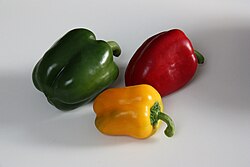 Green, yellow, and red bell peppers | |
| Species | Capsicum annuum |
| Heat | None |
| Scoville scale | 0 SHU |
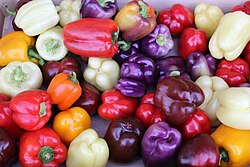
The bell pepper (also known as sweet pepper, paprika, pepper, capsicum /ˈkæpsɪkəm/1 or, in some parts of the U.S. Midwest, mango2) is the fruit of plants in the Grossum Group of the species Capsicum annuum.34 Cultivars of the plant produce fruits in different colors, including red, yellow, orange, green, white, and purple. Bell peppers are sometimes grouped with less pungent chili varieties as "sweet peppers". While they are botanically fruits—classified as berries—they are commonly used as a vegetable ingredient or side dish. Other varieties of the genus Capsicum are categorized as chili peppers when they are cultivated for their pungency, including some varieties of Capsicum annuum.
Peppers are native to Mexico, Central America, the Caribbean and northern South America. Pepper seeds were imported to Spain in 1493 and then spread through Europe and Asia. Preferred growing conditions for bell peppers include warm, moist soil in a temperature range of 21 to 29 °C (70 to 84 °F).5
History
Peppers are native to Mexico, Central America, the Caribbean and northern South America. Capsicum originated in Bolivia and Brazil, being transported to Mesoamerica and the Caribbean before the arrival of Europeans. In Mesoamerica, it was domesticated and C. annuum became the parent to the cayenne, bell, jalapeno, and tabasco peppers.
Pepper seeds were spread all through the globe; Spain by 1493, the East Indies by 1540, and India by 1542, where they became staples for many cuisines and cultures.6 Peppers are one of the oldest domesticated crops based on findings in caves in Mexico, Peru, and Ecuador, suggesting that the species was being used around 7,000 years ago.7 The Spanish introduced peppers to Europe, but the Portuguese played the primary role in their spread to Africa, India, and Southeast Asia.8
Nomenclature

The word pepper is derived from the Sanskrit word rippali meaning "long pepper." As it was traded, the Ancient Greeks called it πέπερι or péperi, and then it entered latin as piper. That latin word was borrowed from Germanic languages and in Old English became piper, before evolving into peper.9 The name Capsicum can be tied to both Greek and Latin. The Greek word kapto meaning to bite, and the Latin word capsa means box.10 An early use of the term bell pepper was in the year 1683.11 The name pepper was applied in Europe to all known spices with a hot and pungent taste and was therefore extended to genus Capsicum when it was introduced from the Americas.
Red, yellow, and green bell peppers are sometimes packaged and sold together in grocery stores under names like "tricolor" or "stoplight mix".12
Colors
The most common colors of bell peppers are green, yellow, orange and red. Other colors include brown, white, lavender, and dark purple, depending on the variety. Most typically, unripe fruits are green or, less commonly, pale yellow or purple. Red bell peppers are simply ripened green peppers,13 although the 'Permagreen' variety maintains its green color even when fully ripe. Therefore, mixed colored peppers also exist during parts of the ripening process.14
| Nutritional value per 100 g (3.5 oz) | |||||||||||||||||||||||||||||||||||||||||||||||||||||
|---|---|---|---|---|---|---|---|---|---|---|---|---|---|---|---|---|---|---|---|---|---|---|---|---|---|---|---|---|---|---|---|---|---|---|---|---|---|---|---|---|---|---|---|---|---|---|---|---|---|---|---|---|---|
| Energy | 110 kJ (26 kcal) | ||||||||||||||||||||||||||||||||||||||||||||||||||||
6.65 g | |||||||||||||||||||||||||||||||||||||||||||||||||||||
| Sugars | 2.4 g | ||||||||||||||||||||||||||||||||||||||||||||||||||||
| Dietary fiber | 1.8 g | ||||||||||||||||||||||||||||||||||||||||||||||||||||
0.13 g | |||||||||||||||||||||||||||||||||||||||||||||||||||||
0.9 g | |||||||||||||||||||||||||||||||||||||||||||||||||||||
| |||||||||||||||||||||||||||||||||||||||||||||||||||||
| Other constituents | Quantity | ||||||||||||||||||||||||||||||||||||||||||||||||||||
| Water | 92 g | ||||||||||||||||||||||||||||||||||||||||||||||||||||
| †Percentages estimated using US recommendations for adults,15 except for potassium, which is estimated based on expert recommendation from the National Academies.16 | |||||||||||||||||||||||||||||||||||||||||||||||||||||
Nutrition
A raw red bell pepper is 92% water, 7% carbohydrates, 1% protein, and contains negligible fat (table). A 100-gram (3+1⁄2-ounce) reference amount supplies 26 calories of food energy, and is a rich source of vitamin C – containing 158% of the Daily Value (DV) – with moderate contents of vitamin A, vitamin B6, riboflavin, folate, and vitamin E (11–18% DV, table). A red bell pepper supplies more vitamin C and vitamin A content than a green bell pepper.1718
Uses
Like the tomato, bell peppers are botanical fruits and culinary vegetables. Pieces of bell pepper are commonly used in garden salads and as toppings on pizza. There are many varieties of stuffed peppers prepared using hollowed or halved bell peppers. Bell peppers (and other cultivars of C. annuum) may be used in the production of the spice paprika.
Production
In 2024, world production of raw peppers was 933,415 tonnes, led by Vietnam with 262,230 tonnes, India with 126,038 tonnes, and Brazil with 124,925 tonnes.19
References
References
- Wells, John C. (2008), Longman Pronunciation Dictionary (3rd ed.), Longman, p. 123, ISBN 9781405881180
- Rice, Briana. "Why do some people in Cincinnati call green peppers 'mangoes'?". The Cincinnati Enquirer. USA TODAY Co., Inc. Retrieved 23 October 2025.
- "Capsicum annuum (bell pepper)". CABI. 28 November 2017. Retrieved 15 March 2018.
- "Capsicum annuum (Grossum Group) (Bell Pepper, Red pepper, Sweet Pepper) | North Carolina Extension Gardener Plant Toolbox". plants.ces.ncsu.edu. Retrieved 22 March 2020.
- "Growing Peppers: The Important Facts". GardenersGardening.com. Archived from the original on 27 January 2013. Retrieved 10 January 2013.
- Nunn, Nathan; Qian, Nancy (2010). "The Columbian Exchange: A History of Disease, Food, and Ideas". Journal of Economic Perspectives. 24 (2): 171. doi:10.1257/jep.24.2.163. ISSN 0895-3309.
- Bosland, Paul (1 August 199). "Chiles: A gift from a Fiery God". HortScience. 34 (5): 809–11. doi:10.21273/HORTSCI.34.5.809.
- Tripodi, Pasquale; Rabanus-Wallace, Mark Timothy; Barchi, Lorenzo; et al. (24 August 2021). "Global range expansion history of pepper (Capsicum spp.) revealed by over 10,000 genebank accessions". Proceedings of the National Academy of Sciences. 118 (34): 6. doi:10.1073/pnas.2104315118. PMC 8403938. PMID 34400501.
- "Pepper - Etymology, Origin & Meaning". etymonline. Retrieved 23 April 2026.
- "Capsicum". Wordorigins.org. 31 July 2023. Retrieved 4 May 2026.
- Oxford English Dictionary. "bell pepper noun". University of Oxford.
OED's earliest evidence for bell pepper is from 1683, in the writing of J. Poyntz.
- DiMartino, Christina (16 February 2004). "Pero Packing & Sales is preparing to double the size of its facility by 2005". Produce News. Vol. 107, no. 1–12. p. 26.
- "Vegetable of the Month: Bell Pepper". CDC Fruit & Vegetable of the Month. Archived from the original on 3 January 2003. Retrieved 9 April 2012.
- "Capsicum annuum. Encyclopedia Britannica".
- United States Food and Drug Administration (2024). "Daily Value on the Nutrition and Supplement Facts Labels". FDA. Archived from the original on 27 March 2024. Retrieved 28 March 2024.
- "TABLE 4-7 Comparison of Potassium Adequate Intakes Established in This Report to Potassium Adequate Intakes Established in the 2005 DRI Report". p. 120. In: Stallings, Virginia A.; Harrison, Meghan; Oria, Maria, eds. (2019). "Potassium: Dietary Reference Intakes for Adequacy". Dietary Reference Intakes for Sodium and Potassium. pp. 101–124. doi:10.17226/25353. ISBN 978-0-309-48834-1. PMID 30844154. NCBI NBK545428.
- "Nutrient content of a raw green bell pepper per 100 g". FoodData Central, US Department of Agriculture. 28 April 2022. Retrieved 23 April 2026.
- University of the District of Columbia. "Peppers" (PDF). Center for Nutrition, Diet and Health. Retrieved 13 March 2013.
- "Raw pepper production in 2024, Crops/Regions/World list/Production Quantity/Year (pick lists)". UN Food and Agriculture Organization, Corporate Statistical Database (FAOSTAT). 2026. Retrieved 4 May 2026.