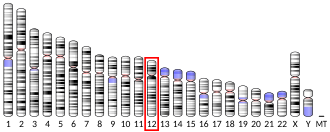
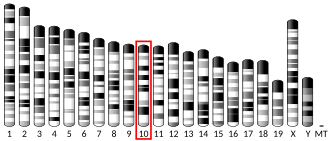
Bardet–Biedl syndrome 10, also known as BBS10 is a human gene.5
Function
The Bardet-Biedl syndrome 10 protein has distant sequence homology to type II chaperonins. As a molecular chaperone, this protein may affect the folding or stability of other ciliary or basal body proteins. Inhibition of this protein's expression impairs ciliogenesis in preadipocytes.67
Clinical significance
Mutations in this gene are associated with the Bardet–Biedl syndrome.5
References
References
- GRCh38: Ensembl release 89: ENSG00000179941 – Ensembl, May 2017
- GRCm38: Ensembl release 89: ENSMUSG00000035759 – Ensembl, May 2017
- "Human PubMed Reference:". National Center for Biotechnology Information, U.S. National Library of Medicine.
- "Mouse PubMed Reference:". National Center for Biotechnology Information, U.S. National Library of Medicine.
- Stoetzel C, Laurier V, Davis EE, Muller J, Rix S, Badano JL, et al. (May 2006). "BBS10 encodes a vertebrate-specific chaperonin-like protein and is a major BBS locus". Nature Genetics. 38 (5): 521–524. doi:10.1038/ng1771. PMID 16582908. S2CID 32269156.
- "Entrez Gene: Bardet-Biedl syndrome 10".
- Maruyama K, Sugano S (January 1994). "Oligo-capping: a simple method to replace the cap structure of eukaryotic mRNAs with oligoribonucleotides". Gene. 138 (1–2): 171–174. doi:10.1016/0378-1119(94)90802-8. PMID 8125298.
Further reading
Further reading
- Stoetzel C, Muller J, Laurier V, Davis EE, Zaghloul NA, Vicaire S, et al. (January 2007). "Identification of a novel BBS gene (BBS12) highlights the major role of a vertebrate-specific branch of chaperonin-related proteins in Bardet-Biedl syndrome". American Journal of Human Genetics. 80 (1): 1–11. doi:10.1086/510256. PMC 1785304. PMID 17160889.
- Gerth C, Zawadzki RJ, Werner JS, Héon E (2008). "Retinal morphology in patients with BBS1 and BBS10 related Bardet-Biedl Syndrome evaluated by Fourier-domain optical coherence tomography". Vision Research. 48 (3): 392–399. doi:10.1016/j.visres.2007.08.024. PMC 2584151. PMID 17980398.
- White DR, Ganesh A, Nishimura D, Rattenberry E, Ahmed S, Smith UM, et al. (February 2007). "Autozygosity mapping of Bardet-Biedl syndrome to 12q21.2 and confirmation of FLJ23560 as BBS10". European Journal of Human Genetics. 15 (2): 173–178. doi:10.1038/sj.ejhg.5201736. PMID 17106446.
- Dollfus H, Muller J, Stoetzel C, Laurier V, Bonneau D, Mégarbané A, et al. (November 2006). "[Bardet-Biedl syndrome: a unique family for a major gene (BBS10)]". Medecine Sciences. 22 (11): 901–904. doi:10.1051/medsci/20062211901. PMID 17101080.
- Marion V, Stoetzel C, Schlicht D, Messaddeq N, Koch M, Flori E, et al. (February 2009). "Transient ciliogenesis involving Bardet-Biedl syndrome proteins is a fundamental characteristic of adipogenic differentiation". Proceedings of the National Academy of Sciences of the United States of America. 106 (6): 1820–1825. Bibcode:2009PNAS..106.1820M. doi:10.1073/pnas.0812518106. PMC 2635307. PMID 19190184.
- Laurier V, Stoetzel C, Muller J, Thibault C, Corbani S, Jalkh N, et al. (November 2006). "Pitfalls of homozygosity mapping: an extended consanguineous Bardet-Biedl syndrome family with two mutant genes (BBS2, BBS10), three mutations, but no triallelism". European Journal of Human Genetics. 14 (11): 1195–1203. doi:10.1038/sj.ejhg.5201688. PMID 16823392.
- Suzuki Y, Yoshitomo-Nakagawa K, Maruyama K, Suyama A, Sugano S (October 1997). "Construction and characterization of a full length-enriched and a 5'-end-enriched cDNA library". Gene. 200 (1–2): 149–156. doi:10.1016/S0378-1119(97)00411-3. PMID 9373149.
External links
External links