 | |
| Course | Dessert |
|---|---|
| Place of origin | Spain |
| Region or state | Basque Country |
| Created by | Santiago Rivera |
| Invented | 1988 |
| Main ingredients | Cream cheese, sugar, eggs, cream, flour |
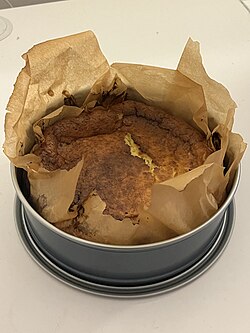
Basque cheesecake, also known as cheesecake San Sebastian or burnt Basque cheesecake (Basque: euskal gazta-tarta, Spanish: tarta de queso vasca), is a crustless cheesecake originating from the Basque Country, Spain. It is characterized by a caramelized surface and a creamy, custard-like interior, achieved by baking at high temperatures.
In Spain, basque cheesecake is associated with San Sebastián and referred to as tarta de queso de La Viña or a San Sebastián–style cheesecake, while the "burnt" descriptor is less commonly used locally.1
History
Basque cheesecake is typically baked at high temperatures, resulting in a caramelized surface and a creamy interior.23
Basque cheesecake was created in 1988 by Santiago Rivera at his pintxo bar La Viña in San Sebastián, a coastal city in the Basque Country, Spain.45 It achieved popularity online during the 2010s. By 2021, it had become widely shared on social media platforms such as Instagram and was described as "ubiquitous" in the United Kingdom.5 The New York Times listed it among its food trend predictions for 2021.6
Prior to the international popularity of the La Viña version, other cheesecakes had gained recognition within the Basque culinary scene. The cheesecake served at the restaurant Zuberoa in Oiartzun, developed by the chef Hilario Arbelaitz, became particularly influential. This version typically incorporated blue cheese alongside other dairy products and was often prepared with a crust, differing in composition and structure from the later La Viña-style cheesecake.78
As the La Viña-style cheesecake spread internationally, it became increasingly associated with a crustless format and a dark, caramelized surface. Spanish food writers have noted that this framing reflects an internationalized interpretation rather than a fixed or uniformly applied characteristic in its place of origin, where browning levels may vary.9
References
References
- "La tarta de queso vasca se ha hecho famosa en todo el mundo, pero de vasca tiene poco". Directo al Paladar (in Spanish). Retrieved 10 January 2026.
- Cloake, Felicity (1 December 2021). "How to make the perfect Basque cheesecake – recipe". The Guardian. Retrieved 10 September 2022.
- Buckley, Marti (1 September 2023). "The story behind Basque burnt cheesecake". National Geographic. Retrieved 12 August 2025.
- Buckley, Marti (4 October 2023). "The true story behind the burnt Basque cheesecake". Condé Nast Traveller. Retrieved 24 January 2025.
- Turnbull, Tony (17 November 2023). "Basque cheesecake: the pudding that broke the internet". The Times. Retrieved 17 November 2023.
- Severson, Kim (22 December 2020). "How Will We Eat in 2021? 11 Predictions to Chew On". The New York Times. Retrieved 12 August 2025.
- "10 tartas de queso favoritas de Pérez y Capel". Gastroactitud (in Spanish). Retrieved 10 January 2026.
- "¿Cuál es la tarta de queso favorita de los cocineros?". El Periódico (in Spanish). Retrieved 10 January 2026.
- "La tarta de queso vasca se ha hecho famosa en todo el mundo, pero de vasca tiene poco". Directo al Paladar (in Spanish). Retrieved 10 January 2026.
External links
External links
- La Viña – official website
- Horowitz, Jason (May 27, 2026), He Invented the Basque Cheesecake. He Prefers Chocolate., Global profile on Santiago Rivera in The New York Times.