Baroque Instruments (c. 1600–1750) are Musical instruments used in Baroque music. They were partly used already before, partly are still used today, but with no technology.1 The movement to perform music in a historically informed way (HIP), trying to recreate the sound of the period, led to the use of historic instruments of the period and to the reconstruction of instruments.2
The following table lists instruments, classified as brass, woodwinds, strings, keyboard, and basso continuo. Many instruments have an Italian or French name which is used as a common name also in English. The use of instruments by composers is shown in examples mostly by Johann Sebastian Bach.
Table of instruments
| Common name | Baroque era name | Type | Example of use by Bach | Notes | |
|---|---|---|---|---|---|
| trumpet(s) | tromba
trombe (pl) |
it | brass, trumpet | Cantata No. 172 | see also Baroque trumpet |
| tromba da tirarsi | tromba da tirarsi
trombe da tirarsi (pl) |
it | brass, trumpet | ||
| high trumpet | clarion
clarini (pl) |
it | brass, trumpet | ||
| trombone(s) | trombone
tromboni (pl) |
it | brass, trombone | ||
| sackbut | sackbut | it | brass, trombone | ||
| horn(s) | corno
corni (pl) |
it | brass, horn | ||
| corno da caccia | corno da caccia
corni da caccia (pl) |
it | brass, horn | ||
| corno da tirarsi | corno da tirarsi
corni da tirarsi (pl) |
it | brass, horn | ||
| lituus(es) | lituo
litui (pl) |
it | brass, lituus | ||
| serpent(s) | serpent
serpentii (pl) |
it | brass | ||
| timpani | timpani | it | percussion | Christmas Oratorio | used with trumpets |
| recorder(s) | flauto (dolce)
flauti (dolci) pl |
it | woodwind, recorder | Cantata No. 39 | |
| descant recorder | flauto piccolo
flauti piccoli (pl) |
it | woodwind, recorder | Cantatas No. 96 and No. 103 | |
| flute(s) | flauto traverso
flauti traversi (pl) |
it | woodwind, Wooden, Single Key | ||
| clarinet(s) | clarinette
clarinetti (pl) |
it | woodwind, clarinet | ||
| chalumeau | chalumeau
chalumeax (pl) |
it | woodwind, clarinet | ||
| oboe(s) | oboe
oboi (pl) |
it | woodwind, oboe | ||
| oboe(s) d'amore | oboe d'amore
oboi d'amore (pl) |
it | woodwind, oboe | ||
| tenor oboe | taille(s) | fr | woodwind, oboe | ||
| oboe(s) da caccia | oboe da caccia
oboi da caccia (pl) |
it | woodwind, oboe | ||
| bassoon(s) | fagotto
fagotti (pl) |
it | woodwind, bassoon | ||
| contrabassoon(s) | contre-fagotto
contre-fagotti (pl) |
it | woodwind, bassoon | ||
| violin(s) | violino
violini (pl) |
it | string, Baroque violin | ||
| violin piccolo | violino piccolo
violini piccoli (pl) |
it | string, violin | Brandenburg Concerto No. 1 | main violin |
| viola(s) | viola
viole (pl) |
it | string, viola | ||
| cello (celli) | violoncello
violoncelli (pl) |
it | string, cello | ||
| violoncello piccolo | violoncello piccolo violoncelli piccoli (pl) | it | string, cello | ||
| viola d'amore | viola d'amore
viole d'amore (pl) |
it | string, viola | ||
| viola da gamba | viola da gamba
viole da gamba (pl) |
it | string, viol | St John Passion Aria "Es ist vollbracht!" | Basso continuo, but sometimes solo |
| violetta | violetta
violette (pl) |
it | string, viola | ||
| violone | violone
violono (pl) |
it | string, viol | ||
| organ(s) | organo
organi (pl) |
it | keyboard, organ | ||
| carillon(s) | carillon | it | key, pitched percussion | ||
| harpsichord(s) | cembalo
cembali (pl) |
it | keyboard, harpsichord | ||
| lute(s) | liuto
liuti (pl) |
it | plucked string, lute | ||
| theorbo(es) | chitarone
chitaroni (pl) |
it | plucked string, lute | ||
| continuo | basso continuo | it | bass group | ||
| clavichord3 | Manicordo | it | Keyboard, clavichord |
Baroque instrumentation
The typical orchestra of the Baroque period was based on string instruments violin, viola, cello, and continuo.4 A continuous bass was the rule in Baroque music; its absence is worth mentioning and has a reason, such as describing fragility.
The specific character of a movement is often defined by wind instruments, such as oboe, flauto traverso, recorder, natural trumpet, natural horn, trombone, bassoon, and timpani.
For Bach, some instruments carried symbolic meaning such as a trumpet, the royal instrument of the Baroque, for secular and divine majesty: three trumpets for the Trinity. In arias, Bach often used obbligato instruments, which correspond with the singer as an equal partner. In his early compositions he used instruments that had become old-fashioned, such as viola da gamba and violone.
Continuo
The basso continuo, or short: continuo, the typical bass group of the period, consisted of a group of instruments, depending upon the other instruments playing and the performance location. The continuous bass is played by a group of instruments that accompany the soloists or melodic voices while playing the bassline and the implied harmonies. A group may consist of cello, double bass (an octave lower) and organ. A bassoon is typically playing when other wind instruments are called for. While an organ will be played in church, a harpsichord will be used in secular surroundings.
Brass
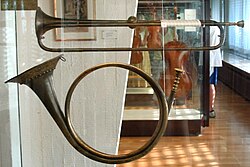
The trumpet is the royal instrument of the Baroque, representing secular and divine majesty. Three trumpets symbolize the Trinity in an aria of Bach's BWV 172, addressing the "Heiligste Dreifaltigkeit" (Most holy Trinity), where the bass voice is accompanied only by three trumpets and timpani. Natural horn was also a prominent instrument during the baroque era. Both natural trumpet and natural horn were not originally built with valves (explains the term "natural"). These natural instruments were limited to certain notes, keys, and octaves they could play. 5
Woodwinds
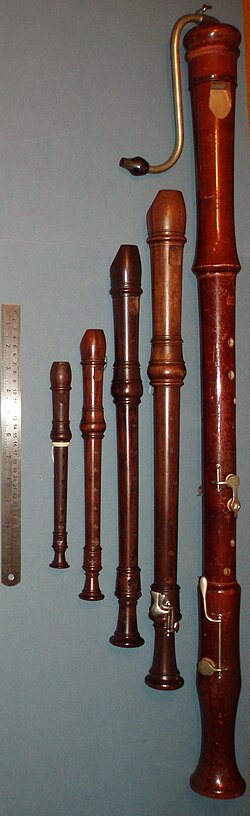
Recorders (flauti dolci) are sometimes used to express humility or poverty, such as in Bach's cantata Brich dem Hungrigen dein Brot, BWV 39.
Flauto piccolo
Bach used a flauto piccolo (what flauto?), a high recorder in F ("descant recorder" or "sopranino recorder"), to express for example the sparkling of the morning star in Herr Christ, der einge Gottessohn, BWV 96.
References
References
- From Renaissance to Baroque : change in instruments and instrumental music in the seventeenth century : proceedings of the National Early Music Association Conference held, in association with the Department of Music, University of York and the York Early Music Festival, at the University College of Ripon and York St. John, York, 2-4 July 1999. Jonathan P. Wainwright, Peter Holman, University of York. Department of Music, York Musical Festival. London: Routledge. 2016. ISBN 978-1-351-56626-1. OCLC 993761721.
{{cite book}}: CS1 maint: others (link) - "Queue-it". inline.carnegiehall.org. Retrieved 2026-05-05.
- "Clavichord (Baroque)".
- Donington, Robert (1973). "The Choice of Instruments in Baroque Music". Early Music. 1 (3): 131–138. doi:10.1093/earlyj/1.1.131. ISSN 0306-1078. JSTOR 3126060.
- Desimone, Alison. "Period Instruments: A Short Guide".