| Backshunt | |
|---|---|
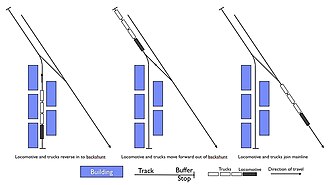 An example of a backshunt from an industrial siding on to a mainline |
A backshunt is a railway track configuration in situations where a change in (almost opposite) direction is required and a traditional curve cannot fit.1
There are two main applications of a backshunt.
- To climb or drop a steep incline using a zig zag2
- To change direction on to a parallel track, often used in industrial sidings.3
Example Backshunts
- Part of the old Cleator and Workington Junction Railway was maintained in Rowrah as a backshunt from Rowrah Head Quarry on to the Whitehaven, Cleator and Egremont Railway.4
References
References
- Graham Hutchins (2011). Last Train to Paradise: Journeys from the Golden Age of New Zealand Railways. Exisle Publishing. p. 72. ISBN 9781927147290.
- Crespi, A.J. (1900). "The Birmingham New Water Works". The New Century Review. 8 (47): 358–366.
- R. D. Singh (2005). Principles and Practices of Modern Coal Mining. New Age Publishing. p. 647. ISBN 9788122409741.
- W. McGowan Gradon (2016). The Track Of The Ironmasters - A History Of The Cleator And Workington Junction Railway. Read Books. p. 23. ISBN 9781473353190.