| Augmented hexagonal prism | |
|---|---|
 | |
| Type | Johnson J53 – J54 – J55 |
| Faces | 4 triangles 5 squares 2 hexagons |
| Edges | 22 |
| Vertices | 13 |
| Vertex configuration | 2×4(42.6) 1(34) 4(32.4.6) |
| Symmetry group | C2v |
| Properties | convex |
| Net | |
 | |
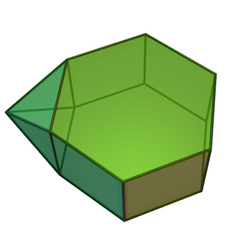
In geometry, the augmented hexagonal prism is one of the Johnson solids (J54). As the name suggests, it can be constructed by augmenting a hexagonal prism by attaching a square pyramid (J1) to one of its equatorial faces. When two or three such pyramids are attached, the result may be a parabiaugmented hexagonal prism (J55), a metabiaugmented hexagonal prism (J56), or a triaugmented hexagonal prism (J57).

Construction
The augmented hexagonal prism is constructed by attaching one equilateral square pyramid onto the square face of a hexagonal prism, a process known as augmentation.1 This construction involves the removal of the prism square face and replacing it with the square pyramid, so that there are eleven faces: four equilateral triangles, five squares, and two regular hexagons.2 A convex polyhedron in which all of the faces are regular is a Johnson solid, and the augmented hexagonal prism is among them, enumerated as .3 Relatedly, two or three equilateral square pyramids attaching onto more square faces of the prism give more different Johnson solids; these are the parabiaugmented hexagonal prism , the metabiaugmented hexagonal prism , and the triaugmented hexagonal prism .1
Properties
An augmented hexagonal prism with edge length has surface area2 the sum of two hexagons, four equilateral triangles, and five squares area. Its volume2 can be obtained by slicing into one equilateral square pyramid and one hexagonal prism, and adding their volume up.2
It has an axis of symmetry passing through the apex of a square pyramid and the centroid of a prism square face, rotated in a half and full-turn angle. Its dihedral angle can be obtained by calculating the angle of a square pyramid and a hexagonal prism in the following:4
- The dihedral angle of an augmented hexagonal prism between two adjacent triangles is the dihedral angle of an equilateral square pyramid,
- The dihedral angle of an augmented hexagonal prism between two adjacent squares is the interior of a regular hexagon,
- The dihedral angle of an augmented hexagonal prism between square-to-hexagon is the dihedral angle of a hexagonal prism between its base and its lateral face,
- The dihedral angle of a square pyramid between triangle (its lateral face) and square (its base) is . Therefore, the dihedral angle of an augmented hexagonal prism between square-to-triangle and between triangle-to-hexagon, on the edge in which the square pyramid and hexagonal prism are attached, are .
References
References
- Rajwade, A. R. (2001). Convex Polyhedra with Regularity Conditions and Hilbert's Third Problem. Texts and Readings in Mathematics. Hindustan Book Agency. p. 84–89. doi:10.1007/978-93-86279-06-4. ISBN 978-93-86279-06-4.
- Berman, Martin (1971). "Regular-faced convex polyhedra". Journal of the Franklin Institute. 291 (5): 329–352. doi:10.1016/0016-0032(71)90071-8. MR 0290245.
- Francis, Darryl (August 2013). "Johnson solids & their acronyms". Word Ways. 46 (3): 177.
- Johnson, Norman W. (1966). "Convex polyhedra with regular faces". Canadian Journal of Mathematics. 18: 169–200. doi:10.4153/cjm-1966-021-8. MR 0185507. S2CID 122006114. Zbl 0132.14603.