| Audovera | |
|---|---|
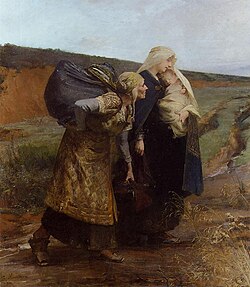 Painting of Audovera's repudiation by Albert Maignan. | |
| Queen consort of Neustria | |
| Tenure | 561 – 567 |
| Born | c. 533 |
| Died | 580 Le Mans |
| Spouse | Chilperic I |
| Issue | Theudebert of Soissons Merovech Clovis Childesinda Basina |
Audovera (c. 533–580) was the first wife or mistress of Chilperic I, king of Neustria.12
They had five children.
- Theudebert, killed in battle in 575 by Guntram Boso during the interminable conflict between Chilperic and his brothers.
- Merovech of Soissons, married the widow Brunhilda, becoming his father's enemy. Killed by his servants on his own orders in 578.
- Clovis of Soissons, assassinated by Fredegund in 580.3
- Childesinda, mentioned but once in the Liber Historiae Francorum as the infant whose botched baptism led to Audovera's dismissal. Committed to the same nunnery as her mother.
- Basina, nun, banished to a convent in 580.4 She later led a revolt in the abbey of Poitiers in 589.53
Some time before 567, Audovera and Fredegund - then a servant of Audovera, but later to become another wife of Chilperic674 - prepared for the baptism of Childesinda while Chilperic was away. Fredegund learnt that it was forbidden for a mother to receive her own child in her arms following a baptism, due to a canon law forbidding marriage between parents and godparents.8 Fredegund arranged the events of the baptism such that Audovera unknowingly broke this taboo.910 On Chilperic's return, Fredegund informed him of what Audovera had done. Chilperic committed Audovera to a convent in a rage. Fredegund later had her murdered in 580 to coincide with the assassination of Clovis and the exile of Basina.
References
References
- Léglu, Catherine (March 2017). "The Vida of Queen Fredegund in Tote listoire de France : Vernacular Translation and Genre in Thirteenth-Century French and Occitan Literature". Nottingham French Studies. 56 (1): 98–112. doi:10.3366/nfs.2017.0170. ISSN 0029-4586.
- Stafford, Pauline (January 1978). "Sons and Mothers: Family Politics in the Early Middle Ages". Studies in Church History Subsidia. 1: 79–100. doi:10.1017/S014304590000034X. ISSN 0143-0459.
- Singer, Rachel (May 2022). "Gregory's forgotten rebel: the portrayal of Basina by Gregory of Tours and its implications". Early Medieval Europe. 30 (2): 185–208. doi:10.1111/emed.12534. ISSN 0963-9462.
- Effros, Bonnie; Moreira, Isabel (2020-05-01). The Oxford Handbook of the Merovingian World. Oxford University Press. ISBN 978-0-19-023419-5.
- Effros, Bonnie; Moreira, Isabel (2020-05-01). The Oxford Handbook of the Merovingian World. Oxford University Press. ISBN 978-0-19-023419-5.
- Dailey, E. T. (2015-01-01), "7 Brunhild and Fredegund, ii: Queens, Politics, and the Writing of History", Queens, Consorts, Concubines: Gregory of Tours and Women of the Merovingian Elite, Brill, pp. 141–160, ISBN 978-90-04-29466-0, retrieved 2024-01-31
{{citation}}: CS1 maint: work parameter with ISBN (link) - Wemple, Suzanne Fonay (2015-12-16). Women in Frankish Society: Marriage and the Cloister, 5 to 9. University of Pennsylvania Press. ISBN 978-1-5128-2133-8.
- Jussen, Bernhard (2000). Spiritual Kinship as Social Practice: Godparenthood and Adoption in the Early Middle Ages. University of Delaware Press. ISBN 978-0-87413-632-6.
- Wood, Ian N. (1998). Franks and Alamanni in the Merovingian Period: An Ethnographic Perspective. Boydell & Brewer. ISBN 978-0-85115-723-8.
- Burgas, Gregory (2000). Legislating Against Reality : The Political Conflicts and Context of the Seventh-Century Merovingian Church Councils (Thesis). Portland State University Library. doi:10.15760/etd.3596.