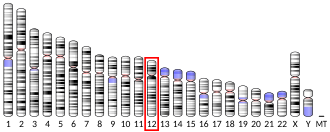
| ATN1 |
|---|
|
| Identifiers |
|---|
| Aliases | ATN1, B37, D12S755E, DRPLA, HRS, NOD, atrophin 1, CHEDDA |
|---|
| External IDs | OMIM: 607462; MGI: 104725; HomoloGene: 1461; GeneCards: ATN1; OMA:ATN1 - orthologs |
|---|
|
| Gene location (Mouse) |
|---|
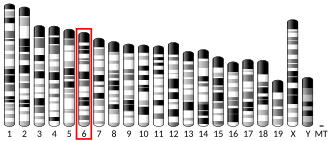 | | Chr. | Chromosome 6 (mouse)2 |
|---|
| | Band | 6 F2|6 59.17 cM | Start | 124,719,507 bp2 |
|---|
| End | 124,733,487 bp2 |
|---|
|
| RNA expression pattern |
|---|
| Bgee | | Human | Mouse (ortholog) |
|---|
| Top expressed in | - right hemisphere of cerebellum
- anterior pituitary
- left ovary
- right uterine tube
- right ovary
- right lobe of thyroid gland
- left lobe of thyroid gland
- body of uterus
- gastric mucosa
- canal of the cervix
|
| | Top expressed in | - neural layer of retina
- primary visual cortex
- superior frontal gyrus
- genital tubercle
- dentate gyrus of hippocampal formation granule cell
- cerebellar cortex
- muscle of thigh
- lip
- ventricular zone
- tail of embryo
|
| | More reference expression data |
|
|---|
| BioGPS | |
|---|
|
|
|
| Wikidata |
|
Atrophin-1 is a protein that in humans is encoded by the ATN1 gene.5 The encoded protein includes a serine repeat and a region of alternating acidic and basic amino acids, as well as the variable glutamine repeat.6 The function of Atrophin-1 has not yet been determined.7 There is evidence provided by studies of Atrophin-1 in animals to suggest it acts as a transcriptional co-repressor.7 Atrophin-1 can be found in the nuclear and cytoplasmic compartments of neurons.7 It is expressed in nervous tissue.8
Function
The function of Atrophin-1 has not been defined yet. It is widely hypothesized that Atrophin-1 functions as a transcriptional co-repressor.9 A transcriptional co-repressor is a protein that indirectly suppresses the activity of specific genes by interacting with DNA-binding proteins.9
Clinical significance
The ATN1 gene has a segment of DNA called the CAG trinucleotide repeat.9 It is made up of cytosine, adenine, and guanine.9 The number of CAG repeats in the ATN1 gene in a healthy person will range from six to thirty-five repeats.9 CAG repeats that exceed thirty-five can cause a gain-of-function mutation in ATN1.10 Studies have supported the idea that mutated Atrophin-1 gathers in neurons and disrupts cell function.11 The sequence of the ATN1 gene contains a nuclear localizing signal (NLS) and a nuclear export signal (NES).11 It has been shown that a mutation of the NES in ATN1 can change where ATN1 localizes, and can cause aggregation to occur in the nucleus.11 This can lead to an increase in cellular toxicity.11
Mutations in ATN1 are associated with a form of trinucleotide repeat disorder known as "dentatorubral-pallidoluysian atrophy" or "dentatorubropallidoluysian atrophy". Dentatorubral-pallidoluysian atrophy (DRPLA) is a rare neurodegenerative disorder characterized by cerebellar ataxia, myoclonic epilepsy, choreoathetosis, and dementia.5 The disorder is related to the expansion of a trinucleotide repeat within this gene.5 In patients with DRPLA, truncated ATN1 has been observed forming intranuclear aggregates that cause cell death.11 The symptoms of this disorder can be credited to the significant reduction of brain and spinal tissue observed in those afflicted with DRPLA.12 There are both juvenile-onset and late adult-onset variants of DRPLA, which show differing degrees of severity of specific symptoms.12
Interactions
ATN1 has been shown to interact with:
References
References
- GRCh38: Ensembl release 89: ENSG00000111676 – Ensembl, May 2017
- GRCm38: Ensembl release 89: ENSMUSG00000004263 – Ensembl, May 2017
- "Human PubMed Reference:". National Center for Biotechnology Information, U.S. National Library of Medicine.
- "Mouse PubMed Reference:". National Center for Biotechnology Information, U.S. National Library of Medicine.
- "ATN1 atrophin 1 [Homo sapiens (human)] - Gene - NCBI". www.ncbi.nlm.nih.gov. Retrieved 2017-03-12.
- "Entrez Gene: ATN1 atrophin 1".
- Wood JD, Nucifora FC, Duan K, Zhang C, Wang J, Kim Y, Schilling G, Sacchi N, Liu JM, Ross CA (September 2000). "Atrophin-1, the dentato-rubral and pallido-luysian atrophy gene product, interacts with ETO/MTG8 in the nuclear matrix and represses transcription". The Journal of Cell Biology. 150 (5): 939–48. doi:10.1083/jcb.150.5.939. PMC 2175251. PMID 10973986.
- Shen Y, Peterson AS (February 2009). "Atrophins' emerging roles in development and neurodegenerative disease". Cellular and Molecular Life Sciences. 66 (3): 437–46. doi:10.1007/s00018-008-8403-9. PMC 11131516. PMID 18953689. S2CID 11380927.
- "ATN1 gene". Genetics Home Reference. Retrieved 2017-02-21.
- Shen Y, Lee G, Choe Y, Zoltewicz JS, Peterson AS (February 2007). "Functional architecture of atrophins". The Journal of Biological Chemistry. 282 (7): 5037–44. doi:10.1074/jbc.M610274200. PMID 17150957.
- Suzuki Y, Yazawa I (April 2011). "Pathological accumulation of atrophin-1 in dentatorubralpallidoluysian atrophy". International Journal of Clinical and Experimental Pathology. 4 (4): 378–84. PMC 3093063. PMID 21577324.
- "Dentatorubral-Pallidoluysian Atrophy, DRPLA". themedicalbiochemistrypage.org. Retrieved 2017-02-21.
- Okamura-Oho Y, Miyashita T, Ohmi K, Yamada M (June 1999). "Dentatorubral-pallidoluysian atrophy protein interacts through a proline-rich region near polyglutamine with the SH3 domain of an insulin receptor tyrosine kinase substrate". Human Molecular Genetics. 8 (6): 947–57. doi:10.1093/hmg/8.6.947. PMID 10332026.
- Wood JD, Yuan J, Margolis RL, Colomer V, Duan K, Kushi J, Kaminsky Z, Kleiderlein JJ, Sharp AH, Ross CA (June 1998). "Atrophin-1, the DRPLA gene product, interacts with two families of WW domain-containing proteins". Molecular and Cellular Neurosciences. 11 (3): 149–60. doi:10.1006/mcne.1998.0677. PMID 9647693. S2CID 20003277.
- Yanagisawa H, Bundo M, Miyashita T, Okamura-Oho Y, Tadokoro K, Tokunaga K, Yamada M (May 2000). "Protein binding of a DRPLA family through arginine-glutamic acid dipeptide repeats is enhanced by extended polyglutamine". Human Molecular Genetics. 9 (9): 1433–42. doi:10.1093/hmg/9.9.1433. PMID 10814707.
Further reading
Further reading
- Wang L, Rajan H, Pitman JL, McKeown M, Tsai CC (March 2006). "Histone deacetylase-associating Atrophin proteins are nuclear receptor corepressors". Genes & Development. 20 (5): 525–30. doi:10.1101/gad.1393506. PMC 1410805. PMID 16481466.
- Onodera O, Oyake M, Takano H, Ikeuchi T, Igarashi S, Tsuji S (November 1995). "Molecular cloning of a full-length cDNA for dentatorubral-pallidoluysian atrophy and regional expressions of the expanded alleles in the CNS". American Journal of Human Genetics. 57 (5): 1050–60. PMC 1801383. PMID 7485154.
- Yazawa I, Nukina N, Hashida H, Goto J, Yamada M, Kanazawa I (May 1995). "Abnormal gene product identified in hereditary dentatorubral-pallidoluysian atrophy (DRPLA) brain". Nature Genetics. 10 (1): 99–103. doi:10.1038/ng0595-99. PMID 7647802. S2CID 5850726.
- Nagafuchi S, Yanagisawa H, Ohsaki E, Shirayama T, Tadokoro K, Inoue T, Yamada M (October 1994). "Structure and expression of the gene responsible for the triplet repeat disorder, dentatorubral and pallidoluysian atrophy (DRPLA)". Nature Genetics. 8 (2): 177–82. doi:10.1038/ng1094-177. PMID 7842016. S2CID 2590882.
- Burke JR, Wingfield MS, Lewis KE, Roses AD, Lee JE, Hulette C, Pericak-Vance MA, Vance JM (August 1994). "The Haw River syndrome: dentatorubropallidoluysian atrophy (DRPLA) in an African-American family". Nature Genetics. 7 (4): 521–4. doi:10.1038/ng0894-521. PMID 7951323. S2CID 40759301.
- Nagafuchi S, Yanagisawa H, Sato K, Shirayama T, Ohsaki E, Bundo M, Takeda T, Tadokoro K, Kondo I, Murayama N (January 1994). "Dentatorubral and pallidoluysian atrophy expansion of an unstable CAG trinucleotide on chromosome 12p". Nature Genetics. 6 (1): 14–8. doi:10.1038/ng0194-14. PMID 8136826. S2CID 19708585.
- Koide R, Ikeuchi T, Onodera O, Tanaka H, Igarashi S, Endo K, Takahashi H, Kondo R, Ishikawa A, Hayashi T (January 1994). "Unstable expansion of CAG repeat in hereditary dentatorubral-pallidoluysian atrophy (DRPLA)". Nature Genetics. 6 (1): 9–13. doi:10.1038/ng0194-9. PMID 8136840. S2CID 27241147.
- Li SH, McInnis MG, Margolis RL, Antonarakis SE, Ross CA (June 1993). "Novel triplet repeat containing genes in human brain: cloning, expression, and length polymorphisms". Genomics. 16 (3): 572–9. doi:10.1006/geno.1993.1232. PMID 8325628.
- Ansari-Lari MA, Muzny DM, Lu J, Lu F, Lilley CE, Spanos S, Malley T, Gibbs RA (April 1996). "A gene-rich cluster between the CD4 and triosephosphate isomerase genes at human chromosome 12p13". Genome Research. 6 (4): 314–26. doi:10.1101/gr.6.4.314. PMID 8723724.
- Takano T, Yamanouchi Y, Nagafuchi S, Yamada M (February 1996). "Assignment of the dentatorubral and pallidoluysian atrophy (DRPLA) gene to 12p 13.31 by fluorescence in situ hybridization". Genomics. 32 (1): 171–2. doi:10.1006/geno.1996.0100. PMID 8786114.
- Yanagisawa H, Fujii K, Nagafuchi S, Nakahori Y, Nakagome Y, Akane A, Nakamura M, Sano A, Komure O, Kondo I, Jin DK, Sørensen SA, Potter NT, Young SR, Nakamura K, Nukina N, Nagao Y, Tadokoro K, Okuyama T, Miyashita T, Inoue T, Kanazawa I, Yamada M (March 1996). "A unique origin and multistep process for the generation of expanded DRPLA triplet repeats". Human Molecular Genetics. 5 (3): 373–9. doi:10.1093/hmg/5.3.373. PMID 8852663.
- Margolis RL, Li SH, Young WS, Wagster MV, Stine OC, Kidwai AS, Ashworth RG, Ross CA (March 1996). "DRPLA gene (atrophin-1) sequence and mRNA expression in human brain". Brain Research. Molecular Brain Research. 36 (2): 219–26. doi:10.1016/0169-328X(95)00241-J. PMID 8965642.
- Ansari-Lari MA, Shen Y, Muzny DM, Lee W, Gibbs RA (March 1997). "Large-scale sequencing in human chromosome 12p13: experimental and computational gene structure determination". Genome Research. 7 (3): 268–80. doi:10.1101/gr.7.3.268. PMID 9074930.
- Miyashita T, Okamura-Oho Y, Mito Y, Nagafuchi S, Yamada M (November 1997). "Dentatorubral pallidoluysian atrophy (DRPLA) protein is cleaved by caspase-3 during apoptosis". The Journal of Biological Chemistry. 272 (46): 29238–42. doi:10.1074/jbc.272.46.29238. PMID 9361003.
- Wellington CL, Ellerby LM, Hackam AS, Margolis RL, Trifiro MA, Singaraja R, McCutcheon K, Salvesen GS, Propp SS, Bromm M, Rowland KJ, Zhang T, Rasper D, Roy S, Thornberry N, Pinsky L, Kakizuka A, Ross CA, Nicholson DW, Bredesen DE, Hayden MR (April 1998). "Caspase cleavage of gene products associated with triplet expansion disorders generates truncated fragments containing the polyglutamine tract". The Journal of Biological Chemistry. 273 (15): 9158–67. doi:10.1074/jbc.273.15.9158. PMID 9535906.
- Wood JD, Yuan J, Margolis RL, Colomer V, Duan K, Kushi J, Kaminsky Z, Kleiderlein JJ, Sharp AH, Ross CA (June 1998). "Atrophin-1, the DRPLA gene product, interacts with two families of WW domain-containing proteins". Molecular and Cellular Neurosciences. 11 (3): 149–60. doi:10.1006/mcne.1998.0677. PMID 9647693. S2CID 20003277.
- Hayashi Y, Kakita A, Yamada M, Koide R, Igarashi S, Takano H, Ikeuchi T, Wakabayashi K, Egawa S, Tsuji S, Takahashi H (December 1998). "Hereditary dentatorubral-pallidoluysian atrophy: detection of widespread ubiquitinated neuronal and glial intranuclear inclusions in the brain". Acta Neuropathologica. 96 (6): 547–52. doi:10.1007/s004010050933. PMID 9845282. S2CID 12861680.
- Takiyama Y, Sakoe K, Amaike M, Soutome M, Ogawa T, Nakano I, Nishizawa M (March 1999). "Single sperm analysis of the CAG repeats in the gene for dentatorubral-pallidoluysian atrophy (DRPLA): the instability of the CAG repeats in the DRPLA gene is prominent among the CAG repeat diseases". Human Molecular Genetics. 8 (3): 453–7. doi:10.1093/hmg/8.3.453. PMID 9949204.
- Okamura-Oho Y, Miyashita T, Ohmi K, Yamada M (June 1999). "Dentatorubral-pallidoluysian atrophy protein interacts through a proline-rich region near polyglutamine with the SH3 domain of an insulin receptor tyrosine kinase substrate". Human Molecular Genetics. 8 (6): 947–57. doi:10.1093/hmg/8.6.947. PMID 10332026.
- Dias Neto E, Correa RG, Verjovski-Almeida S, Briones MR, Nagai MA, da Silva W, Zago MA, Bordin S, Costa FF, Goldman GH, Carvalho AF, Matsukuma A, Baia GS, Simpson DH, Brunstein A, de Oliveira PS, Bucher P, Jongeneel CV, O'Hare MJ, Soares F, Brentani RR, Reis LF, de Souza SJ, Simpson AJ (March 2000). "Shotgun sequencing of the human transcriptome with ORF expressed sequence tags". Proceedings of the National Academy of Sciences of the United States of America. 97 (7): 3491–6. Bibcode:2000PNAS...97.3491D. doi:10.1073/pnas.97.7.3491. PMC 16267. PMID 10737800.
- Yanagisawa H, Bundo M, Miyashita T, Okamura-Oho Y, Tadokoro K, Tokunaga K, Yamada M (May 2000). "Protein binding of a DRPLA family through arginine-glutamic acid dipeptide repeats is enhanced by extended polyglutamine". Human Molecular Genetics. 9 (9): 1433–42. doi:10.1093/hmg/9.9.1433. PMID 10814707.
External links
External links