| ARMS2 | |||||||||||||||||||||||||||||||||||||||||||||||||||
|---|---|---|---|---|---|---|---|---|---|---|---|---|---|---|---|---|---|---|---|---|---|---|---|---|---|---|---|---|---|---|---|---|---|---|---|---|---|---|---|---|---|---|---|---|---|---|---|---|---|---|---|
| Identifiers | |||||||||||||||||||||||||||||||||||||||||||||||||||
| Aliases | ARMS2, ARMD8, age-related maculopathy susceptibility 2 | ||||||||||||||||||||||||||||||||||||||||||||||||||
| External IDs | OMIM: 611313; HomoloGene: 88167; GeneCards: ARMS2; OMA:ARMS2 - orthologs | ||||||||||||||||||||||||||||||||||||||||||||||||||
| |||||||||||||||||||||||||||||||||||||||||||||||||||
| |||||||||||||||||||||||||||||||||||||||||||||||||||
| |||||||||||||||||||||||||||||||||||||||||||||||||||
| Wikidata | |||||||||||||||||||||||||||||||||||||||||||||||||||
| |||||||||||||||||||||||||||||||||||||||||||||||||||



Age-related maculopathy susceptibility protein 2 is a mitochondrial protein that in humans is encoded by the ARMS2 gene.345 The ARMS2 protein is closely linked to the ARMS2 gene. The ARMS2 gene is a genetic risk factor for age-related macular degeneration (AMD). The exact biological mechanism of the ARMS2 protein is not fully understood, but studies of protein transport and variants have indicated that the protein plays a role in processes that impact the retina.6
Cellular transport
The ARMS2 protein undergoes a process to move from inside the cell to the extracellular matrix of the choroid eye layer. This process is one that accounts for the small 11 kDa molecular weight of the ARMS2 protein. The process of which the ARMS2 protein exits the cell is through the use of the chaperone proteins calnexin and calreticulin. The ARMS2 protein is able to recruit the chaperones from the cytosol. This is different from the other known processes of protein secretion which is usually facilitated by the Endoplasmic Reticulum and Golgi Body. The lack of the N-terminal leading sequence contributes to this process. Without the presence of chaperone proteins the ARMS2 proteins are not excreted from the cell.7
Variants
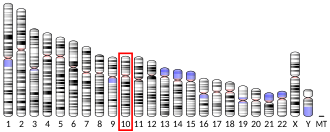
The ARMS2 protein is impacted by the expression of the ARMS2 gene located on chromosome 10q26. The ARMS2 locus is associated with risk factors that connected to the development of age related macular degeneration (AMD). This gene was detected in human retinal pigment epithelial cells (ARPE-19) through immunofluorescence and reverse transcriptase PCR.8
When variants of the gene are expressed they cause the development of mutated ARMS2 proteins, that fail to exit the cell due to the lack of favorable interactions with chaperone proteins, this lack of interaction causes the ARMS2 protein to lack proper tertiary structures.7 ARMS2 protein translation is also impacted by the addition of risk variants experimentally, specifically it is notable that AMD risk haplotype leads to lower levels of ARMS2 mRNA transcription, which results in lower levels of ARMS2 protein translation and availability in the cell. A specific mutation in the 3'-untranslated region of ARMS2 causes this impact as it controls mRNA stability.9
Despite the determination of ARMS2 expression decreasing with the addition of AMD-associated risk variants there is still no concrete evidence that the development of age-related macular degeneration (AMD) is caused by the low levels of ARMS2 protein.9
References
References
- GRCh38: Ensembl release 89: ENSG00000254636 – Ensembl, May 2017
- "Human PubMed Reference:". National Center for Biotechnology Information, U.S. National Library of Medicine.
- Jakobsdottir J, Conley YP, Weeks DE, Mah TS, Ferrell RE, Gorin MB (August 2005). "Susceptibility genes for age-related maculopathy on chromosome 10q26". American Journal of Human Genetics. 77 (3): 389–407. doi:10.1086/444437. PMC 1226205. PMID 16080115.
- Rivera A, Fisher SA, Fritsche LG, Keilhauer CN, Lichtner P, Meitinger T, et al. (October 2005). "Hypothetical LOC387715 is a second major susceptibility gene for age-related macular degeneration, contributing independently of complement factor H to disease risk". Human Molecular Genetics. 14 (21): 3227–3236. doi:10.1093/hmg/ddi353. PMID 16174643.
- "Entrez Gene: ARMS2 age-related maculopathy susceptibility 2".
- Pan Y, Fu Y, Baird PN, Guymer RH, Das T, Iwata T (November 2023). "Exploring the contribution of ARMS2 and HTRA1 genetic risk factors in age-related macular degeneration". Progress in Retinal and Eye Research. 97 101159. doi:10.1016/j.preteyeres.2022.101159. PMID 36581531.
- Kortvely E, Hauck SM, Behler J, Ho N, Ueffing M (August 2016). "The unconventional secretion of ARMS2". Human Molecular Genetics. 25 (15): 3143–3151. doi:10.1093/hmg/ddw162. PMID 27270414.
- Xu YT, Wang Y, Chen P, Xu HF (2012). "Age-related maculopathy susceptibility 2 participates in the phagocytosis functions of the retinal pigment epithelium". International Journal of Ophthalmology. 5 (2): 125–132. doi:10.3980/j.issn.2222-3959.2012.02.02. PMC 3359023. PMID 22762035.
- Friedrich U, Myers CA, Fritsche LG, Milenkovich A, Wolf A, Corbo JC, et al. (April 2011). "Risk- and non-risk-associated variants at the 10q26 AMD locus influence ARMS2 mRNA expression but exclude pathogenic effects due to protein deficiency". Human Molecular Genetics. 20 (7): 1387–1399. doi:10.1093/hmg/ddr020. PMC 3049360. PMID 21252205.
External links
External links
- Human ARMS2 genome location and ARMS2 gene details page in the UCSC Genome Browser.
- Retinal Pigment Epithelial Cells details and arrangement in retina.
Further reading
Further reading
- Schmidt S, Hauser MA, Scott WK, Postel EA, Agarwal A, Gallins P, et al. (May 2006). "Cigarette smoking strongly modifies the association of LOC387715 and age-related macular degeneration". American Journal of Human Genetics. 78 (5): 852–864. doi:10.1086/503822. PMC 1474047. PMID 16642439.
- Shastry BS (2006). "Further support for the common variants in complement factor H (Y402H) and LOC387715 (A69S) genes as major risk factors for the exudative age-related macular degeneration". Ophthalmologica. Journal International D'ophtalmologie. International Journal of Ophthalmology. Zeitschrift Fur Augenheilkunde. 220 (5): 291–295. doi:10.1159/000094617. PMID 16954704. S2CID 30250011.
- Conley YP, Jakobsdottir J, Mah T, Weeks DE, Klein R, Kuller L, et al. (November 2006). "CFH, ELOVL4, PLEKHA1 and LOC387715 genes and susceptibility to age-related maculopathy: AREDS and CHS cohorts and meta-analyses". Human Molecular Genetics. 15 (21): 3206–3218. doi:10.1093/hmg/ddl396. PMID 17000705.
- Tanimoto S, Tamura H, Ue T, Yamane K, Maruyama H, Kawakami H, et al. (February 2007). "A polymorphism of LOC387715 gene is associated with age-related macular degeneration in the Japanese population". Neuroscience Letters. 414 (1): 71–74. doi:10.1016/j.neulet.2006.12.011. PMID 17194541. S2CID 19228896.
- Shastry BS (2007). "Assessment of the contribution of the LOC387715 gene polymorphism in a family with exudative age-related macular degeneration and heterozygous CFH variant (Y402H)". Journal of Human Genetics. 52 (4): 384–387. doi:10.1007/s10038-007-0120-y. PMID 17285240.
- Ross RJ, Bojanowski CM, Wang JJ, Chew EY, Rochtchina E, Ferris FL, et al. (March 2007). "The LOC387715 polymorphism and age-related macular degeneration: replication in three case-control samples". Investigative Ophthalmology & Visual Science. 48 (3): 1128–1132. doi:10.1167/iovs.06-0999. PMC 1885234. PMID 17325155.
- Francis PJ, George S, Schultz DW, Rosner B, Hamon S, Ott J, et al. (2007). "The LOC387715 gene, smoking, body mass index, environmental associations with advanced age-related macular degeneration". Human Heredity. 63 (3–4): 212–218. doi:10.1159/000100046. PMID 17347568. S2CID 43821054.
- Chen D, Langford MP, Duggan C, Madden BJ, Edwards AO (August 2007). "Expression of recombinant protein encoded by LOC387715 in Escherichia coli". Protein Expression and Purification. 54 (2): 275–282. doi:10.1016/j.pep.2007.03.017. PMC 2780029. PMID 17485225.
- Kondo N, Honda S, Ishibashi K, Tsukahara Y, Negi A (October 2007). "LOC387715/HTRA1 variants in polypoidal choroidal vasculopathy and age-related macular degeneration in a Japanese population". American Journal of Ophthalmology. 144 (4): 608–612. doi:10.1016/j.ajo.2007.06.003. PMID 17692272.
- Wiggs JL (September 2007). "Macular degeneration: risk factors for progression". Archives of Ophthalmology. 125 (9): 1264–1265. doi:10.1001/archopht.125.9.1264. PMID 17846368.
- Kanda A, Chen W, Othman M, Branham KE, Brooks M, Khanna R, et al. (October 2007). "A variant of mitochondrial protein LOC387715/ARMS2, not HTRA1, is strongly associated with age-related macular degeneration". Proceedings of the National Academy of Sciences of the United States of America. 104 (41): 16227–16232. Bibcode:2007PNAS..10416227K. doi:10.1073/pnas.0703933104. PMC 1987388. PMID 17884985.
- Brantley MA, Fang AM, King JM, Tewari A, Kymes SM, Shiels A (December 2007). "Association of complement factor H and LOC387715 genotypes with response of exudative age-related macular degeneration to intravitreal bevacizumab". Ophthalmology. 114 (12): 2168–2173. doi:10.1016/j.ophtha.2007.09.008. PMID 18054635.