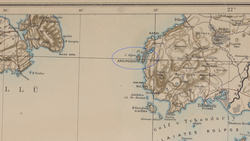
In classical antiquity, the Arginusae (Ancient Greek: Ἀργινοῦσαι Arginousai) were three islands off the Dikili Peninsula on the coast of modern-day Turkey, famous as the site of the Battle of Arginusae during the Peloponnesian War. They were also collectively referred to as Canaea after the city of Canae on the largest island. Today two of the islands remain, while the third and largest has become attached to the mainland as a promontory near the modern village of Bademli:1234
- Baston Islands
- Garip Island (Turkish: Garip Adası, literally "Strange Island"); Nisída Ázano
- Kalem Island (Turkish: Kalem Adası, literally "Pen Island"); Nikolo, Vráchos Nikolós
- Kane Peninsula or Promontory (Turkish: Kane Yarımadası), called Argennusa (Ancient Greek: Ἀργέννουσα; Latin: Arginusa) in antiquity, when it was an island; Canaea, Canae, Κάνη
Argennusa was the site of the ancient city of Canae.
The names Arginusae and Argennusa come from Ancient Greek arginóeis, argennóeis (ἀργινόεις, ἀργεννόεις), "bright-shining".56
References
References
- Hamel, Debra (May 21, 2015). The Battle of Arginusae: Victory at Sea and Its Tragic Aftermath in the Final Years of the Peloponnesian War. U.S.A.: Johns Hopkins University Press. p. 48. ISBN 978-1-4214-1680-9.
- Crew, Bec (November 20, 2015). "An entire ancient island has been rediscovered in the Aegean: Have we finally found the long-lost city of Kane?". Science Alert. Archived from the original on January 28, 2021. Retrieved November 21, 2015.
- Goldhill, Olivia (November 16, 2015). "Researchers just unearthed a lost island in the Aegean". Quartz. Archived from the original on July 8, 2022. Retrieved November 21, 2015.
- "Lost ancient island found in the Aegean". Hurriyet Daily News. İzmir. Archived from the original on December 29, 2016. Retrieved November 14, 2015.
- Androtion (2001). Phillip Harding (ed.). Androtion and the Atthis. Oxford: Clarendon Press. p. 64. ISBN 978-0-19-872149-9.
- "ἀργινόεις Archived 2022-06-04 at the Wayback Machine" in the Greek Word Study Tool