| Apostasioid orchids | |
|---|---|

| |
| Apostasia wallichii | |
Scientific classification 
| |
| Kingdom: | Plantae |
| Clade: | Embryophytes |
| Clade: | Tracheophytes |
| Clade: | Spermatophytes |
| Clade: | Angiosperms |
| Clade: | Monocots |
| Order: | Asparagales |
| Family: | Orchidaceae |
| Subfamily: | Apostasioideae Horan. (1847) |
| Genera | |
| |
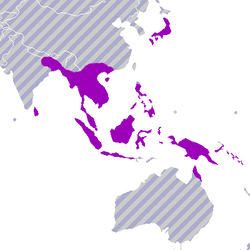
| Distribution of Apostasioideae | |
The subfamily Apostasioideae is one of five subfamilies recognised within the orchid family, Orchidaceae.1 Compared to the other orchid subfamilies, it is relatively species-poor, with only two genera (Neuwiedia and Apostasia) and 15 species.
Members of the subfamily are terrestrial plants found only in humid areas of northern Australia, Southeast Asia, Malaysia, and Japan.2
The Apostasioideae are generally considered to be the sister group to all other orchid lineages34 based on molecular data and flower structure. All other orchid subfamilies with the exception of the Cypripedioideae are monandrous (possessing a single stamen), whereas Apostasioid orchids have 3 stamens.
References
References
- Chase, Mark W.; Cameron, Kenneth M.; Freudenstein, John V.; Pridgeon, Alec M.; Salazar, Gerardo; van den Berg, Cássio; Schuiteman, André (2015). "An updated classification of Orchidaceae". Botanical Journal of the Linnean Society. 177 (2): 151–174. doi:10.1111/boj.12234. ISSN 0024-4074.
- Jersáková, Jana; Trávníček, Pavel; Kubátová, Barbora; Krejčíková, Jana; Urfus, Tomáš; Liu, Zhong-Jian; Lamb, Anthony; Ponert, Jan; Schulte, Katharina; Čurn, Vladislav; Vrána, Jan; Leitch, Ilia J.; Suda, Jan (May 2013). "Genome size variation in Orchidaceae subfamily Apostasioideae: filling the phylogenetic gap: Genome Size in Apostasioideae". Botanical Journal of the Linnean Society. 172 (1): 95–105. doi:10.1111/boj.12027. hdl:11104/0224577.
- Zhang, Guojin; Hu, Yi; Huang, Ming‐Zhong; Huang, Wei‐Chang; Liu, Ding‐Kun; Zhang, Diyang; Hu, Haihua; Downing, Jason L.; Liu, Zhong‐Jian; Ma, Hong (May 2023). "Comprehensive phylogenetic analyses of Orchidaceae using nuclear genes and evolutionary insights into epiphytism". Journal of Integrative Plant Biology. 65 (5): 1204–1225. doi:10.1111/jipb.13462. ISSN 1672-9072.
- Kocyan, A.; Qiu, Y.-L.; Endress, P.K. & Conti, E. (August 2004). "A phylogenetic analysis of Apostasioideae (Orchidaceae) based on ITS, trnL-F and matK sequences" (PDF). Plant Syst. Evol. 247 (3/4): 203–213. Bibcode:2004PSyEv.247..203K. doi:10.1007/s00606-004-0133-3.
Bibliography
Bibliography
- Pridgeon, A.M.; Cribb, P.J.; Chase, M.W. & F. N. Rasmussen (1999): Genera Orchidacearum Vol.1, Oxford U. Press. ISBN 0-19-850513-2