| Luzon montane forest mouse | |
|---|---|
| |
Scientific classification 
| |
| Kingdom: | Animalia |
| Phylum: | Chordata |
| Class: | Mammalia |
| Infraclass: | Placentalia |
| Order: | Rodentia |
| Family: | Muridae |
| Genus: | Apomys |
| Species: | A. datae
|
| Binomial name | |
| Apomys datae (Meyer, 1899)
| |
| |
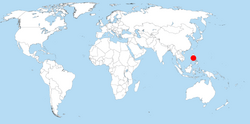
| Range of the Luzon montane forest mouse on global scale | |

| |
| Range of the Luzon montane forest mouse within the Philippines (blue) | |
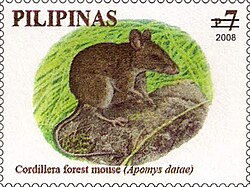
The Luzon montane forest mouse (Apomys datae) is a species of rodent in the family Muridae, from the genus Apomys. It occurs only in the Philippines, where it has been found on the large northern island Luzon (in the Cordillera Central and on the coast of Ilocos Norte). It is most closely related to the large Mindoro forest mouse, which occurs on Mindoro. There may be another related species in the Sierra Madre, but this species is yet undescribed. The Luzon montane forest mouse is a relatively large, ground-dwelling rat with a tail that is quite short for its genus.
Description
The Luzon montane forest mouse is a large, thickset species with a tail that is about the same length as the body. The soft, thick dorsal fur is dark brown, while the ventral side of the body is a cream white. The hind feet are partly brown in colour on the dorsal side, but otherwise white. The tail is brown on the dorsal side, and a cream white ventrally. The animal has a large skull with a square-shaped neurocranium. Some of its skull characteristics are so special that they set the animal apart from most every other species of Apomys. One specimen has a head-torso-length of 143 mm, a tail length of 144 mm and a hind feet length of 34 mm.2 The specimens captured by Sanborn on Mount Data have a mean skull length of 39.2 mm (37.0 to 40.6 mm with a standard deviation of 1.1 mm). The Luzon montane forest mouse's holotype has a skull length of 39.9 mm; that of A. major has a length of 38.4 mm.3
Evolution and phylogenetic relationships
The Luzon montane forest mouse belongs to the Chrotomys division, a group within the Murinae that occurs exclusively on the Philippines, and in addition to Apomys, also includes Rhynchomys, Chrotomys and Archboldomys. Animals in this division share several morphological and genetic features.45
In 2003, a phylogenetic study was published which compared DNA sequences from the cytochrome b gene of thirteen species of Apomys. This study confirmed the proposed relationship between the large Mindoro forest mouse (A. gracilirostris) and the Luzon montane forest mouse (A. datae), as well as the status of the datae group as a sister group of the other species of Apomys.6
The phylogenetic relationships of the Luzon montane forest mouse can be summarized as follows.
| Chrotomys division |
| |||||||||||||||||||||
According to this study, the split between the Luzon montane forest mouse and the large Mindoro forest mouse took place some three million years ago, as calculated using a molecular clock, putting it in the Pliocene. It was also estimated that Apomys dates back more than four million years, with the Chromotys division being again more ancient by another two million years.7 Another study concluded that the Chromotys division was older still, at more than ten million years, and that the split between the Chromotys division and its closest relatives, a predominantly African group including Mus, Otomys and Mastomys, took place some sixteen million years ago.8
Notes and references
- Heaney, L. (2016). "Apomys datae". IUCN Red List of Threatened Species. 2016 e.T1910A22431732. doi:10.2305/IUCN.UK.2016-2.RLTS.T1910A22431732.en. Retrieved 14 November 2021.
- Musser 1982, table 6, specifies these measures as belonging to example USNM 151513, the holotype of Apomys major, but mentions in a footnote that it concerns the holotype of Mus datae.
- Musser 1982, table 4
- Musser & Heaney 1992, pp. 82–89
- Jansa, Barker & Heaney 2006
- Steppan, Zawadzki & Heaney 2003
- Steppan, Zawadzki & Heaney 2003, p. 709
- Jansa, Barker & Heaney 2006, p. 80
Further reading
Further reading
- Jansa, S.A.; Barker, K.F.; Heaney, L.R. (2006). "The pattern and timing of diversification of Philippine endemic rodents: Evidence from mitochondrial and nuclear gene sequences". Systematic Biology. 55 (1): 73–88. doi:10.1080/10635150500431254. PMID 16507525.
- Musser, G. G.; Carleton, M. D. (2005). "Superfamily Muroidea". In Wilson, D. E.; Reeder, D. M. (eds.). Mammal Species of the World: A Taxonomic and Geographic Reference (3rd ed.). Johns Hopkins University Press. pp. 894–1531. ISBN 978-0-8018-8221-0. OCLC 62265494.
- Musser, G.G. (1982). "Results of the Archbold Expeditions. No. 108. The definition of Apomys, a native rat of the Philippine Islands". American Museum Novitates (2746): 1–43. hdl:2246/5294.
- Musser, G.G.; Heaney, L.R. (1992). "Philippine rodents: definitions of Tarsomys and Limnomys plus a preliminary assessment of phylogenetic patterns among native Philippine murines (Murinae, Muridae)". Bulletin of the American Museum of Natural History. 211: 1–138. hdl:2246/906.
- Steppan, S.J.; Zawadzki, C.; Heaney, L.R. (2003). "Molecular phylogeny of the endemic Philippine rodent Apomys (Muridae) and the dynamics of diversification in an oceanic archipelago". Biological Journal of the Linnean Society. 80 (4): 699. doi:10.1111/j.1095-8312.2003.00274.x.