 | |
| Names | |
|---|---|
| IUPAC name
7-(β-D-Glucopyranosyloxy)-4′,5-dihydroxyflavone
| |
| Systematic IUPAC name
5-Hydroxy-2-(4-hydroxyphenyl)-7-{[(2S,3R,4S,5S,6R)-3,4,5-trihydroxy-6-(hydroxymethyl)oxan-2-yl]oxy}-4H-1-benzopyran-4-one | |
| Other names
Apigetrin; Cosmosiine; Cosmetin; Cosmosiin; Cosmosioside; Thalictiin; Cosmosin; Apigenin 7-glucoside; Apigenin 7-O-glucoside
| |
| Identifiers | |
| |
3D model (JSmol)
|
|
| ChEBI | |
| ChEMBL | |
| ChemSpider |
|
| ECHA InfoCard | 100.008.574 |
| KEGG |
|
PubChem CID
|
|
| UNII | |
CompTox Dashboard (EPA)
|
|
| |
| |
| Properties | |
| C21H20O10 | |
| Molar mass | 432.381 g·mol−1 |
Except where otherwise noted, data are given for materials in their standard state (at 25 °C [77 °F], 100 kPa).
| |

Apigetrin is a chemical compound that can be found in dandelion coffee and in Teucrium gnaphalodes.1
Biosynthesis and metabolism
Apigetrin is a glycoside of the flavone, apigenin. Its biosynthesis in plants involves a sequence of enzymes, with chalcone synthase being the one that forms the ring system of the natural product naringenin. Naringenin is then oxidised to apigenin:23



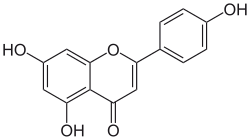
Next, the enzyme flavone 7-O-beta-glucosyltransferase transfers the glucose sugar fragment from UDP-glucose, giving apigetrin, with uridine diphosphate (UDP) as byproduct:24

Apigetrin is further metabolised to apiin when a second apiose sugar is added by the enzyme flavone apiosyltransferase:3

References
References
- Barberán, F. A. T.; Gil, M. I.; Tomás, F.; Ferreres, F.; Arques, A. (1985). "Flavonoid Aglycones and Glycosides from Teucrium gnaphalodes". Journal of Natural Products. 48 (5): 859. doi:10.1021/np50041a040.
- Ververidis Filippos, F; Trantas Emmanouil; Douglas Carl; Vollmer Guenter; Kretzschmar Georg; Panopoulos Nickolas (October 2007). "Biotechnology of flavonoids and other phenylpropanoid-derived natural products. Part I: Chemical diversity, impacts on plant biology and human health". Biotechnology Journal. 2 (10): 1214–34. doi:10.1002/biot.200700084. PMID 17935117.
- Hădărugă, Daniel-Ioan; Hădărugă, Nicoleta-Gabriela (2023). "Flavones: Structure, Properties, Sources and Food Applications". Handbook of Food Bioactive Ingredients. pp. 111–158. doi:10.1007/978-3-031-28109-9_4. ISBN 978-3-031-28108-2.
- Sutter, Arne; Ortmann, Rainer; Grisebach, Hans (1972). "Purification and properties of an enzyme from cell suspension cultures of parsley catalyzing the transfer of d-glucose from UDP-d-glucose to flavonoids". Biochimica et Biophysica Acta (BBA) - Enzymology. 258 (1): 71–87. doi:10.1016/0005-2744(72)90967-9. PMID 5058406.