
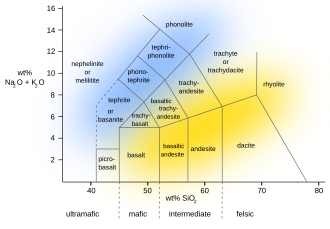

Aphanites (adj. aphanitic; from Ancient Greek αφανης (aphanḗs) 'invisible') are igneous rocks that are so fine-grained that their component mineral crystals are not visible to the naked eye2 (in contrast to phanerites, in which the crystals are visible to the unaided eye). This geological texture results from rapid cooling in volcanic or hypabyssal (shallow subsurface) environments. As a rule, the texture of these rocks is not the same as that of volcanic glass (e.g., obsidian), with volcanic glass being non-crystalline (amorphous), and having a glass-like appearance.3
Aphanites are commonly porphyritic, having large crystals embedded in the fine groundmass, or matrix. The larger inclusions are called phenocrysts. They consist essentially of very small crystals of minerals such as plagioclase feldspar, with hornblende or augite, and may contain also biotite, quartz, and orthoclase.2
Common rocks that can be aphanitic
References
References
- Le Maitre, R. W., ed. (1989). A classification of igneous rocks and glossary of terms. Oxford: Blackwell Science.
- One or more of the preceding sentences incorporates text from a publication now in the public domain: Chisholm, Hugh, ed. (1911). "Aphanite". Encyclopædia Britannica. Vol. 2 (11th ed.). Cambridge University Press. p. 163.
- Bates and Jackson (1984). Dictionary of Geological Terms (3rd ed.). American Geological Institute.