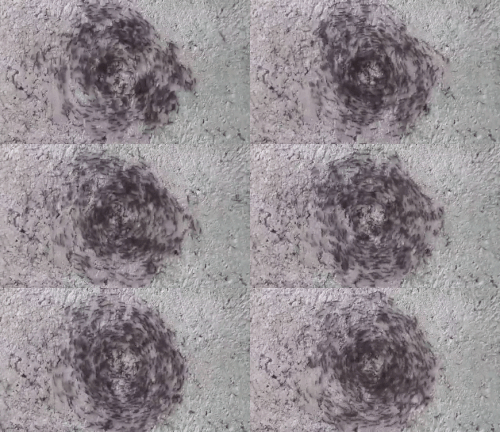
An ant mill is an observed phenomenon in which a group of army ants, separated from the main foraging party, lose the pheromone track and begin to follow one another, forming a continuously rotating circle. This circle is commonly known as a “death spiral” because the ants might eventually die of exhaustion. It has been reproduced in laboratories and in ant colony simulations.1
The phenomenon is a side effect of the self-organizing structure of ant colonies. Each ant merely follows the ant in front of it, which functions until a slight deviation begins to occur, typically by an environmental trigger, and an ant mill forms.2 An ant mill was first described in 1921 by William Beebe, who observed a mill 370 meters (1,210 ft) in circumference. It took each ant two and a half hours to make one revolution.3 Similar phenomena have been noted in processionary caterpillars and fish.4
See also
See also
- Feedback loop – Process where information about current status is used to influence future statusPages displaying short descriptions of redirect targets
- Information cascade – Behavioral phenomenon
- Stigmergy – Social network mechanism of indirect coordination
- The blind leading the blind – Idiom and metaphor in the form of a parallel phrase
- Woozle effect – False credibility due to quantity of citations
References
References
- Delsuc F (2003). "Army Ants Trapped by Their Evolutionary History". PLOS Biology. 1 (2): e37. doi:10.1371/journal.pbio.0000037. PMC 261877. PMID 14624241.
- Couzin ID & NR Franks (2003). "Self-organized lane formation and optimized traffic flow in army ants". Proceedings of the Royal Society B. 270 (1511): 139–146. doi:10.1098/rspb.2002.2210. PMC 1691225. PMID 12590751.
- Beebe, William (1921). Edge of the Jungle. New York: Henry Holt and Co. pp. 291–294.
- Schneirla TC (1944). "A unique case of circular milling in ants, considered in relation to trail following and the general problem of orientation". American Museum Novitates (1253): 1–26. hdl:2246/3733.