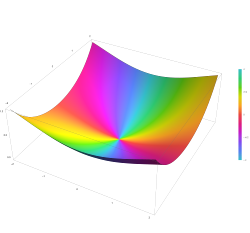
Plot of the Anger function J ν z )n = 2−2 − 2i to 2 + 2i source ↗ In mathematics , the Anger function , introduced by C. T. Anger (1855 ), is a function defined as
J
ν
(
z
)
=
1
π
∫
0
π
cos
(
ν
θ
−
z
sin
θ
)
d
θ
{\displaystyle \mathbf {J} _{\nu }(z)={\frac {1}{\pi }}\int _{0}^{\pi }\cos(\nu \theta -z\sin \theta )\,d\theta }
with complex parameter
ν
{\displaystyle \nu }
z
{\displaystyle {\textit {z}}}
.1 Bessel functions .
The Weber function (also known as Lommel –Weber functionH. F. Weber (1879 ), is a closely related function defined by
E
ν
(
z
)
=
1
π
∫
0
π
sin
(
ν
θ
−
z
sin
θ
)
d
θ
{\displaystyle \mathbf {E} _{\nu }(z)={\frac {1}{\pi }}\int _{0}^{\pi }\sin(\nu \theta -z\sin \theta )\,d\theta }
and is closely related to Bessel functions of the second kind.
Relation between Weber and Anger functions
Plot of the Weber function E ν z )n = 2−2 − 2i to 2 + 2i source ↗ The Anger and Weber functions are related by
sin
(
π
ν
)
J
ν
(
z
)
=
cos
(
π
ν
)
E
ν
(
z
)
−
E
−
ν
(
z
)
,
−
sin
(
π
ν
)
E
ν
(
z
)
=
cos
(
π
ν
)
J
ν
(
z
)
−
J
−
ν
(
z
)
,
{\displaystyle {\begin{aligned}\sin(\pi \nu )\mathbf {J} _{\nu }(z)&=\cos(\pi \nu )\mathbf {E} _{\nu }(z)-\mathbf {E} _{-\nu }(z),\\-\sin(\pi \nu )\mathbf {E} _{\nu }(z)&=\cos(\pi \nu )\mathbf {J} _{\nu }(z)-\mathbf {J} _{-\nu }(z),\end{aligned}}}
so in particular if ν integer they can be expressed as linear combinations of each other. If ν J ν J ν Struve functions .
Power series expansion
The Anger function has the power series expansion2
J
ν
(
z
)
=
cos
π
ν
2
∑
k
=
0
∞
(
−
1
)
k
z
2
k
4
k
Γ
(
k
+
ν
2
+
1
)
Γ
(
k
−
ν
2
+
1
)
+
sin
π
ν
2
∑
k
=
0
∞
(
−
1
)
k
z
2
k
+
1
2
2
k
+
1
Γ
(
k
+
ν
2
+
3
2
)
Γ
(
k
−
ν
2
+
3
2
)
.
{\displaystyle \mathbf {J} _{\nu }(z)=\cos {\frac {\pi \nu }{2}}\sum _{k=0}^{\infty }{\frac {(-1)^{k}z^{2k}}{4^{k}\Gamma \left(k+{\frac {\nu }{2}}+1\right)\Gamma \left(k-{\frac {\nu }{2}}+1\right)}}+\sin {\frac {\pi \nu }{2}}\sum _{k=0}^{\infty }{\frac {(-1)^{k}z^{2k+1}}{2^{2k+1}\Gamma \left(k+{\frac {\nu }{2}}+{\frac {3}{2}}\right)\Gamma \left(k-{\frac {\nu }{2}}+{\frac {3}{2}}\right)}}.}
While the Weber function has the power series expansion2
E
ν
(
z
)
=
sin
π
ν
2
∑
k
=
0
∞
(
−
1
)
k
z
2
k
4
k
Γ
(
k
+
ν
2
+
1
)
Γ
(
k
−
ν
2
+
1
)
−
cos
π
ν
2
∑
k
=
0
∞
(
−
1
)
k
z
2
k
+
1
2
2
k
+
1
Γ
(
k
+
ν
2
+
3
2
)
Γ
(
k
−
ν
2
+
3
2
)
.
{\displaystyle \mathbf {E} _{\nu }(z)=\sin {\frac {\pi \nu }{2}}\sum _{k=0}^{\infty }{\frac {(-1)^{k}z^{2k}}{4^{k}\Gamma \left(k+{\frac {\nu }{2}}+1\right)\Gamma \left(k-{\frac {\nu }{2}}+1\right)}}-\cos {\frac {\pi \nu }{2}}\sum _{k=0}^{\infty }{\frac {(-1)^{k}z^{2k+1}}{2^{2k+1}\Gamma \left(k+{\frac {\nu }{2}}+{\frac {3}{2}}\right)\Gamma \left(k-{\frac {\nu }{2}}+{\frac {3}{2}}\right)}}.}
Differential equations
The Anger and Weber functions are solutions of inhomogeneous forms of Bessel's equation
z
2
y
′
′
+
z
y
′
+
(
z
2
−
ν
2
)
y
=
0.
{\displaystyle z^{2}y^{\prime \prime }+zy^{\prime }+(z^{2}-\nu ^{2})y=0.}
More precisely, the Anger functions satisfy the equation2
z
2
y
′
′
+
z
y
′
+
(
z
2
−
ν
2
)
y
=
(
z
−
ν
)
sin
(
π
ν
)
π
,
{\displaystyle z^{2}y^{\prime \prime }+zy^{\prime }+(z^{2}-\nu ^{2})y={\frac {(z-\nu )\sin(\pi \nu )}{\pi }},}
and the Weber functions satisfy the equation2
z
2
y
′
′
+
z
y
′
+
(
z
2
−
ν
2
)
y
=
−
z
+
ν
+
(
z
−
ν
)
cos
(
π
ν
)
π
.
{\displaystyle z^{2}y^{\prime \prime }+zy^{\prime }+(z^{2}-\nu ^{2})y=-{\frac {z+\nu +(z-\nu )\cos(\pi \nu )}{\pi }}.}
Recurrence relations
The Anger function satisfies this inhomogeneous form of recurrence relation 2
z
J
ν
−
1
(
z
)
+
z
J
ν
+
1
(
z
)
=
2
ν
J
ν
(
z
)
−
2
sin
π
ν
π
.
{\displaystyle z\mathbf {J} _{\nu -1}(z)+z\mathbf {J} _{\nu +1}(z)=2\nu \mathbf {J} _{\nu }(z)-{\frac {2\sin \pi \nu }{\pi }}.}
While the Weber function satisfies this inhomogeneous form of recurrence relation 2
z
E
ν
−
1
(
z
)
+
z
E
ν
+
1
(
z
)
=
2
ν
E
ν
(
z
)
−
2
(
1
−
cos
π
ν
)
π
.
{\displaystyle z\mathbf {E} _{\nu -1}(z)+z\mathbf {E} _{\nu +1}(z)=2\nu \mathbf {E} _{\nu }(z)-{\frac {2(1-\cos \pi \nu )}{\pi }}.}
Delay differential equations
The Anger and Weber functions satisfy these homogeneous forms of delay differential equations 2
J
ν
−
1
(
z
)
−
J
ν
+
1
(
z
)
=
2
∂
∂
z
J
ν
(
z
)
,
{\displaystyle \mathbf {J} _{\nu -1}(z)-\mathbf {J} _{\nu +1}(z)=2{\dfrac {\partial }{\partial z}}\mathbf {J} _{\nu }(z),}
E
ν
−
1
(
z
)
−
E
ν
+
1
(
z
)
=
2
∂
∂
z
E
ν
(
z
)
.
{\displaystyle \mathbf {E} _{\nu -1}(z)-\mathbf {E} _{\nu +1}(z)=2{\dfrac {\partial }{\partial z}}\mathbf {E} _{\nu }(z).}
The Anger and Weber functions also satisfy these inhomogeneous forms of delay differential equations 2
z
∂
∂
z
J
ν
(
z
)
±
ν
J
ν
(
z
)
=
±
z
J
ν
∓
1
(
z
)
±
sin
π
ν
π
,
{\displaystyle z{\dfrac {\partial }{\partial z}}\mathbf {J} _{\nu }(z)\pm \nu \mathbf {J} _{\nu }(z)=\pm z\mathbf {J} _{\nu \mp 1}(z)\pm {\frac {\sin \pi \nu }{\pi }},}
z
∂
∂
z
E
ν
(
z
)
±
ν
E
ν
(
z
)
=
±
z
E
ν
∓
1
(
z
)
±
1
−
cos
π
ν
π
.
{\displaystyle z{\dfrac {\partial }{\partial z}}\mathbf {E} _{\nu }(z)\pm \nu \mathbf {E} _{\nu }(z)=\pm z\mathbf {E} _{\nu \mp 1}(z)\pm {\frac {1-\cos \pi \nu }{\pi }}.}
References
References
Prudnikov, A.P. (2001) [1994], "Anger function" , Encyclopedia of Mathematics EMS Press
Paris, R. B. (2010), "Anger–Weber Functions" , in Olver, Frank W. J. ; Lozier, Daniel M.; Boisvert, Ronald F.; Clark, Charles W. (eds.), NIST Handbook of Mathematical Functions ISBN 978-0-521-19225-5 MR 2723248
Abramowitz, Milton ; Stegun, Irene Ann , eds. (1983) [June 1964]. "Chapter 12" . Handbook of Mathematical Functions with Formulas, Graphs, and Mathematical Tables ISBN 978-0-486-61272-0 LCCN 64-60036 . MR 0167642 . LCCN 65-12253 .C.T. Anger, Neueste Schr. d. Naturf. d. Ges. i. Danzig, 5 (1855) pp. 1–29
Prudnikov, A.P. (2001) [1994], "Weber function" , Encyclopedia of Mathematics EMS Press Watson, G.N. (1952), A treatise on the theory of Bessel functions , Cambridge Univ. Press, pp. 1– 2H.F. Weber, Zurich Vierteljahresschrift, 24 (1879) pp. 33–76