Μακεδόνες | |
|---|---|
 Stag Hunt Mosaic, 4th century BC | |
| Languages | |
| Ancient Macedonian, then Attic Greek, and later Koine Greek | |
| Religion | |
| ancient Greek religion |
The Macedonians (Ancient Greek: Μακεδόνες, Makedónes) were an ancient tribe that lived on the alluvial plain around the rivers Haliacmon and lower Axios in the northeastern part of mainland Greece. Essentially an ancient Greek people,1 they gradually expanded from their homeland along the Haliacmon valley on the northern edge of the Greek world, absorbing or driving out neighbouring non-Greek tribes, primarily Thracian and Illyrian.2 They spoke Ancient Macedonian, which is usually classified as a dialect of Northwest Greek,note 1 and occasionally as a distinct sister language of Greeknote 2 or an Aeolic Greek dialect.note 3 However, the prestige language of Macedon during the Classical era was Attic Greek, replaced by Koine Greek during the Hellenistic era.15 Their religious beliefs mirrored those of other Greeks,21 following the main deities of the Greek pantheon, although the Macedonians continued Archaic burial practices that had ceased in other parts of Greece after the 6th century BC. Aside from the monarchy, the core of Macedonian society was its nobility. Similar to the aristocracy of neighboring Thessaly, their wealth was largely built on herding horses and cattle.
Although composed of various clans, the kingdom of Macedonia, established around the 7th century BC, is mostly associated with the Argead dynasty and the tribe named after it. The dynasty, also known as the Temenid dynasty, was allegedly founded by Perdiccas I, descendant of the legendary Temenus of Argos, while the region of Macedon derived its name from Makedon, a figure of Greek mythology. Traditionally ruled by independent families, the Macedonians seem to have accepted Argead rule by the time of Alexander I (r. 498 – 454 BC). Under Philip II (r. 359 – 336 BC), the Macedonians are credited with numerous military innovations, which enlarged their territory and increased their control over other areas extending into Thrace. This consolidation of territory allowed for the exploits of Alexander the Great (r. 336 – 323 BC), the conquest of the Achaemenid Empire, the establishment of the diadochi successor states, and the inauguration of the Hellenistic period in West Asia, Greece, and the broader Mediterranean world. The Macedonians were eventually conquered by the Roman Republic, which dismantled the Macedonian monarchy at the end of the Third Macedonian War (171–168 BC) and established the Roman province of Macedonia after the Fourth Macedonian War (150–148 BC).
Authors, historians, and statesmen of the ancient world often expressed ambiguous if not conflicting ideas about the ethnic identity of the Macedonians as either Greeks, semi-Greeks, or even barbarians. This has led to some debate among modern academics about the precise ethnic identity of the Macedonians, who nevertheless embraced many aspects of contemporaneous Greek culture such as participation in Greek religious cults and athletic games, including the exclusive Ancient Olympic Games. Given the scant linguistic evidence, such as the Pella curse tablet, ancient Macedonian is regarded by most scholars as another Greek dialect related to Northwest Greek.a
The ancient Macedonians participated in the production and fostering of Classical and later Hellenistic art. In terms of visual arts, they produced frescoes, mosaics, sculptures, and decorative metalwork. The performing arts of music and Greek theatrical dramas were highly appreciated, while famous playwrights such as Euripides came to live in Macedonia. The kingdom also attracted the presence of renowned philosophers, such as Aristotle, while native Macedonians contributed to the field of ancient Greek literature, especially Greek historiography. Their sport and leisure activities included hunting, foot races, and chariot races, as well as feasting and drinking at aristocratic banquets known as symposia.
Etymology
The ethnonym Μακεδόνες (Makedónes) stems from the Ancient Greek adjective μακεδνός (makednós), meaning "tall, slim", also the name of a people related to the Dorians (Herodotus).32 It is most likely cognate with the adjective μακρός (makrós), meaning "long" or "tall" in Ancient Greek.32 The name is believed to have originally meant either "highlanders", "the tall ones", or "high grown men".note 4 According to Robert Beekes, the Greek word μακεδνός (makednós) cannot be analyzed as an original Indo-European word, and belongs to the pre-Greek substrate.32
History
Historical overview

The expansion of the Macedonian kingdom has been described as a three-stage process. As a frontier kingdom on the border of the Greek world with barbarian Europe, the Macedonians first subjugated their immediate northern neighbours — various Paeonian, Illyrian and Thracian tribes — before turning against the states of southern and central Greece. Macedonia then led a pan-Hellenic military force against their primary objective—the conquest of Persia—which they achieved with remarkable ease.33343536 Following the death of Alexander the Great and the Partition of Babylon in 323 BC, the diadochi successor states such as the Attalid, Ptolemaic and Seleucid Empires were established, ushering in the Hellenistic period of Greece, West Asia and the Hellenized Mediterranean Basin.37 With Alexander's conquest of the Achaemenid Empire, Macedonians colonized territories as far east as Central Asia.38
The Macedonians continued to rule much of Hellenistic Greece (323–146 BC), forming alliances with Greek leagues such as the Cretan League and Epirote League (and prior to this, the Kingdom of Epirus).39 However, they often fell into conflict with the Achaean League, Aetolian League, the city-state of Sparta, and the Ptolemaic dynasty of Hellenistic Egypt that intervened in wars of the Aegean region and mainland Greece.40 After Macedonia formed an alliance with Hannibal of Ancient Carthage in 215 BC, the rival Roman Republic responded by fighting a series of wars against Macedonia in conjunction with its Greek allies such as Pergamon and Rhodes.41 In the aftermath of the Third Macedonian War (171–168 BC), the Romans abolished the Macedonian monarchy under Perseus of Macedon (r. 179–168 BC– ) and replaced the kingdom with four client state republics.42 A brief revival of the monarchy by the pretender Andriscus led to the Fourth Macedonian War (150–148 BC), after which Rome established the Roman province of Macedonia and subjugated the Macedonians.43
Prehistoric homeland

In Greek mythology, Makedon is the eponymous hero of Macedonia and is mentioned in Hesiod's Catalogue of Women.44 The first historical attestation of the Macedonians occurs in the works of Herodotus during the mid-5th century BC.45 The Macedonians are absent in Homer's Catalogue of Ships and the term "Macedonia" itself appears late. The Iliad states that upon leaving Mount Olympus, Hera journeyed via Pieria and Emathia before reaching Athos.46 This is re-iterated by Strabo in his Geography.47 Nevertheless, archaeological evidence indicates that Mycenaean contact with or penetration into the Macedonian interior possibly started from the early 14th century BC.4849
In his A History of Macedonia, Nicholas Hammond reconstructed the earliest phases of Macedonian history based on his interpretation of later literary accounts and archaeological excavations in the region of Macedonia.50 According to Hammond, the Macedonians are missing from early Macedonian historical accounts because they had been living in the Orestian highlands since before the Greek Dark Ages, possibly having originated from the same (proto-Greek) population pool that produced other Greek peoples.5152 The Macedonian tribes subsequently moved down from Orestis in the upper Haliacmon to the Pierian highlands in the lower Haliacmon because of pressure from the Molossians, a related tribe who had migrated to Orestis from Pelagonia.53 In their new Pierian home north of Olympus, the Macedonian tribes mingled with the proto-Dorians. This might account for traditions which placed the eponymous founder, Makedon, near Pieria and Olympus.54 Some traditions placed the Dorian homeland in the Pindus mountain range in western Thessaly, whilst Herodotus pushed this further north to the Macedonian Pindus and claimed that the Greeks were referred to as Makednon ethnos (Μακεδνὸν ἔθνος) and then as Doric ethnos when they moved further south.5556 A different, southern homeland theory also exists in traditional historiography. Arnold J. Toynbee asserted that the Makedones migrated north to Macedonia from central Greece, placing the Dorian homeland in Phthiotis and citing the traditions of fraternity between Makedon and Magnes.57
Temenids and Argeads
The Macedonian expansion is said to have been led by the ruling Temenid dynasty, known as "Argeads" or "Argives". Herodotus said that Perdiccas, the dynasty's founder, was descended from the Heraclid Temenus.58 He left Argos with his two older brothers Aeropus and Gayanes, and travelled via Illyria to Lebaea, a city in Upper Macedonia which certain scholars have tried to connect with the villages Albus or Velventos.59 Here, the brothers served as shepherds for a local ruler. After a vision, the brothers fled to another region in Macedonia near the Midas Gardens by the foot of the Vermio Mountains, and then set about subjugating the rest of Macedonia.60 Thucydides's account is similar to that of Herodotus, making it probable that the story was disseminated by the Macedonian court,61 i.e. it accounts for the belief the Macedonians had about the origin of their kingdom, if not an actual memory of this beginning.62 Later historians modified the dynastic traditions by introducing variously Caranus636465 or Archelaus, the son of Temenus, as the founding Temenid kings—although there is no doubt that Euripides transformed Caranus to Archelaus meaning "leader of the people" in his play Archelaus, in an attempt to please Archelaus I of Macedon.66
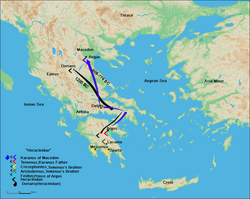
The earliest sources, Herodotus and Thucydides, called the royal family "Temenidae". In later sources (Strabo, Appian, Pausanias) the term "Argeadae" was introduced. However, Appian said that the term Argeadae referred to a leading Macedonian tribe rather than the name of the ruling dynasty.6768 The connection of the Argead name to the royal family is uncertain. The words "Argead" and "Argive" derive via Latin Argīvus69 from Ancient Greek: Ἀργεῖος (Argeios), meaning "of or from Argos",7071 and is first attested in Homer, where it was also used as a collective designation for the Greeks ("Ἀργείων Δαναῶν", Argive Danaans).72 The most common connection to the royal family, as written by Herodotus, is with Peloponnesian Argos.73 Appian connects it with Orestian Argos.67 According to another tradition mentioned by Justin, the name was adopted after Caranus seized the city of Edessa and renamed it Aegae, thereby calling the inhabitants Aegeatae.74 A figure, Argeas, is mentioned in the Iliad (16.417).68
Taking Herodotus's lineage account as the most trustworthy, Appian said that after Perdiccas, six successive heirs ruled: Argeus, Philip, Aeropus, Alcetas, Amyntas and Alexander.75 Amyntas I (r. 547 – 498 BC) ruled at the time of the Persian invasion of Paeonia and when Macedon became a vassal state of Achaemenid Persia.7677 However, Alexander I (r. 498 – 454 BC) is the first truly historic figure. Based on this line of succession and an estimated average rule of 25 to 30 years, the beginnings of the Macedonian dynasty have thus been traditionally dated to 750 BC.6878 Hammond supports the traditional view that the Temenidae did arrive from the Peloponnese and took charge of Macedonian leadership, possibly usurping rule from a native "Argead" dynasty with Illyrian help.60 However, other scholars doubt the veracity of their Peloponnesian origins. For example, Miltiades Hatzopoulos takes Appian's testimony to mean that the royal lineage imposed itself onto the tribes of the Middle Heliacmon from Argos Orestikon,59 whilst Eugene N. Borza argues that the Argeads were a family of notables hailing from Vergina.79
Expansion from the core

Both Strabo and Thucydides said that Emathia and Pieria were mostly occupied by Thracians (Pieres, Paeonians) and Bottiaeans, as well as some Illyrian and Epirote tribes.80 Herodotus states that the Bryges were cohabitants with the Macedonians before their mass migration to Anatolia.81 If a group of ethnically definable Macedonian tribes were living in the Pierian highlands prior to their expansion, the first conquest was of the Pierian piedmont and coastal plain, including Vergina.82 The tribes may have launched their expansion from a base near Mount Bermion, according to Herodotus.83 Thucydides describes the Macedonian expansion specifically as a process of conquest led by the Argeads:84
But the country along the sea which is now called Macedonia, was first acquired and made a kingdom by Alexander [I], father of Perdiccas [II] and his forefathers, who were originally Temenidae from Argos. They defeated and expelled from Pieria the Pierians ... and also expelled the Bottiaeans from Bottiaea ... they acquired as well a narrow strip of Paeonia extending along the Axios river from the interior to Pella and the sea. Beyond the Axios they possess the territory as far as the Strymon called Mygdonia, having driven out the Edoni. Moreover, they expelled from the district now called Eordaea the Eordi ... The Macedonians also made themselves rulers of certain places ... namely Anthemus, Grestonia, and a large part of Macedonia proper.84
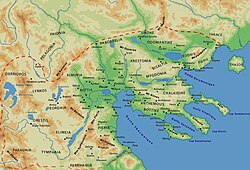
Thucydides's account gives a geographical overview of Macedonian possessions at the time of Alexander I's rule. To reconstruct a chronology of the expansion by Alexander I's predecessors is more difficult, but generally, three stages have been proposed from Thucydides' reading. The initial and most important conquest was of Pieria and Bottiaea, including the locations of Pydna and Dium. The second stage consolidated rule in Pieria and Bottiaea, captured Methone and Pella, and extended rule over Eordaea and Almopia. According to Hammond, the third stage occurred after 550 BC, when the Macedonians gained control over Mygdonia, Edonis, lower Paeonia, Bisaltia and Crestonia.85 However, the second stage might have occurred as late as 520 BC;86 and the third stage probably did not occur until after 479 BC, when the Macedonians capitalized on the weakened Paeonian state after the Persian withdrawal from Macedon and the rest of their mainland European territories.87 Whatever the case, Thucydides' account of the Macedonian state describes its accumulated territorial extent by the rule of Perdiccas II, Alexander I's son. Hammond has said that the early stages of Macedonian expansion were militaristic, subduing or expunging populations from a large and varied area.88 Pastoralism and highland living could not support a very concentrated settlement density, forcing pastoralist tribes to search for more arable lowlands suitable for agriculture.89
Ethnogenesis scenario

Present-day scholars have highlighted several inconsistencies in the traditionalist perspective first set in place by Hammond.90 An alternative model of state and ethnos formation, promulgated by an alliance of regional elites, which redates the creation of the Macedonian kingdom to the 6th century BC, was proposed in 2010.91 According to these scholars, direct literary, archaeological, and linguistic evidence to support Hammond's contention that a distinct Macedonian ethnos had existed in the Haliacmon valley since the Aegean civilizations is lacking. Hammond's interpretation has been criticized as a "conjectural reconstruction" from what appears during later, historical times.92
Similarly, the historicity of migration, conquest and population expulsion have also been questioned. Thucydides's account of the forced expulsion of the Pierians and Bottiaeans could have been formed on the basis of his perceived similarity of names of the Pierians and Bottiaeans living in the Struma valley with the names of regions in Macedonia; whereas his account of Eordean extermination was formulated because such toponymic correspondences are absent.87 Likewise, the Argead conquest of Macedonia may be viewed as a commonly used literary topos in classical Macedonian rhetoric. Tales of migration served to create complex genealogical connections between trans-regional ruling elites, while at the same time were used by the ruling dynasty to legitimize their rule, heroicize mythical ancestors and distance themselves from their subjects.6293
Conflict was a historical reality in the early Macedonian kingdom and pastoralist traditions allowed the potential for population mobility. Greek archaeologists have found that some of the passes linking the Macedonian highlands with the valley regions have been used for thousands of years. However, the archaeological evidence does not point to any significant disruptions between the Iron Age and Hellenistic period in Macedonia. The general continuity of material culture,94 settlement sites,95 and pre-Greek onomasticon contradict the alleged ethnic cleansing account of early Macedonian expansion.96

The process of state formation in Macedonia was similar to that of its neighbours in Epirus, Illyria, Thrace and Thessaly, whereby regional elites could mobilize disparate communities for the purpose of organizing land and resources. Local notables were often based in urban-like settlements, although contemporaneous historians often did not recognize them as poleis because they were not self-ruled but under the rule of a "king".97 From the mid-6th century, there appears a series of exceptionally rich burials throughout the region—in Trebeništa, Vergina, Sindos, Agia Paraskevi, Pella-Archontiko, Aiani, Gevgelija, Amphipolis—sharing a similar burial rite and grave accompaniments, interpreted to represent the rise of a new regional ruling class sharing a common ideology, customs and religious beliefs.91 A common geography, mode of existence, and defensive interests might have necessitated the creation of a political confederacy among otherwise ethno-linguistically diverse communities, which led to the consolidation of a new Macedonian ethnic identity.9198
The traditional view that Macedonia was populated by rural ethnic groups in constant conflict is slowly changing, bridging the cultural gap between southern Epirus and the north Aegean region. Hatzopoulos's studies on Macedonian institutions have lent support to the hypothesis that Macedonian state formation occurred via an integration of regional elites, which were based in city-like centres, including the Argeadae at Vergina, the Paeonian/Edonian peoples in Sindos, Ichnae and Pella, and the mixed Macedonian-Barbarian colonies in the Thermaic Gulf and western Chalkidiki.99 The Temenidae became overall leaders of a new Macedonian state because of the diplomatic proficiency of Alexander I and the logistic centrality of Vergina itself. It has been suggested that a breakdown in traditional Balkan tribal traditions associated with adaptation of Aegean socio-political institutions created a climate of institutional flexibility in a vast, resource-rich land.100 Non-Argead centres increasingly became dependent allies, allowing the Argeads to gradually assert and secure their control over the lower and eastern territories of Macedonia.99 This control was fully consolidated by Phillip II (r. 359 – 336 BC).101
Culture and society
Macedonia had a distinct material culture by the Early Iron Age.102 Typically Balkan burial, ornamental, and ceramic forms were used for most of the Iron Age.102 These features suggest broad cultural affinities and organizational structures analogous with Thracian, Epirote, and Illyrian regions.103104 This did not necessarily symbolize a shared cultural identity, or any political allegiance between these regions.105 In the late sixth century BC, Macedonia became open to south Greek influences, although a small but detectable amount of interaction with the south had been present since late Mycenaean times.106 By the 5th century BC, Macedonia was a part of the "Greek cultural milieu" according to Edward M. Anson, possessing many cultural traits typical of the southern Greek city-states.107 Classical Greek objects and customs were appropriated selectively and used in peculiarly Macedonian ways.108 In addition, influences from Achaemenid Persia in culture and economy are evident from the 5th century BC onward, such as the inclusion of Persian grave goods at Macedonian burial sites as well as the adoption of royal customs such as a Persian-style throne during the reign of Philip II.109
Economy, society, and social class

The way of life of the inhabitants of Upper Macedonia differed little from that of their neighbours in Epirus and Illyria, engaging in seasonal transhumance supplemented by agriculture. Young Macedonian men were typically expected to engage in hunting and martial combat as a byproduct of their transhumance lifestyles of herding livestock such as goats and sheep, while horse breeding and raising cattle were other common pursuits.110 In these mountainous regions, upland sites were important focal points for local communities. In these difficult terrains, competition for resources often precipitated intertribal conflict and raiding forays into the comparatively richer lowland settlements of coastal Macedonia and Thessaly.111 Despite the remoteness of the upper Macedonian highlands, excavations at Aiani since 1983 have discovered finds attesting to the presence of social organization since the 2nd millennium BC. The finds include the oldest pieces of black-and-white pottery, which is characteristic of the tribes of northwest Greece, discovered so far.112 Found with Μycenaean sherds, they can be dated with certainty to the 14th century BC.112113114 The finds also include some of the oldest samples of writing in Macedonia, among them inscriptions bearing Greek names like Θέμιδα (Themida). The inscriptions demonstrate that Hellenism in Upper Macedonia was at a high economic, artistic, and cultural level by the sixth century BC—overturning the notion that Upper Macedonia was culturally and socially isolated from the rest of ancient Greece.112
By contrast, the alluvial plains of Lower Macedonia and Pelagonia, which had a comparative abundance of natural resources such as timber and minerals, favored the development of a native aristocracy, with a wealth that at times surpassed the classical Greek poleis.115 Exploitation of minerals helped expedite the introduction of coinage in Macedonia from the 5th century BC, developing under southern Greek, Thracian and Persian influences.116 Some Macedonians engaged in farming, often with irrigation, land reclamation, and horticulture activities supported by the Macedonian state.117 However, the bedrock of the Macedonian economy and state finances was the twofold exploitation of the forests with logging and valuable minerals such as copper, iron, gold, and silver with mining.118 The conversion of these raw materials into finished products and their sale encouraged the growth of urban centers and a gradual shift away from the traditional rustic Macedonian lifestyle during the course of the 5th century BC.119
Macedonian society was dominated by aristocratic families whose main source of wealth and prestige was their herds of horses and cattle. In this respect, Macedonia was similar to Thessaly and Thrace.104 These aristocrats were second only to the king in terms of power and privilege, filling the ranks of his administration and serving as commanding officers in the military.120 It was in the more bureaucratic regimes of the Hellenistic kingdoms succeeding Alexander the Great's empire where greater social mobility for members of society seeking to join the aristocracy could be found, especially in Ptolemaic Egypt.121 In contrast with classical Greek poleis, the Macedonians held only few slaves.122123

However, unlike Thessaly, Macedonia was ruled by a monarchy from its earliest history until the Roman conquest in 167 BC. The nature of the kingship, however, remains debated. One viewpoint sees it as an autocracy, whereby the king held absolute power and was at the head of both government and society, wielding arguably unlimited authority to handle affairs of state and public policy. He was also the leader of a very personal regime with close relationships or connections to his hetairoi, the core of the Macedonian aristocracy.124 Any other position of authority, including the army, was appointed at the whim of the king himself. The other, "constitutionalist", position argues that there was an evolution from a society of many minor "kings" – each of equal authority – to a sovereign military state whereby an army of citizen soldiers supported a central king against a rival class of nobility.125 Kingship was hereditary along the paternal line, yet it is unclear if primogeniture was strictly observed as an established custom.126
During the Late Bronze Age (circa 15th-century BC), the ancient Macedonians developed distinct, matt-painted wares that evolved from Middle Helladic pottery traditions originating in central and southern Greece.114127 The Macedonians continued to use an individualized form of material culture—albeit showing analogies in ceramic, ornamental and burial forms with the so-called Lausitz culture between 1200 and 900 BC—and that of the Glasinac culture after circa 900 BC.128 While some of these influences persisted beyond the sixth century BC,94129 a more ubiquitous presence of items of an Aegean-Mediterranean character is seen from the latter sixth century BC,130 as Greece recovered from its Dark Ages. Southern Greek impulses penetrated Macedonia via trade with north Aegean colonies such as Methone and those in the Chalcidice, neighbouring Thessaly, and from the Ionic colonies of Asia Minor. Ionic influences were later supplanted by those of Athenian provenance. Thus, by the latter sixth century, local elites could acquire exotic Aegean items such as Athenian red figure pottery, fine tablewares, olive oil and wine amphorae, fine ceramic perfume flasks, glass, marble and precious metal ornaments—all of which would serve as status symbols.131 By the 5th century BC, these items became widespread in Macedonia and in much of the central Balkans.132
Macedonian settlements have a strong continuity dating from the Bronze Age, maintaining traditional construction techniques for residential architecture. While settlement numbers appeared to drop in central and southern Greece after 1000 BC, there was a dramatic increase of settlements in Macedonia.133 These settlements seemed to have developed along raised promontories near river flood plains called tells (Greek: τύμβοι). Their ruins are most commonly found in western Macedonia between Florina and Lake Vergoritis, the upper and middle Haliacmon River, and Bottiaea. They can also be found on either side of the Axios and in the Chalcidice in eastern Macedonia.134
Religion and funerary practices

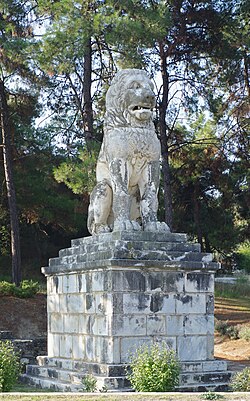
By the 5th century BC the Macedonians and the rest of the Greeks worshiped more or less the same deities of the Greek pantheon.136 In Macedonia, politics and religion often intertwined. For instance, the head of state for the city of Amphipolis also served as the priest of Asklepios, Greek god of medicine; a similar arrangement existed at Cassandreia, where a cult priest honoring the city's founder Cassander was the nominal municipal leader.137 Foreign cults from Egypt were fostered by the royal court, such as the temple of Sarapis at Thessaloniki, while Macedonian kings Philip III of Macedon and Alexander IV of Macedon made votive offerings to the internationally esteemed Samothrace temple complex of the Cabeiri mystery cult.138 This was also the same location where Perseus of Macedon fled and received sanctuary following his defeat by the Romans at the Battle of Pydna in 168 BC.139 The main sanctuary of Zeus was maintained at Dion, while another at Veria was dedicated to Herakles and received particularly strong patronage from Demetrius II Aetolicus (r. 239 – 229 BC) when he intervened in the affairs of the municipal government at the behest of the cult's main priest.138
The ancient Macedonians worshipped the Twelve Olympians, especially Zeus, Artemis, Heracles, and Dionysus. Evidence of this worship exists from the beginning of the 4th century BC onwards, but little evidence of Macedonian religious practices from earlier times exists.140 From an early period, Zeus was the single most important deity in the Macedonian pantheon.140 Makedon, the mythical ancestor of the Macedonians, was held to be a son of Zeus, and Zeus features prominently in Macedonian coinage.140 The most important centre of worship of Zeus was at Dion in Pieria, the spiritual centre of the Macedonians, where beginning in 400 BC King Archelaus established an annual festival, which in honour of Zeus featured lavish sacrifices and athletic contests.140 Worship of Zeus's son Heracles was also prominent; coins featuring Heracles appear from the 5th century BC onwards.140 This was in large part because the Argead kings of Macedon traced their lineage to Heracles, making sacrifices to him in the Macedonian capitals of Vergina and Pella.140 Numerous votive reliefs and dedications also attest to the importance of the worship of Artemis.141 Artemis was often depicted as a huntress and served as a tutelary goddess for young girls entering the coming-of-age process, much as Heracles Kynagidas (Hunter) did for young men who had completed it.141 By contrast, some deities popular elsewhere in the Greek world—notably Poseidon and Hephaestus—were largely ignored by the Macedonians.140
Other deities worshipped by the ancient Macedonians were part of a local pantheon which included Thaulos (god of war equated with Ares), Gyga (later equated with Athena), Gozoria (goddess of hunting equated with Artemis), Zeirene (goddess of love equated with Aphrodite) and Xandos (god of light).142 A notable influence on Macedonian religious life and worship was neighbouring Thessaly; the two regions shared many similar cultural institutions.143 They were tolerant of, and open to, incorporating foreign religious influences such as the sun worship of the Paeonians.21 By the 4th century BC, there had been a significant fusion of Macedonian and common Greek religious identity,144 but Macedonia was nevertheless characterized by an unusually diverse religious life.21 This diversity extended to the belief in magic, as evidenced by curse tablets. It was a significant but secret aspect of Greek cultural practice.145
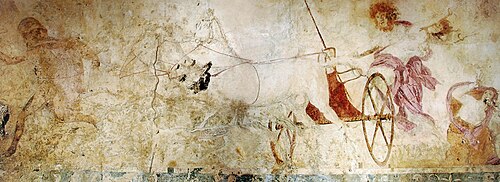
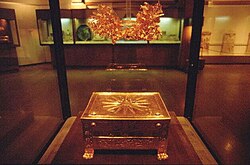
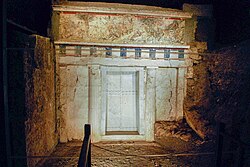
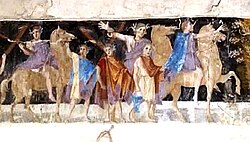
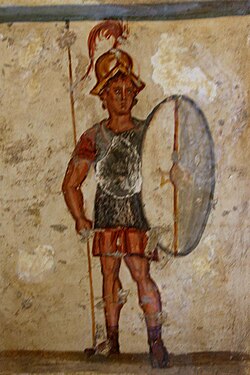
A notable feature of Macedonian culture was the ostentatious burials reserved for its rulers.146 The Macedonian elite built lavish tombs at the time of death rather than constructing temples during life.146 Such traditions had been practiced throughout Greece and the central-west Balkans since the Bronze Age. Macedonian burials contain items similar to those at Mycenae, such as burial with weapons, gold death masks etc.108 From the sixth century, Macedonian burials became particularly lavish, displaying a rich variety of Greek imports reflecting the incorporation of Macedonia into a wider economic and political network centred on the Aegean city-states. Burials contained jewellery and ornaments of unprecedented wealth and artistic style. This zenith of Macedonian "warrior burial" style closely parallels those of sites in south-central Illyria and western Thrace, creating a koinon of elite burials.147 Lavish warrior burials had been discontinued in southern and central Greece from the seventh century onwards, where offerings at sanctuaries and the erection of temples became the norm.148 From the sixth century BC, cremation replaced the traditional inhumation rite for elite Macedonians.91 One of the most lavish tombs dating from the 4th century BC, believed to be that of Phillip II, is at Vergina. It contains extravagant grave goods, highly sophisticated artwork depicting hunting scenes and Greek cultic figures, and a vast array of weaponry.149 This demonstrates a continuing tradition of the warrior society rather than a focus on religious piety and technology of the intellect, which had become paramount facets of central Greek society in the Classical Period.148 In the three royal tombs at Vergina, professional painters decorated the walls with a mythological scene of Hades abducting Persephone (Tomb 1) and royal hunting scenes (Tomb 2), while lavish grave goods including weapons, armor, drinking vessels and personal items were housed with the dead, whose bones were burned before burial in decorated gold coffins.150 Some grave goods and decorations were common in other Macedonian tombs, yet some items found at Vergina were distinctly tied to royalty, including a diadem, luxurious goods, and arms and armor.151 Scholars have debated about the identity of the tomb occupants since the discovery of their remains in 1977–1978,152 yet recent research and forensic examination have concluded with certainty that at least one of the persons buried was Philip II (Tomb 2).153 Located near Tomb 1 are the above-ground ruins of a heroon, a shrine for cult worship of the dead.154 In 2014, the ancient Macedonian Kasta Tomb, the largest ancient tomb found in Greece (as of 2017), was discovered outside of Amphipolis, a city that was incorporated into the Macedonian realm after its capture by Philip II in 357 BC.155156157 The identity of the tomb's occupant is unknown, but archaeologists have speculated that it may be Alexander's close friend Hephaestion.158
The deification of Macedonian monarchs perhaps began with the death of Philip II, yet it was his son Alexander the Great who unambiguously claimed to be a living god.159 As pharaoh of the Egyptians, he was already entitled as Son of Ra and considered the living incarnation of Horus by his Egyptian subjects (a belief that the Ptolemaic successors of Alexander would foster for their own dynasty in Egypt).160 However, following his visit to the oracle of Didyma in 334 BC that suggested his divinity, he traveled to the Oracle of Zeus Ammon (the Greek equivalent of the Egyptian Amun-Ra) at the Siwa Oasis of the Libyan Desert in 332 BC to confirm his divine status.161 After the priest there convinced him that Philip II was merely his mortal father and Zeus his actual father, Alexander began styling himself as the 'Son of Zeus', which brought him into contention with some of his Greek subjects who adamantly believed that living men could not be immortals.162 Although the Seleucid and Ptolemaic diadochi successor states cultivated their own ancestral cults and deification of the rulers as part of state ideology, a similar cult did not exist in the Kingdom of Macedonia.163
Visual arts


Right: Fresco from the Tomb of Judgement in ancient Mieza (modern-day Lefkadia), Imathia, Central Macedonia, Greece, depicting religious imagery of the afterlife, 4th century BC
By the reign of Archelaus I of Macedon, the Macedonian elite started importing significantly greater customs, artwork, and art traditions from other regions of Greece. However, they still retained more archaic, perhaps Homeric funerary rites connected with the symposium and drinking rites that were typified with items such as decorative metal kraters that held the ashes of deceased Macedonian nobility in their tombs.164 Among these is the large bronze Derveni Krater from a 4th-century BC tomb of Thessaloniki, decorated with scenes of the Greek god Dionysus and his entourage and belonging to an aristocrat who had a military career.165 Macedonian metalwork usually followed Athenian styles of vase shapes from the 6th century BC onward, with drinking vessels, jewellery, containers, crowns, diadems, and coins among the many metal objects found in Macedonian tombs.166
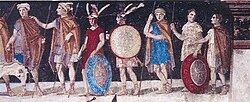
Surviving Macedonian painted artwork includes frescoes and murals on walls, but also decoration on sculpted artwork such as statues and reliefs. For instance, trace colors still exist on the bas-reliefs of the Alexander Sarcophagus.167 Macedonian paintings have allowed historians to investigate the clothing fashions as well as military gear worn by ancient Macedonians, such as the brightly-colored tomb paintings of Agios Athanasios, Thessaloniki showing figures wearing headgear ranging from feathered helmets to kausia and petasos caps.168

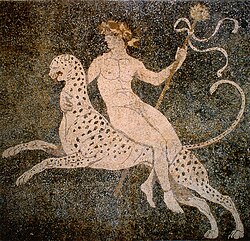
Aside from metalwork and painting, mosaics serve as another significant form of surviving Macedonian artwork, especially those discovered at Pella dating to the 4th century BC.166 The Stag Hunt Mosaic of Pella, with its three dimensional qualities and illusionist style, show clear influence from painted artwork and wider Hellenistic art trends, although the rustic theme of hunting was tailored for Macedonian tastes.170 The similar Lion Hunt Mosaic of Pella illustrates either a scene of Alexander the Great with his companion Craterus, or simply a conventional illustration of the generic royal diversion of hunting.170 Mosaics with mythological themes include scenes of Dionysus riding a panther and Helen of Troy being abducted by Theseus, the latter of which employs illusionist qualities and realistic shading similar to Macedonian paintings.170 Common themes of Macedonian paintings and mosaics include warfare, hunting and aggressive masculine sexuality (i.e. abduction of women for rape or marriage). In some instances these themes are combined within the same work, indicating a metaphorical connection that seems to be affirmed by later Byzantine Greek literature.171
Theatre, music and performing arts
Philip II was assassinated by his bodyguard Pausanias of Orestis in 336 BC at the theatre of Aigai, Macedonia amid games and spectacles held inside that celebrated the marriage of his daughter Cleopatra of Macedon.172 Alexander the Great was allegedly a great admirer of both theatre and music.173 He was especially fond of the plays by Classical Athenian tragedians Aeschylus, Sophocles, and Euripides, whose works formed part of a proper Greek education for his new eastern subjects alongside studies in the Greek language and epics of Homer.174 While he and his army were stationed at Tyre (in modern-day Lebanon), Alexander had his generals act as judges not only for athletic contests but also stage performances of Greek tragedies.175 The contemporaneous famous actors Thessalus and Athenodorus performed at the event, despite Athenodorus risking a fine for being absent from the simultaneous Dionysia festival of Athens where he was scheduled to perform (a fine that his patron Alexander agreed to pay).176
Music was also appreciated in Macedonia. In addition to the agora, the gymnasium, the theatre, and religious sanctuaries and temples dedicated to Greek gods and goddesses, one of the main markers of a true Greek city in the empire of Alexander the Great was the presence of an odeon for musical performances.177 This was the case not only for Alexandria in Egypt, but also cities as distant as Ai-Khanoum in what is now modern-day Afghanistan.177
Literature, education, philosophy, and patronage

Perdiccas II of Macedon was able to host well-known Classical Greek intellectual visitors at his royal court, such as the lyric poet Melanippides and the renowned medical doctor Hippocrates, while Pindar's enkomion written for Alexander I of Macedon may have been composed at his court.178 Yet Archelaus I of Macedon received a far greater number of Greek scholars, artists, and celebrities at his court than his predecessors, leading M. B. Hatzopoulos to describe Macedonia under his reign as an "active centre of Hellenic culture."179 His honored guests included the painter Zeuxis, the architect Callimachus, the poets Choerilus of Samos, Timotheus of Miletus, and Agathon, as well as the famous Athenian playwright Euripides.180 Although Archelaus was criticized by the philosopher Plato, supposedly hated by Socrates, and the first known Macedonian king to be insulted with the label of a barbarian, the historian Thucydides held the Macedonian king in glowing admiration for his accomplishments, including his engagement in panhellenic sports and fostering of literary culture.181 The philosopher Aristotle, who studied at the Platonic Academy of Athens and established the Aristotelian school of thought, moved to Macedonia, and is said to have tutored the young Alexander the Great, in addition to serving as an esteemed diplomat for Alexander's father Philip II.182 Among Alexander's retinue of artists, writers, and philosophers was Pyrrho of Elis, founder of Pyrrhonism, the school of philosophical skepticism.174 During the Antigonid period, Antigonos Gonatas fostered cordial relationships with Menedemos of Eretria, founder of the Eretrian school of philosophy, and Zenon, the founder of Stoicism.173
In terms of early Greek historiography and later Roman historiography, Felix Jacoby identified thirteen possible ancient historians who wrote histories about Macedonia in his Fragmente der griechischen Historiker.183 Aside from accounts in the works of Herodotus and Thucydides, the works compiled by Jacoby are only fragmentary, whereas other works are completely lost, such as the history of an Illyrian war fought by Perdiccas III of Macedon written by the Macedonian general and statesman Antipater.184 The Macedonian historians Marsyas of Pella and Marsyas of Philippi wrote histories of Macedonia, while the Ptolemaic king Ptolemy I Soter authored a history about Alexander and Hieronymus of Cardia wrote a history about Alexander's royal successors.185 Following the Indian campaign of Alexander the Great, the Macedonian military officer Nearchus wrote a work of his voyage from the mouth of the Indus river to the Persian Gulf.186 The Macedonian historian Craterus published a compilation of decrees made by the popular assembly of the Athenian democracy, ostensibly while attending the school of Aristotle.186 Philip V of Macedon had manuscripts of the history of Philip II written by Theopompus gathered by his court scholars and disseminated with further copies.173
Sports and leisure

When Alexander I of Macedon petitioned to compete in the foot race of the ancient Olympic Games, the event organizers at first denied his request, explaining that only Greeks were allowed to compete. However, Alexander I produced proof of an Argead royal genealogy showing ancient Argive Temenid lineage, a move that ultimately convinced the Olympic Hellanodikai authorities of his Greek descent and ability to compete, although this did not necessarily apply to common Macedonians outside of his royal dynasty.187 By the end of the 5th century BC, the Macedonian king Archelaus I was crowned with the olive wreath at both Olympia and Delphi (in the Pythian Games) for winning chariot racing contests.181 Philip II allegedly heard of the Olympic victory of his horse (in either an individual horse race or chariot race) on the same day his son Alexander the Great was born, on either 19 or 20 July 356 BC.188 In addition to literary contests, Alexander the Great also staged competitions for music and athletics across his empire.174 The Macedonians created their own athletic games and, after the late 4th century BC, non-royal Macedonians competed and became victors in the Olympic Games107 and other athletic events such as the Argive Heraean Games. However, athletics were a less favored pastime compared to hunting.189
Dining and cuisine

Ancient Macedonia produced very few fine foods or beverages that were highly appreciated elsewhere in the Greek world, namely eels from the Strymonian Gulf and special wine brewed in Chalcidice.191 The earliest known use of flat bread as a plate for meat was made in Macedonia during the 3rd century BC, which perhaps influenced the later 'trencher' bread of medieval Europe if not Greek pita and Italian pizza.191 Cattle and goats were consumed, although there was no notice of Macedonian mountain cheeses in literature until the Middle Ages.191 As exemplified by works such as the plays by the comedic playwright Menander, Macedonian dining habits penetrated Athenian high society; for instance, the introduction of meats into the dessert course of a meal.192 The Macedonians also most likely introduced mattye to Athenian cuisine, a dish usually made of chicken or other spiced, salted, and sauced meats served during the wine course.193 This particular dish was derided and connected with licentiousness and drunkenness in a play by the Athenian comic poet Alexis about the declining morals of Athenians in the age of Demetrius I of Macedon.194
The symposium (plural: symposia) in the Macedonian and wider Greek realm was a banquet for the nobility and privileged class, an occasion for feasting, drinking, entertainment, and sometimes philosophical discussion.195 The hetairoi, leading members of the Macedonian aristocracy, were expected to attend such feasts with their king.120 They were also expected to accompany him on royal hunts for the acquisition of game meat as well as for sport.120 Symposia had several functions, amongst which was providing relief from the hardship of battle and marching. Symposia were Greek traditions since Homeric times, providing a venue for interaction amongst Macedonian elites. An ethos of egalitarianism surrounded symposia, allowing all male elites to express ideas and concerns, although built-up rivalries and excessive drinking often led to quarrels, fighting and even murder. The degree of extravagance and propensity for violence set Macedonian symposia apart from classical Greek symposia.196 Like symposia, hunting was another focus of elite activity, and it remained popular throughout Macedonia's history. Young men participating in symposia were only allowed to recline after having killed their first wild boar.197
Language

For administrative and political purposes, Attic Greek seems to have operated as a lingua franca among the ethno-linguistically diverse communities of Macedonia and the north Aegean region, creating a diglossic linguistic area.note 5 Attic Greek was standardized as the language of the court, formal discourse and diplomacy from as early as the time of Archelaus at the end of the 5th century BC.198 Attic was further spread by Macedonia's conquests.199 Although Macedonian continued to be spoken well into Antigonid times,200 it became the prevalent oral dialect in Macedonia and throughout the Macedonian-ruled Hellenistic world.201 However, Macedonian became extinct in either the Hellenistic or the Roman period, and entirely replaced by Koine Greek.202 For instance, Cleopatra VII Philopator, the last active ruler of the Ptolemaic dynasty in Egypt, spoke Koine Greek as a first language, and by her reign (51–30 BC), or some time before it, the Macedonian language was no longer used.203
Attempts to classify Ancient Macedonian are hindered by the lack of surviving Ancient Macedonian texts; it was a mainly oral language and most archaeological inscriptions indicate that in Macedonia there was no dominant written language besides Attic and later Koine Greek.202 All surviving epigraphical evidence from grave markers and public inscriptions is in Greek.204 Classification attempts are based on a vocabulary of 150–200 words and 200 personal names assembled mainly from the 5th century lexicon of Hesychius of Alexandria and a few surviving fragmentary inscriptions, coins and occasional passages in ancient sources.202 Most of the vocabulary is regular Greek, with tendencies toward Doric Greek and Aeolic Greek. There can be found some Illyrian and Thracian elements.202205
The Pella curse tablet, which was found in 1986 at Pella and dates to the mid-4th century BC or slightly earlier,206 is believed to be the only substantial attested text in Macedonian. The language of the tablet is a distinctly recognizable form of Northwest Greek. The tablet has been used to support the argument that ancient Macedonian was a Northwest Greek dialect and mainly a Doric Greek dialect.207208209102107 Hatzopoulos's analysis revealed some tendencies toward the Aeolic Greek dialect.205 Hatzopoulos also states that the native language of the ancient Macedonians also betrays a slight phonetic influence from the languages of the original inhabitants of the region who were assimilated or expelled by the invading Macedonians.211 He also asserts that little is known about the languages of these original inhabitants aside from Phrygian spoken by the Bryges, who migrated to Anatolia.211 However, according to Hatzopoulos, Bruno Helly expanded and improved his own earlier suggestion and presented the hypothesis of a (North-)'Achaean' substratum extending as far north as the head of the Thermaic Gulf, which had a continuous relation in prehistoric times, both in Thessaly and Macedonia, with the Northwest Greek-speaking populations living on the other side of the Pindus mountain range, and contacts became cohabitation when the Argead Macedonians completed their wandering from Orestis to Lower Macedonia, in the 7th century BC.212 According to this hypothesis, Hatzopoulos concludes that the Ancient Macedonian dialect of the historical period, attested in inscriptions such as Pella curse tablet, is a sort of koine resulting from the interaction and the influences of various elements, the most important of which are the North-Achaean substratum, the Northwest Greek dialect of the Argead Macedonians, and the Thracian and Phrygian adstrata. Claude Brixhe espoused the hypothesis "of a sporadic secondary voicing of unvoiced consonants within the history of Greek", in agreement with Hatzopoulos.213214212

In Macedonian onomastics, most personal names are recognizably Greek (e.g. Alexandros, Philippos, Dionysios, Apollonios, Demetrios), with some dating back to Homeric (e.g. Ptolemaeos) or Mycenean times and there are also a few non-Greek names (Illyrian or Thracian; e.g. "Bithys"). This material supports the observation that Macedonian personal names have a predominantly Greek character.202 Macedonian toponyms and hydronyms are mostly of Greek origin (e.g. Aegae, Dion, Pieria, Haliacmon), as are the names of the months of the Macedonian calendar and the names of most of the deities the Macedonians worshiped. Hammond states that these are not late borrowings.215
Macedonian has a close structural and lexical affinity with other Greek dialects, especially Northwest Greek and Thessalian.216217 Most of the words are Greek, although some of these could represent loans or cognate forms.218219 Alternatively, a number of phonological, lexical and onomastic features set Macedonian apart.219220 These latter features, possibly representing traces of a substrate language, occur in what are considered to be particularly conservative systems of the language.221
Several hypotheses have consequently been proposed as to the position of Macedonian, all of which broadly regard it as either a peripheral Greek dialect, a closely related but separate language (see Hellenic languages),219222223 or a hybridized idiom incorporating Brygian, Northwest Greek and Thessalian Greek.224225 Drawing on the similarities between Macedonian, Greek and Brygian, Fanula Papazoglu wrote that she formed an Indo-European macro-dialectical group,226 which, according to Georgiev, split before circa 14th–13th century BC before the appearance of the main Greek dialects.227 The same data has been analyzed in an alternative manner, which regards the formation of the main Greek dialects as a later convergence of related but distinct groups. According to this theory, Macedonian did not fully participate in this process, making its ultimate position—other than being a contiguous, related 'minor' language—difficult to define.228 Hatzopoulos, who offers a critical review of recent research on Macedonian speech, argues that all available evidence points to the conclusion that Macedonian is a Greek dialect of the North-West group.9
Another source of evidence is metalinguistics and the question of mutual intelligibility. The available literary evidence has no details about the exact nature of Macedonian; however it suggests that Macedonian and Greek were sufficiently different that there were communication difficulties between Greek and Macedonian contingents, necessitating the use of interpreters as late as the time of Alexander the Great.229230231 Based on this evidence, Papazoglou has written that Macedonian could not have been a Greek dialect,232 however, evidence for non-intelligibility exists for other ancient Greek dialects such as Aetolian233 and Aeolic Greek.234 Hornblower suggests that Greeks were intelligible to Macedonians without an interpreter,235 as supported by the Athenian orator Aeschines.236 Livy wrote that when Aemilius Paulus called together representatives of the defeated Macedonian communities, his Latin pronouncements were translated for the benefit of the assembled Macedonians into Greek.237 According to Hatzopoulos, the sole direct attestation of Macedonian speech preserved in an ancient author, is a verse in a non-Attic Greek dialect that the 4th century BC Athenian poet Strattis in his comedy 'The Macedonians' places a character, presumably Macedonian, to give as an answer to the question of an Athenian: – ἡ σφύραινα δ’ ἐστὶ τίς; (‘the sphyraena, what's that?’) – κέστραν μὲν ὔμμες, ὡτικκοί, κικλήσκετε (‘it's what ye in Attica dub cestra’).238 Georgios Giannakis writes that recent scholarship has established the position of ancient Macedonian within the dialect map of North-West Greek.9
Identity

Nature of sources
Most ancient sources on the Macedonians come from outside Macedonia.183 According to Eugene N. Borza, most of these sources are either ill-informed, hostile or both, making the Macedonians one of the "silent" peoples of the ancient Mediterranean.239 Most of the literary evidence comes from later sources focusing on the campaigns of Alexander the Great rather than on Macedonia itself. For example, Ernst Badian notes that nearly all surviving references to antagonisms and differences between Greeks and Macedonians found in Arrian's Anabasis of Alexander, where they are described as belonging to different génē,201 and the latter as being distinct from both Greeks and barbarians, are traced back to speeches that were composed by Arrian himself;240 Arrian wrote approximately 500 years after Alexander's campaign,241 during a period (i.e. the Roman Empire) in which any notion of an ethnic disparity between Macedonians and other Greeks was incomprehensible.242 Most contemporaneous evidence on Philip is Athenian and hostile.243 Moreover, most ancient sources focus on the deeds of Macedonian kings in connection with political and military events such as the Peloponnesian War. Evidence about the ethnic identity of Macedonians of lower social status from the Archaic to the Hellenistic period is highly fragmentary and unsatisfactory.244 For information about Macedonia before Philip, historians must rely on archaeological inscriptions and material remains, a few fragments from historians whose work is now lost, occasional passing mentions in Herodotus and Thucydides, and universal histories from the Roman era.243
Ancient sources on the Argeads
In Homer, the term Argead was used as a collective designation for the Greeks ("Ἀργείων Δαναῶν", Argive Danaans).72245 The earliest version of the Temenid foundation myth was circulated by Alexander I via Herodotus during his apparent appearance at the Olympic Games.246 Despite protests from some competitors, the Hellanodikai ("Judges of the Greeks") accepted Alexander's Greek genealogy, as did Herodotus and later Thucydides. Alexander had proved to the judges that he was an Argive Greek (descendant from the mythical king of Argos, Temenus).246247 Surviving fragments of the Pindaric ode seem to confirm his participation, by praising "his pentathlon victory".248 Nevertheless, the historicity of Alexander I's participation in the Olympics has been doubted by some scholars, who see the story as a piece of propaganda engineered by the Argeads and spread by Herodotus. Alexander's name does not appear in any list of Olympic victors.249 That there were protests from other competitors suggests that the supposed Argive genealogy of the Argeads "was far from mainstream knowledge".250 Although some have formulated that the appellation "Philhellene" was "surely not an appellation that could be given to an actual Greek",250251 ancient Greek authors had confirmed that the term "philhellene" (fond of Greece) was also used as a title for Greek patriots.252253 Whatever the case, according to Hall, "what mattered was that Alexander had played the genealogical game à la grecque and played it well, perhaps even excessively".254
The emphasis on the Heraclean ancestry of the Argeads served to heroicize the royal family and to provide a sacred genealogy which established a "divine right to rule" over their subjects.255 The Macedonian royal family, like those of Epirus, emphasized "blood and kinship in order to construct for themselves a heroic genealogy that sometimes also functioned as a Hellenic genealogy".256

Pre-Hellenistic Greek writers expressed an ambiguity about the Greekness of Macedonians —specifically their monarchic institutions and their background of Persian alliance—often portraying them as a potential barbarian threat to Greece.257 For example, the late 5th century sophist Thrasymachus of Chalcedon wrote, "we Greeks are enslaved to the barbarian Archelaus" (Fragment 2).258 This fragment is an adaptation of a verse from Euripides' tragedy Telephos which was destined to become a stock expression. Hatzopoulos states that given the fragment's conventional character, it can hardly be taken literally as ethnological or linguistic evidence.259 The issue of Macedonian Hellenicity and that of their royal house was particularly pertinent in the 4th century BC regarding the politics of invading Persia. Demosthenes regarded Macedonia's monarchy to be incongruous with an Athenian-led Pan-Hellenic alliance. He castigated Philip II for being "not only no Greek, nor related to the Greeks, but not even a barbarian from any place that can be named with honor, but a pestilent knave from Macedonia, whence it was never yet possible to buy a decent slave".260
This was obvious political slander and is regarded as "an insulting speech",261 but "the orator clearly could not do this, if his audience was likely to regard his claim as nonsense: it could not be said of a Theban, or even a Thessalian";262 however, he also calls Meidias, an Athenian statesman, "barbarian"263 and in an event mentioned by Athenaeus, the Boeotians, the Thessalians and the Eleans were labeled "barbarians".264 Demosthenes regarded only those who had reached the cultural standards of southern Greece as Greek and he did not take ethnological criteria into consideration,265 and his corpus is considered by Eugene N. Borza as an "oratory designed to sway public opinion at Athens and thereby to formulate public policy."239 Isocrates believed that only Macedonia was capable of leading a war against Persia; he felt compelled to say that Phillip was a "bona fide" Hellene by discussing his Argead and Heraclean heritage.266267 Aeschines also sought to defend Philip and publicly described him at a meeting of the Athenian popular assembly as being "entirely Greek".268 Moreover, Philip, in his letter to the council and people of Athens, mentioned by Demosthenes, places himself "with the rest of the Greeks".269
Ancient sources on the Macedonian people
The earliest reference about Greek attitudes towards the Macedonian ethnos as a whole comes from Hesiod's Catalogue of Women. The text maintains that the Macedonians descended from Makedon, son of Zeus and Thyia (daughter of Deucalion), and was therefore a nephew of Hellen, progenitor of the Greeks.44 Magnes, brother of the eponymous Makedon, was also said to be a son of Zeus and Thyia.54 The Magnetes, descendants of Magnes, were an Aeolian tribe; according to Hammond this places the Macedonians among the Greeks.270 Engels also wrote that Hesiod counted the Macedonians as Greeks, while Hall said that "according to strict genealogical logic, [this] excludes the population that bears [Makedon's] name from the ranks of the Hellenes".271 Two later writers deny Makedon a lineage from Hellen: Apollodorus (3.8.1) makes him a son of Lycaon, son of earth-born Pelasgus, whilst Pseudo–Scymnos (6.22) makes him born directly from the earth;272 Apollodorus (3.8.1), however, is technically identifying Makedon with the Greek royalty of Arcadia, thus placing Macedonia within the orbit of the most archaic of Greek myths.273 At the end of the 5th century BC Hellanicus of Lesbos asserted Macedon was the son of Aeolus, the latter a son of Hellen and ancestor of the Aeolians, one of the major tribes of the Greeks.44 Hellanicus modified Hesiod's genealogy by making Makedon the son of Aeolus, firmly placing the Macedonians in the Aeolic Greek-speaking family.274 In addition to belonging to tribal groups such as the Aeolians, Dorians, Achaeans, and Ionians, Anson also stresses the fact that some Greeks even distinguished their ethnic identities based on the polis (i.e. city-state) they originally came from.275
These early writers and their formulation of genealogical relationships demonstrate that before the 5th century, Greekness was defined on an ethnic basis and was legitimized by tracing descent from eponymous Hellen.276 Subsequently, cultural considerations assumed greater importance.
Herodotus regarded the Macedonians as either northern Greeks, or an intermediate group between "pure" Greeks and barbarians.277 In the Histories (5.20.4) Herodotus calls king Alexander I an anēr Hellēn, Makedonōn huparchos (Ancient Greek: ἀνὴρ Ἕλλην, Μακεδόνων ὕπαρχος), which translates to either a "Greek viceroy of Macedonia",278 or "a Greek who ruled over Macedonians".277 In 7.130.3, he says that the Thessalians were the "first of the Greeks" to submit to Xerxes.279 In the first book of the Histories, Herodotus recalls a reliable tradition according to which the Greek ethnos, in its wandering, was called "Macedonian" when it settled around Pindus and "Dorian" when it came to the Peloponnese,280 and in the eighth book he groups several Greek tribes under "Macedonians" and "Dorians", implying that the Macedonians were Greeks.281282
In parts of his work, Thucydides placed the Macedonians on his cultural continuum closer to barbarians than Hellenes,283 or an intermediate category between Greeks and non–Greeks.284 In other parts, he distinguishes between three groups fighting in the Peloponnesian War: The Greeks (including Peloponnesians), the Macedonians and the barbarian Illyrians.284 Recounting Brasidas' expedition to Lyncus, Thucydides considers Macedonians separate from the barbarians; he says, "In all there were about three thousand Hellenic heavy infantry, accompanied by all the Macedonian cavalry with the Chalcidians, near one thousand strong, besides an immense crowd of barbarians",285 and "night coming on, the Macedonians and the barbarian crowd took fright in a moment in one of those mysterious panics to which great armies are liable".286 More explicit is his recounting of Brasidas' speech where he tells his Peloponnesian troops to dispel fear of fighting against "barbarians: because they had already fought against Macedonians".287 Euripides, in his work Archelaus, tells us that the Macedonians were Greeks.288
Ancient geographers differed in their views on the size of Macedonia and on the ethnicity of the Macedonians.289 Most ancient geographers did not include the core territories of the Macedonian kingdom in their definition of Greece, the reasons for which are unknown. For example, Strabo says that while "Macedonia is of course part of Greece, yet now, since I am following the nature and shape of the places geographically, I have chosen to classify it apart from the rest of Greece".289290 Strabo supports the Greek ethnicity of the Macedonian people and wrote of the "Macedonians and the other Greeks",291 as does Pausanias, the latter of which did not include Macedonia in Hellas as indicated in Book 10 of his Description of Greece.289 Pausanias said that the Macedonians took part in the Amphictyonic League292 and that Caranus of Macedon—the mythical founder of the Argead dynasty—set up a trophy after the Argive fashion for a victory against Cisseus.293

Isocrates defended Philip's Greek origins but perhaps did not think the same of his people. In Hall's version, he wrote, "He (Perdiccas I) left the Greek world alone completely, but he desired to hold the kingship in Macedonia; for he understood that Greeks are not accustomed to submit themselves to monarchy whereas others are incapable of living their lives without domination of this sort ... for he alone of the Greeks deemed it fit to rule over an ethnically unrelated population".272 On the other hand, Michael Cosmopoulos reports that Isocrates clearly states that the Macedonians were Greeks,288 as in George Norlin's translation, Isocrates describes Perdiccas' people as being rather of "kindred race" with the Greeks.295 Nevertheless, Philip named the federation of Greek states he created with Macedon at its head—nowadays referred to as the League of Corinth—as simply "The Hellenes" (i.e. Greeks). The Macedonians were granted two seats in the exclusively Greek Great Amphictyonic League in 346 BC when the Phocians were expelled. Badian sees it as a personal honour awarded to Phillip and not to the Macedonian people as a whole.296 Aeschines said that Phillip's father Amyntas III joined other Greeks in the Panhellenic congress of the Lacedaemonian allies, known as the "Congress of Sparta", in a vote to help Athens recover possession of Amphipolis.297 The list of theorodokoi (sacred envoy-receivers whose duty was to host and assist the theoroi ("viewers") before the Panhellenic games and festivals), was listing Greek cities and tribes, to which the major Panhellenic sanctuaries sent theoroi in Epidaurus. Amyntas' son and Phillip's older brother, Perdiccas III of Macedon, served as theorodokos in the Panhellenic Games that took place in Epidaurus around 360/359 BC.298
With Philip's conquest of Greece, Greeks and Macedonians enjoyed privileges at the royal court, and there was no social distinction among his court hetairoi, although Philip's armies were only ever led by Macedonians. The process of Greek and Macedonian syncretism culminated during the reign of Alexander the Great, and he allowed other Greeks to command his armies.299 In his speech at the battle of Issus, mentioned in Arrian's Anabasis, Alexander is seen to place himself among the Greeks, further acknowledging that, while the Greek allies of Darius III fight for pay, his own army fights for the Greek cause.300 The persisting antagonism between Macedonians and other Greeks however, continued into Antigonid times.301 Some Greek citizens continued to rebel against their Macedonian overlords throughout the Hellenistic era.302 They rejoiced on the death of Phillip II303 and they revolted against Alexander's Antigonid successors. The Greeks called this conflict the Hellenic War.304 However, Pan-Hellenic sloganeering was used by Greeks against Antigonid dominance and also by Macedonians to corral popular support throughout Greece. Those who considered Macedonia as a political enemy, such as Hypereides and Chremonides, likened the Lamian War and Chremonidean War, respectively, to the earlier Greco-Persian Wars and efforts to liberate Greeks from tyranny.305 Yet even those who considered Macedonia an ally, such as Isocrates, were keen to stress the differences between their kingdom and the Greek city states, to assuage fears about the extension of the Macedonian-style monarchism into the governance of their poleis.306
After the 3rd century BC, and especially in Roman times, the Macedonians were consistently regarded as Greeks.307 To begin with, Polybius considers the Macedonians as Greeks and sets them apart from their neighboring non-Greek tribes.288 For example, in his Histories, the Acarnanian character Lyciscus tells the Spartans that they are "of the same tribe" as the Achaeans and the Macedonians,308 who should be honoured because "throughout nearly their whole lives are ceaselessly engaged in a struggle with the barbarians for the safety of the Greeks".309 Polybius also used the phrase "Macedonia and the rest of Greece",310 and says that Philip V of Macedon associates himself with "the rest of the Greeks".311 In his text History of Rome, Livy states that the Macedonians, Aetolians and Acarnanians were "all men of the same language".312 Similar opinions are shared by Arrian,313 Dionysius of Halicarnassus,314 Strabo315 and Plutarch, who wrote of Aristotle advising Alexander "to have regard for the Greeks as for friends and kindred";316 more specifically, to be "a leader to the Greeks and a despot to the barbarians, to look after the former as after friends and relatives, and to deal with the latter as with beasts or plants".317 M. B. Hatzopoulos points out that passages in Arrian's text also reveal that the terms "Greeks" and "Macedonians" were at times synonymous. For instance, when Alexander the Great held a feast accompanied by Macedonians and Persians, with religious rituals performed by Persian magi and "Greek seers", the latter of whom were Macedonians.318 Any preconceived ethnic differences between Greeks and Macedonians faded soon after the Roman conquest of Macedonia by 148 BC and then the rest of Greece with the defeat of the Achaean League by the Roman Republic at the Battle of Corinth (146 BC).319


The Persians referred to both Greeks and Macedonians as Yauna ("Ionians", their term for "Greeks"), though they distinguished the "Yauna by the sea and across the sea" from the Yaunã Takabara or "Greeks with hats that look like shields", ostensibly referring to the Macedonian kausia hat.322 According to another interpretation, the Persians used such terms in a geographical rather than an ethnic sense. Yauna and its various attributes possibly referred to regions to the north and west of Asia Minor.323 Overall, Persian inscriptions indicate that the Persians considered the Macedonians to be Greeks.324 In Hellenistic times, most Egyptians and Syrians included the Macedonians among the larger category of Greeks, as the Persians had done earlier.322
Modern discourse
Modern scholarly discourse has produced several hypotheses about the Macedonians' place within the Greek world. Considering material remains of Greek-style monuments, buildings, inscriptions dating from the 5th century and the predominance of Greek personal names, one school of thought says that the Macedonians were "truly Greeks" who had retained a more archaic lifestyle than those living in southern Greece. This cultural discrepancy was used during the political struggles in Athens and Macedonia in the 4th century.277 This has been the predominant viewpoint since the 20th century. Worthington wrote, "... not much need to be said about the Greekness of ancient Macedonia: it is undeniable",325 and he concludes that "there is still more than enough evidence and reasoned theory to suggest that the Macedonians were racially Greek."326 Paul Christesen and Saraj C. Murray wrote that "it is now widely acknowledged that Macedonians were from the outset linguistically and culturally Greek".327 Miltiades Hatzopoulos argues that there was no real ethnic difference between Macedonians and Greeks, only a political distinction contrived after the creation of the League of Corinth in 337 BC (which was led by Macedonia through the league's elected hegemon Philip II, despite him not being a member of the league itself).328 Hatzopoulos stresses the fact that Macedonians and other peoples such as the Epirotes and Cypriots, despite speaking a Greek dialect, worshiping in Greek cults, engaging in panhellenic games, and upholding traditional Greek institutions, nevertheless occasionally had their territories excluded from contemporary geographic definitions of "Hellas" and were even considered non-Greek barbarians by some.329 Panagiotis Filos notes that the term "barbarian" was often used by ancient Greek authors in a very broad sense, referring not only to non-Greek populations, but also to Greek populations on the fringe of the Greek world with dialectal differences, such as the Macedonians.330 The term was also known for being used in a pejorative and politically motivated manner, especially by the Athenians, to deride other Greek tribes and states such as Epirotes, Eleans, Boeotians and Aeolic-speakers.331332 Other academics who concur that the difference between the Macedonians and Greeks was a political rather than a true ethnic discrepancy include N. G. L. Hammond, Michael B. Sakellariou,333 Robert Malcolm Errington,268 Craige B. Champion,334 Robin Lane Fox,211 Simon Hornblower,335 Ian Worthington336 and Miltiades B. Hatzopoulos.3 Simon Hornblower writes that "the question 'Were the Macedonians Greeks?' perhaps needs to be chopped up further" and concludes that "the crude one-word answer to the question has to be 'yes'", noting that "Macedonians were Greeks by criteria two and three, that is, religion and language" and "Macedonian customs were in certain respects unlike those of a normal polis, but they were compatible with Greekness, apart, perhaps, from the institutions".335

Another perspective interprets the literary evidence and the archaeological-cultural differences between Macedonia and central-southern Greece before the 6th century and beyond as evidence that the Macedonians were originally non-Greek tribes who underwent a process of Hellenization,337 or that "whatever the ethnic origins and identity of the Macedonians, they were generally perceived in their own time by Greeks and themselves not to be Greeks".338339 Eugene Borza emphasized the Macedonians "made their mark in antiquity as Macedonians, not as a tribe of some other people",340 but argued that "the 'highlanders' or 'Makedones' of the mountainous regions of western Macedonia may have been derived from northwest Greek stock",341 that "those who emerged into the lowlands were to be distinguished from the rest of the Makedones who remained in the mountain cantons by the name Argeadae",342 and that "the Macedonians themselves may have originated from the same population pool that produced other Greek peoples".343 Accepting that political factors played a part, they highlight the degree of antipathy between Macedonians and Greeks, which was of a different quality to that seen among other Greek states—even those with a long-term history of mutual animosity (e.g. Sparta and Athens).344 According to these scholars, the Macedonians came to be regarded as "northern Greeks" only with the ongoing Hellenization of Macedonia and the emergence of Rome as a common enemy in the west. This coincides with the period during which ancient authors such as Polybius and Strabo called the ancient Macedonians "Greeks".337 By this point, to have been a Greek could have defined a quality of culture and intelligence rather than a racial or ethnic affinity.345346 Roger D. Woodard asserts that in addition to persisting uncertainty in modern times about the proper classification of the Macedonian language and its relation to Greek, ancient authors also presented conflicting ideas, such as Demosthenes when labeling Philip II of Macedon inaccurately as a "barbarian",347 whereas Polybius called the Achaeans and Macedonians as homophylos (i.e. part of the same race or kin).348349 Carol J. King elaborates that finding the reason why "ancient Greeks themselves differentiated between Greeks and Macedonians" is limited by the fact that "if one seeks historical truth about an ancient people who have left no definitive record, one may have to let go of the hope for a definitive answer" especially considering that ancient Macedonia was composed of Greeks, people akin to Greeks and non-Greeks.350

Others have adopted both views. According to Sansone, "there is no question that, in the fifth and fourth centuries, there were noticeable difference between the Greeks and the Macedonians," yet the issue of Macedonian Hellenicity was ultimately a "political one".351 Hall adds, "to ask whether the Macedonians 'really were' Greek or not in antiquity is ultimately a redundant question given the shifting semantics of Greekness between the 6th and 4th centuries BC. What cannot be denied, however, is that the cultural commodification of Hellenic identity that emerged in the 4th century might have remained a provincial artifact, confined to the Balkan peninsula, had it not been for the Macedonians."352 In the context of ethnic origins of the companions of the Antigonid kings, James L. O'Neil distinguishes Macedonians and Greeks as separate ethnic groups, the latter becoming more prominent in Macedonian affairs and the royal court after Alexander the Great's reign,353 but he also points to the Pella curse tablet as evidence that a form of Doric Greek was spoken in Macedon, that was different from any of the West Greek dialects of areas neighboring Macedon.354 Anson argues that some Hellenic authors expressed complex if not ever-changing and ambiguous ideas about the exact ethnic identity of the Macedonians, who were considered by some as barbarians, and by others as semi-Greek or fully Greek, while noting that "Macedonia and the southern Greeks shared most of the same gods" and "the evidence suggests that the language spoken by most Macedonians was a dialect of Greek and had been for centuries".355
See also
See also
- Demographic history of Macedonia – Historical overview of Macedonia's demographics
- Government of Macedonia (ancient kingdom) – Political history topic
- History of Macedonia (ancient kingdom)
- Macedonians (Greeks) – Greek regional and historical population group
- Macednon
Notes
Notes
- Pioneered by Friedrich Wilhelm Sturz (1808),3 and subsequently supported by Olivier Masson (1996),4 Michael Meier-Brügger (2003),5 Johannes Engels (2010),6 J. Méndez Dosuna (2012),7 Joachim Matzinger (2016),8 Georgios Giannakis (2017),9 Emilio Crespo (2017, 2023),1011 Claude Brixhe (2018),12 M. B. Hatzopoulos (2020)3 and Lucien van Beek (2022).13
- Suggested by Georgiev (1966),14 Joseph (2001)15 and Hamp (2013).16
- Suggested by August Fick (1874),4 Otto Hoffmann (1906),4 N. G. L. Hammond (1997),17 Ian Worthington (2012)18 and Wojciech Sowa (2018, 2022).1920
- Engels 2010, p. 89; Borza 1995, p. 114; Eugene N. Borza writes that the "highlanders" or "Makedones" of the mountainous regions of western Macedonia are derived from northwest Greek stock; they were akin to those who at an earlier time may have migrated south to become the historical "Dorians".
- There were Dorian and Euboean colonies, as well as tribal ethne speaking Greek, Illyrian, Thracian, Paeonian, Brygian, etc.
References
References
- Worthington 2014a, p. 10; Christesen & Murray 2010, pp. 428–429; Hornblower 2008, pp. 55–58; Joint Association of Classical Teachers 1984, pp. 50–51; Errington 1990; Fine 1983, pp. 607–608; Hall 2000, p. 64; Hammond 2001, p. 11; Jones 2001, p. 21; Osborne 2004, p. 127; Hammond 1989, pp. 12–13; Hammond 1993, p. 97; Starr 1991, pp. 260, 367; Toynbee 1981, p. 67; Worthington 2008, pp. 8, 219; Chamoux 2002, p. 8; Cawkwell 1978, p. 22; Perlman 1973, p. 78; Hamilton 1974, Chapter 2: The Macedonian Homeland, p. 23; Bryant 1996, p. 306; O'Brien 1994, p. 25.
- Trudgill 2002, p. 125; Theodossiev 2000, pp. 175–209.
- Hatzopoulos, Miltiades B. (2020). "The speech of the ancient Macedonians". Ancient Macedonia. De Gruyter. pp. 64, 77. ISBN 978-3-11-071876-8. Archived from the original on 22 January 2023. Retrieved 28 June 2022.
- Masson, Olivier (2003). "[Ancient] Macedonian language". In Hornblower, Simon; Spawforth, Antony (eds.). The Oxford Classical Dictionary (revised 3rd ed.). Oxford University Press. pp. 905–906. ISBN 978-0-19-860641-3.
- Michael Meier-Brügger, Indo-European linguistics, Walter de Gruyter, 2003, p.28,on Google books Archived 6 October 2023 at the Wayback Machine
- Roisman, Worthington, 2010, "A Companion to Ancient Macedonia", Chapter 5: Johannes Engels, "Macedonians and Greeks", p. 95
- Dosuna, J. Méndez (2012). "Ancient Macedonian as a Greek dialect: A critical survey on recent work (Greek, English, French, German text)". In Giannakis, Georgios K. (ed.). Ancient Macedonia: Language, History, Culture. Centre for Greek Language. p. 145. ISBN 978-960-7779-52-6.
- Matzinger, Joachim (2016). Die Altbalkanischen Sprachen (PDF) (Speech) (in German). Ludwig-Maximilians-Universität München. Archived (PDF) from the original on 15 October 2022. Retrieved 28 June 2022.
- Giannakis, Georgios (2017). "From Central Greece to the Black Sea: Introductory Remarks". In Giannakis, Georgios; Crespo, Emilio; Filos, Panagiotis (eds.). Studies in Ancient Greek Dialects. Emilio Crespo, Panagiotis Filos. De Gruyter. p. 18. doi:10.1515/9783110532135. ISBN 978-3-11-053213-5.
Recent scholarship has established the position of (ancient) Macedonian within the dialect map of North-West Greek (see, among others, Méndez Dosuna 2012, 2014, 2015; Crespo 2012, 2015). Here belongs the study by M. Hatzopoulos, who offers a critical review of recent research on the Macedonian dialect, arguing that all available evidence points to the conclusion that this is a Greek dialect of the North-West group.
- Crespo, Emilio (2017). "The Softening of Obstruent Consonants in the Macedonian Dialect". In Giannakis, Georgios K.; Crespo, Emilio; Filos, Panagiotis (eds.). Studies in Ancient Greek Dialects: From Central Greece to the Black Sea. Walter de Gruyter. p. 329. ISBN 978-3-11-053081-0.
- Crespo, Emilio (2023). "Dialects in Contact in the Ancient Kingdom of Macedon". In Cassio, Albio Cesare; Kaczko, Sara (eds.). Alloglōssoi: Multilingualism and Minority Languages in Ancient Europe. De Gruyter. ISBN 978-3-11-077968-4.
- Brixhe, Claude (2018). "Macedonian". In Klein, Jared; Joseph, Brian; Fritz, Matthias (eds.). Handbook of Comparative and Historical Indo-European Linguistics. Vol. 3. De Gruyter. pp. 1862–1867. ISBN 978-3-11-054243-1. Archived from the original on 22 January 2023. Retrieved 28 June 2022.
- van Beek, Lucien (2022). "Greek" (PDF). In Olander, Thomas (ed.). The Indo-European Language Family: A Phylogenetic Perspective. Cambridge University Press. pp. 190–191. doi:10.1017/9781108758666.011. ISBN 978-1-108-49979-8.
- Vladimir Georgiev, "The Genesis of the Balkan Peoples", The Slavonic and East European Review 44:103:285-297 (July 1966)
- Joseph, Brian D. (2001). "Ancient Greek". In Garry, Jane; Rubino, Carl; Bodomo, Adams B.; Faber, Alice; French, Robert (eds.). Facts about the World's Languages: An Encyclopedia of the World's Major Languages, Past and Present. H. W. Wilson Company. p. 256. ISBN 9780824209704. Archived from the original on 16 October 2019. Retrieved 28 June 2022.
- Eric Hamp & Douglas Adams (2013) "The Expansion of the Indo-European Languages", Sino-Platonic Papers, vol 239.
- Hammond, N.G.L (1997). Collected Studies: Further studies on various topics. A.M. Hakkert. p. 79. Archived from the original on 22 January 2023. Retrieved 28 June 2022.
- Worthington 2012, p. 71.
- Sowa, Wojciech (2018). Studies in Greek Lexicography. De Gruyter. pp. 189–190. ISBN 978-3-11-062274-4.
Such an assumption would certainly agree with certain current views on the status of Ancient Macedonian, according to which it should be interpreted as a Greek dialect of Northwest provenance which absorbed non-Greek elements (Brixhe/Panayotou 1994, 205–220), or perhaps of an Aeolic provenance, with strong influences from the northwestern dialectal area as well as from the non-Greek languages of the Northern Balkans (e.g. Peters 2000, 383) – an assumption which seems to be supported by the analysis of the material yielded by ancient literary sources. Cf. also the claims of classical historians such as Hammond, that "the Macedonians from Lower Macedonian spoke an Aeolic dialect, those from Upper Macedonia a "north-western" Greek dialect" (Hammond 1994, 131–134).
- Sowa, Wojciech (2022). "Macedonian glosses and their Balkan context: the linguistic assessment of the secondary evidence".
In recent scholarship, however, especially in dialectology of the Ancient Greek, the Macedonian has been interpreted as one of the dialects of Greek (a sort of para-Greek), originally of an Aeolic provenance, with strong influences from the north-western dialectal area as well as from the non-Greek languages of the Northern Balkans. It seems also possible that the inhabitants of the Lower Macedonia spoke an Aeolic dialect, and those from Upper Macedonia a north-western Greek dialect. The inscription from Pella published in 1995, which is the single epichoric monument of Macedonian, seems to verify positively such an assumption, cf. the use of characteristic Dorisms, along with some 'local' features.
- Christesen & Murray 2010, p. 428.
- Hammond 1989, p. .
- Masson, Olivier (2003) [1996]. "[Ancient] Macedonian language". In Hornblower, S.; Spawforth A. (eds.). The Oxford Classical Dictionary (revised 3rd ed.). USA: Oxford University Press. pp. 905–906. ISBN 0-19-860641-9.
- Meier-Brügger, Michael; Fritz, Matthias; Mayrhofer, Manfred (2003). Indo-European Linguistics. Walter de Gruyter. p. 28. ISBN 978-3-11-017433-5.
- Roisman, Worthington, 2010, "A Companion to Ancient Macedonia", Chapter 5: Johannes Engels, "Macedonians and Greeks", p. 95: "This (i.e. Pella curse tablet) has been judged to be the most important ancient testimony to substantiate that Macedonian was a north-western Greek and mainly a Doric dialect".
- "[W]e may tentatively conclude that Macedonian is a dialect related to North-West Greek.", Olivier Masson, French linguist, “Oxford Classical Dictionary: Macedonian Language”, 1996.
- Masson & Dubois 2000, p. 292: "..."Macedonian Language" de l'Oxford Classical Dictionary, 1996, p. 906: "Macedonian may be seen as a Greek dialect, characterized by its marginal position and by local pronunciation (like Βερενίκα for Φερενίκα etc.)."
- Hatzopoulos, Miltiades B. (2017). "Recent Research in the Ancient Macedonian Dialect: Consolidation and New Perspectives". In Giannakis, Georgios K.; Crespo, Emilio; Filos, Panagiotis (eds.). Studies in Ancient Greek Dialects: From Central Greece to the Black Sea. Walter de Gruyter. p. 299. ISBN 978-3-11-053081-0. Archived from the original on 22 January 2023. Retrieved 24 November 2020.
- Crespo, Emilio (2017). "The Softening of Obstruent Consonants in the Macedonian Dialect". In Giannakis, Georgios K.; Crespo, Emilio; Filos, Panagiotis (eds.). Studies in Ancient Greek Dialects: From Central Greece to the Black Sea. Walter de Gruyter. p. 329. ISBN 978-3-11-053081-0.
- Crespo, Emilio (2023). "Dialects in Contact in the Ancient Kingdom of Macedon". In Cassio, Albio Cesare; Kaczko, Sara (eds.). Alloglōssoi: Multilingualism and Minority Languages in Ancient Europe. De Gruyter. ISBN 978-3-11-077968-4.
- Lamont, Jessica (2023). In Blood and Ashes, Curse Tablets and Binding Spells in Ancient Greece. Oxford University Press. ISBN 9780197517789.
- Beekes 2009, p. 894.
- Harle 1998, p. 24.
- Hanson 2012, Ian Worthington, "5. Alexander the Great, Nation Building, and the Creation and Maintenance of Empire", p. 119.
- Kristinsson 2010, p. 79.
- Kinzl 2010, p. 553.
- Adams 2010, pp. 208–211, 216–217; Errington 1990, pp. 117–120, 129, 145–147; Bringmann 2007, p. 61; for a discussion about the Hellenistic period in both the Eastern and Western Mediterranean regions in antiquity, see Prag & Quinn 2013, pp. 1–13.
- Olbrycht 2010, pp. 365–367.
- Adams 2010, p. 223; Errington 1990, pp. 174, 242; Greenwalt 2010, pp. 289–304.
- Adams 2010, pp. 221–224; Errington 1990, pp. 167–174, 179–185;
- Errington 1990, pp. 191–216; Eckstein 2010, pp. 231–245; Greenwalt 2010, p. 302; Bringmann 2007, pp. 79–88, 97–99.
- Errington 1990, pp. 216–217; Eckstein 2010, p. 245; Greenwalt 2010, p. 304; Bringmann 2007, pp. 99–100.
- Errington 1990, pp. 216–217; Eckstein 2010, pp. 246–248; Bringmann 2007, pp. 104–105.
- Anson 2010, p. 16; Rhodes 2010, p. 24.
- Anson 2010, p. 7 Asirvatham 2010, pp. 101–102, 123.
- Homer. Iliad, 14.226.
- Strabo. Geography, Book 7 (Fragment 2.
- Best & de Vries 1989, R. F. Hoddinott, "Thracians, Mycenaeans and 'The Trojan Question'", p. 64.
- Borza 1992, p. 64.
- Errington 1990, pp. 7–9; Borza 1982, p. 8.
- Borza 1992, p. 84
- Vanderpool 1982, Eugene N. Borza, "Athenians, Macedonians, and the Origins of the Macedonian Royal House", p. 7.
- On pages 433–434 of "The Position of the Macedonian Dialect", A. Panayotou describes the geographical delimitations of ancient Macedon as encompassing the region from Mount Pindus to the Nestos River, and from Thessaly to Paeonia (the area occupied by the kingdom of Philip II, which preceded the much larger Roman province of the same name).
- Hesiod. Catalogue of Women, fragment 7 Most.
- Herodotus. Histories, 1.56.3 Archived 19 September 2018 at the Wayback Machine: "For these were the most eminent races in ancient time, the second being a Pelasgian and the first a Hellenic race: and the one never migrated from its place in any direction, while the other was very exceedingly given to wanderings; for in the reign of Deucalion this [Hellenic] race dwelt in Pthiotis, and in the time of Doros the son of Hellen in the land lying below Ossa and Olympos, which is called Histiaiotis; and when it was driven from Histiaiotis by the sons of Cadmos, it dwelt in Pindos and was called Makedonian; and thence it moved afterwards to Dryopis, and from Dryopis it came finally to Peloponnesus, and began to be called Dorian"., 8.43.1; Hammond & Griffith 1972, pp. 430–440.
- This was but one of several traditions regarding the "Dorian homeland" variously placing it in Phthiotis, Dryopis, Erineos, etc. For the formation of Dorian ethnicity, and its traditions, see chapters 3 and 4 of Johnathan Hall's Ethnic Identity in Greek Antiquity.
- Toynbee 1969, Chapter 3: "What was the Ancestral Language of the Makedones?", pp. 66–77.
- Herodotus. Histories, 8.137.8.
- Hatzopoulos 1999.
- Hammond & Griffith 1972, pp. 433–434.
- Sprawski 2010, pp. 127–128.
- Sprawski 2010, p. 129.
- Titus Livius, "The History of Rome", 45.9 Archived 11 September 2020 at the Wayback Machine: "This was the end of the war between the Romans and Perseus, after four years of steady campaigning, and also the end of a kingdom famed over a large part of Europe and all of Asia. They reckoned Perseus as the twentieth after Caranus, who founded the kingdom."
- Marcus Velleius Paterculus, "History of Rome", 1.6: "In this period, sixty-five years before the founding of Rome, Carthage was established by the Tyrian Elissa, by some authors called Dido. About this time also Caranus, a man of royal race, eleventh in descent from Hercules, set out from Argos and seized the kingship of Macedonia. From him Alexander the Great was descended in the seventeenth generation, and could boast that, on his mother's side, he was descended from Achilles, and, on his father's side, from Hercules".
- Plutarch, "Alexander", 2.1 Archived 16 June 2021 at the Wayback Machine: "As for the lineage of Alexander, on his father's side he was a descendant of Heracles through Caranus, and on his mother's side a descendant of Aeacus through Neoptolemus; this is accepted without any question."
- Gagarin 2010, "Argeads", p. 229.
- Appian. Roman History, 11.63.333.
- Sprawski2010, p. 130.
- Charlton T. Lewis and Charles Short. A Latin Dictionary, Argīvus Archived 7 August 2020 at the Wayback Machine.
- Henry George Liddell and Robert Scott. A Greek-English Lexicon, Ἀργεῖος Archived 7 February 2021 at the Wayback Machine.
- Argive, Oxford Dictionaries.
- Homer. Iliad, 2.155–175 Archived 7 August 2020 at the Wayback Machine, 4.8 Archived 12 September 2020 at the Wayback Machine; Odyssey, 8.578 Archived 23 October 2020 at the Wayback Machine, 4.6 Archived 7 August 2020 at the Wayback Machine.
- Herodotus. Histories, 5.22.
- Justin, Historiarum Philippicarum, 7.1.7–10: "But Caranus, accompanied by a great multitude of Greeks, having been directed by an oracle to seek a settlement in Macedonia, and having come into Emathia, and followed a flock of goats that were fleeing from a tempest, possessed himself of the city of Edessa, before the inhabitants, on account of the thickness of the rain and mist, were aware of his approach; and being reminded of the oracle, by which he had been ordered 'to seek a kingdom with goats for his guides,' he made this city the seat of his government, and afterwards religiously took care, whithersoever he led his troops, to keep the same goats before his standards, that he might have those animals as leaders in his enterprises which he had had as guides to the site of his kingdom. He changed the name of the city, in commemoration of his good fortune, from Edessa to Aegeae, and called the inhabitants Aegeatae."
- Herodotus. Histories, 8.139.
- Olbrycht 2010, pp. 343–345.
- Herodotus. Histories, 5.17.1–2.
- Hammond & Griffith 1972, p. 433.
- Borza 1992, p. 82.
- Hammond & Griffith 1979, p. 434.
- Herodotus. Histories, 7.73, 8.138; Hatzopoulos 2011a, p. 43.
- Hammond & Griffith 1972, p. 434; Borza 1992, p. 78.
- Hammond & Griffith 1972, p. 434.
- Thucydides. History of the Peloponnesian War, 2.99
- Hammond & Griffith 1972, pp. 437–438.
- Borza 1992, p. 87.
- Sprawski 2010, p. 133.
- Hammond & Griffith 1979, p. 438.
- Borza 1992, pp. 79–80.
- Archibald 2010, p. 329.
- Sprawski 2010, p. 134.
- Borza 1992, p. 70.
- Hall 2002, pp. 70–73.
- Snodgrass 2000, p. 163.
- Brock & Hodkinson 2000, Chapter 12: Zosia Halina Archibald, "Space, Hierarchy, and Community in Archaic and Classical Macedonia, Thessaly, and Thrace", pp. 222–224.
- Hornblower, Matthews & Fraser 2000, Miltiade Hatzopoulos, ""L'histoire par les noms" in Macedonia", p. 112.
- Brock & Hodkinson 2000, Chapter 12: Zosia Halina Archibald, "Space, Hierarchy, and Community in Archaic and Classical Macedonia, Thessaly, and Thrace", p. 215.
- Thomas 2010, p. 74.
- Hatzopoulos 1999, p. 464.
- Butler 2008, pp. 222–223.
- Butler 2008, p. 223.
- Whitley 2007, p. 253.
- Brock & Hodkinson 2000, Chapter 13: J. K. Davies, "A Wholly Non-Aristotelian Universe: The Molossians as Ethnos, State, and Monarchy", p. 251.
- Brock & Hodkinson 2000, Chapter 12: Zosia Halina Archibald, "Space, Hierarchy, and Community in Archaic and Classical Macedonia, Thessaly, and Thrace", p. 213.
- Whitley 2007, p. 233.
- Lemos 2002, p. 207.
- Anson 2010, p. 19.
- Whitley 2007, p. 254.
- Olbrycht 2010, p. 345.
- Hatzopoulos 2011a, pp. 47–48; Errington 1990, p. 7.
- Boardman 1982, [Part III: The Balkans and the Aegean] Chapter 15: N. G. L. Hammond, "Illyris, Epirus and Macedonia in the Early Iron Age", pp. 621–624.
- "Encyclopædia Britannica – Hellenism in Macedonia". Archived from the original on 15 February 2011. Retrieved 2 June 2022..
- Iordanidis, Garcia-Guinea & Karamitrou-Mentessidi 2007, pp. 1796–1807.
- Karamitrou-Mentessidi 2007.
- Brock & Hodkinson 2000, Chapter 12: Zosia Halina Archibald, "Space, Hierarchy, and Community in Archaic and Classical Macedonia, Thessaly, and Thrace", p. 212.
- Anson 2010, p. 8.
- Hatzopoulos 2011a, pp. 47–48; for a specific example of land reclamation near Amphipolis during the reign of Alexander the Great, see Hammond & Walbank 2001, p. 31.
- Hatzopoulos 2011a, p. 48; Errington 1990, pp. 7–8, 222–223.
- Hatzopoulos 2011a, p. 48.
- Anson 2010, p. 10.
- Anson 2010, pp. 10–11.
- Engels 2010, p. 92.
- Hammond & Walbank 2001, pp. 12–13.
- Anson 2010, pp. 9–10.
- King 2010, pp. 374–375.
- King 2010, pp. 376–377.
- Horejs 2007.
- Hammond & Griffith 1972, pp. 420–426; Snodgrass 2000, p. 257.
- Snodgrass 2000, p. 253.
- Boardman 1982, [Part III: The Balkans and the Aegean] Chapter 15: N.G.L. Hammond, "Illyris, Epirus and Macedonia in the Early Iron Age", pp. 644–650.
- Brock & Hodkinson 2000, Chapter 12: Zosia Halina Archibald, "Space, Hierarchy, and Community in Archaic and Classical Macedonia, Thessaly, and Thrace", p. 217.
- Wilkes 1995, pp. 104–107.
- Whitley 2007, p. 243.
- Brock & Hodkinson 2000, Chapter 12: Zosia Halina Archibald, "Space, Hierarchy, and Community in Archaic and Classical Macedonia, Thessaly, and Thrace", pp. 223–224.
- Sansone 2017, p. 223.
- Anson 2010, pp. 17–18.
- Errington 1990, pp. 225–226.
- Errington 1990, p. 226.
- Errington 1990, pp. 226–227.
- Christesen & Murray 2010, p. 430.
- Christesen & Murray 2010, p. 431.
- Cook, Adcock & Charlesworth 1928, pp. 197–198; Sakellariou 1992, p. 60.
- Graninger 2010, pp. 323–324.
- Engels 2010, p. 97.
- Christesen & Murray 2010, p. 434.
- Christesen & Murray 2010, p. 429.
- Fisher & Wees 1998, p. 51; Archibald 2010, p. 340.
- Whitley 2007, pp. 254–255.
- Christesen & Murray 2010, pp. 439–440.
- Borza 1992, pp. 257–260; see also Hammond & Walbank 2001, pp. 5–7 for further details.
- Borza 1992, pp. 259–260; see also Hammond & Walbank 2001, pp. 5–6 for further details.
- Borza 1992, pp. 257, 260–261.
- Sansone 2017, p. 224; Hammond & Walbank 2001, p. 6;
Rosella Lorenzi (10 October 2014). "Remains of Alexander the Great's Father Confirmed Found: King Philip II's bones are buried in a tomb along with a mysterious woman-warrior Archived 18 January 2017 at the Wayback Machine." Seeker. Retrieved 17 January 2017. - Borza 1992, p. 257.
- Sansone 2017, pp. 224–225.
- Kate Müser (9 September 2014). "Greece's largest ancient tomb: Amphipolis". www.dw.de. Deutsche Welle. Archived from the original on 9 September 2014. Retrieved 10 September 2014..
- Andrew Marszal (7 September 2014). "Marble female figurines unearthed in vast Alexander the Great-era Greek tomb". The Daily Telegraph. Archived from the original on 12 January 2022..
- Papapostolou, Anastasios. (30 September 2015). "Hephaestion's Monogram Found at Amphipolis Tomb Archived 1 October 2015 at the Wayback Machine." Greek Reporter. Retrieved 31 March 2017.
- Worthington 2012, p. 319.
- Worthington 2014b, p. 180; Sansone 2017, p. 228.
- Worthington 2014b, pp. 180–183.
- Worthington 2012, p. 319; Worthington 2014b, pp. 182–183.
- Errington 1990, pp. 219–220.
- Hardiman 2010, p. 515.
- Hardiman 2010, pp. 515–517.
- Hardiman 2010, p. 517.
- Head 2016, pp. 12–13; Piening 2013, pp. 1182.
- Head 2016, p. 13; Aldrete, Bartell & Aldrete 2013, p. 49.
- Olga Palagia (2000). "Hephaestion's Pyre and the Royal Hunt of Alexander," in A.B. Bosworth and E.J. Baynham (eds), Alexander the Great in Fact and Fiction. Oxford & New York: Oxford University Press. ISBN 978-0-19-815287-3, p. 185.
- Hardiman 2010, p. 518.
- Cohen 2010, pp. 13–34.
- Müller 2010, p. 182.
- Errington 1990, p. 224.
- Worthington 2014b, p. 186.
- Worthington 2014b, p. 185.
- Worthington 2014b, pp. 185–186.
- Worthington 2014b, pp. 183, 186.
- Hatzopoulos 2011b, p. 58; Roisman 2010, p. 154; Errington 1990, pp. 223–224.
- Hatzopoulos 2011b, pp. 58–59; see also Errington 1990, p. 224 for further details.
- Hatzopoulos 2011b, pp. 59; Sansone 2017, p. 223; Roisman 2010, p. 157.
- Hatzopoulos 2011b, pp. 59.
- Chroust 2016, p. 137.
- Rhodes 2010, p. 23.
- Rhodes 2010, pp. 23–25; see also Errington 1990, p. 224 for further details.
- Errington 1990, pp. 224–225;
For Marsyas of Pella, see also Hammond & Walbank 2001, p. 27 for further details. - Errington 1990, p. 225.
- Badian 1982, p. 34, Anson 2010, p. 16; Sansone 2017, pp. 222–223.
- Nawotka 2010, p. 2.
- Sawada 2010, p. 403.
- Cohen 2010, p. 28.
- Dalby 1997, p. 157.
- Dalby 1997, pp. 155–156.
- Dalby 1997, p. 156.
- Dalby 1997, pp. 156–157.
- Anson 2010, p. 10; Cohen 2010, p. 28.
- Sawada 2010, pp. 392–408.
- Sawada 2010, p. 394.
- Borza 1992, p. 92.
- Christidēs, Arapopoulou & Chritē 2007, Chapter 6: A. Panayotou, "The Position of the Macedonian Dialect", p. 433.
- Engels 2010, p. 96.
- Malkin 2001, Chapter 6: Jonathan M. Hall, "Contested Ethnicities: Perceptions of Macedonia within Evolving Definitions of Greek Identity", p. 161.
- Engels 2010, p. 94.
- Jones 2006, pp. 33–34.
- Anson 2010, p. 20.
- Borza 1992, p. 93.
- Voutiras 1998, p. 25.
- Engels 2010, p. 95.
- Masson & Dubois 2000, p. 292: "... "Macedonian Language" de l'Oxford Classical Dictionary, 1996, p. 906.
- Masson 1996, "Macedonian Language", pp. 905–906.
- Masson, Olivier (2003) [1996]. "[Ancient] Macedonian language". In Hornblower, S.; Spawforth A. (eds.). The Oxford Classical Dictionary (revised 3rd ed.). USA: Oxford University Press. pp. 905–906. ISBN 0-19-860641-9.
- Hatzopoulos 2011a, pp. 43–45.
- Hatzopoulos, Miltiades B. (2017). "Recent Research in the Ancient Macedonian Dialect: Consolidation and New Perspectives". In Giannakis, Georgios K.; Crespo, Emilio; Filos, Panagiotis (eds.). Studies in Ancient Greek Dialects: From Central Greece to the Black Sea. Walter de Gruyter. pp. 321–322. ISBN 978-3-11-053081-0. Archived from the original on 22 January 2023. Retrieved 24 November 2020.
- Brixhe, Claude (2018). "Macedonian". In Klein, Jared; Joseph, Brian; Fritz, Matthias (eds.). Handbook of Comparative and Historical Indo-European Linguistics. Vol. 3. De Gruyter. pp. 1864–1865. ISBN 978-3-11-054243-1.
Far more worthy of consideration is the view adopted by Hatzopoulos (most recently 2006: 41–46), who supposes a Greek development *bh > ph > f > v.
- Hatzopoulos 2020, p. 77: "Brixhe in two gallant and generous articles finally discarded the Phrygian hypothesis and espoused that of a sporadic secondary voicing of unvoiced consonants within the history of Greek, as I had contended for three decades. His present views, to most of which I gladly adhere, are the following: the conquering Argead Macedonians, who spoke a North-Western Greek dialect, upon their descent from Mount Pindos down to the plains, met Achaean Greeks intermingled with non-Greek speakers. The substitution of the letter sign of the voiced stop for that of the voiceless 'aspirate' cannot be explained by the hypothetical survival of the Indo-European voiced 'aspirate' stops of their non-'aspirate' reflex."
- Worthington 2003, p. 20.
- Christidēs, Arapopoulou & Chritē 2007, Chapter 6: A. Panayotou, "The Position of the Macedonian Dialect", pp. 431–433.
- Hornblower, Matthews & Fraser 2000, Miltiade Hatzopoulos, ""L'histoire par les noms" in Macedonia", p. 111.
- Boardman 1982, Chapter 20c: R. A. Crossland, "Linguistic Problems of the Balkan Areya in Late Prehistoric and Early Classical Periods", p. 846.
- Woodard 2008b, p. 11.
- Boardman 1982, Chapter 20c: R. A. Crossland, "Linguistic Problems of the Balkan Area in Late Prehistoric and Early Classical Periods", pp. 846–847.
- Personal names, names of gods and months, and phonological features. Refer to: Christidēs, Arapopoulou & Chritē 2007, Chapter 6: A. Panayotou, "The Position of the Macedonian Dialect", pp. 438–439.
- Finkelberg 2005, p. 121.
- Malkin 2001, Chapter 6: Jonathan M. Hall, "Contested Ethnicities: Perceptions of Macedonia within Evolving Definitions of Greek Identity", pp. 163–165.
- Hornblower, Matthews & Fraser 2000, Miltiade Hatzopoulos, ""L'histoire par les noms" in Macedonia", p. 115.
- Christidēs, Arapopoulou & Chritē 2007, Chapter 6: A. Panayotou, "The Position of the Macedonian Dialect", p. 439.
- Papazoglou 1977, pp. 65–83.
- Georgiev 1981, pp. 170, 360.
- Garrett 1999, pp. 146–156.
- Malkin 2001, Chapter 6: Jonathan M. Hall, "Contested Ethnicities: Perceptions of Macedonia within Evolving Definitions of Greek Identity", pp. 161–163.
- Borza 1999, pp. 42–43.
- Barr-Sharrar & Borza 1982, E. Badian, "Greeks and Macedonians", p. 41.
- Papazoglou 2000, pp. 771–777.
- Thucydides. History of the Peloponnesian War, 3.94 Archived 4 November 2020 at the Wayback Machine.
- Plato. Protagoras, 341c Archived 16 June 2022 at the Wayback Machine.
- Hornblower, Simon (2002). "Macedon, Thessaly and Boiotia". The Greek World, 479–323 BC (Third ed.). Routledge. p. 90. ISBN 0-415-16326-9.
- Aeschines. Against Ctesiphon, 3.72 Archived 4 November 2020 at the Wayback Machine.
- Livy. The History of Rome, 45.29.3 Archived 16 June 2022 at the Wayback Machine.
- Hatzopoulos, Miltiades B. (2017). "Recent Research in the Ancient Macedonian Dialect: Consolidation and New Perspectives". In Giannakis, Georgios K.; Crespo, Emilio; Filos, Panagiotis (eds.). Studies in Ancient Greek Dialects: From Central Greece to the Black Sea. Walter de Gruyter. p. 309. ISBN 978-3-11-053081-0. Archived from the original on 22 January 2023. Retrieved 24 November 2020.
- Borza 1992, p. 5.
- Badian 1982, n. 72 on p. 51
- Hidber 2007, pp. 183–184
- Badian 1982, n. 72 on p. 51; Johannes Engels comes to a similar conclusion. See: Engels 2010, p. 82.
- Anson 2010, p. 7.
- Engels 2010, p. 85.
- Cartledge 2011, Chapter 4: Argos, p. 23..
- Herodotus. Histories, 5.22 Archived 16 June 2023 at the Wayback Machine; Engels 2010, pp. 92–93.
- Review: John Cole of Hammond & Griffith 1979 in Phoenix Vol. 35, No. 3. pp. 262–267.
- Sprawski 2010, p. 142.
- Asirvatham 2010, p. 101.
- Barr-Sharrar & Borza 1982, E. Badian, "Greeks and Macedonians", p. 34.
- Engels 2010, p. 93.
- Henry George Liddell and Robert Scott. A Greek-English Lexicon, φιλέλλην Archived 28 September 2020 at the Wayback Machine.
- cf. Plato. Republic, 5.470e Archived 24 April 2021 at the Wayback Machine; Xenophon. Agesilaus, 7.4 Archived 31 October 2020 at the Wayback Machine; Isocrates. To Phillip, 5.22 Archived 18 April 2023 at the Wayback Machine (in Greek).
- Hall 2002, p. 156.
- Malkin 2001, Chapter 6: Jonathan M. Hall, "Contested Ethnicities: Perceptions of Macedonia within Evolving Definitions of Greek Identity", p. 169; Engels 2010, p. 91.
- Malkin 1998, p. 140.
- Asirvatham 2010, p. 103.
- Malkin 2001, Chapter 6: Jonathan M. Hall, "Contested Ethnicities: Perceptions of Macedonia within Evolving Definitions of Greek Identity", p. 160.
- Hatzopoulos 2011b, pp. 60.
- Demosthenes Third Philippic, 9.31 Archived 11 November 2020 at the Wayback Machine
- Hammond 1991.
- Barr-Sharrar & Borza 1982, E. Badian, "Greeks and Macedonians", p. 42.
- Demosthenes, Against Meidias, Speeches, 21.150 Archived 5 November 2020 at the Wayback Machine: "And yet, though he has thus become the possessor of privileges to which he has no claim, and has found a fatherland which is reputed to be of all states the most firmly based upon its laws, he seems utterly unable to submit to those laws or abide by them. His true, native barbarism and hatred of religion drive him on by force and betray the fact that he treats his present rights as if they were not his own—as indeed they are not."
- Athenaeus, The Deipnosophists, 8.42: "And when he was asked again, according to the account given by Hegesander, which were the greatest barbarians, the Boeotians or the Thessalians, he said, 'the Eleans'.".
- MacDowell 2009, 13: War and Defeat.
- Isocrates. Philippus, 32–34 and 76–77; Malkin 2001, Chapter 6: Jonathan M. Hall, "Contested Ethnicities: Perceptions of Macedonia within Evolving Definitions of Greek Identity", pp. 159–160.
- Isocrates. To Philip, 5.127: "Therefore, since the others are so lacking in spirit, I think it is opportune for you to head the war against the King; and, while it is only natural for the other descendants of Heracles, and for men who are under the bonds of their polities and laws, to cleave fondly to that state in which they happen to dwell, it is your privilege, as one who has been blessed with untrammelled freedom, to consider all Hellas your fatherland, as did the founder of your race, and to be as ready to brave perils for her sake as for the things about which you are personally most concerned."
- Errington 1990, pp. 3–4.
- Demosthenes, Philip's Letter to Athenians, Speeches, 12.6 Archived 4 November 2020 at the Wayback Machine: "This is the most amazing exploit of all; for, before the king reduced Egypt and Phoenicia, you passed a decree calling on me to make common cause with the rest of the Greeks against him, in case he attempted to interfere with us".
- Worthington 2003, Chapter 2: N.G.L. Hammond, "The Language of the Macedonians", p. 20.
- Hall 2002, p. 165; Malkin 2001, Chapter 6: Jonathan M. Hall, "Contested Ethnicities: Perceptions of Macedonia within Evolving Definitions of Greek Identity", p. 169.
- Malkin 2001, Chapter 6: Jonathan M. Hall, "Contested Ethnicities: Perceptions of Macedonia within Evolving Definitions of Greek Identity", p. 169.
- Daskalakis 1965, pp. 12–13.
- Hall 2002, p. 165.
- Anson 2010, p. 15.
- Malkin 2001, Chapter 6: Jonathan M. Hall, "Contested Ethnicities: Perceptions of Macedonia within Evolving Definitions of Greek Identity", p. 170.
- Engels 2010, p. 84.
- Herodotus. The Histories, 5.20.4 Archived 2 November 2020 at the Wayback Machine.
- Malkin 2001, Chapter 6: Jonathan M. Hall, "Contested Ethnicities: Perceptions of Macedonia within Evolving Definitions of Greek Identity", p. 171.
- Herodotus. Histories, 1.56.2–3.
- Herodotus. Histories, 8.43 Archived 3 June 2021 at the Wayback Machine.
- Hammond & Griffith 1972, pp. 429–430. Hammond states that Pelagonia might have been initially called Argestia.
- Malkin 2001, Chapter 6: Jonathan M. Hall, "Contested Ethnicities: Perceptions of Macedonia within Evolving Definitions of Greek Identity", pp. 171–172.
- Engels 2010, p. 85.
- Thucydides. History of the Peloponnesian War, 4.124.1 Archived 10 June 2021 at the Wayback Machine.
- Thucydides. History of the Peloponnesian War, 4.125.1 Archived 16 June 2022 at the Wayback Machine.
- Thucydides. History of the Peloponnesian War, 4.126.3 Archived 30 March 2023 at the Wayback Machine: "Inexperience now makes you afraid of barbarians; and yet the trial of strength which you had with the Macedonians among them, and my own judgment, confirmed by what I hear from others, should be enough to satisfy you that they will not prove formidable."; Malkin 2001, Chapter 6: Jonathan M. Hall, "Contested Ethnicities: Perceptions of Macedonia within Evolving Definitions of Greek Identity", p. 160.
- Cosmopoulos 1992, p. 13
- Engels 2010, p. 88.
- Strabo. Geography, Book 7, Fragment 9 Archived 28 January 2021 at the Wayback Machine.
- Strabo. Geography, 10.2.23 Archived 18 May 2021 at the Wayback Machine.
- Pausanias. Description of Greece, 10.8.2–4 Archived 19 June 2022 at the Wayback Machine.
- Pausanias. Description of Greece, 9.40.8–9 Archived 6 October 2023 at the Wayback Machine: "The Macedonians say that Caranus, king of Macedonia, overcame in battle Cisseus, a chieftain in a bordering country. For his victory Caranus set up a trophy after the Argive fashion, but it is said to have been upset by a lion from Olympus, which then vanished. Caranus, they assert, realized that it was a mistaken policy to incur the undying hatred of the non-Greeks dwelling around, and so, they say, the rule was adopted that no king of Macedonia, neither Caranus himself nor any of his successors, should set up trophies, if they were ever to gain the good-will of their neighbors. This story is confirmed by the fact that Alexander set up no trophies, neither for his victory over Dareius nor for those he won in India."
- Engels 2010, p. 87; Olbrycht 2010, pp. 343–344.
- Isocrates. Philippos, 108. Archived 3 September 2023 at the Wayback Machine
- Barr-Sharrar & Borza 1982, E. Badian, "Greeks and Macedonians", p. 34.
- Aeschines. On the Embassy, 2.32 Archived 7 December 2021 at the Wayback Machine.
- Perlman 2000, pp. 38, 126.
- Ashley 2004, p. 49.
- Arrian, Anabasis of Alexander, 2.7.4
- Barr-Sharrar & Borza 1982, E. Badian, "Greeks and Macedonians", p. 43.
- Asirvatham 2010, p. 104.
- Diodorus Siculus. Historical Library, 17.3.
- IG 2 448.58-50, SIG 317.6–19.
- Hatzopoulos 2011b, pp. 69–70.
- Hatzopoulos 2011b, pp. 68–69, 73.
- Anson 2010, p. 18.
- Polybius. Histories, 9.37 Archived 16 June 2022 at the Wayback Machine.
- Polybius. Histories, 9.35 Archived 3 March 2021 at the Wayback Machine.
- Polybius. Histories, 7.9 Archived 21 October 2020 at the Wayback Machine.
- Polybius. Histories, 18.4.8.
- Livy. History of Rome, 31.29.15 Archived 31 October 2020 at the Wayback Machine.
- Arrian. Anabasis Alexandri, 1.16.7, 2.7.4, 2.14.4.
- Dionysius of Halicarnassus. Roman Antiquities, 20.1.3 Archived 21 April 2021 at the Wayback Machine.
- Strabo. Geography, 7.7.1.
- Plutarch. Moralia: On the Fortune of Alexander, I, 329b.
- Green 1991, pp. 58–59.
- Hatzopoulos 2011b, pp. 70–71.
- Hatzopoulos 2011b, p. 74.
- Darius I, DNa inscription, Line 29
- Adams 2010, pp. 343–344
- Engels 2010, p. 87.
- Kinzl 2010, Robert Rollinger, "The Eastern Mediterranean and Beyond", p. 205.
- Cosmopoulos 1992, p. 14
- Worthington 2008.
- Worthington 2014a, p. 10.
- Christesen & Murray 2010, pp. 428–429: "Since it is now widely acknowledged that Macedonians were from the outset linguistically and culturally Greek and since there is already a vast literature on Greek religion, ..."
- Hatzopoulos 2011b, pp. 69–71.
- Hatzopoulos 2011b, pp. 52, 71–72; Johannes Engels comes to a similar conclusion about the comparison between Macedonians and Epirotes, saying that the "Greekness" of the Epirotes, despite them not being considered as refined as southern Greeks, never came into question. Engels suggests this perhaps because the Epirotes did not try to dominate the Greek world as Philip II of Macedon had done. See: Engels 2010, pp. 83–84.
- Filos, Panagiotis (2017). "The Dialectal Variety of Epirus". Studies in Ancient Greek Dialects. De Gruyter. p. 218. doi:10.1515/9783110532135-013. ISBN 978-3-11-053213-5.
In general, the term 'barbarian' has often been used by Greek authors in a very broad sense referring not only to clearly non-Greek populations, but also to Greek populations on the fringe of the Greek world and/or with a particular linguistic character that may have partly arisen due to some substratum/adstratum interference (e.g Macedonia, Pamphylia).
- Delante Bravo, Chrostopher (2012). Chirping like the swallows: Aristophanes' portrayals of the barbarian "other". BiblioBazaar. p. 9. ISBN 978-1-248-96599-3.
- Baracchi, Claudia (2014). The Bloomsbury Companion to Aristotle. Bloomsbury Academic. p. 292. ISBN 978-1-4411-0873-9.
- Sakellariou 1983, pp. 52.
- Champion 2004, p. 41.
- Hornblower 2008, p. 58: "The question "Were the Macedonians Greeks?" perhaps needs to be chopped up further. The Macedonian kings emerge as Greeks by criterion one, namely shared blood, and personal names indicate that Macedonians generally moved north from Greece. The kings, the elite, and the generality of the Macedonians were Greeks by criteria two and three, that is, religion and language. Macedonian customs (criterion four) were in certain respects unlike those of a normal polis, but they were compatible with Greekness, apart, perhaps, from the institutions which I have characterized as feudal. The crude one-word answer to the question has to be "yes"."
- Worthington 2008.
- Danforth 1997, p. 169.
- Borza 1992, p. 96.
- Barr-Sharrar & Borza 1982, E. Badian, "Greeks and Macedonians", p. 47.
- Borza 1992, p. 306.
- Borza 1992, p. 78.
- Borza 1992, p. 80.
- Borza 1992, p. 84.
- Borza 1992, p. 96.
- Badian, Wallace & Harris 1996, Peter Green, "The Metamorphosis of the Barbarian: Athenian Panhellenism in a Changing World", p. 24.
- Isaac 2004, p. 113.
- Boardman, John; Griffin, Jasper; Murray, Oswyn, eds. (2001). The Oxford Illustrated History of Greece and the Hellenistic World. Oxford University Press. p. 148.
- Polybius, Histories, 9.37.7: "τότε μὲν γὰρ ὑπὲρ ἡγεμονίας καὶ δόξης ἐφιλοτιμεῖσθε πρὸς Ἀχαιοὺς καὶ Μακεδόνας ὁμοφύλους καὶ τὸν τούτων ἡγεμόνα Φίλιππον."
- Woodard 2010, pp. 9–10; Johannes Engels also discusses this ambiguity in ancient sources. See: Engels 2010, pp. 83–89.
- King, Carol J. (28 July 2017). Ancient Macedonia. Routledge. ISBN 9780415827287.
Allowing that there were living in ancient Macedonia throughout the Archaic, Classical, and Hellenistic periods people who were Greek, people who were akin to Greeks, and people who were not Greek, if one seeks historical truth about an ancient people who have left no definitive record, one may have to let go of the hope for a definitive answer. The ancient Greeks themselves differentiated between "Greeks" and "Macedonians," and if the difference was not one of written language, then it ought to be constructive to consider what factors did differentiate the Macedonians—in the opinion of ancient Greeks.
- Sansone 2017, Chapter 11: "The Transformation of the Greek World in the Fourth Century" (Section: "Philip II of Macedon and the Conquest of Greece").
- Malkin 2001, Chapter 6: Jonathan M. Hall, "Contested Ethnicities: Perceptions of Macedonia within Evolving Definitions of Greek Identity", p. 172.
- O'Neil 2003, pp. 510–522.
- Scientific Analysis of the Pella Curse Tablet by James L. O'Neil, (University of Sydney)
- Anson 2010, pp. 14–17.
Sources
Sources
- Adams, Winthrop Lindsay (2010). "Alexander's Successors to 221 BC". In Roisman, Joseph; Worthington, Ian (eds.). A Companion to Ancient Macedonia. Oxford, Chichester, & Malden: Wiley-Blackwell. pp. 208–224. ISBN 978-1-4051-7936-2.
- Aldrete, Gregory S.; Bartell, Scott; Aldrete, Alicia (2013). Reconstructing Ancient Linen Body Armor: Unraveling the Linothorax Mystery. Baltimore: Johns Hopkins University Press. ISBN 978-1-4214-0819-4.
- Anson, Edward M. (2010). "Why Study Ancient Macedonia and What This Companion is About". In Roisman, Joseph; Worthington, Ian (eds.). A Companion to Ancient Macedonia. Oxford, Chichester, & Malden: Wiley-Blackwell. pp. 3–20. ISBN 978-1-4051-7936-2.
- Archibald, Zosia (2010). "Macedonia and Thrace". In Roisman, Joseph; Worthington, Ian (eds.). A Companion to Ancient Macedonia. Oxford, Chichester, & Malden: Wiley-Blackwell. pp. 326–341. ISBN 978-1-4051-7936-2.
- Ashley, J.R. (2004). The Macedonian Empire: The Era of Warfare Under Philip II and Alexander the Great, 359–323 B.C. McFarland. ISBN 0786419180.
- Asirvatham, Sulochana R. (2010). "Perspectives on the Macedonians from Greece, Rome, and Beyond". In Roisman, Joseph; Worthington, Ian (eds.). A Companion to Ancient Macedonia. Oxford, Chichester, & Malden: Wiley-Blackwell. pp. 99–124. ISBN 978-1-4051-7936-2.
- Badian, Ernst (1982). "Greeks and Macedonians". Studies in the History of Art. SYMPOSIUM SERIES I. 10. National Gallery of Art: 33–51. JSTOR 42617918.
- Badian, Ernst; Wallace, Robert W.; Harris, Edward Monroe (1996). Transitions to Empire: Essays in Greco-Roman History, 360-146 B.C. in Honor of E. Badian. Norman: University of Oklahoma Press. ISBN 0-8061-2863-1.
- Barr-Sharrar, Beryl; Borza, Eugene N. (1982). Macedonia and Greece in Late Classical and Early Hellenistic Times. National Gallery of Art. ISBN 0-89468-005-6.
- Beekes, Robert S. P. (2009). Etymological Dictionary of Greek. Brill. ISBN 978-90-04-32186-1.
- Best, Jan; de Vries, Nanny (1989). Thracians and Mycenaeans: Proceedings of the Fourth International Congress of Thracology, Rotterdam, 24-26 September 1984. Leiden, The Netherlands: E.J. Brill. ISBN 90-04-08864-4.
- Boardman, John (1982). The Cambridge Ancient History - Volume 3, Part 1: The Prehistory of the Balkans and the Middle East and the Aegean World, Tenth to Eighth Centuries B.C. Cambridge, UK: Cambridge University Press. ISBN 0-521-22496-9.
- Borza, Eugene N. (1982). "Athenians, Macedonians and the Origins of the Macedonian Royal House". Studies in Attic Epigraphy, History and Topography. 19.
- Borza, Eugene N. (1992). In the Shadow of Olympus: The Emergence of Macedon. Princeton, NJ: Princeton University Press. ISBN 0-691-00880-9.
- Borza, Eugene N. (1995). Makedonika. Claremont, CA: Regina Books. ISBN 978-0-941690-64-5.
- Borza, Eugene N. (1999). Before Alexander: Constructing Early Macedonia. Claremont, CA: Regina Books. ISBN 0-941690-96-2.
- Bringmann, Klaus (2007) [2002]. A History of the Roman Republic. Translated by Smyth, W. J. Cambridge & Malden: Polity Press. ISBN 978-0-7456-3371-8.
- Brock, Roger; Hodkinson, Stephen (2000). Alternatives to Athens: Varieties of Political Organization and Community in Ancient Greece. Oxford, UK: Oxford University Press. ISBN 0-19-815220-5.
- Bryant, Joseph M. (1996). Moral Codes and Social Structure in Ancient Greece: A Sociology of Greek Ethics from Homer to the Epicureans and Stoics. Albany, NY: State University of New York Press. ISBN 0-7914-3042-1.
- Butler, Margaret Erwin (2008). Of Swords and Strigils: Social Change in Ancient Macedon. Stanford, CA: Stanford University.
- Cartledge, Paul (2011). Ancient Greece: A Very Short Introduction. Oxford: Oxford University Press. ISBN 978-0-19-960134-9.
- Cawkwell, George (1978). Philip of Macedon. London, UK: Faber & Faber. ISBN 0-571-10958-6.
- Chamoux, François (2002). Hellenistic Civilization. Oxford, UK: Blackwell Publishing. ISBN 0-631-22241-3.
- Champion, Craige B. (2004). Cultural Politics in Polybius's Histories. University of California Press. ISBN 0-520-23764-1.
- Christesen, Paul; Murray, Sarah C. (2010). "Macedonian Religion". In Roisman, Joseph; Worthington, Ian (eds.). A Companion to Ancient Macedonia. Oxford, Chichester, & Malden: Wiley-Blackwell. pp. 428–445. ISBN 978-1-4051-7936-2.
- Christidēs, Anastasios-Phoivos; Arapopoulou, Maria; Chritē, Maria (2007). A History of Ancient Greek: From the Beginnings to Late Antiquity. Cambridge, UK: Cambridge University Press. ISBN 978-0-521-83307-3.
- Chroust, Anton-Hermann (2016) [1977]. Aristotle: New Light on His Life and on Some of His Lost Works, Volume 1: Some Novel Interpretations of the Man and His Life. London & New York: Routledge. ISBN 978-1-138-93706-2.
- Cohen, Ada (2010). Art in the Era of Alexander the Great: Paradigms of Manhood and Their Cultural Traditions. Cambridge & New York: Cambridge University Press. ISBN 978-0-521-76904-4.
- Cook, Stanley Arthur; Adcock, Frank E.; Charlesworth, Martin Percival, eds. (1928). The Cambridge Ancient History: The Hellenistic Monarchies and the Rise of Rome. Vol. VII. Cambridge, UK: Cambridge University Press. ISBN 9780521233477.
{{cite book}}: ISBN / Date incompatibility (help) - Dalby, Andrew (1997) [1996]. Siren Feasts: a History of Food and Gastronomy in Greece. London & New York: Routledge. ISBN 0-415-15657-2.
- Danforth, Loring M. (1997). The Macedonian Conflict: Ethnic Nationalism in a Transnational World. Princeton, NJ: Princeton University Press. ISBN 0-691-04356-6.
- Daskalakis, A. (1965). "The Hellenism of Ancient Macedonia". Hidryma Meletōn Chersonēsou Tou Haimou. 74. Thessaloniki: Institute for Balkan Studies.
- Eckstein, Arthur M. (2010). "Macedonia and Rome, 221–146 BC". In Roisman, Joseph; Worthington, Ian (eds.). A Companion to Ancient Macedonia. Oxford, Chichester, & Malden: Wiley-Blackwell. pp. 225–250. ISBN 978-1-4051-7936-2.
- Engels, Johannes (2010). "Macedonians and Greeks". In Roisman, Joseph; Worthington, Ian (eds.). A Companion to Ancient Macedonia. Oxford, Chichester, & Malden: Wiley-Blackwell. pp. 81–98. ISBN 978-1-4051-7936-2.
- Errington, Robert Malcolm (1990). A History of Macedonia. Berkeley and Los Angeles, CA: University of California Press. ISBN 0-520-06319-8.
- Fine, John Van Antwerp (1983). The Ancient Greeks: A Critical History. Cambridge, Massachusetts: Harvard University Press. ISBN 0-674-03314-0.
- Finkelberg, Margalit (2005). Greeks and Pre-Greeks: Aegean Prehistory and Greek Heroic Tradition. Cambridge, UK: Cambridge University Press. ISBN 0-521-85216-1.
- Fisher, Nicholas Ralph Edmund; Wees, Hans van, eds. (1998). Archaic Greece: New Approaches and New Evidence. London, UK: Duckworth. ISBN 0-7156-2809-7.
- Gagarin, Michael, ed. (2010). The Oxford Encyclopedia of Ancient Greece and Rome. Vol. 1. New York and Oxford: Oxford University Press. ISBN 978-0-19-517072-6.
- Garrett, Andrew (1999). "A New Model of Indo-European Subgrouping and Dispersal" (PDF). Annual Meeting of the Berkeley Linguistics Society. 25: 146–156. doi:10.3765/bls.v25i1.1180.
- Georgiev, Vladimir Ivanov (1981). Introduction to the History of the Indo-European Languages. Sofia, Bulgaria: Publishing House of the Bulgarian Academy of Sciences. ISBN 9789535172611.
- Graninger, Denver (2010). "Macedonia and Thessaly". In Roisman, Joseph; Worthington, Ian (eds.). A Companion to Ancient Macedonia. Oxford, Chichester, & Malden: Wiley-Blackwell. pp. 306–325. ISBN 978-1-4051-7936-2.
- Green, Peter (1991). Alexander of Macedon. University of California Press. ISBN 978-0-520-27586-7.
- Greenwalt, William S. (2010). "Macedonia, Illyria, and Epirus". In Roisman, Joseph; Worthington, Ian (eds.). A Companion to Ancient Macedonia. Oxford, Chichester, & Malden: Wiley-Blackwell. pp. 279–305. ISBN 978-1-4051-7936-2.
- Hall, Jonathan M. (2002). Hellenicity: Between Ethnicity and Culture. Chicago, Illinois and London, UK: The University of Chicago Press. ISBN 0-226-31329-8.
- Hall, Jonathan M. (2000). Ethnic Identity in Greek Antiquity. Cambridge, UK: Cambridge University Press. ISBN 0-521-78999-0.
- Hamilton, J. R. (1974) [1973]. Alexander the Great. Pittsburgh, Pennsylvania: University of Pittsburgh Press. ISBN 0-8229-6084-2.
- Hammond, Nicholas Geoffrey Lemprière (2001). Collected Studies: Further Studies on Various Topics. Amsterdam, the Netherlands: Hakkert.
- Hammond, Nicholas Geoffrey Lemprière (1993). Studies concerning Epirus and Macedonia before Alexander. Amsterdam, the Netherlands: Hakkert. ISBN 9789025610500.
- Hammond, Nicholas Geoffrey Lemprière (1991). The Miracle that was Macedonia. New York: St. Martin's Press. ISBN 0-283-99910-1.
- Hammond, Nicholas Geoffrey Lemprière (1989). The Macedonian State: Origins, Institutions, and History. Oxford, UK: Clarendon Press. ISBN 0-19-814883-6.
- Hammond, Nicholas Geoffrey Lemprière; Griffith, Guy Thompson (1979). A History of Macedonia: 550-336 B.C. Vol. II. Oxford, UK: Clarendon Press. ISBN 0-19-814814-3.
- Hammond, Nicholas Geoffrey Lemprière; Griffith, Guy Thompson (1972). A History of Macedonia: Historical Geography and Prehistory. Vol. I. Oxford, UK: Clarendon Press. ISBN 9780198142942.
- Hammond, Nicholas Geoffrey Lemprière; Walbank, Frank William (1988). A History of Macedonia: Volume III, 336-167 B.C. Oxford, UK: Oxford University Press. ISBN 0-19-814815-1.
- Hammond, Nicholas Geoffrey Lemprière; Walbank, Frank William (2001). A History of Macedonia: Volume III, 336–167 B.C. (reprint ed.). Oxford & New York: Clarendon Press of the Oxford University Press.
- Hanson, Victor Davis, ed. (2012). Makers of Ancient Strategy: From the Persian Wars to the Fall of Rome. Princeton, NJ: Princeton University Press. ISBN 978-0-691-15636-1.
- Hardiman, Craig I. (2010). "Classical Art to 221 BC". In Roisman, Joseph; Worthington, Ian (eds.). A Companion to Ancient Macedonia. Oxford, Chichester, & Malden: Wiley-Blackwell. pp. 505–521. ISBN 978-1-4051-7936-2.
- Harle, Vilho (1998). Ideas of Social Order in the Ancient World. Westport, CT: Greenwood Press. ISBN 978-0-313-30582-5.
- Hatzopoulos, M. B. (2011a). "Macedonia and Macedonians". In Lane Fox, Robin J. (ed.). Brill's Companion to Ancient Macedon: Studies in the Archaeology and History of Macedon, 650 BC – 300 AD. Leiden: Brill. pp. 43–50. ISBN 978-90-04-20650-2.
- Hatzopoulos, M. B. (2011b). "Macedonians and Other Greeks". In Lane Fox, Robin J. (ed.). Brill's Companion to Ancient Macedon: Studies in the Archaeology and History of Macedon, 650 BC – 300 AD. Leiden: Brill. pp. 51–78. ISBN 978-90-04-20650-2.
- Hatzopoulos, Miltiades (1999). "The Speech of the Ancient Macedonians, in the Light of Recent Epigraphic Discoveries". Proceedings of the Sixth International Symposion on Ancient Macedonia.
- Head, Duncan (2016) [1982]. Armies of the Macedonian and Punic Wars: 359 BC to 146 BC (reprint ed.). Wargames Research Group Ltd. ISBN 978-1-326-25656-2.
- Hidber, Thomas (2007). "Arrian". In de Jong, Irene J. F.; Nünlist, René (eds.). Time in Ancient Greek Literature (Studies in Ancient Greek Narrative, Volume 2). Brill. pp. 183–195. doi:10.1163/9789047422938_013. ISBN 978-90-474-2293-8.
- Horejs, Barbara (3 October 2007). "The Phenomenon of Mattpainted Pottery in the Northern Aegean: Introduction, Overview and Theories". Aegeo-Balkan Prehistory. Archived from the original on 3 September 2011.
- Hornblower, Simon; Matthews, Elaine; Fraser, Peter Marshall (2000). Greek Personal Names: Their Value as Evidence. Published for the British Academy by Oxford University Press. ISBN 0-19-726216-3.
- Hornblower, Simon. "2: Greek Identity in the Archaic and Classical Periods". In Zacharia (2008)..
- Isaac, Benjamin H. (2004). The Invention of Racism in Classical Antiquity. Princeton, NJ: Princeton University Press. ISBN 0-691-12598-8.
- Joint Association of Classical Teachers (1984). The World of Athens: An Introduction to Classical Athenian Culture. Cambridge, UK: Cambridge University Press. ISBN 0-521-27389-7.
- Jones, Archer (2001). The Art of War in the Western World. Champaign, Illinois: University of Illinois Press. ISBN 0-252-06966-8.
- Jones, Prudence J. (2006). Cleopatra: a sourcebook. Norman, OK: University of Oklahoma Press. ISBN 9780806137414.
- Iordanidis, A.; Garcia-Guinea, J.; Karamitrou-Mentessidi, Georgia (May 2007). "Characterisation of Mycenaean and Matt-Painted Pottery from Aiani, Ancient Upper Macedonia, Greece". Bulletin of the Geological Society of Greece. 40 (4). Athens, Greece: Proceedings of the 11th International Congress: 1796–1807. doi:10.12681/bgsg.17141.
- Karamitrou-Mentessidi, Georgia (16 March 2007). "The Late Bronze Age in Aiani". Aegeo-Balkan Prehistory. Archived from the original on 15 October 2007.
- King, Carol J. (2010). "Macedonian Kingship and Other Political Institutions". In Roisman, Joseph; Worthington, Ian (eds.). A Companion to Ancient Macedonia. Oxford, Chichester, & Malden: Wiley-Blackwell. pp. 373–391. ISBN 978-1-4051-7936-2.
- Kinzl, Konrad H. (2010). A Companion to the Classical Greek World. West Sussex, UK: John Wiley and Sons Limited. ISBN 978-1-4443-3412-8.
- Cosmopoulos, Michael B. (1992). Macedonia: An Introduction to Its Political History. Manitoba Studies in Classical Civilization. ISBN 978-0-9696691-0-4.
- Kristinsson, Axel (2010). Expansions: Competition and Conquest in Europe since the Bronze Age. Reykjavík, Iceland: ReykjavíkurAkademían. ISBN 978-9979-9922-1-9.
- Lemos, Irene S. (2002). The Protogeometric Aegean: The Archaeology of the Late Eleventh and Tenth Centuries BC. Oxford, UK: Oxford University Press. ISBN 0-19-925344-7.
- MacDowell, Douglas M. (2009). Demosthenes the Orator. New York: Oxford University Press. ISBN 978-0-19-160873-5.
- Malkin, Irad (1998). The Returns of Odysseus: Colonization and Ethnicity. Berkeley and Los Angeles, California: University of California Press. ISBN 978-0-520-21185-8.
- Malkin, Irad (2001). Ancient Perceptions of Greek Ethnicity. Center for Hellenic Studies, Trustees for Harvard University. ISBN 0-674-00662-3.
- Masson, Olivier; Dubois, Laurent (2000). Onomastica Graeca Selecta. Geneva, Switzerland: Librairie Droz. ISBN 2-600-00435-1.
- Masson, Olivier (1996). Oxford Classical Dictionary. Oxford, UK: Oxford University Press.
- Müller, Sabine (2010). "Philip II". In Roisman, Joseph; Worthington, Ian (eds.). A Companion to Ancient Macedonia. Oxford, Chichester, & Malden: Wiley-Blackwell. pp. 166–185. ISBN 978-1-4051-7936-2.
- Nawotka, Krzysztof (2010). Alexander the Great. Newcastle Upon Tyne: Cambridge Scholars Publishing. ISBN 978-1-4438-1743-1.
- O'Brien, John Maxwell (1994) [1992]. Alexander the Great: The Invisible Enemy - A Biography. New York, New York and London, UK: Routledge (Taylor & Francis). ISBN 0-415-10617-6.
- O'Neil, James L. (2003). "The Ethnic Origins of the Friends of the Antigonid Kings of Macedon". The Classical Quarterly. 10 (2): 510–522. doi:10.1093/cq/53.2.510. JSTOR 3556219.
- Olbrycht, Marck Jan (2010). "Macedonia and Persia". In Roisman, Joseph; Worthington, Ian (eds.). A Companion to Ancient Macedonia. Oxford, Chichester, & Malden: Wiley-Blackwell. pp. 342–370. ISBN 978-1-4051-7936-2.
- Osborne, Robin (2004). Greek History. New York, New York and London, UK: Routledge. ISBN 0-415-31717-7.
- Papazoglou, Fanoula (2000). "Le Language Macėdoniene Antique". Južnoslovenski Filolog. 56 (3–4): 771–777.
- Papazoglou, Fanoula (1977). "Sur le Structure Ethnique de l'Ancienne Macedonie". Balcanica (8): 65–82.
- Perlman, Samuel (1973). Philip and Athens. Cambridge, UK: Heffer. ISBN 0-85270-076-8.
- Perlman, Paula (2000). City and Sanctuary in Ancient Greece: The Theorodokia in the Peloponnese. Göttingen: Vandenhoeck & Ruprecht. ISBN 978-3525252185.
- Piening, H. (2013). "Mobile UV-VIS Absorption Spectrometry Investigations in the "Alexander-Sarcophagus" in Istanbul". In Büyüköztürk, Oral; Ali Taşdemir, Mehmet (eds.). Nondestructive Testing of Materials and Structures: Proceedings of NDTMS-2011, Istanbul Turkey, May 15–18 2011, Part 1. Heidelberg, New York, & London: RILEM & Springer. pp. 1179–1186. ISBN 978-94-007-0722-1.
- Prag, Johnathan R. W.; Quinn, Josephine Crawley (2013). "Introduction". In Prag, Johnathan R. W.; Quinn, Josephine Crawley (eds.). The Hellenistic West: Rethinking the Ancient Mediterranean. Cambridge & New York: Cambridge University Press. pp. 1–13. ISBN 978-1-107-03242-2.
- Rhodes, P. J. (2010). "The Literary and Epigraphic Evidence to the Roman Conquest". In Roisman, Joseph; Worthington, Ian (eds.). A Companion to Ancient Macedonia. Oxford, Chichester, & Malden: Wiley-Blackwell. pp. 23–40. ISBN 978-1-4051-7936-2.
- Roisman, Joseph (2010). "Classical Macedonia to Perdiccas III". In Roisman, Joseph; Worthington, Ian (eds.). A Companion to Ancient Macedonia. Oxford, Chichester, & Malden: Wiley-Blackwell. pp. 145–165. ISBN 978-1-4051-7936-2.
- Sakellariou, Michael B. (1983). "Inhabitants". In Michael B. Sakellariou (ed.). Macedonia: 4000 Years of Greek History and Civilization. Athens: Ekdotike Athenon S.A. pp. 44–63.
- Sakellariou, M. V. (1992). Macedonia, 4000 years of Greek History and Civilization. Athens, Greece: Ekdotikè Athenon.
- Sansone, David (2017). Ancient Greek Civilization (3rd ed.). Malden, Oxford, Chichester: Wiley-Blackwell. ISBN 978-1-119-09815-7.
- Sawada, Noriko (2010). "Social Customs and Institutions: Aspects of Macedonian Elite Society". In Roisman, Joseph; Worthington, Ian (eds.). A Companion to Ancient Macedonia. Oxford, Chichester, & Malden: Wiley-Blackwell. pp. 392–408. ISBN 978-1-4051-7936-2.
- Snodgrass, Anthony M. (2000). The Dark Age of Greece: An Archaeological Survey of the Eleventh to the Eighth Centuries BC. New York, New York: Routledge. ISBN 0-415-93635-7.
- Sprawski, Slawomir (2010). "The Early Temenid Kings to Alexander I". In Roisman, Joseph; Worthington, Ian (eds.). A Companion to Ancient Macedonia. Oxford, Chichester, & Malden: Wiley-Blackwell. pp. 127–144. ISBN 978-1-4051-7936-2.
- Starr, Chester G. (1991). A History of the Ancient World. New York, New York: Oxford University Press. ISBN 0-19-506628-6.
- Theodossiev, Nikola (May 2000). "The Dead with Golden Faces. II Other Evidence and Connections". Oxford Journal of Archaeology. 19 (2): 175–209. doi:10.1111/1468-0092.00106.
- Thomas, Carol G. (2010). "The Physical Kingdom". In Roisman, Joseph; Worthington, Ian (eds.). A Companion to Ancient Macedonia. Oxford, Chichester, & Malden: Wiley-Blackwell. pp. 65–80. ISBN 978-1-4051-7936-2.
- Toynbee, Arnold Joseph (1969). Some Problems of Greek History. Oxford, UK: Oxford University Press. ISBN 978-0-19-215249-7.
- Toynbee, Arnold Joseph (1981). The Greeks and Their Heritages. Oxford, UK: Oxford University Press. ISBN 9780192152565.
- Trudgill, Peter (2002). Sociolinguistic Variation and Change. Edinburgh, UK: Edinburgh University Press. ISBN 0-7486-1515-6.
- Vanderpool, Eugene (1982). Studies in Attic Epigraphy, History, and Topography. Princeton, NJ: American School of Classical Studies at Athens. ISBN 0-87661-519-1.
- Voutiras, Emmanuel (1998). ΔΙΟΝΥΣΟΦΩΝΤΟΣ ΓΑΜΟΙ: Marital Life and Magic in Fourth Century Pella. Amsterdam, the Netherlands: J. C. Gieben. ISBN 90-5063-407-9.
- Whitley, James (2007). The Archaeology of Ancient Greece. Cambridge, UK: Cambridge University Press. ISBN 978-0-521-62733-7.
- Wilkes, John J. (1995). The Illyrians. Oxford, UK: Blackwell Publishing. ISBN 0-631-19807-5.
- Woodard, Roger D. (2008a). The Ancient Languages of Asia Minor. Cambridge, UK: Cambridge University Press. ISBN 978-0-521-68496-5.
- Woodard, Roger D. (2010) [2008]. "Language in Ancient Europe: an Introduction". In Woodard, Roger D. (ed.). The Ancient Languages of Europe. Cambridge: Cambridge University Press. pp. 1–13. ISBN 978-0-521-68495-8.
- Woodard, Roger D. (2008b). The Ancient Languages of Europe. Cambridge, UK: Cambridge University Press. ISBN 978-0-521-68495-8.
- Worthington, Ian (2014a) [2004]. Alexander the Great: Man and God. New York, NY: Routledge. ISBN 978-1-317-86644-2.
- Worthington, Ian (2003). Alexander the Great: A Reader. London, UK: Routledge. ISBN 978-0-415-29187-3.
- Worthington, Ian (2008). Philip II of Macedonia. New Haven, Connecticut: Yale University Press. ISBN 978-0-300-12079-0.
- Worthington, Ian (2012). Alexander the Great: a Reader (2nd ed.). London & New York: Routledge. ISBN 978-0-415-66742-5.
- Worthington, Ian (2014b). By the Spear: Philip II, Alexander the Great, and the Rise and Fall of the Macedonian Empire. Oxford and New York: Oxford University Press. ISBN 978-0-19-992986-3.
- Zacharia, Katerina (2008). Hellenisms: Culture, Identity, and Ethnicity from Antiquity to Modernity. Hampshire, England: Ashgate Publishing. ISBN 978-0-7546-6525-0.
Further reading
Further reading
- Anson, Edward M. (1984). "The Meaning of the Term Macedones". Ancient World. 10: 67–68.
- Baldry, H. C. (1959). Greek Literature for the Modern Reader. Cambridge, UK: Cambridge University Press.
- Baracchi, Claudia, ed. (2014). The Bloomsbury Companion to Aristotle. London and New York: Bloomsbury Academic. ISBN 978-1-4411-4854-4.
- Buckley, Terry (2010). Aspects of Greek History: A Source-Based Approach. London and New York: Routledge. ISBN 978-1-135-28184-7.
- Castelnuovo, Luisa Moscati (2002). Identità e Prassi Storica nel Mediterraneo Greco. Milan, Italy: Et. ISBN 88-86752-20-2.
- Crossland, R. A.; Birchall, Ann (1974). Bronze Age Migrations in the Aegean: Archaeological and Linguistic Problems in Greek Prehistory. Park Ridge, NJ: Noyes Press. ISBN 0-8155-5022-7.
- Dunstan, William E. (2000). Ancient Greece. Fort Worth, Texas: Harcourt College Publishers. ISBN 0-15-507383-4.
- Green, Peter (1992). Alexander of Macedon 356-323 B.C.: A Historical Biography. Berkeley and Los Angeles, California: University of California Press. ISBN 0-520-07166-2.
- Hatzopoulos, Miltiades (2002). "Perception of the Self and the Other: The Case of Macedon". Proceedings of the Seventh International Symposion on Ancient Macedonia.
- Pan-Montojo, Juan; Pedersen, Frederik, eds. (2007). Communities in European History: Representations, Jurisdictions, Conflicts. Pisa, Italy: Edizioni Plus – Pisa University Press. ISBN 978-88-8492-462-9.
External links
External links
- Ancient Macedonia at Livius Ancient History' Archived 3 March 2016 at the Wayback Machine
- Demetrius C. Evangelides – "The Yaunã Takabara and the Ancient Macedonians"
- Heracles to Alexander The Great: Treasures From The Royal Capital of Macedon, A Hellenic Kingdom in the Age of Democracy (Ashmolean Museum of Art and Archaeology, University of Oxford)