
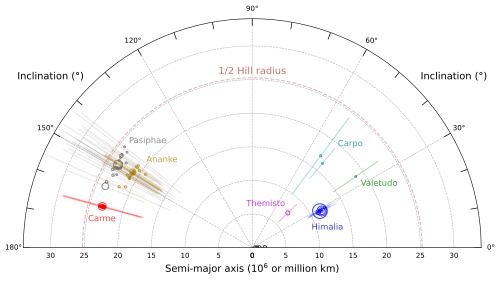
The Ananke group (or family or cluster) is a group of retrograde irregular satellites of Jupiter that follow similar orbits to Ananke and are thought to have a common origin.
Their semi-major axes (distances from Jupiter) range between 19.2 and 21.8 million km, their orbital inclinations between 144.3° and 155.5°, and their orbital eccentricities between 0.09 and 0.30.
The International Astronomical Union (IAU) reserves names ending in -e for all retrograde moons of Jupiter, including this group's members.
Origin
The Ananke group is believed to have been formed when an asteroid was captured by Jupiter and subsequently fragmented by a collision. This belief is founded on the fact that the dispersion of the mean orbital parametersa of the core members is very small and can be accounted for by a small velocity impulse (15 < δV < 80 m/s), compatible with a single collision and breakup.1
Based on the sizes of the satellites, the original asteroid may have been about 28 km in diameter. Since this value is near the approximate diameter of Ananke itself, it is likely the parent body was not heavily disrupted.2
Available photometric studies put this in doubt, however, and suggest that secular resonance has mixed the Ananke and Pasiphae groups: three of the moons of the former family (Harpalyke, Praxidike and Iocaste) display similar grey colours (average colour indices: B−V = 0.77 and V−R = 0.42) while Ananke itself is on the boundary between grey and light red.3
Classification
The Ananke group is typically simply visually identified in orbital element space, differing in inclination from the Carme group and having smaller semi-major axes than the Pasiphae group. However, some authors only consider the tight cluster immediately surrounding Ananke to be part of its group.145 At other times, there is no distinction made between the Ananke and Pasiphae groups, and the two may be considered a single group.367
List
The members of the Ananke group are (in order of date announcement):84
| Name | Diameter (km)9 |
Semi-Major Axis (km) |
Period (days)10b |
|---|---|---|---|
| Ananke | 28 | 21029500 | –623.11 |
| Iocaste | 5 | 21062300 | –624.55 |
| Harpalyke | 4 | 20887500 | –616.78 |
| Praxidike | 7 | 20931100 | –618.72 |
| Thyone | 4 | 20972700 | –620.59 |
| Hermippe | 4 | 21103600 | –626.38 |
| Euanthe | 3 | 20822900 | –613.93 |
| Orthosie | 2 | 20897800 | –617.23 |
| Euporie | 2 | 19261900 | –546.18 |
| Jupiter LXXIII | 2 | 20992900 | –621.47 |
| Eupheme | 2 | 20763400 | –611.32 |
| Helike | 4 | 20911400 | –617.86 |
| S/2003 J 12 | 1 | 20959300 | –619.96 |
| S/2003 J 16 | 2 | 20877500 | –622.88 |
| Jupiter LV | 2 | 20332800 | –592.33 |
| Mneme | 2 | 20815800 | –613.61 |
| Thelxinoe | 2 | 20972300 | –620.55 |
| Jupiter LII | 1 | 20786900 | –612.35 |
| Jupiter LIV | 1 | 20796700 | –612.78 |
| Jupiter LXIV | 2 | 20936500 | –618.97 |
| Jupiter LXVIII | 2 | 20960400 | –620.02 |
| Jupiter LXX | 3 | 21764200 | –656.05 |
| S/2021 J 1 | 1 | 20954700 | –619.77 |
| S/2021 J 2 | 1 | 20926600 | –618.50 |
| S/2021 J 3 | 2 | 20776600 | –611.87 |
| S/2022 J 3 | 1 | 21015100 | –622.44 |
| S/2017 J 10 | 2 | 21075800 | –625.15 |
| S/2010 J 6 | 2 | 21489800 | –643.67 |
| S/2021 J 8 | 1 | 20978900 | –620.85 |
Notes
Notes
- Osculating orbital parameters of irregular satellites of Jupiter change widely in short intervals due to heavy perturbation by the Sun. For example, changes of as much as 1 million km in semi-major axis in 2 years, 0.5 in eccentricity in 12 years, and as much as 5° in inclination in 24 years have been reported. Mean orbital elements are the averages calculated by the numerical integration of current elements over a long period of time, used to determine the dynamical families.
- Negative period is indicative of retrograde motion.
References
References
- Nesvorný, David; Alvarellos, Jose L. A.; Dones, Luke; Levison, Harold F. (July 2003). "Orbital and Collisional Evolution of the Irregular Satellites". The Astronomical Journal. 126 (1): 398–429. Bibcode:2003AJ....126..398N. doi:10.1086/375461. S2CID 8502734.
- Sheppard, Scott S.; Jewitt, David C. (5 May 2003). "An abundant population of small irregular satellites around Jupiter" (PDF). Nature. 423 (6937): 261–263. Bibcode:2003Natur.423..261S. doi:10.1038/nature01584. PMID 12748634. S2CID 4424447. Archived from the original (PDF) on 13 August 2006.
- Grav, Tommy; Holman, Matthew J.; Gladman, Brett; Aksnes, Kaare (2 January 2003). "Photometric Survey of the Irregular Satellites". Icarus. 166 (1): 33–45. arXiv:astro-ph/0301016. Bibcode:2003Icar..166...33G. doi:10.1016/j.icarus.2003.07.005. S2CID 7793999.
- Nesvorný, David; Beaugé, Cristian; Dones, Luke (2004). "Collisional Origin of Families of Irregular Satellites". The Astronomical Journal. 127 (3): 1768–1783. Bibcode:2004AJ....127.1768N. doi:10.1086/382099. S2CID 27293848 – via IOP Publishing.
- Brozović, Marina; Jacobson, Robert A. (1 April 2017). "The Orbits of Jupiter's Irregular Satellites". The Astronomical Journal. 153 (4): 147. Bibcode:2017AJ....153..147B. doi:10.3847/1538-3881/aa5e4d. ISSN 0004-6256.
- Grav, T.; Bauer, J. M.; Mainzer, A. K.; Masiero, J. R.; Nugent, C. R.; Cutri, R. M.; Sonnett, S.; Kramer, E. (4 August 2015). "NEOWISE: OBSERVATIONS OF THE IRREGULAR SATELLITES OF JUPITER AND SATURN". The Astrophysical Journal. 809 (1): 3. arXiv:1505.07820. Bibcode:2015ApJ...809....3G. doi:10.1088/0004-637X/809/1/3. ISSN 1538-4357. S2CID 5834661.
- Vilas, Faith; Hendrix, Amanda R. (1 February 2024). "Clues to the Origin of Jovian Outer Irregular Satellites from Reflectance Spectra". The Planetary Science Journal. 5 (2): 34. Bibcode:2024PSJ.....5...34V. doi:10.3847/PSJ/ad150b. ISSN 2632-3338. S2CID 267531422.
- Sheppard, Scott S.; Jewitt, David C.; Porco, Carolyn (2004). "Jupiter's outer satellites and Trojans" (PDF). In Bagenal, Fran; Dowling, Timothy E.; McKinnon, William B. (eds.). Jupiter. The planet, satellites and magnetosphere. Cambridge planetary science. Vol. 1. Cambridge, UK: Cambridge University Press. pp. 263–280. Bibcode:2004jpsm.book..263J. ISBN 0-521-81808-7. S2CID 117582048. Archived from the original (PDF) on 14 June 2007.
- "Moons of Jupiter". Earth & Planets Laboratory. Carnegie Institution for Science. 25 January 2024.
- "Planetary Satellite Mean Elements". Jet Propulsion Laboratory. California Institute of Technology. 25 January 2024.