Amide rings are small motifs in proteins and polypeptides. They consist of rings formed by two CO...HN hydrogen bonds between a side chain amide group and the main chain atoms of a short polypeptide.1 If this group is part of a ring then it makes a new compound called Lactam. There are a couple types of amide rings (lactams) and are classified by the size of the ring. β-lactam which is a 4-membered ring and is very strained and highly reactive. ү-lactam which is a 5 membered ring and is more stable. Lastly о̄-lactam which is a 6-membered ring and is the most stable out of the three.

They are observed with glutamine or asparagine side chains within proteins and polypeptides. Structurally similar rings occur in the binding of purine, pyrimidine and nicotinamide bases to the main chain atoms of proteins2. About 4% of asparagines and glutamines form amide rings; in databases of protein domain structures, one is present, on average, every other protein.
In such rings the polypeptide has the conformation of beta sheet or of type II polyproline helix (PPII). A number of glutamines and asparagines help bind short peptides (with the PPII conformation) in the groove of class II major histocompatibility complex proteins3 by forming these motifs. An 11-atom amide ring, involving a glutamine residue, occurs at the interior of the light chain variable domains of some immunoglobulin G antibodies and assists in linking the two beta-sheets.2
An amide ring is employed in the specificity of the adaptor protein GRB2 for a particular asparagine within proteins it binds. GRB2 binds strongly to the pentapeptide EYINQ (when the tyrosine is phosphorylated); 2in such structures a 9-atom amide ring occurs between the amide side chain of the pentapeptide's asparagine and the main chain atoms of residue 109 of GRB2.4 Hydrolysis of amide bonds can be slow under physiological conditions, they can become significant under extreme pH or enzymatic catalysis. Enzymes like protease are made to be able to break amide bonds in proteins which enable digestion and protein turnover. While non-enzymatic hydrolysis of amide rings need harsh conditions. Strained rings like the β-lactam bypass the stability because they react evenly even under mild conditions.
Key properties
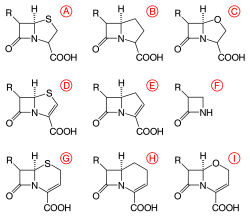
Amides are chemically stable but the small rings like β-lactam are less stable because of ring strain. For hydrolysis amide rings can be broken into carboxylic acid and amine depending on the conditions presented; reactivity depends on ring strain like the larger rings are more resistant while the smaller ones react easily. In typical amides resonance delocalization makes the C-N bond partially double which results in it being stable. In β-lactams the ring strain force bond angles to be around 90° instead of being around 120° which reduces resonance overlap between the nitrogen lone pair and carbonyl. This makes them highly reactive to nucleophiles. β-lactam rings mimic the D-Ala-D-Ala substrate of bacterial transpeptidase enzymes.2
The biological activity of the β-lactam antibiotics give good examples of how structural strain translates into function. These molecules inhibit bacterial cell wall synthesis by targeting transpeptidase enzymes, they are responsible for cross linking peptidoglycan strands. The β-lactam ring resembles the natural substrate of these enzymes that allow it to bind effectively. Once its bounds the strained ring opens and makes a covalent bond with the enzyme irreversibly inactivating it; this stops the bacterium from maintaining the cell wall, this leads to cell lysis5. Resistance to the β-lactam antibiotics was brought up as a major challenge in medicine. Some bacteria make an enzyme called β-lactamase which hydrolyzes the β-lactam ring before it can interact with its target. This shows how the same chemical reactivity that make them effective drugs can also make them vulnerable to degradation. In order to counter act this chemists made β-lactamase inhibitors and modified antibiotic structures to improve resistance to the breakdown.6 Another application of lactams is in the synthesis of biologically active natural products2. A lot of natural compounds have amide structures that are important for their activity and function. These compounds exhibit antimicrobial and anti-inflammatory properties. These natural systems have shown researchers how to design new drugs that can mimic these effects.
Function

In medicine they are used in drug design, they are very common in pharmaceuticals because of their balance stability, with the ability to bond to biological molecules. When it comes to target binding the amides hydrogen bonding helps drugs "dock" into the enzyme or receptors active sites. Adding an amide can improve water solubility while keeping lipophilicity to cross membranes. Thanks to amides being resistant to breakdown the drugs that use them last longer in the body.2 Amides are present in drugs such as penicillin, it has a strained cyclic amide or β-lactam which is important for the antibacterial activity it does.6 One important thing to remember is that not all amides act the same, while a cyclic amide can be more reactive than linear amides which is a reason why drugs like penicillin is able to break down bacteria cell walls.
In immunology the presence of an amide ring motifs can affect the antigen recognition. The proteins involved in an immune response need a subtle structural features to be able to tell between self and non-self molecules5. The formation of these rings can change the way a peptide fragments look which affects how they are seen and recognized by immune receptors.7 This shows how important amide rings are not only in structural biology, but also in communication between cells when defending the body against foreign molecules.
In synthetic chemistry amide rings are used as an intermediates or targets in the making of complex molecules. Chemists can change the ring size and stereochemistry to fine tune characteristics like solubility, reactivity, and biological activity. For example, cyclic amides can serve as scaffolds when it comes to drug development because they give a stable but changeable outline to which a functional group can be added, this makes amide rings valuable tools in medicinal chemistry.5
In material science, amide rings are also central to the properties of synthetic polymers. Nylon for example is a polyamide which repeating amide linkages give strength and durability. The hydrogen bonding in the chains give high tensile strength and resistance to deformation.7 These are not cyclic amides but the same principles of polarity, resonance, and hydrogen bonding still apply. This expresses how this broad relevance of amide chemistry in different types of sciences and fields.2
Additional information
Amide rings and lactams are more than simple motifs, they have a unique combination of stability, resonance, polarity, and reactivity. This allows them to have a diverse role in biology, medicine, and chemistry. These important and strong functional groups show how subtle molecular features can make a very big effect on function as well as structure.
References
References
- Le Questel, JY; Morris DG (1993). "Common ring motifs in proteins involving asparagine or glutamine groups hydrogen-bonded to main-chain atoms". Journal of Molecular Biology. 231 (3): 888–896. doi:10.1006/jmbi.1993.1335. PMID 8515458.
- Greenberg, Arthur; Breneman, Curt M.; Liebman, Joel F. (2000). The Amide Linkage: Structural Significance in Chemistry, Biochemistry, and Materials Science. John Wiley & Sons. ISBN 978-0-471-42025-5.
- Painter, CA; Negroni MP (2011). "Conformational Liability in Class II MHC 3/10-Helix". Proc Natl Acad Sci USA. 108 (48): 19329–19338. doi:10.1073/pnas.1108074108. PMC 3228433. PMID 22084083.
- Rahuel, J; Gay B (1996). "Structural basis for specificity of GRB-2-SH2 revealed by a novel ligand binding mode". Nat Struct Biol. 90 (7): 586–589. doi:10.1038/nsb0796-586. PMID 8673601. S2CID 1899970.
- "Amide - an overview | ScienceDirect Topics". www.sciencedirect.com. Retrieved 2026-05-13.
- Wang, Binju; Cao, Zexing (2011). "Acid-Catalyzed Reactions of Twisted Amides in Water Solution: Competition between Hydration and Hydrolysis". Chemistry – A European Journal. 17 (42): 11919–11929. doi:10.1002/chem.201101274. ISSN 1521-3765. PMID 21901771.
- Kaspar, Allan A.; Reichert, Janice M. (2013-09-01). "Future directions for peptide therapeutics development". Drug Discovery Today. 18 (17): 807–817. doi:10.1016/j.drudis.2013.05.011. ISSN 1359-6446. PMID 23726889.
External links
External links
- Greenberg A., Breneman C.M., Leibman J.F. (2000). "The Amide Linkage: Structural Significance, Biochemistry, and Material Science". Wiley: New York, NY, USA
- Mahesh, Sriram; Tang, Kuei-Chien; Raj, Monika (2018-10-12). "Amide Bond Activation of Biological Molecules". Molecules (Basel, Switzerland). 23 (10): 2615. doi:10.3390/molecules23102615. ISSN 1420-3049. PMC 6222841. PMID 30322008.
- Motivated Proteins
- Amide, "Science Direct Topics"
- Leader, DP; Milner-White (2009). "Motivated Proteins: A web application for studying small three-dimensional protein motifs". BMC Bioinformatics. 10 (1): 60. doi:10.1186/1471-2105-10-60. PMC 2651126. PMID 19210785.
- PDBeMotif
- Greenberg, Arthur, Curt M. Breneman, Joel Leibman, 2000 "The amide Linkage: Structural Significance in Chemistry, Biochemistry, and Material Science". Wiley-Interscience
- Golovin, A; Henrick (2008). "MSDmotif: exploring protein sites and motifs". BMC Bioinformatics. 9 (1): 312. Bibcode:2008BMCBi...9..312G. doi:10.1186/1471-2105-9-312. PMC 2491636. PMID 18637174.