| Amb Temples | |
|---|---|
| امب مندر (Urdu) | |
 The site consists of the ruins of two Hindu temples located in Pakistan's Salt Range mountains | |
Location of Amb Temples in Pakistan Show map of PakistanAmb Temples (South Asia) Show map of South Asia | |
| 32°30′30″N 71°56′12″E / 32.508402°N 71.936538°E / 32.508402; 71.936538 | |
| Type | Temple complex |
| Periods | Odi Shahi |
| Location | Khushab District, Punjab, Pakistan |
| Region | Salt Range |
| History | |
| Built | 9th–10th centuries CE.1 |
The Amb Temples (Urdu: امب مندر), are part of an abandoned Hindu temple complex located at the western edge of the Salt Range in Punjab, Pakistan. The temple complex was built in Gandhara Nagara style in the 9th to 10th centuries CE by the Odi Shahi dynasty.1
Location
The ruins are located near Amb Sharif village, on the Sakesar peak in the Soon Valley.1 The ruins form the westernmost ruins of a string of Hindu temples in the Salt Range that includes the Katas Raj Temples and Tilla Jogian monastic complex.
Architecture
The main temple, termed 'Temple B' by Michael W. Meister in his monograph on Odi Shahi temples,1 is roughly 15 metres tall, and built of kanjūr, a porous sedimentary rock widely used in Gandhara architecture, and mortar on a square plinth. It is regarded as the "loftiest" of temples built by the Odi Shahis.2 The temple ruins have three stories, with stairwells leading to inner ambulatories.3
The temple is decorated with Kashmiri style motifs on its exterior, including a cusped niche.3 The structure of the main temple, differs from Kashmiri temples which typically have pointed tops.3 The main temple is instead similar in style to the nearby Kalar temple, and Kafir Kot temple in Khyber Pakhtunkhwa province.4
To the west about 75 metres lies another smaller temple, termed 'Temple A' by Meister,1 which is 2 story or 7 to 8 meters high,5 and situated near a cliff. The temple features a small vestibule chamber facing towards the main temple. It was a few metres from a second similarly sized temple, which no longer exists.3 The entire temple complex was surrounded by a fortification, with the earliest construction at the site dating to the late Kushan period.3
Conservation
The site was visited by Alexander Cunningham in the late 19th century, and was partly conserved in 1922–24 by Daya Ram Sahni.3 The temple had been looted over the centuries. The last remaining statuary was taken in the late 19th century and placed in the Lahore Museum.3 The site is currently protected by Pakistan's Antiquities Act (1975).
Gallery
-
 The main temple
 -
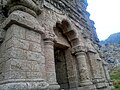 The main temple features a Kashmiri-style cusped archway
 -
 A view of the smaller temple with its vestibule chamber
 -
 The base of the main temple
 -
 A view of the main temple's plinth
References
References
- Meister, Michael W. (26 July 2010). Temples of the Indus: Studies in the Hindu Architecture of Ancient Pakistan. BRILL. pp. 29–31. ISBN 978-90-04-19011-5.
- Rashid, Salman (2001). The Salt Range and the Potohar Plateau. Sang-e-Meel Publications. p. 134. ISBN 9789693512571.
- Meister, Michael (2005). "Fig Gardens of Amb-Sharif, Folklore and Archaeology". East and West. 55 (1/4). Istituto Italiano per l'Africa e l'Oriente: 201–216. JSTOR 29757645.
- Journal of the Royal Asiatic Society of Great Britain and Ireland. Cambridge University Press for the Royal Asiatic Society. 1903. Retrieved 21 September 2017.
- Amir, Tariq (12 May 2014). "Pakistan Geotagging: Hindu Temple At Amb".