| Leptospermum rupestre | |
|---|---|
| |
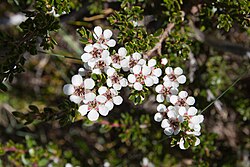
| Leptospermum rupestre, Walls of Jerusalem National Park | |
Scientific classification 
| |
| Kingdom: | Plantae |
| Clade: | Embryophytes |
| Clade: | Tracheophytes |
| Clade: | Spermatophytes |
| Clade: | Angiosperms |
| Clade: | Eudicots |
| Clade: | Rosids |
| Order: | Myrtales |
| Family: | Myrtaceae |
| Genus: | Leptospermum |
| Species: | L. rupestre
|
| Binomial name | |
| Leptospermum rupestre | |
| |
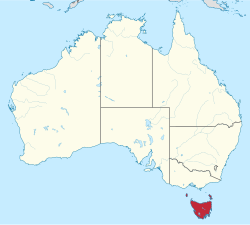
| Leptospermum rupestre is endemic to Tasmania2 | |
| Synonyms2 | |
| |
Leptospermum rupestre, commonly known as alpine tea-tree or prostrate tea-tree,3 is a flowering shrub in the myrtle family, Myrtaceae. It is endemic to Tasmania. In alpine areas it assumes a prostrate habit while in subalpine areas it appears as a large shrub.
Description
Leptospermum rupestre is a common alpine and subalpine shrub in Tasmania. The growth habit varies, at higher exposed altitudes it is a prostrate plant up to 1 m (3 ft 3 in) high. At lower altitudes it can become a large shrub to 4 m (13 ft) high. It has small, blunt, shiny dark green, oval to elliptic shaped leaves, 2–9 mm (0.079–0.354 in) long. The white flowers are small 1 cm (0.39 in) wide, 5 petalled, with an open habit and flower in profusion in leaf axils during summer. The reddish branches become mat-forming over rocks. The small seed capsules are about 5 mm (0.20 in) in diameter.456
Taxonomy and naming
Leptospermum rupestre was first formally described in 1840 by botanist Joseph Dalton Hooker and the description was published in Icones Plantarum.78 Robert Brown observed it growing on rocky outcrops on Mount Wellington and nearby mountains. The word rupestre is derived from the Latin word rupestris,9 meaning rocky, referring to the habitat where it was found.7
Distribution and habitat
This species is endemic to Tasmania, found growing in a sunny situation on light to medium soils.3
Cultivation
It is one of the hardiest species of its genus and is suitable for cultivation outdoors.10
References
References
- "Leptospermum rupestre". Australian Plant Census. Retrieved 9 November 2019.
- "Leptospermum rupestre Hook.f." Plants of the World Online. Royal Botanic Gardens, Kew. Retrieved 4 January 2024.
- "Leptospermum rupestre". Ole Lantana's Seed Store. Retrieved 20 December 2019.
- Wrigley, John W.; Fagg, Murray (2001). Australian Native Plants. Louise Eggerton-Read New Holland. ISBN 1-876334-30-4.
- "Leptospermum rupestre". Australian Native Plants-Online. Retrieved 19 December 2019.
- "Leptospermum rupestre (Myrtaceae)". Key to Tasmanian vascular plants. University of Tasmania. Retrieved 10 January 2012.
- "Icones Plantarum". Biodiversity Heritage Library. Retrieved 18 December 2019.
- "Leptospermum rupestre". Australian Plant Name Index. Retrieved 19 December 2019.
- Francis Aubie Sharr (2019). Western Australian Plant Names and their Meanings. Kardinya Western Australia: Four Gables Press. p. 299. ISBN 9780958034180.
- Dawson, M. (2012). "Australian Leptospermum in cultivation: species and cultivars." NZ Garden J, 15, 14-22.