| Allosyncarpia | |
|---|---|
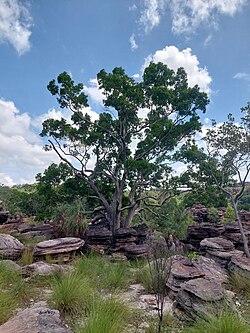
| |
Scientific classification 
| |
| Kingdom: | Plantae |
| Clade: | Embryophytes |
| Clade: | Tracheophytes |
| Clade: | Spermatophytes |
| Clade: | Angiosperms |
| Clade: | Eudicots |
| Clade: | Rosids |
| Order: | Myrtales |
| Family: | Myrtaceae |
| Subfamily: | Myrtoideae |
| Tribe: | Eucalypteae |
| Genus: | Allosyncarpia S.T.Blake |
| Species: | A. ternata
|
| Binomial name | |
| Allosyncarpia ternata | |
Allosyncarpia is a genus of plant in the eucalypt family Myrtaceae. It contains a single species, Allosyncarpia ternata, which is endemic to the Northern Territory, Australia. Both were described in 1981 by Stanley Thatcher Blake of the Queensland Herbarium.
Description
Allosyncarpia ternata is a spreading, shady tree with grey fibrous bark, reaching about 18 m (59 ft) in height. The leaves are somewhat stiff and arranged in whorls of three around the twigs, each attached by a petiole up to 10 mm (0.39 in) long. The leaves grow up to 11 cm (4.3 in) long and 3 cm (1.2 in) wide, and are narrowly ovate to elliptic, with 16–22 pairs of lateral veins.34
Flowers are arranged in groups of three in racemose or paniculate inflorescences. They have five petals and numerous stamens. The fruit is a two-celled capsule which splits open at maturity, but usually only one cell contains a seed.34
Distribution and habitat
They grow in sandstone gorges along creeks emerging from the Arnhem Land plateau. The tree dominates the closed monsoon rainforest communities along the sandstone escarpment of the western Arnhem Land Plateau. The distribution of the species appears to be limited to areas not subject to wildfire.56
Ecology
Allosyncarpia dominated rainforest is an important vegetation community along the floristic boundary between the patches of monsoon forest that are sheltered from wildfire, and the fire-tolerant, eucalypt dominated, tropical savannas.57 A species of sandstone favouring monitor, the long-tailed Varanus glebopalma, is closely associated with Allosyncarpia woodland in some parts of its range.8
Conservation status
This plant has been assessed as being of least concern under the Northern Territory government's Territory Parks and Wildlife Conservation Act.9 As of March 2026, the International Union for Conservation of Nature has not rated this species.
Etymology
The common name anbinik comes from the Kundedjnjenghmi and Kundjeyhmi dialects of Bininj Kunwok, spoken in West Arnhem Land. In other dialects, such as the Kunwinjku spoken in Gunbalanya, the tree is known as manbinik.10
References
References
- "Allosyncarpia ternata S.T.Blake". Australian Plant Name Index (APNI). Centre for Australian National Biodiversity Research, Australian Government. Retrieved 25 March 2026.
- "Allosyncarpia ternata S.T.Blake". Plants of the World Online. Royal Botanic Gardens, Kew. 2026. Retrieved 25 March 2026.
- F.A.Zich; B.P.M.Hyland; T.Whiffen; R.A.Kerrigan (2020). "Allosyncarpia ternata S.T.Blake". Australian Tropical Rainforest Plants (RFK8). Centre for Australian National Biodiversity Research (CANBR), Australian Government. Retrieved 27 May 2021.
- Blake, S.T. (1977). "Allosyncarpia ternata, a new genus and species of Myrtaceae subfamily Leptospermoideae from northern Australia". Austrobaileya. 1 (1): 43–46. Retrieved 25 March 2026.
- Freeman, Jeremy; Edwards, Andrew; Russell-Smith, Jeremy (2017). "Fire-Driven Decline of Endemic Allosyncarpia Monsoon Rainforests in Northern Australia". Forests. 8 (12): 481. doi:10.3390/f8120481.
- Bowman, D.M.J.S. (1991). "Environmental determinants of Allosyncarpia ternata forests that are endemic to western Arnhem Land, northern Australia". Australian Journal of Botany. 39 (6): 575–589. doi:10.1071/BT9910575.
- Russell-Smith, J.; Lucas, D.E.; Brock, J.; Bowman, D.M.J.S. (1993). "Allosyncarpia-dominated rain forest in monsoonal northern Australia". Journal of Vegetation Science. 4 (1): 67–82. doi:10.2307/3235734. JSTOR 3235734.
- Shea, G.; Cogger, H. (2018). "Black-palmed Rock Monitor". IUCN Red List of Threatened Species. 2018 e.T83778099A101752315. doi:10.2305/IUCN.UK.2018-1.RLTS.T83778099A101752315.en. Retrieved 24 March 2026.
- Cowie I, Lewis D, et al. (2013). "Allosyncarpia ternata S.T.Blake". FloraNT, Northern Territory Herbarium. Northern Territory Government, Darwin. Retrieved 25 March 2026.
- Garde, Murray. "manbinik". Bininj Kunwok dictionary. Bininj Kunwok Regional Language Centre. Retrieved 24 June 2019.
External links
External links
- Map of recorded sightings of this species at the Australasian Virtual Herbarium
- Observations of this species on iNaturalist
- Images of this species on Flickriver.com