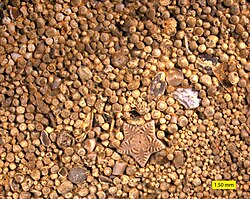
The term Allochem was introduced by sedimentary petrologist Robert L. Folk as part of his petrographic classification of limestones1 to describe the recognizable "grains" in carbonate rocks. Examples would include ooids, peloids, oncolites, pellets, fossil or pre-existing carbonate fragments. Fragments are still termed allochems if they have undergone chemical transformations – for example, if an aragonite shell were to dissolve and be later replaced by calcite, the replacement would still be deemed an allochem.2
The allochems are typically embedded in a matrix of micrite (< 5 μm in lime mud) or sparry calcite (larger calcite crystals in the size range 20–100 μm).
References
References
- Folk, R. L. (1959) Practical petrographic classification of limestones. American Association of Petroleum Geologists Bulletin. 43, pp. 1–38.
- Scholle, P. A., and D. S. Ulmer-Scholle (2003) A Color Guide to the Petrography of Carbonate Rocks: Grains, textures, porosity, diagenesis. American Association of Petroleum Geologists Memoir no. 77. Tulsa, Oklahoma, American Association of Petroleum Geologists. 474 pp. ISBN 0-89181-358-6