| Ali عليّ | |
|---|---|
| Amir al-Mu'minin Abu al-Hasan Asadullah al-Murtaḍā ʿAlayhi-s-Salām Raḍiya Ilāhu ʿAnhū | |
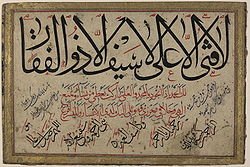
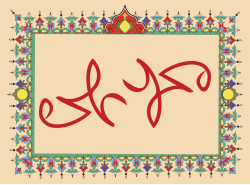
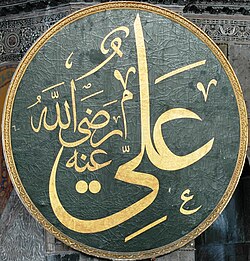 Calligraphic seal featuring Ali's name, on display in the Hagia Sophia, Istanbul 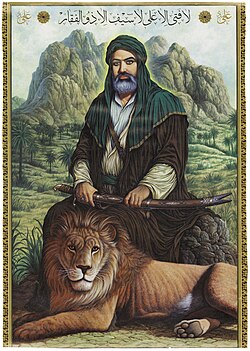 A conventional depiction of Ali ibn Abi Talib in the Shia tradition | |
| 4th Caliph of the Rashidun Caliphate | |
| Reign | 17 June 656 – 28 January 661 (4 years, 226 days) |
| Predecessor | Uthman |
| Successor | Hasan ibn Ali (as caliph)1 |
| 1st Shia Imam | |
| Tenure | 8 June 632–28 January 661 |
| Predecessor | Established position |
| Successor | Hasan ibn Ali |
| Born | c. 600 CE Mecca, Hejaz, Arabia |
| Died | c. 28 January 661 CE (c. 21 Ramadan 40 AH) (aged c. 60) Kufa, Rashidun Caliphate |
| Burial | |
| Spouse |
|
| Issue | Descendants of Ali
|
| Tribe | Quraysh (Banu Hashim) |
| Father | Abu Talib ibn Abd al-Muttalib |
| Mother | Fatima bint Asad |
| Religion | Islam |
Ali ibn Abi Talib (Arabic: عليّ بن أبي طالب, romanized: ʿAlī ibn Abī Ṭālib; c. 600 – 661 CE) was the fourth Rashidun caliph who ruled from 656 CE until his assassination in 661, as well as the first Shia Imam. He was the cousin and son-in-law of the Islamic prophet Muhammad. Born to Abu Talib ibn Abd al-Muttalib and Fatima bint Asad, Ali was raised in the household of his cousin Muhammad and was among the first to accept his teachings.
Ali played a pivotal role in the early years of Islam when Muslims were severely persecuted in Mecca. After the immigration (hijra) to Medina in 622, Muhammad gave his daughter Fatima to Ali in marriage and swore a pact of brotherhood with him. Ali served as Muhammad's secretary and deputy in this period, and was the flag-bearer of his army. Numerous sayings of Muhammad praise Ali, the most controversial of which was uttered in 632 at the Ghadir Khumm, "Whoever I am his mawla, then Ali is his mawla." The interpretation of the polysemous Arabic word mawla is disputed: for Shia Muslims, Muhammad thus invested Ali with his religious and political authority, while Sunni Muslims view this as a mere statement of friendship and rapport. When Muhammad died in the same year, a group of Muslims met in the absence of Ali and appointed Abu Bakr (r. 632–634) as their leader. Ali later relinquished his claims to leadership and resigned from public life during the reigns of Abu Bakr and his successor, Umar (r. 634–644). Even though his advice was occasionally sought, the conflicts between Ali and the first two caliphs are epitomized by his refusal to follow their practices. This refusal cost Ali the caliphate to the benefit of Uthman (r. 644–656), who was thus appointed to succeed Umar by the electoral council. Ali was also highly critical of Uthman, who was widely accused of nepotism and corruption. Yet Ali also repeatedly mediated between the caliph and the provincial dissidents angered by his policies.
Following Uthman's assassination in June 656, Ali was elected caliph in Medina. He immediately faced two separate rebellions to avenge Uthman: The triumvirate of Talha, Zubayr, both companions of Muhammad, and his widow Aisha captured Basra in Iraq but were defeated by Ali in the Battle of the Camel in 656. Elsewhere, Mu'awiya, whom Ali had removed from the governorship of Syria, fought against Ali in the inconclusive Battle of Siffin in 657, which ended in a failed arbitration process that alienated some of Ali's supporters. These formed the Kharijites, who later terrorized the public and were crushed by Ali in the Battle of Nahrawan in 658. Ali was assassinated in 661 by the Kharijite dissident Ibn Muljam, which paved the way for Mu'awiya to seize power and found the dynastic Umayyad Caliphate.
Ali is revered for his courage, honesty, unbending devotion to Islam, magnanimity, and equal treatment of all Muslims. For his admirers, he has thus become the archetype of uncorrupted Islam and pre-Islamic chivalry. Sunni Muslims regard him as the last of the rashidun (lit. 'rightly-guided') caliphs, while Shia Muslims venerate him as their first Imam and the rightful religious and political successor to Muhammad. Ali's place is said to be second only to Muhammad in Shia Muslim culture. The shrine of Ali in Najaf, Iraq, is a major destination for Shia pilgrimage. The legacy of Ali is collected and studied in numerous books, the most famous of which is Nahj al-balagha.
Historical Reliability
Unveiling Ali's inner world is highly important for religious groups such as Shia and Alawite; similarly, presenting his pure and unexaggerated story as the Rashidun Caliph is historically significant. However, this period is archaeologically poor2 and largely consists of oral traditions until the rise of the Abbasids.3

Much has been written about Ali in Islamic literature, second only to Muhammad.5 However, the sayings and stories attributed to him are compilations from several centuries after his time. For example Nahj al-balāgha is the best-known collection of sermons, letters, and sayings attributed to Ali was the compilation credited to Sharif al-Radi (d. 1015).6 Critics of hadith emphasize that, among other things, the most common forms of fabricated hadith are those of a political nature,7 which include the glorification (fadail) of future caliphs8 and imams (imams in Shi'ism9 also hold political identities), the condemnation of rivals,a or warnings that provide clear information about future events and seditions (Vaticinium ex eventu). Undeniable gaps between individuals' historical identity and their narrative-imaginative identity and life stand before historians as indisputable realities. These identities are sometimes supernatural personalities to whom or their representatives (Imams, Qutbs, Sheikhs) are attributed with unseen powers, including special inspirations and detailed knowledge of the future (books of the unseen), extraordinary charisma beyond human limits10 to the point of arranging the universe for them (the sunset is delayed for Ali’s prayer11), and help in great crises ("help me Muhammad, help me Ali").
Limited archaeological evidence suggests that the Rashidun period lacked a distinct Islamic identity,12 and that its early conquests were likely a secular Arabic expansion rather than a religiously-Islamic driven expansion. The expansion neither forced the population to convert to Islam nor oppressed the non-Muslim population.13
New historical research has cast doubt on classic accounts of the geographical origin and history of Islamb. Furthermore, some researchers, such as Volker Popp, consider names like Ali (the exalted one) and Muhammad not as names but as titles.c
Birth and early life
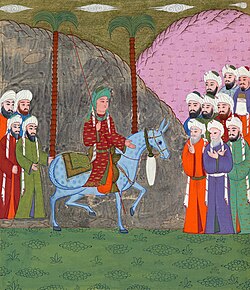
Ali was born in tradition to Abu Talib ibn Abd al-Muttalib and his wife Fatima bint Asad around 600 CE,18 possibly 13 Rajab,195 which is the occasion celebrated annually by Shia Muslims.20 Ali may have been also the only person born inside the Ka'ba,51918 the holiest site of Islam, which is located in Mecca. Ali's father was a leading member of the Banu Hashim, a clan within the Meccan tribe of Quraysh.19 However, modern historians do not accept genealogies from the pre-Islamic and early Islamic periods as verifiable information. Genealogies were oral products of the ayyām (Days of the Arabs) culture, which was established in Bedouin and semi-Bedouin Arab communities, as part of other traditional narrative forms based on lineage boasting. This form of transmission is one in which narratives are transmitted in a flexible manner, reshaped according to the social expectations present in each performance and the interaction between the narrator and the listener.21 According to tradition, Abu Talib raised his nephew Muhammad, whose parents had died, and later, when Abu Talib fell into poverty, Muhammad became wealthy by marrying Khadija, a rich woman. Therefore, Ali came under the guardianship of Muhammad and his wife Khadija when Ali was about five years old.5
Aged about eleven,18 Ali was among the first to accept Muhammad's teachings and profess Islam. Ali did so either after Khadija or after Khadija and Muhammad's successor, Abu Bakr. While the precise order here is debated among Shia and Sunni scholars,22 the earliest sources place Ali before Abu Bakr.18 Muhammad's call to Islam in Mecca lasted from 610 to 622, during which Ali assiduously supported the small Muslim community, especially the poor.5 Some three years after his first revelation,23 Muhammad gathered his relatives for a feast, invited them to Islam, and asked for their assistance.24 Aged about fourteen,2425 Ali was the only relative there who offered his support, after which Muhammad told his guests that Ali was his brother and his successor,1824 according to the Sunni historian al-Tabari (d. 923). The Shia interpretation of this episode is that Muhammad had already designated Ali as his successor.2426
Companionship of Muhammad
When tipped off about an assassination plot in 622, Muhammad escaped to Yathrib, now known as Medina, but Ali stayed behind as his decoy.527 That Ali risked his life for Muhammad is said to be the reason for the revelation of the Quranic passage, "But there is also a kind of man who gives his life away to please God."282919 This emigration marks the beginning of the Islamic calendar (AH). Ali also escaped Mecca after returning the goods that had been entrusted to Muhammad there.22 Later in Medina, Muhammad selected Ali as his brother when he paired Muslims for fraternity pacts.30 Around 623–625, Muhammad gave his daughter Fatima to Ali in marriage,3132 aged about twenty-two at the time.5 Muhammad had earlier turned down marriage proposals for Fatima by some of his companions, notably, Abu Bakr and Umar.333234
Event of the mubahala
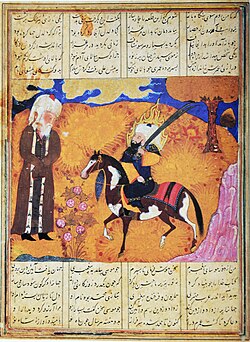
A Christian envoy from Najran, located in South Arabia, arrived in Medina circa 632 and negotiated a peace treaty with Muhammad.3536 The envoy also debated with Muhammad the nature of Jesus, human or divine.3738 Linked to this episode is verse 3:61 of the Quran,39 which instructs Muhammad to challenge his opponents to mubahala (lit. 'mutual cursing'),40 perhaps when their debate had reached a deadlock.38 Even though the delegation ultimately withdrew from the challenge,36 Muhammad appeared for the occasion of mubahala, accompanied by Ali, his wife Fatima, and their two sons, Hasan and Husayn.4130 The inclusion of these four by Muhammad in the mubahala ritual, as his witnesses and guarantors,4243 likely raised their religious rank within the community.3744 If the word 'ourselves' in the verse is a reference to Ali and Muhammad, as Shia authors argue, then the former naturally enjoys a similar religious authority in the Quran as the latter.4546
Political career
In Medina, Ali acted as Muhammad's secretary and deputy.4722 He was also one of the scribes tasked with committing the Quran to writing.5 In 628, Ali wrote down the terms of the Treaty of al-Hudaybiya, the peace treaty between Muslims and Meccan pagans. In 630, divine orders pushed Muhammad to replace Abu Bakr with Ali for a key Quranic announcement in Mecca,4849 according to the canonical Sunni source Sunan al-Nasa'i.19 Ali also helped ensure that the Conquest of Mecca in 630 was bloodless and later destroyed the idols housed in Ka'ba.5 In 631, Ali was sent to preach Islam in Yemen,5 as a consequence of which the Hamdanids peacefully converted.2719 Ali also peacefully resolved a blood feud between Muslims and the Banu Jadhima.19
Military career
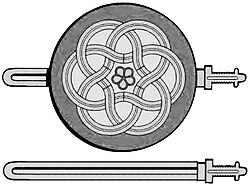
Ali accompanied Muhammad in all of his military missions except the Expedition of Tabuk in 630, during which Ali was left behind in charge of Medina.27 The hadith of the position is linked to this occasion, "Are you not content, Ali, to stand to me as Aaron stood to Moses, except that there will be no prophet after me?" This statement appears in the canonical Sunni sources Sahih al-Bukhari and Sahih Muslim, among others.50 For the Shia, this hadith signifies Ali's usurped right to succeed Muhammad.51 In the absence of Muhammad, Ali commanded the expedition to Fadak in 628.225
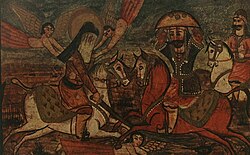
Ali was renowned for his bravery on the battlefield,3022 and for his magnanimity towards his defeated enemies.52 He was the standard-bearer in the Battle of Badr (624) and the Battle of Khaybar (628).47 He vigorously defended Muhammad in the Battle of Uhud (625) and the Battle of Hunayn (630),305 and Muslims' victory in the Battle of Khaybar has been attributed to his courage,22 where he is said to have torn off the iron gate of the enemy fort.30 Ali also defeated the pagan champion Amr ibn Abd Wudd in the Battle of the Trench in 627.19 According to al-Tabari,19 Muhammad reported hearing a divine voice at Uhud, "[There is] no sword but Zulfiqar [Ali's sword], [there is] no chivalrous youth (fata) but Ali."495 Ali and another companion, Zubayr, apparently oversaw the killing of the Banu Qurayza men for treachery in 626–627,22 though the historicity of this account has been doubted.535455
Ghadir Khumm
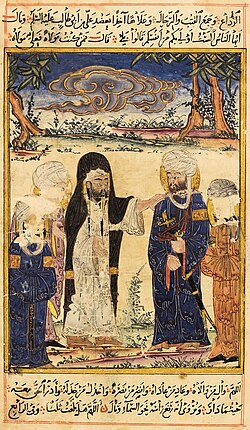
On his return trip from the Hajj pilgrimage in 632, Muhammad halted the large caravan of pilgrims at the Ghadir Khumm and addressed them after the congregational prayer.56 After the prayer,57 Muhammad delivered a sermon to a large number of Muslims in which he emphasized the importance of the Quran and his ahl al-bayt (lit. 'people of the house', his family).58596061 Taking Ali by the hand, Muhammad then asked if he was not awla (lit. 'have more authority over' or 'closer to') the believers than themselves,6162 this is evidently a reference to verse 33:6 of the Quran.6364 When they affirmed,61 Muhammad then declared, "He whose mawla I am, Ali is his mawla."6561 Musnad Ibn Hanbal, a canonical Sunni source, adds that Muhammad repeated this statement three or four more times and that Umar congratulated Ali after the sermon, "You have now become the mawla of every faithful man and woman."6660 Muhammad had earlier alerted Muslims about his impending death.675868 Shia sources describe the event in greater detail, linking the announcement to verses 5:3 and 5:67 of the Quran.67
The authenticity of the Ghadir Khumm is rarely contested,61697058 as it is "among the most extensively acknowledged and substantiated" reports in classical Islamic sources.71 However, mawla is a polysemous Arabic word and its interpretation in the context of the Ghadir Khumm is split along sectarian lines. Shia sources interpret mawla as 'leader', 'master', and 'patron',72 while Sunni sources interpret it as love or support for Ali.573 Shias, therefore, view the Ghadir Khumm as the investiture of Ali with Muhammad's religious and political authority,747519 while Sunnis regard it as a statement about the rapport between the two men,55876 or that Ali should execute Muhammad's will.5 Shias point to the extraordinary nature of the announcement,73 give Quranic and textual evidence,776758 and argue to eliminate other meanings of mawla in the hadith except for authority,78 while Sunnis minimize the importance of the Ghadir Khumm by casting it as a simple response to earlier complaints about Ali.79 During his caliphate, Ali is known to have asked Muslims to come forward with their testimonies about the Ghadir Khumm,808182 presumably to counter challenges to his legitimacy.83
Life under Rashidun Caliphs
Succession to Muhammad
Saqifa
Muhammad died in 632 when Ali was in his early thirties.84 As he and other close relatives prepared for the burial,8586 a group of the Ansar (Medinan natives, lit. 'helpers') gathered at the Saqifa to discuss the future of Muslims or to retake control of their city, Medina. Abu Bakr and Umar were among the few representatives of the Muhajirun (Meccan converts, lit. 'migrants') at the Saqifa.87 The case of Ali was unsuccessfully brought up at the Saqifa in his absence,8889 and, ultimately, those present there appointed Abu Bakr to leadership after a heated debate that is said to have become violent.90 Clan rivalries at the Saqifa played a key role in favor of Abu Bakr,8591 and the outcome may have been different in a broad council (shura) with Ali as a candidate.9293 In particular, the Quraysh tradition of hereditary succession strongly favored Ali,949596 even though his youth weakened his case.2284 By contrast, the succession (caliphate) of Abu Bakr is often justified on the basis that he led some of the prayers in Muhammad's final days,8597 but the veracity and political significance of such reports have been questioned.859899
Attack on Fatima's house
While the appointment of Abu Bakr was met with little resistance in Medina,97 the Banu Hashim and some companions of Muhammad soon gathered in protest at Ali's house.100101 Among them were Zubayr and Muhammad's uncle Abbas.101 These protestors held Ali to be the rightful successor to Muhammad,32102 probably in reference to the Ghadir Khumm.58 Among others,103 al-Tabari reports that Umar then led an armed mob to Ali's residence and threatened to set the house on fire if Ali and his supporters did not pledge their allegiance to Abu Bakr.10432105106 The scene soon grew violent,103107 but the mob retreated after Ali's wife, Fatima, pleaded with them.104 Abu Bakr later placed a successful boycott on the Banu Hashim,108 who eventually abandoned their support for Ali.108109 Most likely, Ali himself did not pledge his allegiance to Abu Bakr until Fatima died within six months of her father, Muhammad.110 In Shia sources, the death (and miscarriage) of the young Fatima are attributed to an attack on her house to subdue Ali by the order of Abu Bakr.11132102 Sunnis categorically reject these reports,112 but there is evidence in their early sources that a mob entered Fatima's house by force and arrested Ali,113114115 an incident that Abu Bakr regretted on his deathbed.116117 Likely a political move to weaken the Banu Hashim,118119120121 Abu Bakr had earlier confiscated from Fatima the rich lands of Fadak, which she considered her inheritance (or a gift) from her father.122123 The confiscation of Fadak is often justified in Sunni sources with a hadith about prophetic inheritance, the authenticity of which has been doubted partly because it contradicts Quranic injunctions.122124
Caliphate of Abu Bakr (r. 632–634)
In the absence of popular support, Ali eventually accepted the temporal rule of Abu Bakr, probably for the sake of Muslim unity.125126127 In particular, Ali turned down proposals to forcefully pursue the caliphate.12822 He nevertheless viewed himself as the most qualified candidate for leadership by virtue of his merits and his kinship with Muhammad.129130131 Evidence suggests that Ali further considered himself as the designated successor of Muhammad.13281133 Unlike Muhammad's lifetime,134135 Ali retired from public life during the caliphates of Abu Bakr and his successors, Umar and Uthman.513430 Ali did not participate in the Ridda wars and the early Muslim conquests,30 though he remained an advisor to Abu Bakr and Umar on government and religious matters.,530 However, their conflicts with Ali is also well-documented,136137138 but largely ignored in Sunni sources.139140 These tensions were epitomized during the proceedings of the electoral council in 644 when Ali refused to be bound by the precedence of the first two caliphs.135134 In contrast, Shia sources view Ali's pledge to Abu Bakr as a (coerced) act of political expediency (taqiya).141 The conflicts with Ali are probably magnified in Shia sources.139
Caliphate of Umar (r. 634–644)
Before his death in 634, Abu Bakr designated Umar as his successor.142 Ali was not consulted about this appointment, which was initially resisted by some senior companions.143 Ali himself did not press any claims this time and kept aloof from public affairs during the caliphate of Umar,144 who nevertheless consulted Ali in certain matters.5145 For instance, Ali is credited with the idea of adopting the migration to Medina (hijra) as the beginning of the Islamic calendar.27 Yet Ali's political advice was probably ignored.22 For example, Umar devised a state register (diwan) to distribute excess state revenues according to Islamic precedence,146 but Ali held that those revenues should be equally distributed among Muslims, following the practice of Muhammad and Abu Bakr.14722 Ali was also absent from the strategic meeting of notables near Damascus.22 Ali did not participate in Umar's military expeditions,14818 although he does not seem to have publicly objected to them.18 Umar likely opposed the combination of prophethood and caliphate in the Banu Hashim,149150 and he prevented Muhammad from dictating his will on his deathbed,59151152 possibly fearing that he might expressly designate Ali as his successor.153 Nevertheless, perhaps realizing the necessity of Ali's cooperation in his collaborative scheme of governance, Umar made some limited overtures to Ali and the Banu Hashim during his caliphate.154 For instance, Umar returned Muhammad's estates in Medina to Ali, but kept Fadak and Khayber.155 By some accounts, Umar also insisted on marrying Ali's daughter Umm Kulthum, to which Ali reluctantly agreed when the former enlisted public support for his demand.156
Election of Uthman (644)
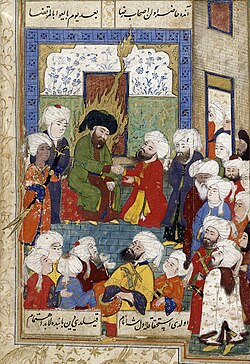
Before his death in 644,157 Umar tasked a small committee with choosing the next caliph among themselves.158 Ali and Uthman were the strongest candidates in this committee,159160 whose members were all early companions of Muhammad from the Quraysh tribe.158 Another member, Abd al-Rahman ibn Awf, was given the deciding vote either by the committee or by Umar.161162163 After deliberations, Ibn Awf appointed his brother-in-law Uthman as the next caliph,164165 when the latter promised to follow the precedent of the first two caliphs.164 By contrast, Ali rejected this condition,164163 or gave an evasive answer.166 The Ansar were not represented in the committee,167162 which was evidently biased toward Uthman.168169163 Both of these factors worked against Ali,162170171 who could not have been simply excluded from the proceedings.172
Caliphate of Uthman (r. 644–656)
Uthman was widely accused of nepotism,173 corruption,174175 and injustice.176 Ali too criticized Uthman's conduct,2218177 including his lavish gifts for his kinsmen.178179 Ali also protected outspoken companions, such as Abu Dharr and Ammar,180181 and overall acted as a restraining influence on Uthman.180 Some supporters of Ali were part of the opposition movement,182183 joined in their efforts by Talha and Zubayr, both senior companions of Muhammad, and by his widow Aisha.184185182 Among such supporters of Ali were Malik al-Ashtar and other religiously learned qurra (lit. 'Quran readers').186179 These supporters wanted to see Ali as the next caliph but there is no evidence that he coordinated with them.187 Ali also rejected the requests to lead the rebels,22188 although he probably sympathized with their grievances.189188 He was therefore considered a natural focus for the opposition,190 at least morally.22
Assassination of Uthman (656)
As their grievances mounted, provincial dissidents poured into Medina in 656.30 The Egyptian opposition sought the advice of Ali, who urged them to negotiate with Uthman.191192 Ali similarly asked the Iraqi opposition to refrain from violence, which they heeded.193 He also repeatedly mediated between Uthman and the dissidents,30194195 to address their economic and political grievances.19630 In particular, Ali negotiated and guaranteed the agreement that ended the first siege.19730 He then convinced Uthman to publicly repent,198 which the caliph did but then retracted his statement, possibly influenced by his secretary Marwan ibn al-Hakam.199 Egyptian rebels laid siege to Uthman's residence for a second time when they intercepted an official letter ordering their punishment. They demanded the caliph's abdication but he refused and maintained his innocence about the letter,200 for which Marwan is often blamed in the early sources.201202 Ali also sided with Uthman,200 but the caliph apparently accused him about the letter.203 This is probably when Ali refused to further intercede for Uthman,200190 who was assassinated soon after by Egyptian rebels.201204205 Ali played no role in the deadly attack,22206 and his son Hasan was injured while guarding Uthman's besieged residence at Ali's behest.5207182 He also convinced the rebels to deliver water to Uthman's house during the siege.200180
Caliphate
Election (656)
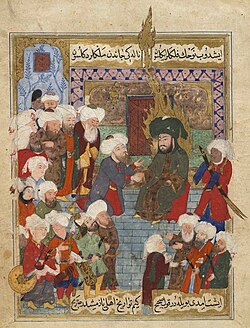
When Uthman was assassinated in 656 by Egyptian rebels,201 the potential candidates for caliphate were Ali and Talha. The Umayyads had fled Medina, leaving the provincial rebels and the Ansar in control of the city. Among the Egyptians, Talha enjoyed some support, but the Iraqis and most of the Ansar supported Ali.125 The majority of the Muhajirun,30188208 and key tribal figures also favored Ali at this time.209 The caliphate was offered by these groups to Ali, who, after some hesitation,1883018 publicly took the oath of office.210211212 Malik al-Ashtar might have been the first to pledge his allegiance to Ali.212 Talha and Zubayr, who both aspired to the caliphate,213214 also gave their pledges to Ali, most likely willingly,18215207 but later broke their oaths.21618217 Ali probably did not force anyone to pledge,210 and there is little evidence of any violence, even though many broke with Ali later, claiming that they had pledged under duress.218 At the same time, the supporters, who were in the majority in Medina, might have intimidated others.219
Legitimacy
Ali thus filled the power vacuum created by the regicide.220194221 His election, irregular and without a council,125 faced little public opposition in Medina,206222220 but the rebels' support for him left him exposed to accusations of complicity in Uthman's assassination.22 Even though underprivileged groups readily rallied around Ali,223213 he had limited support among the powerful Quraysh, some of whom aspired to caliphate.224125 Within the Quraysh, two camps opposed Ali: the Umayyads, who believed that the caliphate was their right after Uthman, and those who wished to restore the caliphate of Quraysh on the same principles laid by Abu Bakr and Umar. This second group was likely the majority within the Quraysh.216206 Ali was indeed vocal about the divine prerogative of Muhammad's kin to leadership,225226 which would have jeopardized the political ambitions of the rest of the Quraysh.227
Administrative policies
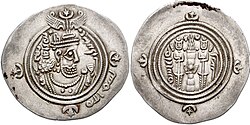
Justice
The caliphate of Ali was characterized by his strict justice.22923030 He implemented radical policies to restore his vision of prophetic governance,231232233 and dismissed nearly all of Uthman's governors,224 whom he considered corrupt.234 Ali also distributed the treasury funds equally among Muslims, following the practice of Muhammad,235 and is said to have shown zero tolerance for corruption.236237 Some of those affected by Ali's egalitarian policies soon revolted against him under the pretext of revenge for Uthman.238 Among them was Mu'awiya, the long-time governor of the Levant.183 Ali has therefore been criticized by some for political naivety and excessive rigorism,22239 and praised by others for righteousness and lack of political expediency.238233 His supporters identify similar decisions of Muhammad,240241 and argue that Islam never allows for compromising on a just cause, citing verse 68:9 of the Quran,241 "They wish that thou might compromise and that they might compromise."242243 Some instead suggest that Ali's decisions were actually justified on a practical level.21124430 For instance, the removal of unpopular governors was perhaps the only option available to Ali because injustice was the main grievance of the rebels.211
Religious authority
As evident from his public speeches,245 Ali viewed himself not only as the temporal leader of the Muslim community but also as its exclusive religious authority.246247 He thus laid claim to the religious authority to interpret the Quran and Sunna.248249 Some supporters of Ali indeed held him as their divinely-guided leader who deserved the same type of loyalty that Muhammad did.250 They felt an absolute and all-encompassing bond of spiritual loyalty (walaya) to Ali that transcended politics.251 For instance, many of them publicly offered Ali their unconditional support circa 658.252253 They justified their absolute loyalty to Ali based on his merits, precedent in Islam,254 his kinship with Muhammad,255 and also the announcement by the latter at the Ghadir Khumm.251 Many of these supporters also viewed Ali as the rightful successor to Muhammad after his death,256 as evidenced in the poetry from that period, for instance.257258
Fiscal policies
Ali opposed centralized control over provincial revenues.209 He equally distributed excess taxes and booty among Muslims,20922 following the precedent of Muhammad and Abu Bakr.259235 In comparison, Umar had distributed the state revenues according to Islamic merit,260261 and Uthman was widely accused of nepotism and corruption.173262174 The strictly egalitarian policies of Ali earned him the support of underprivileged groups, including the Ansar, the qurra, and the late immigrants to Iraq.223 By contrast, Talha and Zubayr were both Qurayshite companions of Muhammad who had amassed immense wealth under Uthman.263 They both revolted against Ali when he refused to grant them favors.264235 Some other figures among the Quraysh similarly turned against Ali,265266 who even withheld public funds from his relatives,267268 whereas his archenemy Mu'awiya readily offered monetary gifts.266269 Ali instructed his officials to collect tax payments on a voluntary basis and without harassment, and to prioritize the poor when distributing public funds.270 A letter attributed to Ali directs his governor to pay more attention to land development than taxation.271272
Rules of war
During the civil war, Ali forbade his soldiers from looting,273274 and instead paid them from the tax revenues.273 He also pardoned his enemies in victory.274275 Both of these practices were later enshrined in Islamic law.274 Ali also advised his commander al-Ashtar not to reject any calls to peace, not to violate any agreements,276 and ordered him not to commence hostilities.277 Ali similarly barred his troops from disturbing civilians,278 killing the wounded and those who fled, mutilating the dead, entering homes without permission, looting, and harming women.279 He prevented the enslavement of women in victory, even though some protested.22 Before the Battle of Siffin, Ali did not retaliate and allowed his enemies to access drinking water when he gained the upper hand.280281
Battle of the Camel
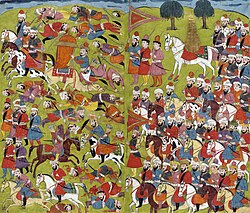
Aisha publicly campaigned against Ali immediately after his accession.282224 She was joined in Mecca by her close relatives, Talha and Zubayr,283 who thus broke their earlier oaths of allegiance to Ali.21618217 This opposition demanded the punishment of Uthman's assassins,284194 and accused Ali of complicity in the assassination.19421630 They also called for the removal of Ali from office and for a Qurayshite council to appoint his successor.224285 Their primary goal was likely the removal of Ali, rather than vengeance for Uthman,285286287 against whom the triumvirate had stirred up public opinion.207288289 The opposition failed to gain enough traction in Hejaz,3022 and instead captured Basra in Iraq,1830 killing many there. Ali raised an army from nearby Kufa,207290 which formed the core of Ali's forces in the coming battles.290 The two armies soon camped just outside of Basra,29130 both probably numbered around ten thousand men.292 After three days of failed negotiations,293 the two sides readied for battle.2933018
Account of the battle
The battle took place in December 656.294295 The rebels commenced hostilities,207296 and Aisha was present on the battlefield, riding in an armored palanquin atop a red camel, after which the battle is named.297298 Talha was soon killed by another rebel, Marwan, the secretary of Uthman.299300 Zubayr, an experienced fighter, deserted shortly after the battle had begun,296207 but was pursued and killed.296207 His desertion suggests he had serious moral misgivings about their cause.301207 Ali won the day,207302211 and Aisha was respectfully escorted back to Hejaz.303207294 Ali then announced a public pardon,304 setting free all war prisoners, including Marwan,305303 and prohibiting the enslavement of their women. Their seized properties were also returned.306 Ali then stationed himself in Kufa,307 which thus became his de facto capital.294287
Battle of Siffin
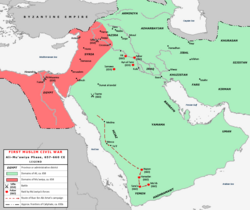
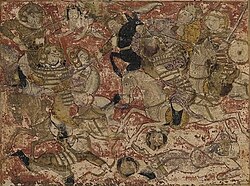
Mu'awiya, the incumbent governor of Greater Syria, was deemed corrupt and unfit by Ali,234 who removed him from his post.308309310 In turn, Mu'awiya refused to step down and informed Ali through a representative that he would recognize Ali as caliph in exchange for the continued governorship of Syria, and possibly the annexation of Egypt.311 Ali rejected this proposal.312
In response, Mu'awiya launched a propaganda campaign across Syria, blaming Ali for the regicide and calling for revenge.313314315 Mu'awiya also joined forces with Amr ibn al-As,316 a military strategist,317 who pledged to back the Umayyads against Ali in return for the life-long governorship of Egypt.318 Mu'awiya then formally declared war, charging Ali with complicity in the regicide, demanding his removal, and a council in Syria thereafter to elect the next caliph.319 Contemporary authors tend to view Mu'awiya's call for revenge as a pretext to retain power.320247321322323324
Account of the battle
In the summer of 657, Ali's Iraqi army and Mu'awiya's Syrian forces camped at Siffin, west of the Euphrates River,325 numbering perhaps at 100,000 and 130,000, respectively.326 Many of Muhammad's companions were present in Ali's army, whereas Mu'awiya could only boast a handful.230326 The two sides negotiated for a while, to no avail,19432730328329 after which the main battle took place from Wednesday, 26 July 657,324320 until Friday or Saturday morning.330327 Ali probably refrained from initiating hostilities,211 and later fought alongside his men on the frontline, whereas Mu'awiya led from his pavilion,331332 and rejected a proposal to settle the matters in a personal duel with Ali.333324334 Among those killed fighting for Ali was Ammar ibn Yasir.332 In canonical Sunni sources, a prophetic hadith predicts Ammar's death at the hands of al-fi'a al-baghiya (lit. 'rebellious aggressive group').335326327
Call to arbitration
Fighting stopped when some Syrians raised pages of the Quran on their lances, shouting, "Let the Book of God be the judge between us."336327 Since Mu'awiya had for long insisted on battle, this call for arbitration suggests that he now sensed defeat.336194337 By contrast, Ali exhorted his men to fight, telling them that raising Qurans was for deception, but to no avail.336324 Through their representatives, the qurra and the ridda tribesmen of Kufa,338328327 the largest bloc in Ali's army,30328 both threatened Ali with mutiny if he did not answer the Syrians' call.33630339340 Facing strong peace sentiments in his army, Ali accepted the arbitration proposal,341 most likely against his own judgment.327341
Arbitration agreement
Mu'awiya now proposed that representatives from both sides should find a Quranic resolution.30342 Mu'awiya was represented by his ally Amr,343 whereas, despite Ali's opposition, the majority in his camp pressed for the neutral Abu Musa, the erstwhile governor of Kufa.344327345 The arbitration agreement was written and signed on 2 August 657,346 stipulating that the two representatives should meet on neutral territory,347 adhere to the Quran and Sunna, and restore peace.346320 Both armies left the battlefield after the agreement.348 The arbitration agreement thus divided Ali's camp, as many did not support his negotiations with Mu'awiya, whose claims they considered fraudulent. By contrast, the agreement strengthened Mu'awiya's position, who was now an equal contender for the caliphate.349
Formation of the Kharijites
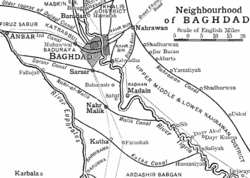
Some of Ali's men left him in protest to the arbitration agreement.348211 Many of them eventually rejoined Ali,35035135222 while the rest gathered in the town of al-Nahrawan.211 They became known as the Kharijites (lit. 'seceders'), who later took up arms against Ali in the Battle of Nahrawan.35335430 The Kharijites, many of whom belonged to the qurra,355 were likely disillusioned with the arbitration process.35630 Their slogan was, "No judgment but that of God,"320 highlighting their rejection of arbitration (by men) in reference to the Quranic verse 49:9.357 Ali called this slogan a word of truth by which the seceders sought falsehood because he viewed the ruler as indispensable in the conduct of religion.358
Arbitration proceedings
The two arbitrators met together in Dumat al-Jandal,359 perhaps in February 658.30 There they reached the verdict that Uthman had been killed wrongfully and that Mu'awiya had the right to seek revenge.36036130 They could not agree on anything else.362 Rather than a judicial ruling, this was a political concession by Abu Musa, who probably hoped that Amr would later reciprocate this gesture.362 Ali denounced the conduct of the two arbitrators as contrary to the Quran and began organizing a second Syria campaign.36322 Solely an initiative of Mu'awiya,360 there was also a second meeting in Udhruh.360211 The negotiations there also failed,363 as the two arbitrators could not agree on the next caliph: Amr supported Mu'awiya,30 while Abu Musa nominated his son-in-law Abd Allah ibn Umar,30149 who stood down.30364 At its closure, Abu Musa publicly deposed both Mu'awiya and Ali and called for a council to appoint his successor per earlier agreements with Amr. When Amr took the stage, however, he deposed Ali and appointed Mu'awiya as his successor.14936530 The Kufan delegation reacted furiously to Abu Musa's concessions,363 and the common view is that the arbitration failed,360344 or was inconclusive.366350367 It nevertheless strengthened the Syrians' support for Mu'awiya and weakened the position of Ali.36036823030369
Battle of Nahrawan
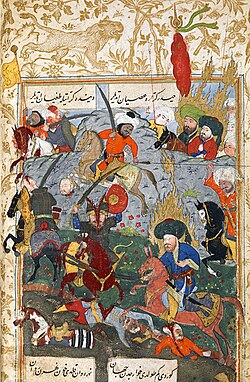
After the arbitration, Mu'awiya received the Syrians' pledge as caliph.370 Ali then organized a new, much smaller,30 Syria campaign.352149371 But he postponed the expedition,372 and instead marched to Nahrawan with his army,372 when he learned that the Kharijites were interrogating and executing civilians.373374 They killed many, apparently not even sparing women.353 Ali convinced many of the Kharijites to separate from their army, leaving about 1,500–1,800, or 2,800, out of about 4,000 fighters.375376 The rest of the Kharijites then attacked and were crushed by Ali's army of about 14,000 men.377376 The battle took place either on 17 July 658,378352 or in 657.379378 Ali has been criticized by some for killing his erstwhile allies,380381382 many of whom were outwardly pious Muslims. For others, subduing the Kharijites was necessary, for they were violent and radicalized rebels who posed a danger to Ali's base in Kufa.383384344385
Final years
Following the Battle of Nahrawan, Ali could not muster enough support for a second Syria campaign.386382 Perhaps his soldiers were demoralized,381 or perhaps they were recalled by their tribal leaders,387388 many of whom had been bribed and swayed by Mu'awiya.389388381 By contrast, Ali did not grant any financial favors to tribal chiefs as a matter of principle.265266 At any rate, the secession of so many of the qurra and the coolness of the tribal leaders weakened Ali.387194390 Ali consequently lost Egypt to Mu'awiya in 658.365391 Mu'awiya also began dispatching military detachments,365 which targeted civilians along the Euphrates river, near Kufa, and most successfully, in the Hejaz and Yemen.392 Ali could not mount a timely response to these assaults.22 He eventually found sufficient support for a second Syria offensive, set to commence in late winter 661. His success was in part due to the public outrage over Syrian raids.393 However, plans for a second campaign were abandoned after the assassination of Ali.394
Assassination and burial
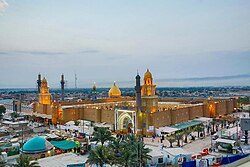
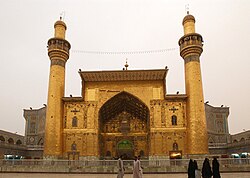
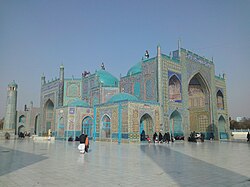
Ali was assassinated during the morning prayer on 28 January 661 (19 Ramadan 40 AH) at the Great Mosque of Kufa. The other given dates are 26 and 30 January. He was struck over his head by the Kharijite dissident Ibn Muljam with a poison-coated sword,395 in revenge for their defeat in the Battle of Nahrawan.396 Ali died from his wounds about two days later, aged sixty-two or sixty-three. By some accounts, he had long known about his fate by premonition or through Muhammad.395
Before his death, Ali requested either a meticulous application of lex talionis to Ibn Muljam or his pardon. At any rate, Ibn Muljam was later executed by Hasan, the eldest son of Ali.395
Fearing that his body might be exhumed and profaned by his enemies, Ali's burial place was kept a secret and remains uncertain.22 Several sites are mentioned as containing Ali's remains, including the shrine of Ali in Najaf and the shrine of Ali in Mazar.397 The former site was identified during the reign of the Abbasid caliph Harun al-Rashid (r. 786–809) and the town of Najaf developed around it, which has become a major destination for Shia pilgrimage.22 The present shrine was built by the Safavid monarch Safi (r. 1629–1642),398 near which lies an immense cemetery for Shias who wished to be buried next to their imam.22 Najaf is also home to top religious colleges and prominent Shia scholars.2218 Other sites for Ali's burial are claimed to be Baghdad, Damascus, Medina, Ray while a minority of Shias believe it be somewhere in the city of Kufa.397
Succession
When Ali died, his son Hasan was acknowledged as the next caliph in Kufa.376399 As Ali's legatee, Hasan was the obvious choice for the Kufans, especially because Ali was vocal about the exclusive right of Muhammad's kin to leadership.400399 Most surviving companions of Muhammad were in Ali's army, and they also pledged their allegiance to Hasan,401402 but overall the Kufans' support for Hasan was likely weak.403404 Hasan later abdicated in August 661 to Mu'awiya when the latter invaded Iraq with his Syrian army.403404 Mu'awiya thus founded the dynastic Umayyad Caliphate. Throughout his reign, he persecuted the family and supporters of Ali,405406 and authorized the cursing of Ali as part of the communal prayers.405407
Descendants of Ali
The first marriage of Ali was to Fatima, who bore him three sons, Hasan, Husayn, and Muhsin.406 Muhsin either died in infancy,32 or Fatima miscarried him when she was injured in a raid on her house during the succession crisis.111 The descendants of Hasan and Husayn are known as the Hasanids and the Husaynids, respectively.408 As the progeny of Muhammad, they are honored in Muslim communities by nobility titles such as sharif and sayyid.5 Ali and Fatima also had two daughters, Zaynab and Umm Kulthum.409 After Fatima's death in 632, Ali remarried multiple times and had more children, including Muhammad al-Awsat and Abbas ibn Ali.409 In his life, Ali fathered seventeen daughters, and eleven, fourteen, or eighteen sons,406 among whom, Hasan, Husayn, and Muhammad ibn al-Hanafiyya played a historical role.22 Descendants of Ali are known as the Alids.408
Under the Umayyads (661–750)
Mu'awiya succeeded Ali in 661 and founded the dynastic Umayyad Caliphate,410 during which Alids were severely persecuted.409 After Ali, his followers (shi'a) recognized his eldest son Hasan as their imam. When he died in 670, likely poisoned at the instigation of Mu'awiya,411410412 the Shia community followed Hasan's younger brother Husayn, who was killed by Umayyad forces in the Battle of Karbala in 680, alongside many of his relatives.408 To revenge the Karbala massacre, soon followed in 685 the Shia uprising of al-Mukhtar, who claimed to represent Ibn al-Hanafiyya.408 The main movements that followed this uprising were the now-extinct Kaysanites and the Imamites.413 The Kaysanites mostly followed Abu Hashim, the son of Ibn al-Hanafiyya. When Abu Hashim died around 716, this group largely aligned itself with the Abbasids, that is, the descendants of Muhammad's uncle Abbas.408414 On the other hand, the Imamites were led by quiescent descendants of Husayn, through his only surviving son, Ali Zayn al-Abidin (d. 713). An exception was Ali's son Zayd, who led a failed uprising against the Umayyads around 740.408 For his followers, known as the Zaydites, any learned Hasanid or Husaynid who rose against tyranny qualified as imam.415
Under the Abbasids (750–1258)
Alids were also persecuted under the Abbasids, who toppled the Umayyads in 750.408416 Some of the Alids thus revolted,406 while some established regional dynasties in remote areas.408417 In particular, through imprisonment or surveillance, the Abbasids removed the imams of the Imamites from public life,418419 and they are thought to be responsible for the imams' deaths.420421 Mainstream Imamites were the antecedents of the Twelvers,422 who believe that their twelfth and final imam, Muhammad al-Mahdi, was born around 868,423 but was hidden from the public in 874 for fear of persecution. He remains in occultation by divine will until his reappearance at the end of time to eradicate injustice and evil.424425 The only historic split among the Imamites happened when their sixth imam, Ja'far al-Sadiq, died in 765.408422 Some claimed that his designated successor was his son Isma'il, who had predeceased al-Sadiq. These were the antecedents of the Isma'ilites,408 who found political success at the turn of the tenth century,426 as the Fatimid Caliphate in Egypt and the Qarmatians in Bahrain.427
Works

Most of the works attributed to Ali were first delivered as speeches and later committed to writing by others. There are also supplications, such as Du'a Kumayl, which he may have taught others.18
Nahj al-balagha
Nahj al-balagha (lit. 'the path of eloquence') is an eleventh-century collection of sermons, letters, and sayings, all attributed to Ali, compiled by Sharif al-Radi (d. 1015), a prominent Twelver scholar.428429 Because of its sometimes sensitive content, the authenticity of Nahj al-balagha has long been polemically debated. However, by tracking its content in earlier sources, recent academic research has attributed most of Nahj al-balagha to Ali.430431 The book, particularly its letter of instructions addressed at al-Ashtar,18 has served as an ideological basis for Islamic governance.429 The book also includes detailed discussions about social responsibilities, emphasizing that greater responsibilities result in greater rights.429 Nahj al-balagha also contains sensitive material, such as sharp criticism of Ali's predecessors in its Shaqshaqiya sermon,18 and disapproval of Aisha, Talha, and Zubayr, who had revolted against Ali.428432 Celebrated as an example of the most eloquent Arabic,18 Nahj al-balagha has significantly influenced the Arabic literature and rhetoric.430 Numerous commentaries have been written about the book, including the comprehensive work of the Mu'tazilite scholar Ibn Abil-Hadid (d. 1258).18
Ghurar al-hikam
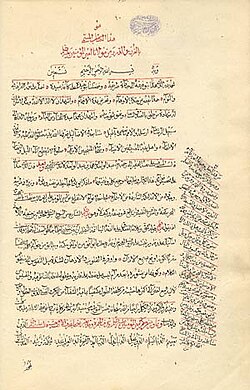
Ghurar al-hikam wa durar al-kalim (lit. 'exalted aphorisms and pearls of speech') was compiled by Abd al-Wahid al-Amidi (d. 1116), who was either a Shafi'i jurist or a Twelver scholar. The book contains thousands of short sayings of Ali on piety and ethics.43318 These aphorisms and other works attributed to Ali have considerably influenced the Islamic mysticism.434
Mushaf of Ali
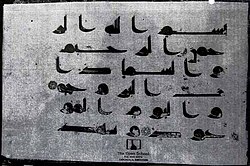
Mushaf of Ali is a recension of the Quran compiled by Ali, who was one of its first scribes.435 By some Shia accounts, this codex (mushaf) of Ali was rejected for official use during the succession crisis.436 Some early Shia traditions also suggest differences with the standard Uthmanid codex,437 although now the prevalent Shia view is that Ali's recension matches the Uthmanid codex, save for the order of its content.438 Ali's codex is said to be in the possession of Muhammad al-Mahdi, who would reveal the codex (and its authoritative commentary by Ali) when he reappears.439424
Kitab Ali
Kitab Ali (lit. 'book of Ali') is a non-extant collection of prophetic sayings gathered by Ali. The book may have concerned matters of lawfulness (halal) and unlawfulness (haram), including a detailed penal code. Kitab Ali is also often linked to al-Jafr, which is said to contain the esoteric teachings of Muhammad for his household.440441 Copies of Kitab Ali were likely available until the early eighth century, and parts of it have survived in later Shia and Sunni works.442
Other works
The Du'a' Kumayl is a popular Shia supplication attributed to Ali, transmitted by his companion, Kumayl ibn Ziyad.18 Also attributed to Ali is Kitab al-Diyat on Islamic law, fully quoted in the Shia hadith collection Man la yahduruhu al-faqih.443 The judicial decisions and executive orders of Ali during his caliphate have also been recorded.444 Other extant works attributed to Ali are collected in Kitab al-Kafi and other Shia sources.18
Contributions to Islamic sciences
The standard recitation of the Quran has been traced back to Ali,445446230 and his written legacy is dotted with Quranic commentaries.442 Ibn Abbas, a leading early exegete, credited Ali with his interpretations of the Quran.447 Ali also related several hundred prophetic hadiths.442 He is further credited with the first systematic evaluations of hadiths, and is often considered a founding figure for hadith sciences.442 Ali is also regarded by some as the founder of Islamic theology, and his sayings contain the first rational proofs of the unity of God (tawhid) in Islam.44849 In later Islamic philosophy, Ali's sayings and sermons were mined for metaphysical knowledge.5 In particular, Nahj al-balagha is a vital source for Shia philosophical doctrines, after the Quran and Sunna.449 As a Shia imam, statements and practices attributed to Ali are widely studied in Shia Islam, where they are viewed as the continuation of prophetic teachings.442
Names and titles
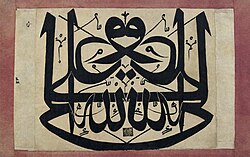
Ali is known by many honorifics in the Islamic tradition, some of which are especially used by Shias.5 His main kunya (teknonym) was ʾAbū al-Ḥasan ("father of al-Hasan").4505 His titles include al-Murtaḍā (lit. 'one with whom [God] is pleased' or 'one who is chosen and contented'),4505 Asad Allāh (lit. 'lion of God'),451 Ḥaydar (lit. 'lion', the name initially his mother gave him),450 Amīr al-Muʾminīn (lit. 'commander of the faithful' or 'prince of the faithful'), and Imām al-Muttaqin (lit. 'leader of the God-fearing').4505 In particular, Twelvers consider the title of Amir al-Mu'minin to be unique to Ali.452 He is also referred to as Abū Turāb (lit. 'father of dust'),5 which might have initially been a pejorative by his enemies.22 Siddiq al-Akbar and al-Farooq (the one who distinguishes right from wrong) are other titles of Ali.450
Character

Often praised for his piety and courage,23045322 Ali fought to uphold his beliefs,22454 but was also magnanimous in victory,455230 even risking the ire of some supporters to prevent the enslavement of women.22 He also showed his grief, wept for the dead, and reportedly prayed over his enemies.22 Yet Ali has also been criticized for his idealism and political inflexibility,22239 for his egalitarian policies and strict justice antagonized many.456238 These qualities were said to be also present in Muhammad,241240 whom the Quran addresses as, "They wish that thou [Muhammad] might compromise and that they might compromise."457 At any rate, these qualities of Ali, rooted in his religious beliefs, contributed to his image today for his followers as a paragon of Islamic virtues,22458456 particularly justice.19 Ali is also viewed as the model par excellence for Islamic chivalry (futuwwa).459460461
Historical accounts about Ali are often tendentious.22 For instance, in person, Ali is described in some Sunni sources as bald, heavy-built, short-legged, with broad shoulders, hairy body, long white beard, and affected by eye inflammation.22 Shia accounts about the appearance of Ali are markedly different. Those perhaps better match his reputation as a capable warrior.462 Likewise, Ali is presented in some Sunni sources as rough, brusque, and unsociable.22 By contrast, Shia sources describe him as generous, gentle, and cheerful,46019 to the point that the Syrian war propaganda accused him of frivolity.236 Shia and Sufi sources are also replete with reports about his acts of kindness, especially to the poor.463 The necessary qualities in a commander, described in a letter attributed to Ali, may have well been a portrait of himself: slow to anger, happy to pardon, kind to the weak, and severe with the strong.464 His companion, Sa'sa'a ibn Suhan, described him similarly, "He [Ali] was amongst us as one of us, of gentle disposition, intense humility, leading with a light touch, even though we were in awe of him with the kind of awe that a bound prisoner has before one who holds a sword over his head."19464
Assessment and legacy
Ali | |
|---|---|
 Gouache illustration of Ali (centre) and his sons, Hasan and Husayn, 1838, by an unknown painter | |
| |
| Venerated in | |
| Major shrine | Imam Ali Shrine, Najaf |
In Islam
Ali's place is said to be second only to Muhammad in Shiasim.30 Ali is revered for his courage, honesty, unbending devotion to Islam, magnanimity, and equal treatment of all Muslims.455 For his admirers, he has thus become the archetype of uncorrupted Islam and pre-Islamic chivalry.458
In the Quran
Ali regularly represented Muhammad in missions which are commonly linked to Quranic injunctions.465466 For instance, the verse of walaya (5:55) is a reference to when Ali gave his ring to a beggar, while praying in the mosque, according to Shia and some Sunni accounts.467 If so, then this verse gives Ali the same spiritual authority (walaya) as Muhammad.468469 In Shia sources, the verse of tabligh (5:67) spurred Muhammad to designate Ali as his successor at the Ghadir Khumm, while the verse of ikmal al-din (5:3) subsequently announced the perfection of Islam.470 The verse of purification (33:33) concerns the status of purity of the Ahl al-Bayt (lit. 'people of the house'), which is limited to Ali, Fatima, and their two sons in Shia and some Sunni sources.471472473 Another reference to the Ahl al-Bayt might be the verse of mawadda (42:23).474475476 For Shias, this verse is a Quranic mandate to love and follow the Ahl al-Bayt.477474
In hadith literature
Muhammad frequently praise the qualities of Ali. The most controversial such statement, "He whose mawla I am, Ali is his mawla," was delivered at the Ghadir Khumm. This gave Ali the same spiritual authority (walaya) as Muhammad, according to the Shia.478 Elsewhere, the hadith of the position likens Muhammad and Ali to Moses and Aaron,50 and thus supports the usurped right of Ali to succeed Muhammad in Shia Islam.479 Other examples in standard Shia and Sunni collections of hadith include, "There is no youth braver than Ali," "No-one but a believer loves Ali, and no-one but a hypocrite (munafiq) hates Ali," "I am from Ali, and Ali is from me, and he is the wali (lit. 'patron' or 'guardian') of every believer after me," "The truth revolves around him [Ali] wherever he goes," "I am the city of knowledge and Ali is its gate (bab)," "Ali is with the Quran and the Quran is with Ali. They will not separate until they return to me at the [paradisal] pool."48049
In Sufism
Ali is the common source of mystical and spiritual currents within both Sunni and Shia sects of Islam.481482 In particular, Ali is the spiritual head of some Sufi movements,18 for Sufis believe that Ali inherited from Muhammad his esoteric knowledge and saintly authority,5 which guide believers on their journey toward God.18 Nearly all Sufi orders trace their lineage to Muhammad through Ali, an exception being the Naqshbandis, who reach Muhammad through Abu Bakr.5
In Sunni Islam
In Sunni Islam, Ali is venerated as a close companion of Muhammad,483 a foremost authority on the Quran and Islamic law,447484 and the fountainhead of wisdom in Sunni spirituality.481 When the prophet died in 632, Ali had his claims to leadership, perhaps in reference to the Ghadir Khumm,12658 but he eventually accepted the temporal rule of the first three caliphs in the interest of Muslim unity.485 Ali is portrayed in Sunni sources as a trusted advisor of the first three caliphs,530 while their conflicts with Ali are minimized,139140 in line with the Sunni tendency to show accord among companions.140486487 As the fourth and final Rashidun caliph, Ali holds a particularly high status in Sunni Islam, although this doctrinal reverence for Ali is a recent development for which the prominent Sunni traditionist Ibn Hanbal (d. 855) is likely to be credited.18 Sunni hierarchy of companions places Ali below his three predecessors and above those who fought against him.18488483 This ordering has required Sunni reinterpretation of those prophetic sayings that explicitly elevate Ali above all companions.18
In Shia Islam
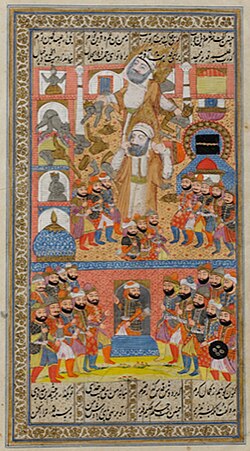
Ali takes center stage in Shia Islam:5 The Arabic word shi'a itself is short for 'shi'a of Ali' (lit. 'followers of Ali'),489 his name is incorporated into the daily call to prayer (adhan),5 and he is regarded as the foremost companion of Muhammad.490491 The defining doctrine of Shia Islam is that Ali was the rightful successor of Muhammad through divinely-ordained designation,30492 which is primarily a reference to the Ghadir Khumm.493 Ali is thought to have inherited the political and religious authority of Muhammad, even before his ascension to the caliphate in 656.494495 In particular, Ali's predecessors are regarded as illegitimate rulers and usurpers of his rights.30 The all-encompassing bond of loyalty between Shia Muslims and their imams (and Muhammad in his capacity as imam) is known as walaya.251 Ali is also thought to be endowed with the privilege of intercession on the Judgment Day.18 Early on, some Shias even attributed divinity to Ali,30490 but such extreme views were gradually rooted out of Shi'ism.496
In Shia belief, Ali also inherited the esoteric knowledge of Muhammad,19497 for instance, in view of the prophetic hadith, "I [Muhammad] am the city of knowledge, and Ali is its gate."19 Ali is thus regarded, after Muhammad, as the interpreter, par excellence, of the Quran and the sole authoritative source of its (esoteric) teachings.493 Unlike Muhammad, however, Ali is not thought to have received divine revelation (wahy), though he might have been guided by divine inspiration (ilham).494498 Verse 21:73 of the Quran is sometimes cited here, "We made them imams, guiding by Our command, and We revealed (awhayna') to them the performance of good deeds, the maintenance of prayers, and the giving of zakat (alms), and they used to worship Us."499 Shia Muslims also believe in the infallibility of Ali, as with Muhammad, that is, their divine protection from sins.18500 Here, the verse of purification is sometimes cited.501502 Ali's words and deeds are therefore considered a model for the Shia community and a source for their religious injunctions.503504
In Ibadism
Ibadis maintain a distinct theological judgment of Ali based on his adherence to Quranic principles during the First Fitna. While they initially recognized his legitimacy and approved of his stance against the rebellions of Aisha and Mu'awiya, their tradition holds that Ali forfeited his right to lead upon accepting arbitration at the Battle of Siffin.505 From the Ibadi perspective, this decision was an abandonment of a divine mandate that rendered him unfit for the imamate.
This view is solidified by his subsequent military action at the Battle of Nahrawan where he killed the Ahl al-Nahr (People of the River). Ibadis regard these opponents of Ali as the true keepers of the faith and consider their leader, Abd Allah ibn Wahb al-Rasibi, as the legitimate successor to the imamate following the error of Ali at Siffin.506 Consequently, Ali is not viewed as a rightly-guided figure in his later years. Instead, the genealogy of Islam (nasab al-islām) is believed to have passed through individuals such as Hurqus ibn Zuhayr as-Sa'di who preserved the faith in its original form.507
In Alawism
The Alawites venerate Ali, the first of the Twelve Imams, as the physical manifestation of God.508509 Even, the Alawite testimony of faith (shahada) translates as "there is no God but Ali".510 The Alawite trinity envisions God as being composed of three distinct manifestations, Ma'na (meaning), Ism (Name) and Bab (Door); which together constitute an "indivisible trinity". Ma'na symbolises the "source and meaning of all things" in Alawite mythology. According to Alawite doctrines, Ma'na generated the Ism, which in turn built the Bab. These beliefs are closely tied to the Alawite doctrine of reincarnations of the trinity.511512 The final trinity of reincarnation in the Alawite trinity consists of Ali (Ma'na), Muhammad (Ism) and Salman the Persian (Bab). Alewites depict them as the sky, sun and moon respectively. Alawites deify Ali as the "last and supreme manifestation of God" who built the universe, attribute to him divine superiority, and believe that Ali created Muhammad and gave him the mission to spread Qur'anic teachings on earth.513514511515
In other religions
In the Druze faith, Ali is considered a "minor prophet," like Plato and Socrates.516 Even though the faith originally developed out of the Isma'ili branch of Shia Islam, the Druze are not Muslims,517518 and do not accept the five pillars of Islam.518 In Yarsanism, a religion founded by the Kurdish mystic Sultan Sahak, Ali is thought to be an incarnation of God,519 and superior to Muhammad,519 but their image as a Ghulat (lit. 'exaggerators' or 'extremists') subsect of Shia Islam is incorrect.519
-
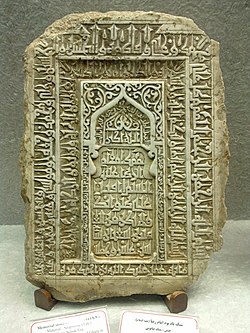 The verse of walaya, possibly the most controversial statement in the Quran linked to Ali, is engraved on the margins of this memorial stone, dating to the Seljuk era
 -
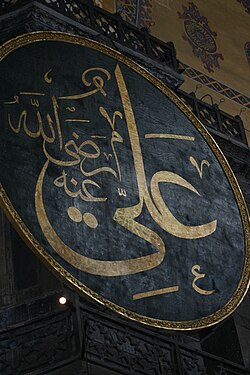
-
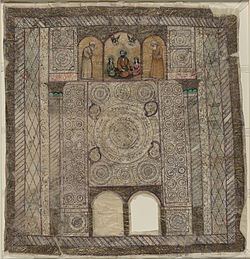 Ali with his sons, nineteenth century Iranian tapestry
Historiography
Much has been written about Ali in Islamic literature, second only to Muhammad.5 However, much of this material is colored by a positive or negative bias towards Ali.5 The primary sources about Ali are the Quran, hadiths, and other early Islamic works,5 the most notable being The Book of Sulaym ibn Qays, attributed to a companion of Ali.520 Such works were initially scarce, but this changed with the introduction of affordable paper in the Abbasid period. For instance, at least twenty-one monographs were composed on the Battle of Siffin between 750 and 950, thirteen of which were authored by the early historian Abu Mikhnaf (d. 773–774). Most of these monographs are not extant except through quotations in later collections, such as the tenth-century Tarikh al-Tabari.521 In addition to numerous works authored by Muslims, the secondary sources about Ali include writings of Arab Christians, Hindus, and also works by Western scholars.5 When writing about Ali, early Western scholars often dismissed as fabricated the reports gathered in later periods because their authors often advanced their own Sunni or Shia partisan views. For instance, L. Caetani (d. 1935) often rejected the historical reports attributed to the pro-Ali Ibn Abbas and anti-Ali Aisha. Caetani instead preferred accounts reported without isnad by early historians like Ibn Ishaq (d. 767). By contrast, W. Madelung (d. 2023) argued that the tendentiousness of a report alone does not imply its fabrication. Madelung instead advocated for the authentication of historical reports on the basis of their compatibility with other events and figures.522
Notes
Notes
- “There will be in my umma a man named Abu Óanifa, and he will be its lamp . . . and there will be in my umma a man named Muhammad b. Idris [al-Shafii] whose strife is more harmful than that of Satan.https://so06.tci-thaijo.org/index.php/M-JICI/article/download/260009/175713/9885
- Western historians describe the purpose of these early biographies as largely to convey a message—of a hagiographic nature—rather than to strictly and accurately record history.14 Lawrence Conrad examines the early sirah books and sees that the dates of Muhammad's birth span a period of up to 85 years. Conrad defines this as: "the fluidity (evolutionary process) continued even in the written period."15
- The titles given to Jesus by Assyrian Christians living in the Sasanian Empire are equivalent to Muhammad's New Testament benedictus, ευλογημένος. In a numismatic study, Popp identified coins dating to 16 AH inscribed with mhmd (Arabic written without vowels, but lacking the rasulullah, which became common later). Popp added Arab-Sasanian and Syrian coins inscribed with MHMT in the Pahlavi script, and also partly with mhmd in the Arabic script, combined with Christian symbolism in some cases.1617
Footnotes
Footnotes
- Lapidus, Ira M. (2014). A History of Islamic Societies. doi:10.1017/CBO9781139048828. ISBN 978-0-521-51430-9.
- Donner 2010, p. 628.
- Vansina (1985)
- Album, Bates & Floor 2012.
- Afsaruddin & Nasr 2023.
- Shah-Kazemi 2006a.
- Brown, Daniel W. (1999). Rethinking tradition in modern Islamic thought. Cambridge University Press. pp. 81–107. ISBN 0521570778.
- https://sunnah.com/abudawud:4646
- https://en.wikishia.net/view/Hadith_al-Lawh
- During his Ascension, Muhammad experienced and witnessed such things related to Ali that upon his return he said to Ali, "Ali, if I had not witnessed your birth with my own eyes and embraced you with my own hands, I would have believed that you were God."Literatur: Hadji Bektach: Un Mythe Et Ses Avatars: Genhse Et Evolution Du Soufisme Populaire En Turquie; Brill Academic Pub, 1998; ISBN 90-04-10954-4, Cem Kirklar auf S. 17–24, S. 51, S. 227–236 - (französisch)
- "The narration was considered as fabricated (mawdu) by scholars such as Ali ibn al-Madini, Ahmad ibn Hanbal, Ibn al-Jawzi, Ibn Taymiyyah, al-Zahabi, Ibn Kathir, Ibn Qayyim al-Jawziyya and Muhammad Nasiruddin al-Albani. Scholars such as Ahmad ibn Salih al-Misri, Tahawi, Qaḍi Iyaz, Sibt ibn al-Jawzi, Mogultay ibn Kilic, al-Haythami, Abu Zur’a al-Iraqi, Ibn Hajar, al-Ayni, al-Suyuti, Sahawi, Ali al-Qari, Munawi, al-Ajluni, and al-Qasimi regarded the hadith as sabit." https://dergipark.org.tr/en/download/article-file/3290781
- Under the Umayyad caliph ʿAbd al-Malik ibn Marwān, the Dome of the Rock was built in Jerusalem (691–692). There the word Islām appears for the first time. Until this moment the Muslims called themselves simply "believers", and coins were minted in the Arabic empire showing Christian symbols. Ibn Marwān also plays a major role in the reworking of the Quranic text. See: Patricia Crone / Michael Cook: Hagarism (1977) p. 29; Yehuda D. Nevo: Crossroads to Islam: The Origins of the Arab Religion and the Arab State (2003) pp. 410-413; Karl-Heinz Ohlig (Hrsg.): Der frühe Islam. Eine historisch-kritische Rekonstruktion anhand zeitgenössischer Quellen (2007) pp. 336 ff.
- Robert G. Hoyland: In God's Path. The Arab Conquests and the Creation of an Islamic Empire (2015)
- Lecker, Michael (2010), Brockopp, Jonathan E. (ed.), "Glimpses of Muḥammad's Medinan decade", The Cambridge Companion to Muhammad, Cambridge University Press, pp. 61–80, doi:10.1017/ccol9780521886079.004, ISBN 978-0-521-88607-9
{{citation}}: CS1 maint: work parameter with ISBN (link) - Conrad (June 1987). "Abraham and Muhammad: Some Observations Apropos of Chronology and Literary topoi in the Early Arabic Historical Tradition". Bulletin of the School of Oriental and African Studies. 50 (2): 239. doi:10.1017/S0041977X00049016
- Popp, Volker. “Bildliche Darstellungen aus der Frühzeit des Islam. Das Kopfreliquiar Johannes des Täufers auf den omaijadischen Münzen von Damaskus.” Imprimatur.
- Ohlig, Karl-Heinz; Puin, Gerd-Rüdiger (2006). Die dunklen Anfänge: neue Forschungen zur Entstehung und frühen Geschichte des Islam. H. Schiler. pp. 16–123. ISBN 3899301285.
- Gleave 2008.
- Shah-Kazemi 2015b.
- Momen 1985, p. 239.
- Toral-Niehoff 2021, p. 47–48.
- Veccia Vaglieri 2012a.
- Rubin 1995, p. 130.
- Momen 1985, p. 12.
- Abbas 2021, p. 34.
- Rubin 1995, pp. 136–7.
- Huart 2012a.
- Mavani 2013, p. 71, 98.
- Abbas 2021, pp. 46, 206.
- Poonawala 1982.
- Kassam & Blomfield 2015.
- Buehler 2014, p. 186.
- Klemm 2005, p. 186.
- Qutbuddin 2006, p. 248.
- Momen 1985, pp. 13–14.
- Schmucker 2012.
- Madelung 1997, p. 16.
- Osman 2015, p. 110.
- Nasr et al. 2015, p. 379.
- Haider 2014, p. 35.
- Haider 2014, p. 36.
- McAuliffe 2023.
- Fedele 2018, p. 56.
- Lalani 2006, p. 29.
- Mavani 2013, p. 72.
- Bill & Williams 2002, p. 29.
- Momen 1985, p. 13.
- Momen 1985, p. 14.
- Shah-Kazemi 2014.
- Miskinzoda 2015, p. 69.
- Miskinzoda 2015, pp. 76–7.
- Shah-Kazemi 2019, p. 46.
- Faizer 2006.
- Donner 2010, pp. 72–3.
- Arafat 1976.
- Dakake 2007, pp. 34–9.
- Mavani 2013, p. 79.
- Amir-Moezzi 2014.
- Momen 1985, p. 16.
- Mavani 2013, p. 80.
- Veccia Vaglieri 2012b.
- Lalani 2000, p. 70–71.
- Dakake 2007, p. 34.
- Lalani 2000, p. 71.
- Dakake 2007, pp. 34–7.
- Momen 1985, p. 15.
- Veccia Vaglieri 2012d.
- Jones 2009.
- Mavani 2013, p. 20.
- Dakake 2007, p. 35.
- Lalani 2011.
- Jafri 1979, p. 20.
- Dakake 2007, p. 45.
- Mavani 2013, p. 2.
- Dakake 2007, p. 47.
- Jafri 1979, p. 21.
- Mavani 2013, p. 70.
- Dakake 2007, p. 46.
- Dakake 2007, pp. 44–5.
- Lalani 2006, p. 590.
- Madelung 1997, p. 253.
- McHugo 2017, §2.IV.
- Dakake 2007, p. 41.
- Afsaruddin 2013, p. 51.
- Jafri 1979, p. 39.
- Momen 1985, p. 18.
- Madelung 1997, pp. 30–2.
- Jafri 1979, p. 37.
- Madelung 1997, p. 35.
- Madelung 1997, pp. 31–33.
- Momen 1985, pp. 18–9.
- Madelung 1997, pp. 36, 40.
- McHugo 2017, §1.III.
- Madelung 1997, p. 5.
- Mavani 2013, p. 34.
- Keaney 2021, §3.1.
- Walker 2014, p. 3.
- Lecomte 2012.
- Shaban 1971, p. 16.
- Khetia 2013, pp. 31–2.
- Madelung 1997, p. 32.
- Fedele 2018.
- Madelung 1997, p. 43.
- Jafri 1979, p. 40.
- Qutbuddin 2006, p. 249.
- Cortese & Calderini 2006, p. 8.
- Jafri 1979, p. 41.
- Madelung 1997, pp. 43–4.
- Jafri 1979, pp. 40–1.
- Soufi 1997, p. 86.
- Khetia 2013, p. 78.
- Abbas 2021, p. 98.
- Soufi 1997, pp. 84–5.
- Ayoub 2014, pp. 17–20.
- Khetia 2013, p. 35.
- Soufi 1997, p. 84.
- Khetia 2013, p. 38.
- Jafri 1979, p. 47.
- Madelung 1997, p. 50.
- Mavani 2013, p. 116.
- Soufi 1997, pp. 104–105.
- Sajjadi 2018.
- Veccia Vaglieri 2012c.
- Soufi 1997, p. 100.
- Madelung 1997, p. 141.
- Momen 1985, pp. 19–20.
- McHugo 2017, p. 40.
- Jafri 1979, p. 44.
- Madelung 1997, pp. 141, 253.
- Mavani 2013, p. 113–114.
- Momen 1985, p. 62.
- Mavani 2013, pp. 114, 117.
- Shah-Kazemi 2019, p. 79.
- Anthony 2013.
- Mavani 2013, p. 117.
- Aslan 2005, p. 122.
- Madelung 1997, pp. 42, 52–54, 213–4.
- Abbas 2021, p. 94.
- Jafri 1979, p. 45.
- Shah-Kazemi 2019, p. 78.
- Shah-Kazemi 2019, p. 81.
- Dakake 2007, p. 50.
- Jafri 1979, pp. 47–8.
- Momen 1985, p. 20.
- Veccia Vaglieri 2012a, p. 382.
- Afsaruddin 2013, p. 32.
- Ayoub 2014, p. 32.
- Jafri 1979, p. 46.
- Glassé 2001, p. 40.
- Tabatabai 1975, p. 158.
- Abbas 2021, p. 89.
- Madelung 1997, p. 22.
- Madelung 1997, pp. 66–7.
- Madelung 1997, pp. 62, 65.
- Madelung 1997, pp. 62–64.
- Madelung 1997, p. 67.
- Pellat 1983.
- Jafri 1979, p. 50.
- Jafri 1979, p. 52.
- Ayoub 2014, p. 43.
- Madelung 1997, p. 71.
- Jafri 1979, p. 51.
- Momen 1985, p. 21.
- Jafri 1979, p. 54.
- Kennedy 2016, p. 60.
- Keaney 2021, §3.4.
- Shaban 1971, pp. 62–3.
- Madelung 1997, pp. 71–2.
- Jafri 1979, pp. 52–3.
- Abbas 2021, p. 116.
- Madelung 1997, p. 68.
- Jafri 1979, pp. 52–53, 55.
- Madelung 1997, p. 87.
- Veccia Vaglieri 1970, p. 67.
- Shah-Kazemi 2019, p. 84.
- Dakake 2007, p. 52.
- Madelung 1997, pp. 108, 113.
- Jafri 1979, p. 53.
- Madelung 1997, p. 108.
- Hinds 1972a, p. 467.
- Madelung 1997, p. 109.
- Jafri 1979, p. 63.
- Daftary 2014, p. 30.
- Madelung 1997, p. 98.
- Madelung 1997, pp. 100–2.
- Jafri 1979, p. 59.
- Madelung 1997, pp. 107–8.
- Momen 1985, p. 22.
- Jafri 1979, p. 62.
- McHugo 2017, p. 49.
- Madelung 1997, p. 121.
- Madelung 1997, pp. 118–9.
- Madelung 1997, p. 128.
- Anthony 2013, p. 31.
- Madelung 1997, p. 111.
- Veccia Vaglieri 1970, p. 68.
- Madelung 1997, pp. 111, 119.
- Madelung 1997, p. 122.
- Madelung 1997, p. 123.
- Madelung 1997, p. 112.
- Madelung 1997, p. 127.
- Levi Della Vida & Khoury 2012.
- Madelung 1997, p. 126.
- Hinds 1972a.
- Donner 2010, p. 152.
- Kennedy 2016, p. 65.
- Veccia Vaglieri 2012f.
- Donner 2010, p. 157.
- Lapidus 2002, p. 56.
- Ayoub 2014, p. 81.
- Bahramian 2015.
- Madelung 1997, pp. 142–3.
- Momen 1985, p. 24.
- Ayoub 2014, p. 70.
- Madelung 1997, p. 143.
- Madelung 1997, p. 147.
- Jafri 1979, p. 64.
- Madelung 1997, pp. 144–5.
- Madelung 1997, p. 144.
- Shaban 1971, p. 71.
- Ayoub 2014, p. 85.
- Veccia Vaglieri 1970, p. 69.
- Shaban 1971, p. 72.
- Donner 2010, p. 158.
- Keaney 2021, §3.5.
- Madelung 1997, p. 72.
- Abbas 2021, p. 115.
- "ARAB-SASANIAN COINS". Encyclopaedia Iranica. Retrieved 27 February 2026.
- Madelung 1997, pp. 309–10.
- Momen 1985, p. 25.
- Tabatabai 1975, p. 43.
- McHugo 2017, p. 53.
- Ayoub 2014, p. 91.
- Madelung 1997, p. 148.
- Tabatabai 1975, p. 45.
- Shah-Kazemi 2019, p. 105.
- Madelung 1997, p. 272.
- Tabatabai 1975, p. 44.
- Madelung 1997, pp. 149–50.
- Shah-Kazemi 2019, p. 89.
- Tabatabai 1975, p. 46.
- Tabatabai 1975, p. 64.
- Nasr et al. 2015, p. 3203.
- Shah-Kazemi 2019, pp. 89–90.
- Madelung 1997, p. 150.
- Shah-Kazemi 2019, p. 77.
- Shaban 1971, p. 73.
- Shaban 1971, pp. 72–73.
- Mavani 2013, pp. 67–68.
- Dakake 2007, p. 57.
- Haider 2014, p. 34.
- Dakake 2007, p. 60.
- Madelung 1997, pp. 251–252.
- Dakake 2007, p. 59.
- Jafri 1979, p. 71.
- Dakake 2007, pp. 58–59.
- Dakake 2007, p. 262n30.
- Jafri 1979, p. 67.
- Abbas 2021, p. 133.
- Shah-Kazemi 2019, p. 90.
- Ayoub 2014, p. 83.
- Shah-Kazemi 2019, pp. 84, 90.
- Jafri 1979, pp. 55–6.
- Ayoub 2014, p. 94.
- Ayoub 2014, p. 95.
- McHugo 2017, p. 64.
- Madelung 1997, p. 264.
- Shah-Kazemi 2019, pp. 105–6.
- Madelung 1997, p. 276.
- Abbas 2021, p. 153.
- Lambton 1991, pp. xix, xx.
- Abbas 2021, p. 156.
- Heck 2023.
- Shah-Kazemi 2019, p. 94.
- Ayoub 2014, p. 84.
- Shah-Kazemi 2019, p. 115.
- Ayoub 2014, p. 109.
- Ayoub 2014, p. 108.
- Ayoub 2014, pp. 109–10.
- Madelung 1997, p. 227.
- Ayoub 2014, pp. 111–2.
- Ayoub 2014, p. 89.
- Madelung 1997, p. 133.
- Cappucci 2014, p. 19.
- Madelung 1997, p. 157.
- Aslan 2005, p. 132.
- McHugo 2017, §2.II.
- Madelung 1997, pp. 98, 101, 107.
- Ayoub 2014, p. 88.
- Hinds 1971, p. 361.
- Madelung 1997, p. 166.
- Hazleton 2009, p. 107.
- Madelung 1997, p. 169.
- Donner 2010, p. 159.
- Madelung 1997, pp. 169–70.
- Madelung 1997, p. 170.
- Hazleton 2009, p. 113.
- Abbas 2021, p. 139.
- Madelung 1997, pp. 171–2.
- Abbas 2021, p. 140.
- Madelung 1997, p. 171.
- Madelung 1997, p. 172.
- Abbas 2021, p. 141.
- Hazleton 2009, p. 121.
- Madelung 1997, p. 180-1.
- Hazleton 2009, p. 122.
- Madelung 1997, p. 182.
- Madelung 1997, p. 194.
- Petersen 1958, p. 165.
- Ayoub 2014, p. 97.
- Madelung 1997, p. 203.
- Madelung 1997, p. 204.
- Madelung 1997, p. 190.
- Abbas 2021, p. 144.
- Rahman 1995, p. 58.
- Donner 2010, p. 160.
- Ayoub 2014, p. 99.
- Madelung 1997, p. 196.
- Madelung 1997, pp. 204–205.
- Shah-Kazemi 2014, p. 23.
- Shah-Kazemi 2019, pp. 95–6.
- Madelung 1997, p. 186.
- Kennedy 2016, p. 66.
- McHugo 2017, 2.III.
- Madelung 1997, p. 226.
- Lecker 2012.
- Donner 2010, p. 161.
- Shaban 1971, p. 75.
- Kennedy 2016, p. 67.
- Madelung 1997, p. 232.
- Hazleton 2009, p. 198.
- Madelung 1997, p. 234.
- Madelung 1997, p. 235.
- Ayoub 2014, p. 119.
- Abbas 2021, p. 149.
- Madelung 1997, p. 238.
- Adamec 2017, p. 406.
- Veccia Vaglieri 1970, p. 70.
- Ayoub 2014, pp. 123–4.
- Hinds 1972b, p. 97.
- Madelung 1997, p. 241.
- Hinds 1972b, p. 98.
- Madelung 1997, pp. 241–2.
- Afsaruddin 2013, p. 53.
- Dakake 2007, pp. 1–2.
- Madelung 1997, p. 243.
- Dakake 2007, p. 1.
- Madelung 1997, p. 247.
- Madelung 1997, p. 245.
- Rauf 2007, p. 191.
- Madelung 1997, p. 248–249.
- Donner 2010, p. 163.
- Levi Della Vida 2012.
- Donner 2010, p. 162.
- Hinds 1972b, p. 100.
- Hinds 1972b, p. 101.
- Rauf 2007, pp. 190–191.
- Madelung 1997, pp. 249–50.
- Ayoub 2014, p. 129.
- Madelung 1997, p. 255.
- Aslan 2005, p. 137.
- Madelung 1997, p. 256.
- Madelung 1997, p. 257.
- Madelung 1997, p. 286.
- Donner 2010, p. 165.
- Fadel 2013, p. 43.
- Hinds 1972b, p. 102.
- Jafri 1979, p. 65.
- Daftary 2013, p. 31.
- Madelung 1997, pp. 257–8.
- Madelung 1997, pp. 255, 257.
- Madelung 1997, pp. 259–60.
- Wellhausen 1901, pp. 17–18.
- Madelung 1997, p. 254.
- Madelung 1997, p. 260.
- Wellhausen 1901, p. 18.
- Madelung 1997, pp. 259–261.
- Madelung 1997, pp. 260–1.
- Wellhausen 1927, p. 85.
- Ayoub 2014, pp. 141, 171.
- Donner 2010, p. 164.
- Madelung 1997, p. 262.
- Madelung 1997, p. 261.
- Kelsay 1993, p. 87.
- Shah-Kazemi 2019, pp. 97–8.
- Ayoub 2014, p. 141.
- Shaban 1971, p. 77.
- Jafri 1979, p. 123.
- Kennedy 2016, p. 68.
- Kennedy 2016, p. 69.
- Madelung 1997, pp. 268–9.
- Madelung 1997, pp. 262, 288–291, 293.
- Madelung 1997, p. 307.
- Donner 2010, p. 166.
- Veccia Vaglieri 2012g.
- Madelung 1997, p. 308.
- Kohlberg 1982.
- Momen 1985, p. 26.
- Veccia Vaglieri 2012e.
- Madelung 1997, p. 311.
- Momen 1985, pp. 26–7.
- Jafri 1979, p. 91.
- Momen 1985, p. 27.
- Jafri 1979, pp. 109–10.
- Madelung 1997, p. 334.
- Lewis 2012.
- Dakake 2007, pp. 67, 78.
- Daftary 2014.
- Huart 2012b.
- Madelung 2003.
- Momen 1985, p. 28.
- Anthony 2013, p. 216.
- McHugo 2017, p. 104.
- Momen 1985, p. 69.
- Momen 1985, pp. 49, 50.
- Momen 1985, p. 71.
- Donner 1999, p. 26.
- Sachedina 1981, p. 25.
- Dakake 2007, p. 211.
- Pierce 2016, p. 44.
- Momen 1985, p. 44.
- McHugo 2017, p. 107.
- Momen 1985, p. 161.
- Amir-Moezzi 1998.
- McHugo 2017, p. 108.
- Haider 2014, p. 92.
- Daftary 2007, pp. 2, 110, 128.
- Thomas 2008.
- Esposito 2003, p. 227.
- Shah-Kazemi 2006.
- Djebli 2012.
- Dakake 2007, p. 225.
- Shah-Kazemi 2007, p. 4.
- Jozi & Shah-Kazemi 2015.
- Modarressi 2003, p. 2.
- Modarressi 1993, p. 13.
- Amir-Moezzi 2009, p. 24.
- Momen 1985, pp. 77, 81.
- Amir-Moezzi 1994, p. 89.
- Esposito 2003, pp. 175–176.
- Modarressi 2003, p. 5.
- Pakatchi 2015.
- Modarressi 2003, pp. 12–13.
- Modarressi 2003, p. 17.
- Modarressi 2003, p. 3.
- Hulmes 2008, p. 45.
- Lalani 2006, p. 28.
- Nasr 2006, pp. 2, 120.
- Corbin 2006, pp. 35–36.
- Haj Manouchehri 2015.
- Alizadeh 2015.
- Gibb 2012.
- Shah-Kazemi 2019, p. 72.
- Steigerwald 2004.
- Madelung 1997, pp. 309–310.
- Ayoub 2014, p. 134.
- Tabatabai 1975, pp. 46, 64.
- Madelung 1997, p. 310.
- Shah-Kazemi 2007, p. 189n1.
- Glassé 2001, p. 41.
- Momen 1985, p. 90.
- Abbas 2021, p. 63.
- Shah-Kazemi 2019, pp. 35–36.
- Shah-Kazemi 2019, p. 104.
- Lalani 2006.
- Momen 1985, pp. 11–12.
- Nasr et al. 2015, p. 706.
- Nasr et al. 2015, p. 706-7.
- Mavani 2013, p. 46.
- Mavani 2013, pp. 70–71.
- Momen 1985, pp. 16, 17.
- Leaman 2006.
- Momen 1985, pp. 16–7, 325.
- Lalani 2000, p. 66.
- Momen 1985, p. 152.
- Mavani 2013, pp. 41, 60.
- Mavani 2013, p. 41.
- Tabatabai 1975, p. 35.
- Miskinzoda 2015, p. 76.
- Momen 1985, pp. 14–15.
- Shah-Kazemi 2007, p. 134.
- Louër 2020, p. 30.
- Rauf 2007, p. 201.
- Rauf 2007, p. 202.
- Keaney 2021, p. 136.
- Lucas 2004, p. 255-84.
- Soufi 1997, p. 120.
- Crone 2005, p. 135.
- Shomali 2003, p. 14.
- Steigerwald 2004, p. 36.
- Poonawala 2014, p. 305.
- Momen 1985, p. 147.
- Daftary 2015, p. 172.
- Gleave 2004.
- Mavani 2013, pp. 52, 53.
- Momen 1985, pp. 67–68.
- Steigerwald 2004, p. 37.
- Mavani 2013, pp. 52–53.
- Tabatabai 1975, pp. 186–189.
- Haider 2014, p. 42.
- Mavani 2013, p. 68.
- Momen 1985, p. 155.
- Momen 1985, p. 174.
- Shah-Kazemi 2015a, p. 38.
- Hoffman 2012, p. 7.
- Hoffman 2012, p. 10.
- Gaiser 2010, p. 43.
- Nisan 2002, p. 116.
- Cosman & Jones 2009, p. 407.
- Atwan 2015, p. 58.
- Ismail 2016, p. 67.
- Moosa 1987, p. 311–312.
- Moosa 1987, p. 312.
- Esposito & Moosa 1995, p. 64.
- Nisan 2002, p. 115, 117.
- "Druze in Syria". Harvard Divinity School. Harvard University Press. Archived from the original on 9 December 2023. Retrieved 9 December 2023.
- Jacobs 2014, p. 193.
- McLaurin 1979, p. 114.
- Algar 1994, p. 513.
- Clarke 2005, p. 59.
- Robinson 2003, pp. 27, 28, 34.
- Madelung 1997, pp. xi, 19, 20.
References
References
Books
- Abbas, H. (2021). The Prophet's Heir: The Life of Ali ibn Abi Talib. Yale University Press. ISBN 978-0-300-25205-7.
- Adamec, L.W. (2017). Historical Dictionary of Islam (Third ed.). Rowman & Littlefield. ISBN 978-1-4422-7723-6.
- Afsaruddin, A. (2013). The First Muslims: History and Memory. Oneworld Publications. ISBN 978-1-85168-518-9.
- Amir-Moezzi, M.A. (1994). The Divine Guide In Early Shi'ism: The Sources of Esotericism in Islam. Translated by Streight, David. State University of New York Press. ISBN 0-7914-2122-8.
- Amir-Moezzi, M.A. (2009). "Information, Doubts and Contradictions in Islamic Sources". In Kohlberg, E.; Amir-Moezzi, M.A. (eds.). Revelation and Falsification. Brill. pp. 12–23. ISBN 978-90-04-16782-7.
- Aslan, R. (2005). No god but God: The Origins and Evolution of Islam. Random House. ISBN 1-58836-445-3.
- Ayoub, M.M. (2014). The Crisis of Muslim History: Religion and Politics in Early Islam. Oneworld Publications. ISBN 978-1-78074-674-6.
- Bill, J.; Williams, J.A. (2002). Roman Catholics and Shi'i Muslims: Prayer, Passion, and Politics. University of North Carolina Press. ISBN 0-8078-2689-8.
- Esposito, John L.; Moosa, Matti (1995). "Alawiyyah". The Oxford Encyclopedia of the Modern Islamic World. Vol. 1. Oxford University Press. ISBN 0-19-509612-6.
- Ismail, Raihan (2016). Saudi Clerics and Shī'a Islam. Oxford University Press. ISBN 978-0-19-023331-0.
- Crone, P. (2005). Medieval Islamic Political Thought. Edinburgh University Press. ISBN 0-7486-2194-6.
- Atwan, Abdel Bari (2015). Islamic State: The Digital Caliphate. Oakland: University of California Press. ISBN 978-0-520-28928-4.
- Clarke, L. (2005). "The Rise and Decline of Taqiyya in Twelver Shi'ism". In Lawson, T. (ed.). Reason and Inspiration in Islam: Theology, Philosophy and Mysticism in Muslim Thought. I.B. Tauris. pp. 46–63. ISBN 978-1-85043-470-2.
- Cortese, D.; Calderini, S. (2006). Women and the Fatimids in the World of Islam (1st ed.). Edinburgh University Press. ISBN 978-0-7486-1732-6.
- Corbin, H. (2006). History of Islamic Philosophy. Translated by Sherrard, L.; Sherrard, P. Kegan Paul International. ISBN 978-0-7103-0416-2.
- Cosman, Madeleine Pelner; Jones, Linda Gale (2009). "The Nusayriyya Alawis". Handbook to Life in the Medieval World, 3-Volume Set. Infobase Publishing. ISBN 978-1-4381-0907-7.
- Daftary, F. (2013). A History of Shi'i Islam. I.B. Tauris. ISBN 978-0-85772-333-8.
- Daftary, F. (2015). "Shi'i Communities in History". In Daftary, F.; Sajoo, A.B.; Jiwa, S. (eds.). The Shi'i World: Pathways in Tradition and Modernity. I.B. Tauris. pp. 169–209. ISBN 978-1-78453-477-6.
- Dakake, M.M. (2007). The Charismatic Community: Shi'ite Identity in Early Islam. State University of New York Press. ISBN 978-0-7914-7033-6.
- Daftary, F. (2007). The Ismā'īlīs: Their History and Doctrines (Second ed.). Cambridge University Press. ISBN 978-0-511-35561-5.
- Donaldson, Dwight M. (1933). The Shi'ite Religion (A history of Islam in Persia and Irak). Luzac and Company.
- Donner, Fred M. (1999). "Muhammad and the Caliphate: Political History of the Islamic Empire up to the Mongol Conquest". In Esposito, J.L. (ed.). The Oxford history of Islam. New York: Oxford University Press. pp. 1–61. ISBN 0-19-510799-3.
- Donner, F.M. (2010). Muhammad and the Believers: At the Origins of Islam. Harvard University Press. ISBN 978-0-674-06414-0.
- Esposito, J.L. (2003). The Oxford Dictionary of Islam. Oxford University Press. ISBN 0-19-512558-4.
- Rauf, F.A. (2007). "What is Sunni Islam?". In Cornell, V.J. (ed.). Voices of Islam. Vol. 1. Praeger. pp. 185–216. ISBN 978-0-275-98733-6.
- Haider, N. (2014). Shi'i Islam: An Introduction. Cambridge University Press. ISBN 978-1-107-03143-2.
- Hajjar, Lisa (2005). Courting Conflict: The Israeli Military Court System in the West Bank and Gaza. University of California Press. ISBN 9780520241947.
- Halm, H. (2004). Shi'ism. Translated by Watson, J.; Hill, M. (Second ed.). Edinburgh University Press. ISBN 0-7486-1888-0.
- Jacobs, Martin (2014). Reorienting the East: Jewish Travelers to the Medieval Muslim World. University of Pennsylvania Press. ISBN 9780812290011.
- Jafri, S.H.M. (1979). Origins and Early Development of Shi'a Islam. Longman. ISBN 0-582-78080-2.
- Kassam, Z.; Blomfield, B. (2015). "Remembering Fatima and Zaynab: Gender in Perspective". In Daftary, F.; Sajoo, A.; Jiwa, S. (eds.). The Shi'i World: Pathways in Tradition and Modernity. I.B. Tauris. ISBN 978-0-85772-967-5.
- Keaney, H.N. (2021). 'Uthman ibn 'Affan: Legend or Liability?. Oneworld Publications. ISBN 978-1-78607-697-7.
- Kelsay, J. (1993). Islam and War: A Study in Comparative Ethics. Westminster/John Knox Press. ISBN 0-664-25302-4.
- Kennedy, H. (2016). The Prophet and the Age of the Caliphates: The Islamic Near East from the Sixth to the Eleventh Century (3rd ed.). Routledge. ISBN 978-1-138-78761-2.
- Klemm, V. (2005). "Image Formation of an Islamic Legend: Fāṭima, the Daughter of the Prophet Muḥammad". In Günther, S. (ed.). Ideas, Images, and Methods of Portrayal: Insights into Classical Arabic Literature and Islam. Brill. pp. 181–208. ISBN 978-90-474-0726-3.
- Lalani, A.R. (2000). Early Shī'ī Thought: The Teachings of Imam Muḥammad al-Bāqir. I.B. Tauris. ISBN 1-85043-592-8.
- Lambton, A.K.S. (1991). Landlord and Peasant in Persia: A Study of Land Tenure and Land Revenue Administration. I.B. Tauris. ISBN 1-85043-293-7.
- Lapidus, I. (2002). A History of Islamic Societies (Second ed.). Cambridge University Press. ISBN 978-0-521-77933-3.
- Louër, L. (2020). Sunnis and Shi'a: A Political History. Translated by Rundell, E. Princeton University Press. ISBN 978-0-691-18661-0.
- Lucas, S.C. (2004). Constructive Critics, Ḥadīth Literature, and the Articulation of Sunnī Islam: The Legacy of the Generation of Ibn Sa'd, Ibn Ma'īn, and Ibn Ḥanbal. Brill. ISBN 978-90-04-13319-8.
- Madelung, W. (1997). The Succession to Muḥammad: A Study of the Early Caliphate. Cambridge University Press. ISBN 978-0-521-64696-3.
- Mavani, H. (2013). Religious Authority and Political Thought in Twelver Shi'ism: From Ali to Post-Khomeini. Routledge. ISBN 978-0-203-69428-2.
- McHugo, J. (2017). A Concise History of Sunnis and Shi'is. Georgetown University Press. ISBN 978-1-62616-587-8.
- McLaurin, Ronald D. (1979). The Political Role of Minority Groups in the Middle East. Michigan University Press. ISBN 9780030525964.
- Modarressi, H. (2003). Tradition and Survival: A Bibliographical Survey of Early Shī'ite Literature. Vol. 1. Oneworld Publications. ISBN 978-1-85168-331-4.
- Momen, M. (1985). An Introduction to Shi'i Islam. Yale University Press. ISBN 978-0-300-03531-5.
- Moosa, Matti (1987). Extremist Shiites: The Ghulat Sects (1st ed.). Syracuse University Press. ISBN 0-8156-2411-5.
- Nasr, S.H.; Dagli, C.K.; Dakake, M.M.; Lumbard, J.E.B.; Rustom, M., eds. (2015). The Study Quran: A New Translation and Commentary. Harper Collins. ISBN 978-0-06-112586-7.
- Nasr, S.H. (2006). Islamic Philosophy from Its Origin to the Present: Philosophy in the Land of Prophecy. State University of New York Press. ISBN 978-0-7914-6799-2.
- Nisan, Mordechai (2002). "6: Alawites: To Power and the Unknown". Minorities in the Middle East (2nd ed.). McFarland & Company, Inc. ISBN 978-0-7864-1375-1.
- Osman, R. (2015). Female Personalities in the Qur'an and Sunna: Examining the Major Sources of Imami Shi'i Islam. Routledge. ISBN 978-1-315-77014-7.
- Pierce, M. (2016). Twelve Infallible Men: The Imams and the Making of Shi'ism. Harvard University Press. ISBN 978-0-674-73707-5.
- Rahman, H.U. (1995). A Chronology of Islamic History, 570–1000 CE. Ta-Ha Publishers. ISBN 1-897940-32-7.
- Robinson, C.F. (2003). Islamic Historiography. Cambridge University Press. ISBN 978-0-521-62936-2.
- Rubin, U. (1995). The Eye of the Beholder: The Life of Muḥammad as Viewed by the Early Muslims. Darwin Press. ISBN 0-87850-110-X.
- Sachedina, A.A. (1981). Islamic Messianism: The Idea of the Mahdi in Twelver Shi'ism. State University of New York Press. ISBN 978-0-87395-458-7.
- Shaban, M.A. (1971). Islamic History. Cambridge University Press. ISBN 0-521-08137-8.
- Shah-Kazemi, R. (2007). Justice and Remembrance: Introducing the Spirituality of Imam 'Ali. I.B. Tauris. ISBN 978-1-84511-526-5.
- Shah-Kazemi, R. (2019). Imam 'Ali: From Concise History to Timeless Mystery. Matheson Trust. ISBN 978-1-908092-18-2.
- Tabatabai, S.M.H. (1975). Shi'ite Islam. Translated by Nasr, S.H. State University of New York Press. ISBN 0-87395-390-8.
- Vansina, Jan (1985). Oral Tradition as History. James Currey Publishers. ISBN 978-0852550076.
- Veccia Vaglieri, L. (1970). "The Patriarchal and Umayyad Caliphates". In Holt, P.M.; Lambton, A.K.S.; Lewis, B. (eds.). The Cambridge History of Islam. Vol. 1. Cambridge University Press. pp. 57–103.
- Watt, W.M. (1960). Muhammad at Mecca. Oxford University Press.
- Wain, A.; Hashim Kamali, M. (2017). The Architects of Islamic Civilisation. Pelanduk Publications. ISBN 978-967-978-990-4.
- Wellhausen, J. (1901). Die Religiös-Politischen Oppositionsparteien im Alten Islam (in German). Weidmannsche Buchhandlung. OCLC 453206240.
- Wellhausen, J. (1927). The Arab Kingdom and Its Fall. Translated by Weir, M.G. University of Calcutta. OCLC 752790641.
- Hazleton, L. (2009). After the Prophet: The Epic Story of the Shia-Sunni Split in Islam. Doubleday. ISBN 978-0-385-53209-9.
- Shomali, M.A. (2003). Shi'i Islam: Origins, Faith and Practices. Islamic College for Advanced Studies Press. ISBN 1-904063-11-X.
- Poonawala, I.K. (2014). "The Evolution of al-Qādi al-Nu'man's Theory of Ismaili Jurisprudence as Reflected in the Chronology of his Works on Jurisprudence". In Daftary, F.; Miskinzoda, G. (eds.). The Study of Shi'i Islam: History, Theology, and Law. I.B. Tauris. pp. 295–351. ISBN 978-1-78076-506-8.
- Shah-Kazemi, R. (2015a). "Imam Ali". In Daftary, F.; Sajoo, A.B.; Jiwa, S. (eds.). The Shi'i World: Pathways in Tradition and Modernity. I.B. Tauris. pp. 33–55. ISBN 978-1-78453-477-6.
- Toral-Niehoff, Isabel (2021). "Talking about Arab Origins: The Transmission of the ayyām al-ʿarab in Kūfa, Baṣra and Baghdād" (PDF). In Scheiner, J.; Janos, D. (eds.). The Place to Go Contexts of Learning in Baghdād, 750-1000 C.E. Darwin Press. pp. 43–69.
- Gaiser, Adam B. (2010). Muslims, Scholars, and Soldiers: The Origin and Elaboration of the Ibadi Imamate Traditions. Oxford University Press. ISBN 978-0-19-973893-9.
- Gaiser, Adam (2021). "Ibāḍiyya". In Fleet, Kate; Krämer, Gudrun; Matringe, Denis; Nawas, John; Rowson, Everett (eds.). Encyclopaedia of Islam (3rd ed.). Brill Online. doi:10.1163/1573-3912_ei3_COM_30614. ISSN 1873-9830.
- Hoffman, Valerie Jon (2012). The Essentials of Ibadi Islam. Syracuse: Syracuse University Press. ISBN 9780815650843.
Encyclopedias
Encyclopædia Iranica
- Album, Stephen; Bates, Michael L.; Floor, Willem (30 December 2012) [15 December 1992]. "COINS AND COINAGE". Encyclopædia Iranica. Vol. VI/1. New York: Columbia University. pp. 14–41. doi:10.1163/2330-4804_EIRO_COM_7783. Retrieved 23 May 2022.
As the Arabs of the Ḥejāz had used the drahms of the Sasanian emperors [...] it was natural for them to leave many of the Sasanian mints in operation, striking coins like those of the emperors in every detail except for the addition of brief Arabic inscriptions like besmellāh in the margins.
- Amir-Moezzi, M.A. (1998). "Eschatology iii. Imami Shi'ism". Encyclopaedia Iranica. Vol. VIII/6. pp. 575–581.
- Kohlberg, E. (1982). "ʿALĪ B. ABĪ ṬĀLEB ii. ʿAlī as seen by the Community". Encyclopedia Iranica.
- Madelung, W. (2003). "Ḥasan b. 'Ali b. Abi Ṭāleb". Encyclopaedia Iranica. pp. 26–28. Archived from the original on 17 November 2013.
- Pellat, Ch. (1983). "Abū Lo'Lo'a". Encyclopaedia Iranica. Vol. I/3. pp. 333–334.
- Poonawala, I.K. (1982). "'Alī b. Abī Ṭāleb I. Life". Encyclopaedia Iranica (Online ed.).
Encyclopaedia of Islam
- Algar, Hamid (1994). "EHL-i HAK". İslâm Ansiklopedisi (in Turkish). Vol. 10. pp. 513–515.
- Amir-Moezzi, M.A. (2014). "Ghadīr Khumm". In Fleet, K.; Krämer, G.; Matringe, D.; Nawas, J.; Stewart, D.J. (eds.). Encyclopaedia of Islam (Third ed.). doi:10.1163/1573-3912_ei3_COM_27419. ISBN 978-90-04-26961-3.
- Daftary, F. (2014). "'Alids". In Fleet, K.; Krämer, G.; Matringe, D.; Nawas, J.; Stewart, D.J. (eds.). Encyclopaedia of Islam (Third ed.). doi:10.1163/1573-3912_ei3_COM_26329. ISBN 978-90-04-17137-4.
- Djebli, M. (2012). "Nahd̲j̲ al-Balāg̲h̲a". In Bearman, P.; Bianquis, Th.; Bosworth, C.E.; van Donzel, E.; Heinrichs, W.P. (eds.). Encyclopaedia of Islam (Second ed.). doi:10.1163/1573-3912_islam_SIM_5752. ISBN 978-90-04-16121-4.
- Gibb, H.A.R. (2012). "Amīr al-Mu'minīn". Encyclopaedia of Islam (Second ed.). doi:10.1163/1573-3912_islam_SIM_0617. ISBN 978-90-04-16121-4.
- Gleave, R.M. (2008). "'Alī ibn Abī Ṭālib". In Fleet; Krämer, G.; Matringe, D.; Nawas, J.; Stewart, D.J. (eds.). Encyclopaedia of Islam (Third ed.). doi:10.1163/1573-3912_ei3_COM_26324. ISBN 978-90-04-17137-4.
- Huart, Cl. (2012a). "'Ali". In Houtsma, M.Th.; Arnold, T.W.; Basset, R.; Hartmann, R. (eds.). Encyclopaedia of Islam (First ed.). doi:10.1163/2214-871X_ei1_COM_0020. ISBN 978-90-04-08265-6.
- Huart, Cl. (2012b). "'Alids". In Houtsma, M.Th.; Arnold, T.W.; Basset, R.; Hartmann, R. (eds.). Encyclopaedia of Islam (First ed.). doi:10.1163/2214-871X_ei1_SIM_0645. ISBN 978-90-04-08265-6.
- Lecker, M. (2012). "Ṣiffīn". In Bearman, P.; Bianquis, Th.; Bosworth, C.E.; van Donzel, E.; Heinrichs, W.P. (eds.). Encyclopaedia of Islam (Second ed.). doi:10.1163/1573-3912_islam_SIM_7018. ISBN 978-90-04-16121-4.
- Lecomte, G. (2012). "Al-Saḳīfa". In Bearman, P.; Bianquis, Th.; Bosworth, C.E.; van Donzel, E.; Heinrichs, W.P. (eds.). Encyclopaedia of Islam (Second ed.). doi:10.1163/1573-3912_islam_COM_0980. ISBN 978-90-04-16121-4.
- Levi Della Vida, G.; Khoury, R.G. (2012). "'Ut̲h̲mān b. 'Affān". In Bearman; Bianquis, Th.; Bosworth, C.E.; van Donzel, E.; Heinrichs, W.P. (eds.). Encyclopaedia of Islam (Second ed.). doi:10.1163/1573-3912_islam_COM_1315. ISBN 978-90-04-16121-4.
- Levi Della Vida, G. (2012). "K̲h̲ārid̲j̲ites". In Bearman; Bianquis, Th.; Bosworth, C.E.; van Donzel, E.; Heinrichs, W.P. (eds.). Encyclopedia of Islam (Second ed.). doi:10.1163/1573-3912_islam_COM_0497. ISBN 978-90-04-16121-4.
- Lewis, B. (2012). "'Alids". In Bearman, P.; Bianquis, Th.; Bosworth, C.E.; van Donzel, E.; Heinrichs, W.P. (eds.). Encyclopaedia of Islam (Second ed.). doi:10.1163/1573-3912_islam_SIM_0543. ISBN 978-90-04-16121-4.
- Madelung, W. (2012). "S̲h̲ī'a". In Bearman, P.; Bianquis, Th.; Bosworth, C.E.; van Donzel, E.; Heinrichs, W.P. (eds.). Encyclopaedia of Islam (Second ed.). doi:10.1163/1573-3912_islam_SIM_6920. ISBN 978-90-04-16121-4.
- Schmucker, W. (2012). "Mubāhala". In Bearman, P.; Bianquis, Th.; Bosworth, C.E.; van Donzel, E.; Heinrichs, W.P. (eds.). Encyclopaedia of Islam (Second ed.). doi:10.1163/1573-3912_islam_SIM_5289. ISBN 978-90-04-16121-4.
- Veccia Vaglieri, L. (2012g). "Ibn Muld̲j̲am". In Bearman, P.; Bianquis, Th.; Bosworth, C.E.; van Donzel, E.; Heinrichs, W.P. (eds.). Encyclopaedia of Islam (Second ed.). doi:10.1163/1573-3912_islam_COM_0339. ISBN 978-90-04-16121-4.
- Veccia Vaglieri, L. (2012f). "al-D̲j̲amal". In Bearman, P.; Bianquis, Th.; Bosworth, C.E.; van Donzel, E.; Heinrichs, W.P. (eds.). Encyclopaedia of Islam (Second ed.). doi:10.1163/1573-3912_islam_SIM_1962. ISBN 978-90-04-16121-4.
- Veccia Vaglieri, L. (2012b). "G̲h̲adīr K̲h̲umm". In Bearman, P.; Bianquis, Th.; Bosworth, C.E.; van Donzel, E.; Heinrichs, W.P. (eds.). Encyclopaedia of Islam (Second ed.). doi:10.1163/1573-3912_islam_SIM_2439. ISBN 978-90-04-16121-4.
- Veccia Vaglieri, L. (2012a). "'Alī b. Abī Ṭālib". In Bearman, P.; Bianquis, Th.; Bosworth, C.E.; van Donzel, E.; Heinrichs, W.P. (eds.). Encyclopaedia of Islam (Second ed.). doi:10.1163/1573-3912_islam_COM_0046. ISBN 978-90-04-16121-4.
- Veccia Vaglieri, L. (2012d). "Fāṭima". In Bearman, P.; Bianquis, Th.; Bosworth, C.E.; van Donzel, E.; Heinrichs, W.P. (eds.). Encyclopaedia of Islam (Second ed.). doi:10.1163/1573-3912_islam_COM_0217. ISBN 978-90-04-16121-4.
- Veccia Vaglieri, L. (2012e). "(al-)Ḥasan b. 'Alī b. Abī Ṭālib". In Bearman, P.; Bianquis, Th.; Bosworth, C.E.; van Donzel, E.; Heinrichs, W.P. (eds.). Encyclopaedia of Islam (Second ed.). doi:10.1163/1573-3912_islam_COM_0272. ISBN 978-90-04-16121-4.
- Veccia Vaglieri, L. (2012c). "Fadak". In Bearman, P.; Bianquis, Th.; Bosworth, C.E.; van Donzel, E.; Heinrichs, W.P. (eds.). Encyclopaedia of Islam (Second ed.). doi:10.1163/1573-3912_islam_SIM_2218. ISBN 978-90-04-16121-4.
- Watt, M.W. (1986). "Abū Bakr". In Bearman, P.; Bianquis, Th.; Bosworth, C.E.; van Donzel, E.; Heinrichs, W.P. (eds.). Encyclopaedia of Islam (Second ed.). doi:10.1163/1573-3912_islam_SIM_0165. ISBN 978-90-04-16121-4.
Encyclopaedia Islamica
- Alizadeh, M. (2015). "'Alī b. Abī Ṭālib 11. The Iconography of Imam 'Alī in Persianate Islamic Art". In Daftary, F. (ed.). Encyclopaedia Islamica. Translated by Negahban, F. doi:10.1163/1875-9831_isla_COM_036126.
- Bahramian, A. (2015). "'Alī b. Abī Ṭālib 3. Caliphate". In Daftary, Farhad (ed.). Encyclopaedia Islamica. Translated by Melvin-Koushki, M. doi:10.1163/1875-9831_isla_COM_036126.
- Haj Manouchehri, F. (2015). "'Alī b. Abī Ṭālib 1. Names and Titles". In Daftary, F. (ed.). Encyclopaedia Islamica. Translated by Melvin-Koushki, Matthew. doi:10.1163/1875-9831_isla_COM_036126.
- Jozi, M.R.; Shah-Kazemi, R. (2015). "'Alī b. Abī Ṭālib 6. Mysticism (Taṣawwuf and 'Irfān)". In Daftary, F. (ed.). Encyclopaedia Islamica. Translated by Brown, K. doi:10.1163/1875-9831_isla_COM_036126.
- Pakatchi, A. (2015). "'Alī b. Abī Ṭālib 4. Qur'ān and Ḥadīth Sciences". In Daftary, F. (ed.). Encyclopaedia Islamica. Translated by Valey, M.I. doi:10.1163/1875-9831_isla_COM_036126.
- Sajjadi, S. (2018). "Fadak". In Daftary, F. (ed.). Encyclopaedia Islamica. Translated by Khaleeli, A. doi:10.1163/1875-9831_isla_COM_036126.
- Shah-Kazemi, R. (2015b). "'Alī b. Abī Ṭālib 2. Biography". In Daftary, F. (ed.). Encyclopaedia Islamica. Translated by Melvin-Koushki, M. doi:10.1163/1573-3912_ei3_COM_26324. ISBN 978-90-04-17137-4.
Others
- Afsaruddin, A. (2006). "Ghadir Khumm". In Leaman, O. (ed.). The Qur'an: An Encyclopedia. Routledge. p. 218. ISBN 9-78-0-415-32639-1.
- Afsaruddin, A.; Nasr, S.H. (2023). "Ali". Encyclopedia Britannica.
- Anthony, S.W. (2013). "Ali b. Abi Talib". In Bowering, G. (ed.). The Princeton Encyclopedia of Islamic Political Thought. Princeton University Press. pp. 30–32. ISBN 978-0-691-13484-0.
- Buehler, A.F. (2014). "Fatima". In Fitzpatrick, C.; Walker, A.H. (eds.). Muhammad in History, Thought, and Culture: An Encyclopaedia of the Prophet of God. Vol. 1. ABC-CLIO. pp. 182–187. ISBN 978-1-61069-178-9.
- Cappucci, J. (2014). "'A'isha". In Fitzpatrick, C.; Walker, A.H. (eds.). Muhammad in History, Thought, and Culture: An Encyclopedia of the Prophet of God. Vol. 1. ABC-CLIO. pp. 18–20. ISBN 978-1-61069-178-9.
- Faizer, R. (2006). "Sira". In Meri, J.W. (ed.). Medieval Islamic Civilization: An Encyclopedia. Routledge. p. 754. ISBN 0-415-96692-2.
- Fadel, M. (2013). "Arbitration". In Bowering, G. (ed.). The Princeton Encyclopedia of Islamic Political Thought. Princeton University Press. pp. 43–44. ISBN 978-0-691-13484-0.
- Fedele, V. (2018). "Fatima". In de-Gaia, S. (ed.). Encyclopedia of Women in World Religions. ABC-CLIO. p. 56. ISBN 978-1-4408-4850-6.
- Glassé, C., ed. (2001). "'Alī ibn Abī Ṭālib (598-40/598-661)". The New Encyclopedia of Islam. AltaMira Press. pp. 39–41. ISBN 0-7591-0189-2.
- Gleave, R. (2004). "Imamate". In Martin, R.C. (ed.). Encyclopaedia of Islam and the Muslim world. Vol. 1. Macmillan Reference USA. pp. 350–351. ISBN 0-02-865604-0.
- Heck, P.L. (2023). "Politics and the Quran". In Pink, J. (ed.). Encyclopaedia of the Qur'ān. doi:10.1163/1875-3922_q3_EQCOM_00149.
- Hulmes, E.D.A. (2008). "'Ali ibn Abi Talib". In Netton, I.R. (ed.). Encyclopedia of Islamic Civilisation and Religion. Routledge. pp. 43–45. ISBN 978-0-700-71588-6.
- Jones, L.G. (2009). "Ali ibn Abi Talib". In Campo, J.E. (ed.). Encyclopedia of Islam. Facts on File. pp. 33–34. ISBN 978-0-8160-5454-1.
- Lalani, A.R. (2006). "'Ali ibn Abi Talib". In Leaman, O. (ed.). The Qur'an: An Encyclopedia. Routledge. pp. 28–32. ISBN 9780415326391.
- Leaman, O. (2006). "Ahl al-Bayt". In Leaman, O. (ed.). The Qur'an: An Encyclopedia. Routledge. pp. 16–17. ISBN 978-0-415-32639-1.
- McAuliffe, J.D. (2023). "Fāṭima". In Pink, J. (ed.). Encyclopaedia of the Qur'ān. doi:10.1163/1875-3922_q3_EQSIM_00153.
- Qutbuddin, T. (2006). "Fatima (al-Zahra') bint Muhammad". In Meri, J.W. (ed.). Medieval Islamic Civilization: An Encyclopedia. Vol. 1. Routledge. pp. 248–250. ISBN 0-415-96692-2.
- Shah-Kazemi, R. (2006). "'Ali ibn Abi Talib". In Meri, J.W. (ed.). Medieval Islamic Civilization: An Encyclopedia. Vol. 1. Routledge. pp. 36–37. ISBN 978-0-415-96690-0.
- Shah-Kazemi, Reza (2006a). "Ali ibn Abi Talib". In Meri, Josef W. (ed.). Medieval Islamic civilization: An encyclopedia. Routledge. p. 36. ISBN 9780415966900.
- Shah-Kazemi, R. (2014). "'Ali ibn Abi Talib". In Fitzpatrick, C.; Walker, A.H. (eds.). Muhammad in History, Thought, and Culture: An Encyclopaedia of the Prophet of God. Vol. 1. ABC-CLIO. pp. 182–187. ISBN 978-1-610-69177-2.
- Steigerwald, D. (2004). "'Ali". In Martin, R.C. (ed.). Encyclopedia of Islam and the Muslim World. Vol. 1. Macmillan Reference USA. pp. 35–38. ISBN 0028656040.
- Thomas, D. (2008). "Nahj al-balagha". In Netton, I.R. (ed.). Encyclopedia of Islamic Civilisation and Religion. Routledge. pp. 477–478. ISBN 978-0-7007-1588-6.
- Walker, A.H. (2014). "Abu Bakr al-Siddiq". In Fitzpatrick, C.; Walker, A.H. (eds.). Muhammad in History, Thought, and Culture: An Encyclopaedia of the Prophet of God. Vol. 1. ABC-CLIO. pp. 1–4. ISBN 9781610691789.
Journals and theses
- Arafat, W. N. (1976). "New Light on the Story of Banū Qurayẓa and the Jews of Medina". Journal of the Royal Asiatic Society. 108 (2): 100–107. doi:10.1017/S0035869X00133349. JSTOR 25203706.
- Hinds, M. (1971). "Kûfan Political Alignments and Their Background in the Mid-Seventh Century A.D.". International Journal of Middle East Studies. 2 (4): 346–367. doi:10.1017/S0020743800001306.
- Hinds, M. (1972a). "The Murder of the Caliph 'Uthman". International Journal of Middle East Studies. 3 (4): 450–469. doi:10.1017/S0020743800025216.
- Hinds, M. (1972b). "The Siffin Arbitration Agreement". Journal of Semitic Studies. 17 (1): 93–129. doi:10.1093/jss/17.1.93.
- Khetia, V. (2013). Fatima as a Motif of Contention and Suffering in Islamic Sources (Thesis). Concordia University.
- Lalani, A. (2011). "Ghadir Khumm". Islamic Studies. doi:10.1093/obo/9780195390155-0105.
- Miskinzoda, G. (2015). "The Significance of the ḥadīth of the Position of Aaron for the Formulation of the Shī'ī Doctrine of Authority". Bulletin of the School of Oriental and African Studies. 78 (1): 67–82. doi:10.1017/S0041977X14001402.
- Modarressi, H. (1993). "Early Debates on the Integrity of the Qur'ān: A Brief Survey". Studia Islamica. 77 (77): 5–39. doi:10.2307/1595789. JSTOR 1595789.
- Petersen, E. L. (1958). "'Alī and Mu'āwiah: The Rise of the Umayyad Caliphate 656–661". Acta Orientalia. 23: 157–196. doi:10.5617/ao.5297.
- Soufi, D. L. (1997). The Image of Fatima in Classical Muslim Thought (PhD thesis). Princeton University. OCLC 232578992. ProQuest 304390529.
Further reading
Further reading
- Hamidullah, Muhammad (1988). The Prophet's Establishing a State and His Succession. University of California. ISBN 978-969-8016-22-7.
- Merrick, James L. (2005). The Life and Religion of Mohammed as Contained in the Sheeah Traditions. Kessinger Publishing. ISBN 978-1-4179-5536-7.