Article · Wikipedia archive·Last revised Jun 11, 2026
Glossary of mycology
This glossary of mycology is a list of definitions of terms and concepts relevant to mycology, the study of fungi. Terms in common with other fields, if repeated here, generally focus on their mycology-specific meaning. Related terms can be found in glossary of biology and glossary of botany, among others. List of Latin and Greek words commonly used in systematic names and Botanical Latin may also be relevant, although some prefixes and suffixes very common in mycology are repeated here for clarity.
Separation, such as a spore detaching from a sporogenous cell. From Latin abscissio, breaking off.4
abstriction
A method of spore formation in fungi characterized by abjunction and then abscission. Spores are produced in a sporogenous filament. In abjunction, they are then separated by transverse walls or septa, with the result spores are grouped in short chains. In abscission, successive portions are cut off and released.5
acidophilous
Organisms that can grow in high-acidity environments; in mycology, lichens that can grow in peaty soil or on acidic tree bark.6
acropetal
A chain of conidia where new spores are formed at the apex, with the oldest at the base. Compare with basipetal.7
acropleurogenous
The acropleurogenous Trichothecium roseum, with conidia on sides and at apex source ↗
Formed at the apex and along the sides; e.g. conidia of Trichothecium.8
adiaspore
Conidium of Emmonsia parva. A large spore that increases notably in size, but does not divide. Upon being inhalted in the lungs of humans and animals, can cause adiaspiromycosis disease. From Gr. a-, without, dia, separating.9
adnate
Adhering; attached to the stipe throughout its width, esp. of lamellae or tubes. Compare with free.10
aero-aquatic fungi
Aquatic fungi that grow in water, but spread their spores via air.11
An agaric, with gills on the underside of the pileus source ↗
A member of the order Agaricales; a mushroom or toadstool. Contains many iconic and highly studied fungi. Agarics have a macroscopic (human-visible) fleshy basidioma with a clearly differentiated stipe (stalk), pileus (cap), and lamellae (gills) on the underside of the pileus.13
Having no stem or pedicel, such as a pileus lacking a stipe and directly attached to the substrate. Found in sporangia of Perichanea for example. From Gr. podos, foot.25
apothecium
A type of fruiting body that, at maturity, opens to expose the hymenium of asci; commonly assumes shape of a cup or saucer. The stipe is sometimes lichenized. From Gr. apotheke, storehouse.26
apophysis
A swelling or a swollen filament. Associated with the swollen end of a sporangiophore in Mucorales or the protuberance found beneath the sporocarp of some fungi, especially Protosteliales.27
Flattened, or closely applied; e.g. of scales or fibers.28
appressorium
A swelling at the end of a germ tube or other hypha that adheres to the surface of its host and penetrates it with infection hyphae. Characteristic of plant pathogenic fungi such as Phytophthora and Colletotrichum, as well as parasites of animals such as Entomophthora.29
aquatic fungi
Fungi that live in water. Sometimes subdivided into freshwater-living fungi and marine fungi for saltwater-living fungi. Freshwater fungi include: Many zoosporic fungi of Chytridiomycota, Chytridiales, and Saprolegniales; some saxicolous lichens of Lichinaceae that live on submerged rocks; aquatic hyphomycetes or Ingoldian fungi, a group of mitosporic fungi that live in freshwater with branched or sigmoidial spores, often growing on dead leaves in streams; smuts of aquatic plants; and certain yeasts.30
archicarp
The cell, hypha, or coil of Ascomycetes that later becomes the ascoma, or part of it.31
ardella
A small spot-like apothecium, as in the lichen Arthonia. From Latin ardere, to sprinkle.32
A delimited space on a surface, separated from others by fissures or cracks.33
arthric
A method of thallic conidiogenesis that converts a hyphal element into a conindium (also called an arthrospore), fragmenting the hypha. Common in many basidiomycetes. Compare with holothallic. From Gr. arthron, joint.34
asc-
A prefix meaning sac, bladder, or ascus. From Gr. askós, vessel, bag, or wineskin.35
Spores formed in the developing ascus, generally as a result of karyogamy (nuclear fusion) followed by meiosis. Commonly, four haploid daughter nuclei divide to make eight haploid nuclei, around which eight ascospores are created by depositing wall material around them, a process sometimes called free cell formation.38
The reproductive cell of ascomycetes; where ascospores form and are contained. While sometimes traditionally restricted to only sexual reproduction, purely asexual mitosporic fungi have since been classified as having asci as well (List of mitosporic Ascomycota).39
assimilative
Hyphae related to growth, nutrition, and asexual reproduction as opposed to sexual reproduction; the soma.40
A spore close in form to a zygospore, but developed asexually (parthogenesis). Found in many species of Mucorales and some species of Entomophthorales, such as Entomophthora muscae. The structure that contains it is called an azygosporangium.42
A chain of conidia in which new spores are formed at the base and the oldest are at the apex. Compare with acropetal.48
blastic
One of the two basic forms of conidiogenesis, with thallic conidiogenesis. Characterized by the enlargement of the conidia initial before it is delimited by a septum. In holoblastic, both inner and outer walls of the blastic conidiogenous cell contribute to the formation of the conidium; in enteroblastic, only the inner walls enlarge and contribute. Monoblastic is from a single conidiogenous locus; polyblastic is when a conindiogenous cell has multiple conidiogenous loci.49
An iconic variety of mushroom characterized by fleshy fruit bodies and a poroidhymenophore (marked by pores rather than the gill-marked cap of agarics). They are often edible. Boletes are members of the order Boletales.51
A type of asexual cellular multiplication. A small outgrowth or bud from a parent cell enlarges and eventually separates from the parent cell. Typical in yeasts and many molds. Sometimes divided by how many buds are made, with monopolar, bipolar, and multipolar budding for one/two/many respectively.52
bulbil
A compact multicellular propagule, with its thin-walled, undifferentiated cells produced in acropetal succession from the hyphae. Superficially resembles plant tissue at maturity (pseudoparenchymatous) such as raspberries, hence the resemblance to bulbils in botany. Found in certain basidiomycetes; characteristic of aero-aquatic fungi such as Bulbillomyces farinosus, where they grow on leaves or tree branches previously submerged in water.53
A 200x magnification of Candida albicans, including a chlamydospore source ↗
An asexual thick-walled spore developed from hyphae, generally for perennation rather than dissemination. From Gr. chlamys, cloak, -ydos, spore.61
A phylum of fungi. Informally known as chytrids. Characterized by chitinous cell walls and reproduction via zoospores, which are usually uniflagellate in the posterior although rarely polyflagellate. Many are saprobes that live in freshwater (see aquatic fungi) or the soil.62
cirrus
A curl-like tuft; usually refers to a tendril-like mass of forced-out spores.63
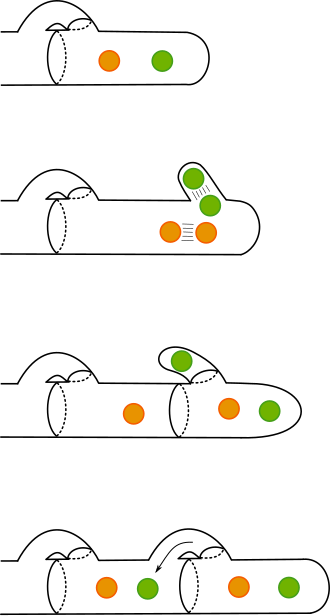
Clamp connection formation between two nuclei (one in green, the other orange) source ↗
A hyphal outgrowth that makes a connection during cell division between the resulting two cells by fusion. Generally associated with mycelium of Basidiomycetes.64
clavate
Narrowing at the base and then thickening; club-shaped.65
An artificial taxon for mitosporic fungi with pycnidial and acervular states, i.e. they form their spores in an internal cavity. From Gtk. koilos, hollow.67
Hyphae that lack septa and are multi-nucleate; seen in Zygomycota and Oomycota. From Gr. kytos, cell. Distinct from a synctium, a multinucleate structure resulting from fusion of protoplasts.69
Producing conidia. Generally used as "conidiogenous cell", fertile cells that produce conidia; or "conidiogenous locus", for the particular point on a hypha or a cell where conidia are generated.74
conidioma
Any multi-hyphal, conidia-bearing structure. An umbrella term that includes various traditional conidia-bearing structures such as a synnema, a sporodochium, an acervulus, or a pycnidium.75
A cobweb-like cortina of Cortinarius claricolorsource ↗
Of agarics, the remnants of the partial veil, frequently web-like, that covers mature gills. Thin and evanescent; eventually breaks up and disappears.81
Crust-like or having a hard surface layer, e.g. in a sporocarp; in lichens, a thallus firmly fixed to the substratum by the whole of their lower surface, generally lacking a distinct lower cortex.84
cyphella
A break in the lower cortex of a lichen thallus which appears as a cup-like structure or marking. Characteristic of Sticta. From Gr. kyphella, the hollow of an ear.85
A parasitic fungus that focuses on tissue with keratin (skin, hair, nails) of humans and animals. Associated with the genera Epidermophyton, Microsporum, and Trichophyton.90
A cow's head afflicted by dermatophytosissource ↗
The skin condition caused by a dermatophyte infection.91
dichotomous
Forking into roughly equal pairs, often repeatedly, e.g. in hyphal branching. Compare with monopodial.92
dictyospore
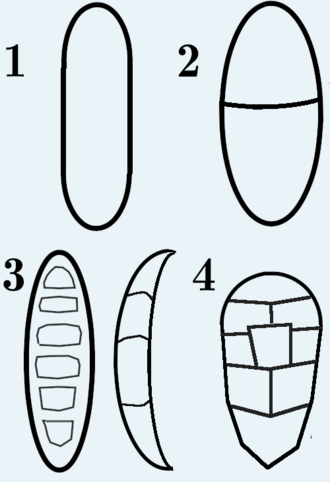
(1) An amerospore with no intersecting septa; (2) a didyomospore with a single intersecting septa; (3) two sample phragmospore patterns with multiple septa subdividing the spore; (4) a dictyospore with a brick wall-like muriform pattern of intersecting septa source ↗
Divided by intersecting septa in more than one plane, both transverse and longitudinal; a muriform spore. Found in Alternaria alternata as an example.93
didymospore
A two-celled spore divided by a single septum. Usually applied to mitosporic fungi. Compare with amerospore and phragmospore.94
A class of saucer-shaped and cup-shaped Ascomycetes in which the hymenium is exposed at maturity; one in which the fruit body is an apothecium (discocarp). Prominent members include Pezizales, Helotiales, Ostropales, and Lecanorales.99
disjunctor
An evanescent connective, consisting of either a cell or cell wall material. It develops through the pores of septal lamellae of adjoining conidia in a chain, before later fragmenting and releasing the conidia.100
In hyphae of basidiomycete fungi, parenthesomes (1) "cap" a dolipore septum; (2) the cell wall; (3) swells around the septal pore to form a barrel-shaped ring. Perforations in the parenthesome allow cytoplasm to flow between (4) and (5). source ↗
A septum found in Basidiomycetes that flares out in the middle to form a channel.101
E
echinate
Having sharply pointed spines, e.g. of spores. Its diminutive is echinulate, for delicate spines. Sometimes synonymous with spinose. From Gr. echinos, hedgehog.102
effete
Past the bearing period; overmature, e.g. a fruiting body that has emptied its spores.103
effuse
Expanded; stretched out flat, e.g. a film-like growth. From Latin fundere, to pour.104
An organism that lives within a plant; in mycology, specifically fungi that live within plants but do not show external signs or damage to the plants. This is usually endomycorrhizial fungi in root systems and asymptomatic fungi in aerial plant parts108
Having a short existence; soon disappearing, e.g. of a veil, an annulus, etc. From Latin evanscere, to disappear.117
eucarpic
Thalli where reproductive structures only develop on limited portions during fructication. The rest of the thallus remains in its original assimilative function. Compare holocarpic. If they have one sporangium, they are monocentric; if they have several sporgangia, they are polycentric. The vast majority of fungi are eucarpic.118
A fairy ringsource ↗
Mushrooms or puffballs forming in a circle, started from a central mycelium in the soil. Fairy rings expand with time if undisturbed, and are generally associated with basidiomycetes.122
falcate
Curved, like a sickle or scythe. From Latin falx and falcis, sickle.123
Pinot Noir grapes being fermented by yeasts in winemakingsource ↗
A chemical change caused by enzymes of living organisms. In mycology, typically yeasts and molds performing anaerobic breakdowns such as changing carbohydrates to carbon dioxide and alcohol. Part of the creation of fermented foods and fermented drinks (most notably alcoholic beverages).124
filament
A fine thread. Commonly used for hyphal threads or other simple thread-like fungal structures. From Latin filum, thread.125
filamentous
1. Thread-like, or composed of filaments.
2. In lichens, when the photobiont forms in threads surrounded by hyphae of the mycobiont; the fungi forms the outer structure. (e.g. Coenogonium, Cystocoleous, Racodium)126
Fluffy or cottony; byssoid. Common among many colonies of fungi. Its diminutive form is flocculose, for a small and delicate floccose element. From Latin floccus, a tuft of wool.131
2. Of lichens, foliose lichens, characterised by flattened leaf-like thalli.135
foot cell
1. A hyphal cell that supports a sporogenous cell or thallus, specifically the support of the conidiophore in Aspergillus and the macroconidium of Fusarium.
Panelluses stipticus, an example of luminiscient fungi (long exposure photograph) source ↗
A phosphorescent light emitted by moist, decaying wood; one of the most famous forms of fungal bioluminescence.137
free
Not adhering; not attached to the stipe, esp. of lamellae or tubes. Compare with adnate.138
A substance able to kill fungi, especially at low concentration. From Latin caedere, to kill. Generally used for chemical substances rather than heat, light, radiation, etc. which are called sterilization instead.142
A banana slug feeding on Amanita. Many animals are opportunistic fungivores and eat fungi if available, but only a few near-exclusively target them. source ↗
Fungus-eating.145
A kingdom of organisms in Eukaryota. Fungi are distinguished based on their morphology, nutritional modes, and ecology. Typical traits are that they lack plastids, are osmotrophic (absorb nutrients from their environment), are never phagotrophic, lack an ameboid pseudopodal phase, cell walls are composed of a chitin-glucan complex, mitochondria have flattened cristae and perioxomes are nearly always present, and are mostly non-flagellate; flagella when present lack mastigonemes. From Gr. sphongos, σπόγγος, sponge.147
1. Another term for chlamydospores, sometimes restricted to specifically spores that broke free from the mycelium to be dispersed, often via water. From Latin gemma, "jewel"
Germ tubes forming in Candida albicans, at 600x magnification source ↗
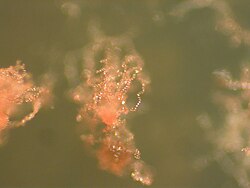
A short hypha that sprouts from the germ pore during germination. If conditions are favorable, will form a full mycelium. In plant pathogenic fungi, forms an appressorium, from which the infective hypha spread and penetrate the tissues of the host.160
Downy mildew infiltrating cells of the plant Arabidopsis thaliana, at 400x magnification. The stained dark blue spheres are the haustoria. source ↗
A hyphal branch for absorption of food. It penetrates the wall of the living host cell. Found in certain parasitic fungal plant pathogens, such as Phytophthora.171
3. A condition where a flagellum possess two rows of tripartite tubular hairs.173
heteromerous
In lichens, when the thallus is stratified. The photobiont is distributed in a compact layer, and the hyphal tissue of the fungi are separated into an outer rind and an inner stratum. From Gr. hetero, different, and meros, part.174
A scar after a spore is discharged; was previously the point of attachment of a basidiospore to the sterigma. From Latin hilum, mask.176
hoary
Covered thickly with silk-like hairs, especially of a pileus or stipe, often grayish or white.177
holocarpic
Having all of the thallus converted into the fruiting body at the end of maturation; compare eucarpic. The somatic and reproductive phases do not coexist as a result. Examples include Olpidiaceae and Synchytriaceae.178
Term describing the whole fungus throughout all its morphs (states, phases). Generally includes a single teleomorph phase and one or more anamorph phases.179
holothallic
A method of thallic conidiogenous in which a hyphal element is converted as a whole into a single conidium. All the cell wall layers are involved. Compare with arthric. From Gr. holos, whole.180
homoiomerous
In lichens, when the photobiont is are distributed uniformly or at random throughout the thallus. From Gr. homoios, similar.181
The spore-bearing fruiting surface of Ascomycetes and Basidiomycetes. An aggregation of asci or basidia in a layer (palisade) mixed with other sterile cells.187
An artificial class of mitosporic fungi that reproduces asexually. Traditionally subdivided into Agonomycetales, Hyphomycetales, Stilbellales, and Tuberculariales.191
hypnospore
A thick-walled resting spore; germinates only after a lapse of weeks or months. From Gr. hypnos, sleep.192
hypo-
Prefix meaning "under" or "lower". From Gr. hypo.193
1. (Of lichens) The first growth of the hyphae, before differentiation has taken place. Usually of a crustaceous lichen's earliest stage, lacking a cortex and photobiont. Often persists as a colored layer on the bottom of the later stages of maturation.
2. (of slime molds) a thin layer on the surface not used up in sporangial development.194
I
inoperculate
Not operculate; lacking an operculum. Generally refers to asci or sporangia that discharge spores by an irregular apical opening or pore instead. Found in various Discomycetes and most other ascomycetes.195
A propagule for lichen growth; can both increase the surface area of a lichen and become detached from the thallus to disperse the lichen. Isidia are structures larger than soredia, and contain both the mycobiont and the photobiont. They are usually cylindrical, but can also be verrucose, clavate, and other shapes.197
isokont
Zoospores with flagella of roughly equal length. Seen in Ectrogella bacillariacearum and other aquatic zoosporic fungi. From Gr. kontos, a pole.198
A gill; a hymenium-covered vertical plate, generally of an agaric. Attaches to the stipe in a variety of ways, including: free, unattached; adnate, attached; adnexed, a partial attachment; sinuate, similar to adnate but with an S-shaped curve; decurrent, attached and also running further down the surface of the stipe. From Latin lamina, a thin plate.204
Lactarius quietus exuding cream-colored latex from gills upon being cut source ↗
A milk-like juice that flows from some fungi when cut or damaged, as in Lactarius.208
Crustose lichens can grow on surfaces hostile to most other lifeforms, such as concrete walls and bare boulders. source ↗
A dual organism that arises from an association of fungi (mycobiont) and algae or cyanobacteria (photobiont). The two coexist in a mutualistic relationship as partners; the resulting lifeform differs markedly from its isolated components.212
Rhizocarpon geographicum (map lichen) in Switzerland source ↗
A technique for studying the exposure age of rock surfaces based on the size and diameter of lichen thalli. Used extensively in glaciology. Most frequently uses map lichen for dating. Lichenometry has been used to date Easter Island moai among other elements.217
An illustration of ectomycorrhizasource ↗
A layer of hyphae covering the roots of ectomycorrhizal plants, generally trees. Connected to a Hartig net on the inside, and extramatrical hyphae on the outside.228
A series of two successive nuclear divisions that reduces the number of chromosomes by one-half, going from a diploid state to a haploid one. The last part of the sexual phase in many fungi, following plasmogamy and karyogamy. Contrast with mitosis.232
merosporangium
A sporangium that is a cylindrical outgrowth from the swollen tip of a sporangiophore. A chain-like row of sporangiospores are produced there. Characteristic of Mucorales; also found in some other zygomycetes.233
A fungus of very small size, usually with microscopic sporocarps.242
monokaryotic
Cells having a single nucleus each; having genetically identical haploid nuclei (monokaryon or haplont). Found, for example, in the mycelium of Agaricales.243
monopodial
A type of branching where there is a persistent main axis from which branches split from, one at a time, often in alternate or spiral series. Often uses acropetal succession. Compare with dichotomous.244
A division of fungi broken off from Zygomycota in the 2010s that includes many of the molds, microscopic fungi. Includes Mucorales, the largest and most closely studied order of zygomycetes.249
Amanita muscaria (fly agaric), an iconic mushroom source ↗
Large agarics, or other fleshy fungi such as boletes. Commonly divided into mushrooms (human-edible) and toadstools (inedible).252
Toxins (the product of one organism injurious to another) produced by fungi. Studied by mycotoxicology. Poisonings are called mycotoxicoses.267
Myxomycota
Hemitrichia serpula, commonly called pretzel slime, a true slime mold source ↗
True slime molds. No longer categorized as fungi, but were formerly categorized as such in older literature, and still studied in mycology; now considered part of Amorphea. Since reclassified as Myxogastria. From Gr. myxa, slime.268
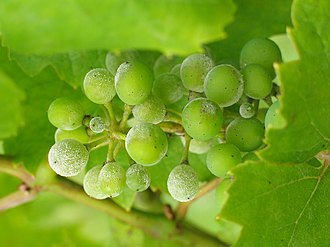
Riesling grapes afflicted by Botrytis cinerea (gray rot), causing a color change source ↗
A condition from the mold Botrytis growing on overripe grapes. Used in the production of certain sweet wines.270
O
obclavate
(of spores, stipe, cystidia, etc.) The reverse of clavate; widest at the base.271
400x magnification showing oospores of Hyaloperonospora parasitica, a downy mildewsource ↗
The resting spore formed as a result of fertilization of the oosphere. Has a thick, resistant wall. Subdivided into centric, subcentric, subeccentric, and eccentric oospores by its structure.277
A small rounded elevation. Generally refers to an elevation on the wall of the sporangium which on breaking serves as the exit point of zoospores and planogametes.283
paraphysis
A sterile upward-growing, basally-attached hypha in a hymenium, especially in ascomata of ascomycetes where they are generally filiform and clavate. The free ends frequently converge toward the ostiole and make a structure called an epithecium over the asci. Part of the hamathecium. Has a number of minor variants distinguished by names such as paraphysoid, pseudoparaphysis, pseudophysis, dikaryoparaphysis, and hyphidium.284
A sample agaric-type basidioma in (A) the early development stage, and (B) after the body is fully expanded. (1) is the universal veil, the outer layer protecting the developing basidioma; (2) is the partial veil, which covers the gills; (3) are cap scales, remnants of the universal veil; (4) is the volva, another remnant of the universal veil, but at the base of the basidioma; (5) is the annulus, a ring-like mark on the stipe that is a remnant of the partial veil, and whose overhanging tissue may become a cortina. source ↗
A layer of tissue that joins the stipe to the edge of the pileus in agarics, covering the gills during hymenium development. May become an annulus or a cortina after development is complete.285
pectinate
Resembling the teeth of a comb, e.g. of the margin of a pileus.286
2. A thin film-like growth on the surface of a liquid culture, e.g. on yeasts.
3. (of agaric basidiomata) A delicate skin-like cuticle of the pileus that can break off.288
penicillus
An asexual conidial head in the shape of a brush. Consists of a pedicel or conidiophore that supports a cluster of conidiogenous cells (phialides). Characteristic of Penicilliumstipes.289
percurrent
1. Conidiogenous cell growth where a conidiophore or germ tube grows through a preexisting pore.
2. Of a columella, extending throughout the entire length, from the base of the gleba through to the peridium's apex. Found in gastromycetes such as Podaxis. Also called a stipe-columella or dendritic columella.290
Feeding by engulfing food; extending a pseudopod or other protoplasmic extension, as seen in protozoa. Never seen in true fungi (Eumycota), but some Pseudofungi use this in addition to osmocytosis, e.g. Myxomycetes.293
A type of conidiogenous cell, bottle-shaped, that produces blastic conidia (phialospores) in basipetal succession. The philade itself does not increase in length. The most common conidiogenous cell among conidial fungi. From Gr. phiale, jar.294
phialospore
An asexual spore formed from the tip of a phialide. Formed by abstriction.295
A tropic phenomenon driven by light, where growth curves toward or against light stimuli. For example, sporangiphores of Pilobus and Phycomyces direct themselves toward light.297
A group of forms alike in morphology. Often means a group of organisms that are potentially interbreeding. In plant pathology, it means a group with similar preferences in plants targeted; a race may be adapted to target only a single cultivar of a plant. Tracking the history of an organism is phylogeny. From Old Italian razza, generation.299
The fusion of two cells or plasmodial cytoplasms, resulting in the nuclei juxtaposed and a dikaryon formed. In many sexual phases of fungi, the first step which precedes karyogamy (nuclear fusion) and meiosis.304
A thick, packed tissue of twisted hyphae formed during basidiocarp development as it enlarges and generative hyphae begin to differentiate. From Gr. plektos, to twist, and enchyma, infusion.305
Any structure that serves to spread the organism, both via propagation of new organisms as well as vegetatively increasing a single organism's size. In fungi, generally spores, bulbils, fragments of mycelium, isidia, soredia, and others.310
A geniculate or zig-zag holoblastic extension of a conidiogenous cell from sympodial conidiogenous cell development. Such cells having a rachis are called rachiform. From Gr. ráchis, axis, spine.321
racket cell
A hyphal cell having a swelling at one end, resembling a tennis racket; found in dermatophytes.322
A slender, tapered structure of anucleate filaments bearing a superficial resemblance to a plant root, as it is extended by the thallus of chytrids as a feeding organ. Generally part of a root system-like aggregation of branched hyphae.326
A strand or cord of mycelium, often with a dark-colored rind surrounding a central core of colorless cells, penetrating a soft substratum or between portions of it (e.g. between bark and wood). Unlike a mycelial cord, features distinct tissue, unlike "normal" hyphae. Functions as organ of absorption of nutritive substances. Seen in some Agaricales and Gasteromycetes.327
A sister group of quasi-fungi that lack chitinous cell walls. Traditionally considered chytrids, but have since been separated and reclassified in the 2010s. Phagotrophs rather than osmotrophes. Rozella, a group of obligate endoparasites, is possibly the earliest diverging lineage of fungi.329
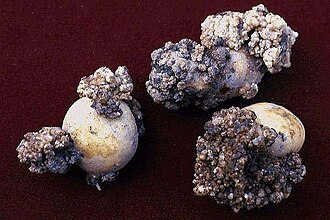
Sclerotinia sclerotiorum sclerotia source ↗
A hardened, often rounded, mass of hyphae, normally having no spores. May give rise to a fruit body, a stroma (as in ergot), conidiophores, or mycelium. Can be a store of nutrients as part of perennation; can reinitiate vegetative growth after conditions have improved and a season has passed.337
scutate
Like a shield or round plate in shape. From Latin scutum, shield.338
A fruiting body with the appearance of an unopened agaric or bolete. The margin of the pileus does not break free of the columella-stipe, generally seen in vertical development (e.g. Podaxis pistillaris).339
1. Growing old. From Latin senescere, to grow old.
2. The degeneration over time that makes indefinite propagation of certain fungi cultures impossible, especially in isolation such as a lab environment.342
Edged with teeth, like a comb or saw, e.g. of gills; its diminutive form is serrulate.345
sexual phase
The phase of the fungal life cycle when sexually reproductive cells and organs are formed. This term is preferred over sex in animals, as the fungal process is not equivalent.346
Acrasis rosea, a cellular slime mold source ↗
A eukaryotic lifeform that spreads via spores. Has both ameba (cellular slime molds) and plasmoidial (multi-nucleate) varieties. No longer categorized as fungi, but were formerly categorized as such in older literature. Cellular slime molds are part of Acrasiomycota or Dictyosteliomycota; plasmodial slime molds were traditionally part of the class Myxomycota, since renamed Myxogastria. From Gr. myxa, slime.347
1. Loose smut of barley, caused by Ustilago nudasource ↗
A class of destructive plant diseases, generally of cereal grasses, caused by parasitic fungi of Ustilaginomycetes. Distinguished by transformation of plant organs permeated by hyphae into a dark mass of spores.
2. Smut-causing fungi themselves in Ustilaginomycetes. Characterized by being host-specific endophytes. Its spores are called ustilospores.
A propagule for vegetative lichen growth; a combination of phycobiont algae wrapped by mycobiont hyphae, and produced on a lichen thallus. Has the appearance of a powdery granule. From Latin soredium, a small heap.351
A heap of spores. Fruiting structure in certain fungi, including the spore mass of rusts, but also Acrasidae and Synchytriaceae. From Gr. soros, heap.352
spawn
Mycelium used for starting fungal cultures, especially mushrooms; e.g. bricks of manure interlaced with mycelia.353
A reproductive structure in fungi. Can result from both sexual and asexual processes.361
spore wall
The layered wall defining a spore. Considered to have five layers. From within to outwards: the thin interior endosporium, the thick episporium, the exosporium (or tunic), the perisporium, and ectosporium, although the outermost two layers are fleeting and can be absorbed back into the perisporium and exosporium.362
Having minute radiating lines or ridges, such as the margin of a pileus.370
stroma
Close-up of a stroma of ergot, an ascomycete source ↗
A mass of vegetative hyphae where fertile hyphae, fruiting bodies, and spores are produced. Common among ascomycetes and anamorphic fungi; a few Pucciniales have them as well.371
A bundle of erect and sometimes fused conidiophores that make a conidioma together. Conidia are born at the apex, and sometimes along the sides as well. Characteristic of certain asexual fungi including Doratomyces, Dendrostilbella, and Graphium.378
The sexual state (or perfect state) of a fungus whose spores are produced by meiosis, i.e. characterized by ascomata or basidiomata.379
thallic
One of the two basic forms of conidiogenesis, with blastic conidiogenesis. Characterized by the conidia initial being delimited by one or more septa before it begins enlargement. The result is that the conidium is differentiated from the whole cell. By comparison, in blastic conidiogenesis, enlargement occurs within the cell before being delimited later.380
1. A layer of hyphae in the central part of an agaric running from the underside of the cap to the lamella, often supporting the hymenium. Sometimes called a hymenophoral trama to distinguish it from the second definition.
2. In old literature, any fleshy part of the pileus, although this use has since been discouraged.383
Arranged in a single row or series. Generally used to differentiate how phialides are arranged in species of Aspergillus; in uniseriate, they are directly on the conidial head, contrasted with biseriate where phialides rest on intermediate outgrowths of sterile cells called metulae.395
The white patches on the caps of these Amanita muscaria mushrooms are cap scales, remnants of the universal veil. source ↗
A layer of tissue covering the basidioma during its early development, in agarics and Gasteromycetes. As the pileus grows, the veil is broken, with its upper remnants becoming cap scales, and the lower section becoming the volva.396
Warty; having rounded bumps. Verruculose is the diminutive version for delicate or small warts.
verticillate
Having parts in rings (verticils); whorled. Develops due to branching in which branches or pedicels are borne at the same level on the hypha, and grow obliquely upward with respect to the central axis. Named after the conidiophores of Verticillium, but appears in other fungi such as the sporangiophore of Actinomucor. From New Latin verticillatus, arranged in a verticil.398
Fungi that digest wood. Mostly basidiomycetes, although a few ascomycetes also possess this ability. Generally categorized into brown rot, which digests a tree's cellulose and hemicellulose but not its lignin; white rot, which can also digest lignin; and soft rots, which are similar to brown rots in attacking cellulose and hemicellulose, but require moist wood and available nitrogen, e.g. from nearby soil. Two other notable types are dry rot (a slight misnomer, as some dampness is still required), a brown rot caused by Serpula lacrimans; and wet rot, several other species including cellar fungus.405
Preferring a dry habitat, or at least capable of subsisting in one. Rare among fungal species, but fungi with this capability can be exceptionally common, such as Aspergillus and Penicillium whose spores can be found in nearly any soil sample.406
Kirk, Paul M.; Cannon, Paul F.; Minter, David W.; Stalpers, Joost A. (2008). Dictionary of the Fungi (10th ed.). Oxon: CAB International. ISBN978-0-85199-826-8.
Snell, Walter H.; Dick, Esther A. (1971). A Glossary of Mycology (Revised ed.). Cambridge, Massachusetts: Harvard University Press. LCCN77-134946.