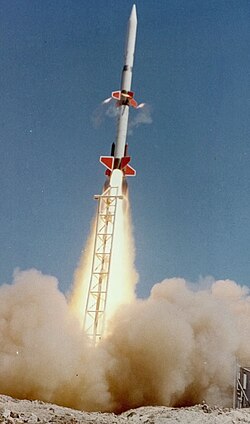
Alcor (also known as Zebra or 30-KS-8000) was a solid rocket engine, originally developed by Aerojet for the US Air Force as the third stage of the Athena test vehicle.123 Its main appeal was a high mass fraction due to the Aerowrap chamber fabrication process. However, production issues with joint sections limited its use. Alcor engines were used from 1960 to 1977.1
The original version was used on a series of rockets: Blue Scout Jr, Blue Scout Junior, Astrobee 200, Blue Scout Jr SLV-1C, RAM B, Blue Scout Jr SLV-1B(m), Athena RTV, Strypi VI and Strypi VIIAR.1
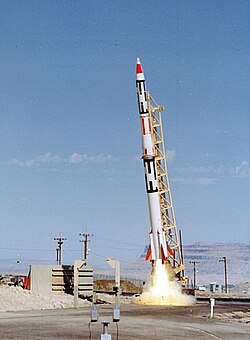
Initially produced with polyurethane propellant, it transitioned to polybutadiene, leading to the Alcor 1A (23KS-11000) variant.145 This variant featured improved nozzle, chamber insulation, and expansion ratio, increasing the mass fraction from 0.886 to 0.906. Both Alcor 1 and 1A were used in Astrobee 500 and 1500 vehicles.1 Alcor 1A was used on the Athena H.46
Another improvement occurred late in 1965, with the introduction of an all welded titanium chamber, resulting in the Alcor 1B variant.178 Alcor 1B was used on the Strypi VIIR.7
References
References
- "Alcor". astronautix.com. Retrieved 2025-01-20.
- Gatland, Kenneth (1964). Spacecraft and Boosters. London: Iliffe Books. p. 249.
- Dorman, Bernie (1995). Aerojet: The Creative Company. Los Angeles: Stuart F Cooper Company. p. 480. ISBN 9780965976909.
- "23KS11000". astronautix.com. Retrieved 2025-01-20.
- ROCKET MOTOR SPIN DATA SUMMARY (PDF). NASA Langley Research Center. 1964. p. 9.
- "Athena H". astronautix.com. Retrieved 2025-01-20.
- "Alcor 1B". astronautix.com. Retrieved 2025-01-20.
- "PERFORMANCE OF THE ALCOR 1B SOLID-PROPELLANT ROCKET MOTOR UNDER THE COMBINED EFFECTS OF ROTATIONAL SPIN AND SIMULATED ALTITUDE". DTIC. Archived from the original on 2023-06-06. Retrieved 2025-01-20.