
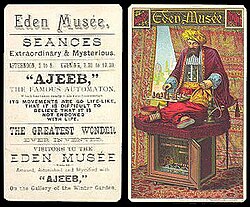
Ajeeb was a chess-playing "automaton", created by Charles Hooper (a cabinet maker),1 first presented at the Royal Polytechnical Institute in 1868. A piece of faux mechanical technology (while presented as entirely automated, it in fact concealed a strong human chess player inside), it drew scores of thousands of spectators to its games, the opponents for which included Harry Houdini, Theodore Roosevelt, and O. Henry.
Ajeeb's name was derived from the Arabic word عجيب (ʿajīb) meaning "wonderful, marvellous, mysterious or strange". Some of the device's operators were Harry Nelson Pillsbury (1898–1904),1 Albert Beauregard Hodges, Constant Ferdinand Burille,2 Charles Moehle, and Charles Francis Barker. Moehle, for instance, gained further popularity playing chess in the United States,3 where the contraption was also exhibited in the Eden Museum in 1885 and Coney Island in 1915.4 Solomon Lipschuetz was one of Ajeeb's notable opponents during this period.5 The machine also played checkers, matching against figures such as 1920s American champ Sam Gonotsky, who would also direct the machine under the ownership of Hattie Elmore.6
In the history of such devices, it succeeded the Mechanical Turk and preceded Mephisto.78
References
References
- Schaeffer, Jonathan (1997). One jump ahead. Springer. pp. 90. ISBN 0-387-94930-5. Retrieved 2009-03-10.
ajeeb chess.
- "Constant Ferdinand Burille". Chessville. Archived from the original on 2010-09-19. Retrieved 2010-02-14.
- Urcan, Olimpiu; Hilbert, John (2017). W.H.K. Pollock: A Chess Biography with 523 Games. Jefferson, NC: McFarland & Company, Inc. Publishers. p. 93. ISBN 9780786458684.
- Goody, Alex (2007). Modernist Articulations: A Cultural Study of Djuna Barnes, Mina Loy and Gertrude Stein. New York: Palgrave Macmillan. p. 213. ISBN 9781349352685.
- Davies, Stephen (2015). Samuel Lipschutz: A Life in Chess. Jefferson, NC: McFarland & Company, Inc., Publishers. p. 22. ISBN 9780786495962.
- Kidwell, Peggy Aldrich. "Playing Checkers with Machines—from Ajeeb to Chinook". Information & Culture 50, no. 4 (2015): 578–587.
- Chess Automatons Archived 2008-10-08 at the Wayback Machine
- ChessBase :: Spotlights :: Der Schachtürke Archived 2009-03-12 at the Wayback Machine