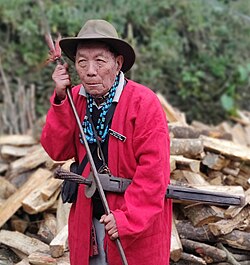
 Portrait of Adi tribals from Arunachal Pradesh | |
| Total population | |
|---|---|
| ~170,000 (est.) | |
| Regions with significant populations | |
 India India | ~162,000 (Arunachal Pradesh, 2011 census) |
| Arunachal Pradesh | East Siang, Upper Siang, West Siang, Shi Yomi, Lower Dibang Valley |
 China China | ~8,000 (Tibet Autonomous Region, est.) |
| Tibet Autonomous Region | Mainling, Medog, Nyingchi counties |
| Languages | |
| Adi (Tani) | |
| Religion | |
| Majority: Donyi-Polo Minority: Christianity, Buddhism | |
| Related ethnic groups | |
| Tani people, Lhoba people, Galo people, Mishing people, Tagin people | |
The Adi people (also historically known as the Abor) are an indigenous Tibeto-Burman ethnic group primarily inhabiting the Indian state of Arunachal Pradesh, with smaller communities in the Tibet Autonomous Region of China. The word Adi means "hill" or "mountain top" in their language, and replaced the older exonym Abor, an Assamese term meaning "independent" or "unsubdued," which the community came to regard as derogatory.1 All ethnic groups identifying as Adi trace their descent from the mythical progenitor Abotani (also Abutani), and share common origin narratives, festivals, and religious traditions.1
The Adi are the second-largest tribal group in Arunachal Pradesh and are concentrated in the districts of East Siang, Upper Siang, West Siang, Shi Yomi, and Lower Dibang Valley, in the subtropical and temperate zones of the Siang River valley and surrounding hill ranges.2 Smaller Adi communities are also found in Lohit, Changlang, and Namsai districts. In China, the Adi along with the Tagin, Galo, Nyishi, Na, and Mishmi peoples are collectively known as the Lhoba and are officially recognised as one of China's 56 ethnic groups.

Etymology
The Adi were historically referred to as Abor by Assamese neighbours and by the British colonial administration, a term derived from Assamese meaning "unruly" or "independent."3 The word reflected the community's fierce resistance to outside authority rather than any self-identification. After Indian independence, the community formally adopted Adi, a term from their own language meaning "hillman" or "mountain dweller," to replace an exonym they considered dismissive.1 The Padams, Milangs, Komkars, Minyongs and Pasis collectively call themselves Adi, meaning "hill people," and akin to one another they speak a common dialect, claim a common origin, and perform and celebrate the same rituals and festivals.2
Sub-tribal names like Adi-Minyong, Adi-Padam, and Adi-Gallong followed from this renaming, though the Galo have since separated from the broader Adi designation following their own constitutional recognition as a distinct tribe.4
Sub-tribes and distribution

The Adi are not a single homogeneous group but an aggregation of multiple subtribes who share common ancestry, language roots, and cultural practices. The principal subtribes are the Padam, Minyong, Milang, Pasi, Komkar, Shimong, Ashing, Bokar, Karko, Panggi, Pailibo, Ramo, and Tangam, with some sources recognising up to fourteen such groupings.5 The Adis have two broad divisions, the Bomis and the Bogums, under each of which sit a number of subtribes. These subtribes are differentiated by dialect, territory, and minor cultural variations, but maintain an overarching Adi identity and do not observe any rigid hierarchical separation among themselves.
As per the 2011 Census of India, the Adi and their enumerated subtribes had a combined population of approximately 162,000 in Arunachal Pradesh, with the Adi (67,869), Adi Minyong (25,112), and Adi Gallong (18,604) forming the three largest enumerated groups within the broader collective.6 The Adi constitute a major group inhabiting the lower part of the Lower Dibang Valley district, especially Roing and Dambuk areas, and are found throughout the temperate and subtropical zones of the Siang valley.2
History
Origins and oral tradition
The Adi do not possess ancient written records, having been an oral people without a script of their own until the twentieth century. Their history is preserved primarily through oral traditions: the Abangs (sacred rhapsodies narrating creation myths and ancestral lineages), Ponungs (lengthy ballads drawing themes from Abangs), and Abes (oratorical pieces delivered at the Kebang council).1 A specialist elder known as the Kebang Abu recites, in poetic form, the migration history of the community from their ancestral homeland, which oral accounts trace to places named Uli, Usha, and Kumting in Tibet.1
The origin myths of the Padam and Minyong subtribes hold that Keyum was the first life form, followed after several generations by Sedi, the creator of the world. Pedong Nane, the sixth generation of Sedi, gave birth to deities, spirits, animals, and finally to Donyi (or Tani), regarded as the common ancestor of the Adi people.2 From Pedong Nane's descendants came the founding figures of individual subtribes: Bome, from whom the Padams descended, and Banyo, from whom the Minyongs traced their line.1 These narratives are shared with variants across the Pasi, Panggi, Karko, Shimong, Milang, and eastern Adi groups. The Galo branch traces its origin separately through the figure of Sichi.
The Adi traditionally believe that their ancestors migrated southward from the northern regions of what is now Tibet, settling over centuries in the remote hill country of present-day Arunachal Pradesh. This geographical isolation played a role in preserving their distinct cultural and linguistic traditions. Knowledge passed across generations orally, with senior citizens and village elders entrusted with the responsibility of guiding younger generations in cultural traits and customary practices; ballads and oral recitations have served as an important means of transmitting knowledge.7
Colonial period
The Adi's first recorded contact with British administration came through a series of expeditions into the Siang frontier during the nineteenth century. Initial expeditions in 1858 and 1859 met fierce resistance. The Adi had established arrangements with the Ahom rulers of Assam that the British declined to honour, and the imposition of the 1873 Inner Line Regulation cut the hill communities off from the foothills on which they depended for labour and trade, generating sustained tension.3 Further clashes followed in 1894. The Abors were an Assam tribe inhabiting a tract of hill country on the north-east frontier of India, first visited by the English in 1826, much of whose area was then terra incognita.8
Tensions reached a peak in what became known as the Abor Massacre of 1911. Captain Noel Williamson, then serving as Assistant Political Officer at Sadiya and Lakhimpur, led an expedition into the Adi hills in March 1911 accompanied by Dr. Gregorson and a large party of porters and escorts.9 Accounts note that a personal altercation between Williamson and the Adi leader Matmur Jamoh at Leedum village, in which Williamson allegedly struck Jamoh, became a decisive trigger for the violence that followed.9 On 31 March 1911, warriors led by Matmur Jamoh and others from the villages of Kebang, Pangi, and Sissan attacked and killed Williamson, Gregorson, and nearly all of their party.10
The British response was the Abor Expedition of 1911-12, a punitive operation commanded by Major-General Sir H. Bower, lasting from October 1911 to April 1912.9 The Adi warriors resisted with conventional tribal weapons including bows and arrows, spears, swords, booby traps, poisoned arrows, and stone chutes, and succeeded in halting the British advance for more than two months at the historical battlefield of Kekar Monying cliff near Rottung.11 The Adi resistance at Kekar Monying is remembered in Arunachal Pradesh as the Poju Mimak, the fourth and last of the Anglo-Abor Wars, fought from 6 October 1911 to 11 January 1912. Matmur Jamoh eventually surrendered after British forces attacked his family, and was sentenced to life imprisonment at the Cellular Jail in the Andaman Islands.12 Other recognised Adi fighters of the period included Tajong Tamuk, Lomlo Darang, and Lotiyang Taloh, whose names have since been added to an official state list of unsung freedom fighters.13
Following Indian independence, the former North-East Frontier Agency (NEFA) was reorganised. The first school in the region was established at Pasighat in 1918; the second at Dambuk in 1922; the first college offering undergraduate courses opened at Pasighat in 1964.14 Arunachal Pradesh attained full statehood in 1987, and the Adi and other tribes transitioned from a position of external administration to full political participation within the Indian democratic system.
Social organisation

The most striking feature of Adi society is the Kebang, the traditional village council that serves simultaneously as a deliberative assembly, a governing body, and a customary court. Every Adi village has a Kebang composed of elected headmen (the Gam or Gao Burra) and respected village elders.15 Decisions are reached collectively and announced in the village community hall, called the Musup or Dere, which stands at the centre of the settlement. The council adjudicates disputes over land, marriage, and community violations; any Adi summoned to appear before a Kebang is obliged to attend, and non-compliance can result in fines or referral to higher-tier councils such as the Banggo Kebang and Bogum Bokkang.15 The importance of Kebangs is recognised by the state government, which has taken steps to systemise the institution by formally appointing elders to the council.16
Adi villages are sited on the spurs of hills. Houses are built in rows with clear passages between them, reflecting a sense of communal planning and provision for emergency access.2 The traditional house is a bamboo structure built on stilts, with raised floors of split bamboo over wooden or bamboo beams (the chang), walls of rough-cut planks or bamboo splits, and roofing of thatch or palm leaves.2 The typical household is a large hall with a central hearth called the Merom, around which family members gather for meals and social life.2 Granaries are placed at the village outskirts to reduce the risk of fire damage. A separate structure called the Moshup serves as a communal house for unmarried boys, typically situated at a central point from which different approaches to the village can be monitored; children above the age of ten can become members, and the institution is thought to build cooperation, mutual respect, and communal feeling among the young.
The Adi have a patriarchal, patrilineal society. Descent and inheritance pass through the father's line, and children belong to the father's clan.2 Some well-known Adi clans include Darang, Taggu, Siboh, Sitek, Perme, Tatak, Taga, Tayeng, Jerang, Pertin, Jamoh, Gao, and Tamut. Family is the smallest social unit and typically follows a nuclear structure; upon marriage, elder siblings usually establish new households in different localities while the youngest siblings remain at the parental home to care for the elderly parents. Monogamy is the prevalent form of marriage, though polygamy is socially permitted in some communities; polyandry is not practised. A marriage is formalised through the payment of bride price, known as kepel, which traditionally includes items such as dried or raw meat, fish, rats, squirrels, and rice beer.2 A marriage arranged by parents and elders is considered ideal, though selection of a partner through courtship is also accepted.2
Women play a vital economic role through weaving, agriculture, and household management, and also participate actively in the formal cultural life of the community, particularly as performers of the Ponung dance during festivals.
Language
The Adi speak a group of closely related dialects and languages belonging to the Tani branch of the Tibeto-Burman family, sometimes referred to as the North Assam group of Tibeto-Burman languages. The Tani branch is shared with several other Arunachal tribes including the Galo, Nyishi, Apatani, Tagin, and Mishing.17 The principal Adi dialects are Minyong, Padam, Shimong, Ashing, Bori, Pasi, Bokar, Ramo, and Karko, forming a dialect continuum with partial mutual intelligibility between neighbouring varieties, though comprehension diminishes significantly across greater distances. Minyong and Padam are among the most widely spoken varieties.
Historically the Adi were without a written script. The first texts in the language were produced by American and British missionaries in the early twentieth century, including an Abor-Miri dictionary published in 1906 by J. H. Lorraine and F. W. Savage, compiled with the assistance of Mupak Mili and Etsong Pertin, who are credited as pioneers of Adi literacy.17 Adi is today primarily written using the Roman script. In matters of broader communication, Hindi serves as the primary language of inter-tribal exchange across Arunachal Pradesh. The language is taught as a third language in schools of Adi-dominated communities.17
Religion
Donyi-Polo

The great majority of the Adi follow Donyi-Polo, the indigenous animist faith of the Tani peoples, whose name translates literally as "Sun-Moon." Donyi (the sun) represents the female principle and Polo (the moon) the male, and together they constitute a notion with some analogy to the yin and yang concept of Chinese culture.18 To the Adi, Donyi-Polo is not understood as the physical sun and moon but as an unseen, omnipresent supreme power, simultaneously the planner, creator, and preserver of all beings. The creator deity Sedi-Melo stands above the faith but is neither worshipped nor invoked directly.19 The Adi also recognise a wide range of spirits, both malevolent and benevolent, inhabiting the natural world, and these are managed through ritual. The main named deities are Kine Nane (goddess of crops and earth), Doying Bote (associated with wisdom and administration), Pedong Nane (ancestral mother of the Tani), and Gumin Soyin (guardian of households).2
Ritual specialists called miri or nyibu (shamans or priests) lead religious ceremonies, conduct animal sacrifices, recite sacred oral literature, and serve as intermediaries between the human and spiritual worlds.19 The sacred oral corpus recited by nyibu priests, known as Niyibu Agom, encodes the community's creation myths, the interplay of life and death, and the reciprocal relationship between humans and natural forces.19 Within the prayer place called a gangging, male members sit on the left in rows and female members on the right, cross-legged, and no noise except the sound of hymns is permitted during prayer.18
The Donyi-Polo revival movement
The Donyi-Polo faith as a formally organised religion is largely a product of the late twentieth century revivalist movement. Christian missionary activity, which gained momentum from the 1950s onward, and later pressure from Hindu organisations, prompted anxiety among Adi and other Tani intellectuals about the gradual erosion of indigenous identity.20 On 28 August 1968, a landmark meeting of Adi and Galo intellectuals was held in Aalo (then Along), the district headquarters of West Siang, where participants resolved to build a Donyi Polo Dere (community hall) and begin preserving their traditional faith.20
The central figure of the revival was Talom Rukbo (1937-2001), an Adi who graduated from St Edmund's College, Shillong, in 1960, served as a language officer in the state government, and took early retirement in 1972 to devote himself entirely to the movement.20 Together with his colleague Arek Megu and later protege Kaling Borang, he established key institutions of the faith. By 1986, three major cultural organisations had been founded: the Tani Jagriti Foundation, the Donyi-Polo Youth Federation, and the Donyi-Polo Yelam Kebang (DPYK).21 The DPYK was formally constituted on 31 December 1986, a date now observed annually as Donyi-Polo Day, after Kaling Borang advised Rukbo that a written script of the Adi spoken language must be developed for the faith to be formally recognised as a religion.20 The DPYK subsequently consecrated sacred spaces called gangging, collected and published prayer hymns and religious literature, and established twice-yearly orientation courses to train youth as faith leaders who could be sent back to their home villages with books and icons.18
Rukbo represented the Donyi-Polo Mission at the International Association for Religious Freedom congresses in 1984, 1985, and 1986, pleading for recognition of Donyi-Poloism as a full-fledged religion.22 His core conviction was that the main reason for the easy erosion of traditional culture was that it lacked written literature, and prayers and hymns were accordingly composed to recover and revitalise endangered rituals.23
The revival has been described as one of the most successful indigenous faith preservation movements in northeast India.24 Its slogan, "Loss of culture is loss of identity," became widely adopted across Arunachal Pradesh.25 The movement has since spread beyond the Tani peoples, inspiring parallel revivals among the Tangsa (Rangfraism), the Idu Mishmi (Intayaism), and other communities of Arunachal Pradesh.18
Christianity and Buddhism
Christianity is practised by a minority of the Adi, primarily as a result of missionary work that gained momentum from the mid-twentieth century onward. Among some Adi communities, Christian practice exists alongside or in hybrid form with Donyi-Polo observance rather than fully displacing it.26 Buddhism is followed by small numbers of Adi, particularly those in areas bordering the Tibetan cultural sphere.
Culture and traditions
Festivals

Solung is the most important festival of the Adi and is celebrated in the first week of September, marking the beginning of the harvest season. The origin of the Solung festival is connected to a legend about the origin of paddy: the paddy plant is said to have sprung from the life-juice of Yidum-Bote (son of the god of knowledge) and was reared by Kine Nane (goddess of the underworld), who agreed to supply paddy to humankind if they sacrificed mithuns and pigs every year.27 The date of Solung is fixed by the Kebang or, with the consent of community leaders, by the village headman, based on the convenience of the village people.28
The festival lasts for five days and is divided into distinct phases. The opening day, Solung-Gidi Dogin, involves the preparation and communal distribution of Apong (rice beer) and traditional foods, including the rice cake Poka made from fermented rice flour.29 The second day, Doreph-Long, is marked by the sacrifice of mithuns (a domesticated bovine, Bos frontalis) and pigs in propitiation of the deities. The third day, Binnýat, features prayers and offerings to Kine Nane, Doying Bote, and Gumin Soyin. On the final days, Ponung dances are performed and the community exchanges meat and gifts. On the last day, bows, arrows, and traditional weapons are placed along the passages of houses in a ritual called Taktor, intended to drive away evil spirits.28 The festival name Solung derives from Eso (mithun) and lung (herd), pointing to the centrality of mithun husbandry to Adi agrarian life.30
The Unying Aran (also simply Aran) is celebrated on 7 March to herald the season of shifting cultivation. Male members of each family undertake a week-long hunting expedition into the jungle, and children perform Yakjong, going from house to house in traditional attire to bless households. The Aran also serves a practical purpose: its rituals are observed to coordinate and reduce crop damage from rodent pests, particularly during the planting season.28
Other major festivals include Donggin (celebrated on 2 February), Podi Barbi (observed on 5 December), and Etor (celebrated on 15 May), the last of which is marked by the Delong dance performed by men in the community hall.
Dance and music

Adi dances are closely tied to specific festivals and social occasions. The Ponung is the most iconic, performed exclusively by women, typically unmarried girls, in vibrant traditional attire. It is characterised by slow, graceful, rhythmic movement synchronised to chants and drums, and is performed during Solung and other major celebrations.31 The Tapu is a war dance performed by men, re-enacting combat through vigorous movement with swords and shields; in the Tapu, dancers emphatically repeat the actions of battle, its descriptions, and the victorious cries of warriors.5 The Delong is performed by men during the Etor festival in the community Dere. The Yakjong is a processional dance performed by children during the Aran festival, in which dancers carry sticks with designs made by removing blisters in certain patterns and then scorching them in fire to create marked black designs.5
Oral literature expressed through these performances includes Abangs (recited or sung creation rhapsodies), Ponungs (narrative ballads), and the Solung Abung (hymns narrating the tribe's origins and heroes, sung across the five nights of Solung).31
Clothing and craft

Adi women are accomplished weavers who produce cloth with highly artistic geometric designs. The female dress is divided into two parts: the upper garment worn above the waist, called Ulta Galuk, and the lower garment called Gale. Women develop considerable knowledge and skill in the weaving of the Gale in particular, selecting devices and materials that require years of experience to master; the culture, belief, and spiritual aspects of the community are considered to be attached to this textile tradition. Men traditionally wear helmets fashioned from cane and deerskin or bearskin, depending on the sub-tribal region. Adi craftsmen produce household items from bamboo and cane, including trays, baskets, haversacks, caps, mats, and headwear.5 The Nadang, a traditional Adi basket, is among the most widely recognised items of Adi material craft. Both men and women wear traditional attire at festivals, and the preservation of these garment traditions is actively promoted through community organisations.5
Adis believe that the chirp of the cicada leads to the ripening of jackfruit during summer, and children traditionally place cicadas on stored jackfruit for early ripening. In earlier times, before the advent of rice cultivation, jackfruit was one of the staple foods of the Adi people. The design of the Pore, a traditional woven textile element, is itself believed to be an imitation of the pattern of cicada wings.
Economy and subsistence
The Adi traditionally practise a combination of wet-rice cultivation in valley areas and shifting (jhum) cultivation on hill slopes. Hills and slopes are terraced while dry lands are used to grow cash crops such as maize and mustard. Agriculture implements are simple, consisting of the dao, axe, spade, dibbles, and scrapers; ploughing is known but use of modern mechanisms and fertilisers are recent innovations.2 Agriculture is complemented by hunting, fishing, and gathering of forest produce. Fishing at large scale by groups is done by diverting the water flow of a stream branch from the main channel, barricading it with leaves and gravel, before netting and trapping fish. Both shotguns and traps are used in hunting; the use of bows and arrows has become rare in recent decades.2
The mithun (Bos frontalis) holds central cultural and economic significance; mithun ownership has historically been the primary indicator of social status and wealth, and mithun sacrifice is integral to major festivals and ceremonies.2 Rice beer (Apong), brewed domestically, is a constant of social and ritual life, shared at feasts, offered to guests, and distributed as gifts during the main festivals.32
Contemporary issues
Cultural change among the Adi community has accelerated since the mid-twentieth century. Migration from rural to urban areas in search of education and employment has brought shifts in tradition and custom. Surveys among Adi youth indicate that a significant proportion, particularly those aged 15-25, are no longer well versed with indigenous tradition and culture, and the majority use English rather than Roman-script Adi on social network platforms.33 The traditional Kebang institution has also faced pressure from urbanisation, though its importance has been reaffirmed by the state government.
Efforts are ongoing to preserve Adi cultural heritage, promote education, and improve socio-economic conditions within the community. The Donyi-Polo revival movement has been a major vehicle of cultural preservation. The Adi Cultural and Literary Society and connected organisations continue to promote literacy in the Adi language, documentation of oral literature, and the perpetuation of traditional weaving, craft, and festival practices.
Notable people
- Daying Ering, politician
- Gegong Apang, politician
- Jomin Tayeng, IAS officer
- Mamang Dai, poet and novelist
- Ninong Ering, politician
- Oken Tayeng, politician
- Omak Apang, politician
- Tapir Gao, politician
- Tati Lego, Administrator and Soldier
- Tamo Mibang, academic
- Talom Rukbo, Spiritualist
- Tarung Pabin, politician
References
References
- Nyori, Tai (1993). History and Culture of the Adis. New Delhi: Omsons Publications.
- "Adis". District Lower Dibang Valley, Government of Arunachal Pradesh. Retrieved 1 April 2026.
- Lego, N. N. (1992). British Relations with the Adis, 1825-1947. New Delhi: Omsons Publications. ISBN 81-7117-097-8.
- "Understanding Naming Patterns and Kin Terms of the Galo Tribe". Ensemble. 2 (1): 102–110. 2020. doi:10.37948/ensemble-2020-0201-a010.
- "Adi Tribe". e-Indigenous Folklore and Folk Music Portal, Government of Arunachal Pradesh. Retrieved 1 April 2026.
- "Census of India 2011: Scheduled Tribes data". Office of the Registrar General of India. Retrieved 1 April 2026.
- "Education, Technology and Cultural Change: A Review of Social, Cultural and Linguistic Change Among the Adi Community" (PDF). Proceedings of the Asian Conference on Society, Education and Technology (ACSET 2015). 2015.
- General Staff India (1913). Frontier and Overseas Expeditions from India, Vol. VII: Abor Expedition 1911-1912. Calcutta: Government of India Press.
- "Abor Expedition 1911-12". FIBIwiki. Retrieved 1 April 2026.
- "Unsung Heroes list up to 219 from Matmur Jamoh". Arunachal Observer. 1 August 2023. Retrieved 1 April 2026.
- General Staff India (1913). Frontier and Overseas Expeditions from India, Vol. VII: Abor Expedition 1911-1912. Calcutta: Government of India Press.
- "Unsung Heroes list up to 219 from Matmur Jamoh". Arunachal Observer. 1 August 2023. Retrieved 1 April 2026.
- "Unsung Heroes list up to 219 from Matmur Jamoh". Arunachal Observer. 1 August 2023. Retrieved 1 April 2026.
- "Education, Technology and Cultural Change: A Review of Social, Cultural and Linguistic Change Among the Adi Community" (PDF). Proceedings of the Asian Conference on Society, Education and Technology (ACSET 2015). 2015.
- Danggen, Bani (2003). The Kebang: A Unique Indigenous Political Institution of the Adis. Delhi: Himalayan Publishers. ISBN 81-86393-51-X.
- "Education, Technology and Cultural Change: A Review of Social, Cultural and Linguistic Change Among the Adi Community" (PDF). Proceedings of the Asian Conference on Society, Education and Technology (ACSET 2015). 2015.
- Mibang, Tamo; Abraham, P. T. (2001). An Introduction to Adi Language. Itanagar: Himalayan Publishers. ISBN 81-86393-35-8.
- Chaudhuri, Sarit K. (2013). "Recasting the Donyi-Polo Movement in Arunachal Pradesh" (PDF). Asian Ethnology. 72 (2): 263–285.
- Mibang, Tamo; Chaudhuri, S. K. (2004). Understanding Tribal Religion. New Delhi: Mittal. ISBN 81-7099-945-6.
- "The Old New Faith in Arunachal Pradesh". Pulitzer Center. Retrieved 1 April 2026.
- "Donyi-Poloism taking roots in Arunachal Pradesh". Arunachal Observer. 19 June 2017. Retrieved 1 April 2026.
- "Donyi-Poloism taking roots in Arunachal Pradesh". Arunachal Observer. 19 June 2017. Retrieved 1 April 2026.
- "Donyi-Poloism taking roots in Arunachal Pradesh". Arunachal Observer. 19 June 2017. Retrieved 1 April 2026.
- "Talom Rukbo and the Donyipolo Yelam Kebang". Heidelberg Asian Studies Publishing. Retrieved 1 April 2026.
- "Donyi-Poloism taking roots in Arunachal Pradesh". Arunachal Observer. 19 June 2017. Retrieved 1 April 2026.
- Misra, Kamal K. (2023). "Donyi-Polo As An "Indigenous Religion" in Arunachal Pradesh: A Facile Analysis" (PDF). Indian Journal of Applied Research. doi:10.47509/IJAR.2023.v02i01.01.
- "Solung Festival". Utsav, Government of India. Retrieved 1 April 2026.
- "Culture and Heritage". District East Siang, Government of Arunachal Pradesh. Retrieved 1 April 2026.
- "Solung: Festival of the Adi Tribe Celebrating Agriculture and Prosperity". Humans of Northeast India. Retrieved 1 April 2026.
- "Solung Festival". Utsav, Government of India. Retrieved 1 April 2026.
- Mibang, Tamo; Chaudhuri, S. K. (2004). Folk Culture and Oral Literature from North-East India. New Delhi: Mittal. ISBN 81-7099-911-1.
- "Solung Festival". Utsav, Government of India. Retrieved 1 April 2026.
- Education, Technology and Cultural Change: A Review of Social, Cultural and Linguistic Change Among the Adi Communityv (PDF). 2015.
Further reading
Further reading
- Lalrempuii, C. (2011). "Morphology of the Adi Language of Arunachal Pradesh" (Doctoral dissertation).
- Nyori, T. (1988). Origin of the name 'Abor'/'Adi'. In Proceedings of North East India History Association (Vol. 9, p. 95).
- Post, Mark W. (fieldwork documentation). Research Centre for Linguistic Typology, La Trobe University.
External links
External links
- BBC: Adi Tribe
- Research Centre for Linguistic Typology: Mark Post (fieldworker)
- Adi Audio Sample at the Endangered Languages Project
- Adi Tribe, Government of Arunachal Pradesh