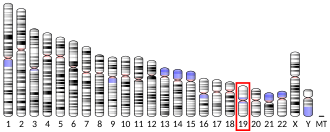
A disintegrin and metalloproteinase with thrombospondin motifs 10 is an enzyme that in humans is encoded by the ADAMTS10 gene.5
This gene belongs to the ADAMTS (a disintegrin and metalloproteinase domain with thrombospondin type-1 motifs) family of zinc-dependent proteases. ADAMTS proteases are complex secreted enzymes containing a prometalloprotease domain of the reprolysin type attached to an ancillary domain with a highly conserved structure that includes at least one thrombospondin type 1 repeat. They have been demonstrated to have important roles in connective tissue organization, coagulation, inflammation, arthritis, angiogenesis and cell migration. The product of this gene plays a major role in growth and in skin, lens, and heart development. It is also a candidate gene for autosomal recessive Weill-Marchesani syndrome.5
References
References
Further reading
Further reading
- Tang BL (2001). "ADAMTS: a novel family of extracellular matrix proteases". Int. J. Biochem. Cell Biol. 33 (1): 33–44. doi:10.1016/S1357-2725(00)00061-3. PMID 11167130.
- Faivre L, Dollfus H, Lyonnet S, et al. (2004). "Clinical homogeneity and genetic heterogeneity in Weill-Marchesani syndrome". Am. J. Med. Genet. A. 123 (2): 204–7. doi:10.1002/ajmg.a.20289. PMID 14598350. S2CID 13600027.
- Apte SS (2004). "A disintegrin-like and metalloprotease (reprolysin type) with thrombospondin type 1 motifs: the ADAMTS family". Int. J. Biochem. Cell Biol. 36 (6): 981–5. doi:10.1016/j.biocel.2004.01.014. PMID 15094112.
- Faivre L, Mégarbané A, Alswaid A, et al. (2002). "Homozygosity mapping of a Weill-Marchesani syndrome locus to chromosome 19p13.3-p13.2". Hum. Genet. 110 (4): 366–70. doi:10.1007/s00439-002-0689-3. PMID 11941487. S2CID 10463979.
- Strausberg RL, Feingold EA, Grouse LH, et al. (2003). "Generation and initial analysis of more than 15,000 full-length human and mouse cDNA sequences". Proc. Natl. Acad. Sci. U.S.A. 99 (26): 16899–903. Bibcode:2002PNAS...9916899M. doi:10.1073/pnas.242603899. PMC 139241. PMID 12477932.
- Brandenberger R, Wei H, Zhang S, et al. (2005). "Transcriptome characterization elucidates signaling networks that control human ES cell growth and differentiation". Nat. Biotechnol. 22 (6): 707–16. doi:10.1038/nbt971. PMID 15146197. S2CID 27764390.
- Fu GK, Wang JT, Yang J, et al. (2005). "Circular rapid amplification of cDNA ends for high-throughput extension cloning of partial genes". Genomics. 84 (1): 205–10. doi:10.1016/j.ygeno.2004.01.011. PMID 15203218.
- Somerville RP, Jungers KA, Apte SS (2005). "Discovery and characterization of a novel, widely expressed metalloprotease, ADAMTS10, and its proteolytic activation". J. Biol. Chem. 279 (49): 51208–17. doi:10.1074/jbc.M409036200. PMID 15355968.
- Charrier L, Yan Y, Driss A, et al. (2005). "ADAM-15 inhibits wound healing in human intestinal epithelial cell monolayers". Am. J. Physiol. Gastrointest. Liver Physiol. 288 (2): G346–53. doi:10.1152/ajpgi.00262.2004. PMID 15358598.
- Dagoneau N, Benoist-Lasselin C, Huber C, et al. (2005). "ADAMTS10 mutations in autosomal recessive Weill-Marchesani syndrome". Am. J. Hum. Genet. 75 (5): 801–6. doi:10.1086/425231. PMC 1182109. PMID 15368195.
External links
External links