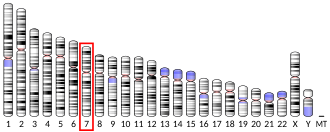
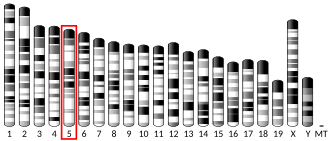
Actin-like protein 6B is a protein that in humans is encoded by the ACTL6B gene.56
Function
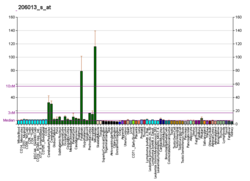
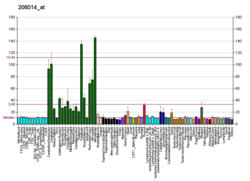
The protein encoded by this gene is a member of a family of actin-related proteins (ARPs) which share significant amino acid sequence identity to conventional actins. Both actins and ARPs have an actin fold, which is an ATP-binding cleft, as a common feature. The ARPs are involved in diverse cellular processes, including vesicular transport, spindle orientation, nuclear migration and chromatin remodeling. This gene encodes a subunit of the BAF (BRG1/brm-associated factor) complex in mammals, which is functionally related to SWI/SNF complex in S. cerevisiae and Drosophila; the latter is thought to facilitate transcriptional activation of specific genes by antagonizing chromatin-mediated transcriptional repression. This subunit may be involved in the regulation of genes by structural modulation of their chromatin, specifically in the brain.6
Interactions
ACTL6B has been shown to interact with CTBP1.7
References
References
- GRCh38: Ensembl release 89: ENSG00000077080 – Ensembl, May 2017
- GRCm38: Ensembl release 89: ENSMUSG00000029712 – Ensembl, May 2017
- "Human PubMed Reference:". National Center for Biotechnology Information, U.S. National Library of Medicine.
- "Mouse PubMed Reference:". National Center for Biotechnology Information, U.S. National Library of Medicine.
- Glöckner G, Scherer S, Schattevoy R, Boright A, Weber J, Tsui LC, Rosenthal A (December 1998). "Large-scale sequencing of two regions in human chromosome 7q22: analysis of 650 kb of genomic sequence around the EPO and CUTL1 loci reveals 17 genes". Genome Res. 8 (10): 1060–73. doi:10.1101/gr.8.10.1060. PMC 310788. PMID 9799793.
- "Entrez Gene: ACTL6B actin-like 6B".
- Oma Y, Nishimori K, Harata M (February 2003). "The brain-specific actin-related protein ArpN alpha interacts with the transcriptional co-repressor CtBP". Biochem. Biophys. Res. Commun. 301 (2): 521–528. doi:10.1016/S0006-291X(02)03073-5. PMID 12565893.
External links
External links
Further reading
Further reading
- Schafer DA, Schroer TA (2000). "Actin-related proteins". Annu. Rev. Cell Dev. Biol. 15: 341–363. doi:10.1146/annurev.cellbio.15.1.341. PMID 10611965.
- Sanger Centre, The; Washington University Genome Sequencing Cente, The (1999). "Toward a complete human genome sequence". Genome Res. 8 (11): 1097–108. doi:10.1101/gr.8.11.1097. PMID 9847074.
- Harata M, Mochizuki R, Mizuno S (1999). "Two isoforms of a human actin-related protein show nuclear localization and mutually selective expression between brain and other tissues". Biosci. Biotechnol. Biochem. 63 (5): 917–923. doi:10.1271/bbb.63.917. PMID 10380635.
- Olave I, Wang W, Xue Y, Kuo A, Crabtree GR (2002). "Identification of a polymorphic, neuron-specific chromatin remodeling complex". Genes Dev. 16 (19): 2509–2517. doi:10.1101/gad.992102. PMC 187451. PMID 12368262.
- Kuroda Y, Oma Y, Nishimori K, Ohta T, Harata M (2003). "Brain-specific expression of the nuclear actin-related protein ArpNalpha and its involvement in mammalian SWI/SNF chromatin remodeling complex". Biochem. Biophys. Res. Commun. 299 (2): 328–334. doi:10.1016/S0006-291X(02)02637-2. PMID 12437990.
- Oma Y, Nishimori K, Harata M (2003). "The brain-specific actin-related protein ArpN alpha interacts with the transcriptional co-repressor CtBP". Biochem. Biophys. Res. Commun. 301 (2): 521–528. doi:10.1016/S0006-291X(02)03073-5. PMID 12565893.