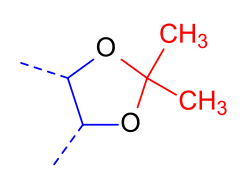
In organic chemistry, an acetonide is the functional group composed of the cyclic ketal of a diol with acetone. The more systematic name for this structure is an isopropylidene ketal. Acetonide is a common protecting group for 1,2- and 1,3-diols.1 The protecting group can be removed by hydrolysis of the ketal using dilute aqueous acid.
Example
The acetonides of small di- and triols, as well as many sugars and sugar alcohols, are common.2 The hexaol mannitol reacts with 2,2-dimethoxypropane to give the bis-acetonide, which oxidizes to give the acetonide of glyceraldehyde:34
- (CHOHCHOHCH2OH)2 + 2 (MeO)2CMe2 → (CHOHCHCH2O2CMe2)2 + 4 MeOH
- (CHOHCHOCH2OCMe2)2 + [O] → 2 OCHCHCH2O2CMe2 + H2O
An example of its use as a protecting group in a complex organic synthesis is the Nicolaou Taxol total synthesis. It is a common protecting group for sugars and sugar alcohols, a simple example being solketal.
The acetonides of corticosteroid are used in dermatology, because their increased lipophilicity leads to better penetration into the skin.56
References
References
- Kocieński, Philip j. (1994). "3.2.2: Diol Protecting Groups—Acetals—Isopropylidene Acetals". Protecting Groups. Foundations of Organic Chemistry Series. Thieme Medical Publishers. p. 103.
- Rychnovsky, S. D.; Rogers, B. N.; Richardson, T. I. (1998). "Configurational Assignment of Polyene Macrolide Antibiotics Using the [13c]Acetonide Analysis". Acc. Chem. Res. 31: 9–17. doi:10.1021/AR960223N.
- Christopher R. Schmid; Jerry D. Bryant (1995). "D-(R)-Glyceraldehyde Acetonide". Org. Synth. 72: 6. doi:10.15227/orgsyn.072.0006.
- Christian Hubschwerlen; Jean-luc Specklin; J. Higelin (1995). "L-(S)-glyceraldehyde Acetonide". Org. Synth. 72: 1. doi:10.15227/orgsyn.072.0001.
- Steinhilber, D; Schubert-Zsilavecz, M; Roth, HJ (2005). Medizinische Chemie (in German). Stuttgart: Deutscher Apotheker Verlag. p. 337. ISBN 3-7692-3483-9.
- Derendorf, H.; Hochhaus, G.; Meibohm, B.; Mollmann, H.; Barth, J. (1998). "Pharmacokinetics and Pharmacodynamics of Inhaled Corticosteroids". J. Allergy Clin. Immunol. 101: S440–S446. doi:10.1016/S0091-6749(98)70156-3.