| Acetabular fossa | |
|---|---|
 Lateral view of the right hip bone | |
| Details | |
| Identifiers | |
| Latin | fossa acetabuli |
| TA98 | A02.5.01.004 |
| TA2 | 1310 |
| FMA | 17269 |
| Anatomical terms of bone | |
The acetabular fossa is the non-articular depressed region at the centre of the floor of the acetabulum. It is surrounded by the articular lunate surface.1: 1368 2 The floor of the fossa is formed mostly by the ischium;2 it is rough1: 1354 and thin (often to the point of transparency). The space of the fossa is continuous inferiorly with the acetabular notch.2
The fossa does not contain any cartilage.1: 1368 It is occupied by the ligament of head of femur,3 and by fibroelastic adipose tissue41: 1368 (within which the acetabular branch of the obturator artery ramifies1: 1250 ) that is mostly lined with synovial membrane.1: 1368 The acetabular "fat pad" is thought to contain abundant proprioceptive nerve endings that sense compression of the fat pad or its displacement through the acetabular notch, producing proprioceptive information.4
Additional images
-
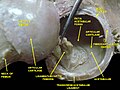 Hip joint. Lateral view. Fat in acetabular fossa.
References
References
- Standring, Susan (2020). Gray's Anatomy: The Anatomical Basis of Clinical Practice (42th ed.). New York. ISBN 978-0-7020-7707-4. OCLC 1201341621.
{{cite book}}: CS1 maint: location missing publisher (link) - Moore, Keith L.; Dalley, Arthur F.; Agur, Anne M. R. (2018). Clinically Oriented Anatomy (8th ed.). Wolters Kluwer. p. 786. ISBN 978-1-4963-4721-3.
- Tank, Patrick W. (2001). "Bones and Joints of the Pelvis and Perineum - Self Study". University of Arkansas. Archived from the original on 2018-10-12. Retrieved 2008-08-26.
- Palastanga, Nigel; Soames, Roger (2012). Anatomy and Human Movement: Structure and Function. Physiotherapy Essentials (6th ed.). Edinburgh: Churchill Livingstone/Elsevier. p. 291. ISBN 978-0-7020-3553-1.