| Abdsamiya | |
|---|---|
| King (malkā) | |
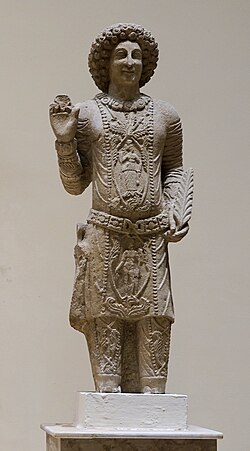 Absadmiya, son of Sanatruq I, as a young Prince. National Museum of Iraq | |
| Reign | 180–205 AD |
| Predecessor | Sanatruq I |
| Successor | Sanatruq II |
| Died | c. 205 AD |
| Issue | Sanatruq II (son) |
| Father | Sanatruq I |
Abdsamiya (Hatran Aramaic: 𐣯𐣡𐣣𐣮𐣬𐣩𐣠) was a king of Hatra,1 an ancient city and kingdom in ancient Mesopotamia. He reigned from about AD 180 to 205. Abdsamiya was the son of king Sanatruq I and the father of Sanatruq II. Abdsamiya is known from eight inscriptions found at Hatra. One of them reports the building of a porticus for the king and is dated to year 504 of the Seleucid era (AD 192/93). Another inscription appears on a statue and is dated to AD 201/202. Abdsamiya is most likely also mentioned by Herodian (3.1.3),2 where he is named as Barsemias,1 there he is reported to have supported Pescennius Niger against Septimius Severus in AD 192.23
References
References
- Sommer, Michael (2003). "Hatra — imperiale und regionale Herrschaft an der Steppengrenze". Klio. 85 (2): 386 – via De Gruyter.
- Hatra on Iranica.com
- "The Civil Wars of 193–195". The Encyclopedia of Ancient Battles. John Wiley & Sons, Inc. 2017. doi:10.1002/9781119099000.wbabat0005. ISBN 9781119099000.
Literature
- Michael Sommer: Hatra. Geschichte und Kultur einer Karawanenstadt im römisch-parthischen Mesopotamien. von Zabern, Mainz 2003, ISBN 3-8053-3252-1, p. 23-24.