  | |
| Observation data Epoch J2000 Equinox ICRS | |
|---|---|
| Constellation | Ophiuchus |
| Right ascension | 18h 20m 52.06435s1 |
| Declination | +03° 22′ 37.7817″1 |
| Apparent magnitude (V) | 4.852 |
| Characteristics | |
| Spectral type | G8III3 |
| U−B color index | +0.614 |
| B−V color index | +0.914 |
| Astrometry | |
| Radial velocity (Rv) | +4.355 km/s |
| Proper motion (μ) | RA: −7.6461 mas/yr Dec.: +12.5461 mas/yr |
| Parallax (π) | 13.7320±0.2060 mas1 |
| Distance | 238 ± 4 ly (73 ± 1 pc) |
| Absolute magnitude (MV) | 0.342 |
| Details | |
| Mass | 2.386 M☉ |
| Radius | 10.52+0.32 −1.041 R☉ |
| Luminosity | 66.0±1.21 L☉ |
| Surface gravity (log g) | 2.706 cgs |
| Temperature | 5,073+271 −761 K |
| Metallicity [Fe/H] | -0.216 dex |
| Rotational velocity (v sin i) | 0.05 km/s |
| Age | 1.737 Gyr |
| Other designations | |
| 74 Oph, BD+03°3680, FK5 1476, GC 25036, GJ 9615 A, HD 168656, HIP 89918, HR 6866, SAO 123377, CCDM J18209+0323A, WDS J18209+0323A8 | |
| Database references | |
| SIMBAD | data |
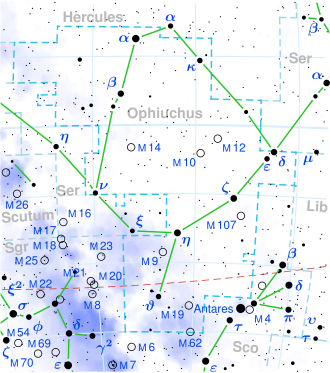
74 Ophiuchi is a suspected binary star9 in the equatorial constellation of Ophiuchus, near the border with Serpens Cauda. It is visible to the naked eye as a faint, yellow-hued point of light with a combined apparent visual magnitude of 4.85.2 The system is located at a distance of 238 light years from the Sun based on parallax,1 and is drifting further away with a radial velocity of +4.4 km/s.5
The primary member, designated component A, is an aging giant star with a stellar classification of G8III3 and an estimated age of 1.737 billion years. Having exhausted the hydrogen supply at its core, the star has expanded to 10.51 times the Sun's radius. It is a red clump giant,10 which means it is on the horizontal branch and is generating energy through helium fusion at its core. The star has 2.46 times the mass of the Sun and is radiating 661 times the Sun's luminosity from its swollen photosphere at an effective temperature of around 5,073 K.1
The magnitude 11.5 secondary, component B, lies at an angular separation of 28.1″ from the primary, as of 2008.9 A visual companion, component C, is magnitude 12.28 and has a separation of 57.9″.11
References
References
- Brown, A. G. A.; et al. (Gaia collaboration) (August 2018). "Gaia Data Release 2: Summary of the contents and survey properties". Astronomy & Astrophysics. 616. A1. arXiv:1804.09365. Bibcode:2018A&A...616A...1G. doi:10.1051/0004-6361/201833051. Gaia DR2 record for this source at VizieR.
- Anderson, E.; Francis, Ch. (2012). "XHIP: An extended hipparcos compilation". Astronomy Letters. 38 (5): 331. arXiv:1108.4971. Bibcode:2012AstL...38..331A. doi:10.1134/S1063773712050015. S2CID 119257644. Vizier catalog entry
- Houk, N.; Swift, C. (1999). "Michigan catalogue of two-dimensional spectral types for the HD Stars". Michigan Spectral Survey. 5. Bibcode:1999MSS...C05....0H.
- Mallama, A. (2014). "Sloan Magnitudes for the Brightest Stars". The Journal of the American Association of Variable Star Observers. 42 (2): 443. Bibcode:2014JAVSO..42..443M.Vizier catalog entry
- Massarotti, Alessandro; Latham, David W.; Stefanik, Robert P.; Fogel, Jeffrey (2008). "Rotational and Radial Velocities for a Sample of 761 Hipparcos Giants and the Role of Binarity". The Astronomical Journal. 135 (1): 209–231. Bibcode:2008AJ....135..209M. doi:10.1088/0004-6256/135/1/209.
- Reffert, Sabine; et al. (2015). "Precise radial velocities of giant stars". Astronomy & Astrophysics. 574: A116. arXiv:1412.4634. Bibcode:2015A&A...574A.116R. doi:10.1051/0004-6361/201322360. hdl:10722/215277. S2CID 59334290. Vizier catalog entry
- Luck, R. Earle (2015). "Abundances in the Local Region. I. G and K Giants". Astronomical Journal. 150 (3). 88. arXiv:1507.01466. Bibcode:2015AJ....150...88L. doi:10.1088/0004-6256/150/3/88. S2CID 118505114.
- "74 Oph". SIMBAD. Centre de données astronomiques de Strasbourg. Retrieved 2019-06-26.
- Eggleton, P. P.; Tokovinin, A. A. (September 2008). "A catalogue of multiplicity among bright stellar systems". Monthly Notices of the Royal Astronomical Society. 389 (2): 869–879. arXiv:0806.2878. Bibcode:2008MNRAS.389..869E. doi:10.1111/j.1365-2966.2008.13596.x. S2CID 14878976.
- Alves, David R. (August 2000). "K-Band Calibration of the Red Clump Luminosity". The Astrophysical Journal. 539 (2): 732–741. arXiv:astro-ph/0003329. Bibcode:2000ApJ...539..732A. doi:10.1086/309278. S2CID 16673121.
- Mason, Brian D.; et al. (2001). "The 2001 US Naval Observatory Double Star CD-ROM. I. The Washington Double Star Catalog". The Astronomical Journal. 122 (6): 3466. Bibcode:2001AJ....122.3466M. doi:10.1086/323920. Vizier catalog entry