  | |
| Observation data Epoch J2000 Equinox J2000 | |
|---|---|
| Constellation | Ophiuchus |
| Right ascension | 18h 07m 20.98393s1 |
| Declination | +09° 33′ 49.8501″1 |
| Apparent magnitude (V) | 3.732 + 14.03 |
| Characteristics | |
| Evolutionary stage | main sequence4 |
| Spectral type | A5 V5 |
| U−B color index | +0.102 |
| B−V color index | +0.122 |
| Astrometry | |
| Radial velocity (Rv) | −23.906 km/s |
| Proper motion (μ) | RA: −62.171 mas/yr Dec.: +79.661 mas/yr |
| Parallax (π) | 37.55±0.21 mas1 |
| Distance | 86.9 ± 0.5 ly (26.6 ± 0.1 pc) |
| Absolute magnitude (MV) | 1.587 |
| Details | |
| Mass | 1.994 M☉ |
| Radius | 1.98 R☉ |
| Luminosity | 204 L☉ |
| Surface gravity (log g) | 4.049 cgs |
| Temperature | 8,7189 K |
| Metallicity [Fe/H] | +0.097 dex |
| Rotational velocity (v sin i) | 654 km/s |
| Age | 2509 Myr |
| Other designations | |
| 72 Oph, BD+09°3564, FK5 680, GC 24695, GJ 9615 A, HD 165777, HIP 88771, HR 6771, SAO 123142, CCDM J18073+0934A, WDS J18073+0934A10 | |
| Database references | |
| SIMBAD | data |
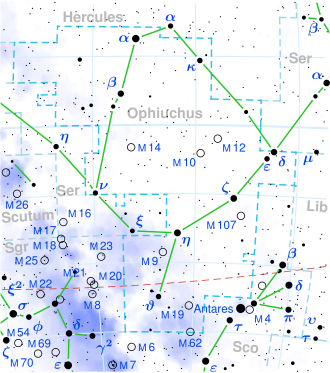
72 Ophiuchi is a binary star3 system in the equatorial constellation of Ophiuchus. It is visible to the naked eye as a faint, white-hued point of light with a combined apparent visual magnitude of 3.73.2 It is located approximately 86.9 light years away from the Sun based on parallax,1 but is moving closer with a heliocentric radial velocity of -23.9 km/s.6
As of 2008, the pair had an angular separation of 25″.3 According to Gray et al. (2003), the primary component has a stellar classification of A5 V,5 matching an A-type main-sequence star. Cowley et al. (1969) had assigned it to a class of A4 IVs,11 suggesting it is a sharp-lined (s) subgiant star. The latter class is still in use by some sources.4312
The primary is 2509 million years old with double4 the mass of the Sun and is spinning with a moderate projected rotational velocity of 65 km/s.4 It is radiating 204 times the luminosity of the Sun from its photosphere at an effective temperature of 8,718 K.9 It displays an infrared excess, suggesting a debris disk is orbiting the star with a mean separation of 82.96 AU and temperature of 60 K.13 The system is a source of X-ray emission,12 which is most likely coming from the 14th3 magnitude companion.12
There are additional visual companions: component C with magnitude 11.5 lies at an angular separation of 64″ from the primary,14 while component D, has magnitude 14.8 and separation 24".15
This star was once considered part of the obsolete constellation Taurus Poniatovii, the brightest star in it. After the International Astronomical Union officially recognised constellations, it was placed in Ophiuchus.16
References
References
- Van Leeuwen, F. (2007). "Validation of the new Hipparcos reduction". Astronomy and Astrophysics. 474 (2): 653–664. arXiv:0708.1752. Bibcode:2007A&A...474..653V. doi:10.1051/0004-6361:20078357. S2CID 18759600. Vizier catalog entry
- Ducati, J. R. (2002). "VizieR Online Data Catalog: Catalogue of Stellar Photometry in Johnson's 11-color system". CDS/ADC Collection of Electronic Catalogues. 2237. Bibcode:2002yCat.2237....0D.
- Eggleton, P. P.; Tokovinin, A. A. (September 2008). "A catalogue of multiplicity among bright stellar systems". Monthly Notices of the Royal Astronomical Society. 389 (2): 869–879. arXiv:0806.2878. Bibcode:2008MNRAS.389..869E. doi:10.1111/j.1365-2966.2008.13596.x. S2CID 14878976.
- Zorec, J.; Royer, F. (2012). "Rotational velocities of A-type stars". Astronomy & Astrophysics. 537: A120. arXiv:1201.2052. Bibcode:2012A&A...537A.120Z. doi:10.1051/0004-6361/201117691. S2CID 55586789. Vizier catalog entry
- Gray, R. O.; et al. (2003). "Contributions to the Nearby Stars (NStars) Project: Spectroscopy of Stars Earlier than M0 within 40 Parsecs: The Northern Sample. I". The Astronomical Journal. 126 (4): 2048. arXiv:astro-ph/0308182. Bibcode:2003AJ....126.2048G. doi:10.1086/378365. S2CID 119417105.
- Kharchenko, N. V.; Scholz, R.-D.; Piskunov, A. E.; Röser, S.; Schilbach, E. (2007). "Astrophysical supplements to the ASCC-2.5: Ia. Radial velocities of ~55000 stars and mean radial velocities of 516 Galactic open clusters and associations". Astronomische Nachrichten. 328 (9): 889. arXiv:0705.0878. Bibcode:2007AN....328..889K. doi:10.1002/asna.200710776. S2CID 119323941.
- Anderson, E.; Francis, Ch. (2012). "XHIP: An extended hipparcos compilation". Astronomy Letters. 38 (5): 331. arXiv:1108.4971. Bibcode:2012AstL...38..331A. doi:10.1134/S1063773712050015. S2CID 119257644. Vizier catalog entry
- Allende Prieto, C.; Lambert, D. L. (1999). "Fundamental parameters of nearby stars from the comparison with evolutionary calculations: Masses, radii and effective temperatures". Astronomy and Astrophysics. 352: 555–562. arXiv:astro-ph/9911002. Bibcode:1999A&A...352..555A. Vizier catalog entry
- David, Trevor J.; Hillenbrand, Lynne A. (2015). "The Ages of Early-Type Stars: Strömgren Photometric Methods Calibrated, Validated, Tested, and Applied to Hosts and Prospective Hosts of Directly Imaged Exoplanets". The Astrophysical Journal. 804 (2): 146. arXiv:1501.03154. Bibcode:2015ApJ...804..146D. doi:10.1088/0004-637X/804/2/146. S2CID 33401607. Vizier catalog entry
- "72 Oph". SIMBAD. Centre de données astronomiques de Strasbourg. Retrieved 2019-06-26.
- Cowley, A.; et al. (April 1969). "A study of the bright A stars. I. A catalogue of spectral classifications". Astronomical Journal. 74: 375–406. Bibcode:1969AJ.....74..375C. doi:10.1086/110819.
- De Rosa, R. J.; et al. (July 2011). "The Volume-limited A-Star (VAST) survey - I. Companions and the unexpected X-ray detection of B6-A7 stars". Monthly Notices of the Royal Astronomical Society. 415 (1): 854–866. arXiv:1103.4363. Bibcode:2011MNRAS.415..854D. doi:10.1111/j.1365-2966.2011.18765.x. S2CID 84181878.
- Gáspár, András; et al. (2016). "The Correlation between Metallicity and Debris Disk Mass". The Astrophysical Journal. 826 (2): 171. arXiv:1604.07403. Bibcode:2016ApJ...826..171G. doi:10.3847/0004-637X/826/2/171. S2CID 119241004.
- Renson, P.; Manfroid, J. (2009). "Catalogue of Ap, HgMn and Am stars". Astronomy and Astrophysics. 498 (3): 961. Bibcode:2009A&A...498..961R. doi:10.1051/0004-6361/200810788.
- Mason, Brian D.; et al. (2001). "The 2001 US Naval Observatory Double Star CD-ROM. I. The Washington Double Star Catalog". The Astronomical Journal. 122 (6): 3466. Bibcode:2001AJ....122.3466M. doi:10.1086/323920. Vizier catalog entry
- Ian Ridpath. "Taurus Poniatovii". Star Tales. Retrieved 2023-11-01.