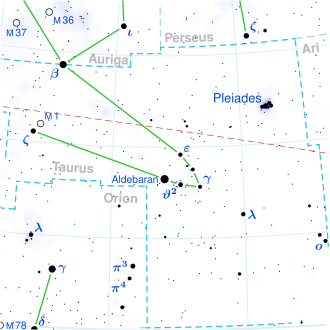
  | |
| Observation data Epoch J2000.0 Equinox J2000.0 | |
|---|---|
| Constellation | Taurus |
| Right ascension | 04h 26m 20.77082s1 |
| Declination | +15° 37′ 05.8841″1 |
| Apparent magnitude (V) | +4.482 |
| Characteristics | |
| Evolutionary stage | main sequence1 |
| Spectral type | F0 V3 |
| U−B color index | +0.132 |
| B−V color index | +0.252 |
| Variable type | δ Sct4 |
| Astrometry | |
| Radial velocity (Rv) | +38.35 km/s |
| Proper motion (μ) | RA: +87.4351 mas/yr Dec.: −20.9781 mas/yr |
| Parallax (π) | 21.3957±0.2511 mas1 |
| Distance | 152 ± 2 ly (46.7 ± 0.5 pc) |
| Absolute magnitude (MV) | 1.106 |
| Details | |
| Mass | 1.946 M☉ |
| Radius | 3.343 R☉ |
| Surface gravity (log g) | 3.737 cgs |
| Temperature | 7,5433 K |
| Rotation | 14.26 d |
| Rotational velocity (v sin i) | 1926 km/s |
| Age | 9667 Myr |
| Other designations | |
| 71 Tau, V777 Tau, BD+15°625, GC 5375, HD 28052, HIP 20713, HR 1394, SAO 939328 | |
| Database references | |
| SIMBAD | data |
71 Tauri is a suspected triple star9 system in the zodiac constellation Taurus, located 152 light years from the Sun.1 It is visible to the naked eye as a faint, yellow-white hued star with an apparent visual magnitude of +4.48.2 The star is moving further away from the Earth with a heliocentric radial velocity of +38 km/s.5 It is a member of the Hyades open cluster.10

The primary component is an F-type main-sequence star with a stellar classification of F0 V.3 In 1979, Stephen Horan discovered that 71 Tauri is a variable star.12 It was given its variable star designation, V777 Tauri, in 1981.13 It is a Delta Scuti variable with an amplitude of 0.02 in magnitude and a frequency of 0.16 d−1.4 This star has about 1.946 times the mass of the Sun and 3.343 times the Sun's radius. It has a projected rotational velocity of 192 km s−1, for an estimated rotation period of 14.2 days.6 Extreme ultraviolet flares have been observed coming from this star's hot corona,3 and it is the second brightest X-ray source in the Hyades.10
References
References
- Vallenari, A.; et al. (Gaia collaboration) (2023). "Gaia Data Release 3. Summary of the content and survey properties". Astronomy and Astrophysics. 674: A1. arXiv:2208.00211. Bibcode:2023A&A...674A...1G. doi:10.1051/0004-6361/202243940. S2CID 244398875. Gaia DR3 record for this source at VizieR.
- Mermilliod, J.-C. (1986), "Compilation of Eggen's UBV data, transformed to UBV (unpublished)", Catalogue of Eggen's UBV Data. SIMBAD, Bibcode:1986EgUBV........0M.
- Mullan, D. J.; Mathioudakis, M. (November 2000), "Extreme-Ultraviolet Flares in an F2 Star", The Astrophysical Journal, 544 (1): 475–480, Bibcode:2000ApJ...544..475M, doi:10.1086/317202.
- Samus, N. N.; et al. (2017), "General Catalogue of Variable Stars", Astronomy Reports, 5.1, 61 (1): 80–88, Bibcode:2017ARep...61...80S, doi:10.1134/S1063772917010085, S2CID 125853869.
- Evans, D. S. (June 20–24, 1966), Batten, Alan Henry; Heard, John Frederick (eds.), "The Revision of the General Catalogue of Radial Velocities", Determination of Radial Velocities and their Applications, Proceedings from IAU Symposium no. 30, vol. 30, University of Toronto: International Astronomical Union, p. 57, Bibcode:1967IAUS...30...57E.
- Pizzolato, N.; Maggio, A.; Sciortino, S. (September 2000), "Evolution of X-ray activity of 1-3 Msun late-type stars in early post-main-sequence phases", Astronomy and Astrophysics, 361: 614–628, Bibcode:2000A&A...361..614P.
- David, Trevor J.; Hillenbrand, Lynne A. (2015), "The Ages of Early-Type Stars: Strömgren Photometric Methods Calibrated, Validated, Tested, and Applied to Hosts and Prospective Hosts of Directly Imaged Exoplanets", The Astrophysical Journal, 804 (2): 146, arXiv:1501.03154, Bibcode:2015ApJ...804..146D, doi:10.1088/0004-637X/804/2/146, S2CID 33401607.
- "71 Tau -- Variable Star of delta Sct type", SIMBAD Astronomical Database, Centre de Données astronomiques de Strasbourg, retrieved 2007-01-25
- Eggleton, P. P.; Tokovinin, A. A. (September 2008), "A catalogue of multiplicity among bright stellar systems", Monthly Notices of the Royal Astronomical Society, 389 (2): 869–879, arXiv:0806.2878, Bibcode:2008MNRAS.389..869E, doi:10.1111/j.1365-2966.2008.13596.x, S2CID 14878976.
- Simon, Theodore; Ayres, Thomas R. (August 2000), "71 Tauri: Hyades Enigma Resolved?", The Astrophysical Journal, 539 (1): 325–330, Bibcode:2000ApJ...539..325S, doi:10.1086/309228.
- "MAST: Barbara A. Mikulski Archive for Space Telescopes". Space Telescope Science Institute. Retrieved 8 December 2021.
- Horan, S. (November 1979). "A photometric survey of the Hyades for delta Scuti variables". Astronomical Journal. 84: 1770–1774. Bibcode:1979AJ.....84.1770H. doi:10.1086/112607.
- Kholopov, P. N.; Samus, N. N.; Kukarkina, N. P.; Medvedeva, G. I.; Perova, N. B. (February 1981). "65th Name-List of Variable Stars" (PDF). Information Bulletin on Variable Stars. 1921: 1–21. Bibcode:1981IBVS.1921....1K. Retrieved 3 September 2025.