  | |
| Observation data Epoch J2000 Equinox J2000 | |
|---|---|
| Constellation | Ophiuchus1 |
| Right ascension | 17h 43m 25.79354s2 |
| Declination | −21° 40′ 59.4989″2 |
| Apparent magnitude (V) | 4.861 |
| Characteristics | |
| Evolutionary stage | main sequence2 |
| Spectral type | F5V3 |
| U−B color index | -0.034 |
| B−V color index | +0.474 |
| Astrometry | |
| Radial velocity (Rv) | +10.205 km/s |
| Proper motion (μ) | RA: −97.2532 mas/yr Dec.: −44.6142 mas/yr |
| Parallax (π) | 58.2437±0.1484 mas2 |
| Distance | 56.0 ± 0.1 ly (17.17 ± 0.04 pc) |
| Absolute magnitude (MV) | +3.631 |
| Details6 | |
| Mass | 1.20 M☉ |
| Radius | 1.43±0.05 R☉ |
| Luminosity | 3.021 L☉ |
| Surface gravity (log g) | 4.21±0.10 cgs |
| Temperature | 6,305±80 K |
| Metallicity [Fe/H] | −0.16±0.06 dex |
| Rotational velocity (v sin i) | 12.2±0.7 km/s |
| Age | 2.6527 Gyr |
| Other designations | |
| 58 Oph, BD−21°4712, FK5 1463, GC 24030, GJ 692, HD 160915, HIP 86736, HR 6595, SAO 1856608 | |
| Database references | |
| SIMBAD | data |
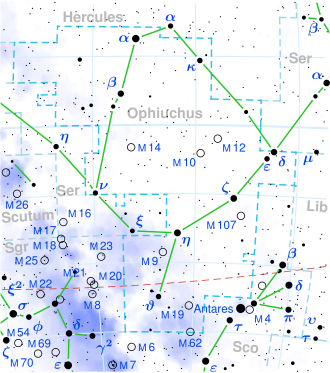
58 Ophiuchi is a single9 star in the equatorial constellation of Ophiuchus. It is visible to the naked eye as a faint, yellow-white hued star with an apparent visual magnitude of 4.86.1 This object is 56 light years away based on parallax,2 and is drifting further from the Earth with a heliocentric radial velocity of +10 km/s.5
This is an ordinary F-type main-sequence star with a stellar classification of F5V.3 It is 2.77 billion years old with a projected rotational velocity of 12 km/s. The star has an estimated 1.2 times the mass of the Sun and 1.43 times the Sun's radius.6 It is radiating three1 times the luminosity of the Sun from its photosphere at an effective temperature of 6,305 K.6
References
References
- Anderson, E.; Francis, Ch. (2012). "XHIP: An extended hipparcos compilation". Astronomy Letters. 38 (5): 331. arXiv:1108.4971. Bibcode:2012AstL...38..331A. doi:10.1134/S1063773712050015. XHIP record for this object at VizieR.
- Vallenari, A.; et al. (Gaia collaboration) (2023). "Gaia Data Release 3. Summary of the content and survey properties". Astronomy and Astrophysics. 674: A1. arXiv:2208.00211. Bibcode:2023A&A...674A...1G. doi:10.1051/0004-6361/202243940. S2CID 244398875. Gaia DR3 record for this source at VizieR.
- Gray, R. O.; Corbally, C. J.; Garrison, R. F.; McFadden, M. T.; Bubar, E. J.; McGahee, C. E.; O'Donoghue, A. A.; Knox, E. R. (2006). "Contributions to the Nearby Stars (NStars) Project: Spectroscopy of Stars Earlier than M0 within 40 pc--The Southern Sample". The Astronomical Journal. 132 (1): 161–170. arXiv:astro-ph/0603770. Bibcode:2006AJ....132..161G. doi:10.1086/504637. S2CID 119476992.
- Mallama, A. (2014). "Sloan Magnitudes for the Brightest Stars". The Journal of the American Association of Variable Star Observers. 42 (2): 443. Bibcode:2014JAVSO..42..443M.Vizier catalog entry
- Gontcharov, G. A. (2006). "Pulkovo Compilation of Radial Velocities for 35 495 Hipparcos stars in a common system". Astronomy Letters. 32 (11): 759–771. arXiv:1606.08053. Bibcode:2006AstL...32..759G. doi:10.1134/S1063773706110065. S2CID 119231169.
- Fuhrmann, K.; Chini, R. (2015). "Multiplicity Among F-Type Stars. II". The Astrophysical Journal. 809 (1): 107. Bibcode:2015ApJ...809..107F. doi:10.1088/0004-637X/809/1/107. S2CID 126218052.
- David, Trevor J.; Hillenbrand, Lynne A. (2015). "The Ages of Early-Type Stars: Strömgren Photometric Methods Calibrated, Validated, Tested, and Applied to Hosts and Prospective Hosts of Directly Imaged Exoplanets". The Astrophysical Journal. 804 (2): 146. arXiv:1501.03154. Bibcode:2015ApJ...804..146D. doi:10.1088/0004-637X/804/2/146. S2CID 33401607. Vizier catalog entry
- "58 Oph". SIMBAD. Centre de données astronomiques de Strasbourg. Retrieved 2019-06-21.
- Eggleton, P. P.; Tokovinin, A. A. (September 2008), "A catalogue of multiplicity among bright stellar systems", Monthly Notices of the Royal Astronomical Society, 389 (2): 869–879, arXiv:0806.2878, Bibcode:2008MNRAS.389..869E, doi:10.1111/j.1365-2966.2008.13596.x, S2CID 14878976.