 | |
 | |
| Clinical data | |
|---|---|
| Other names | 5-Methoxy-N-ethyltryptamine |
| Drug class | Serotonin receptor agonist; Serotonin 5-HT2A receptor agonist; Serotonin releasing agent12 |
| ATC code |
|
| Identifiers | |
| |
| CAS Number | |
| PubChem CID | |
| ChemSpider | |
| ChEMBL | |
| CompTox Dashboard (EPA) | |
| Chemical and physical data | |
| Formula | C13H18N2O |
| Molar mass | 218.300 g·mol−1 |
| 3D model (JSmol) | |
| |
| |
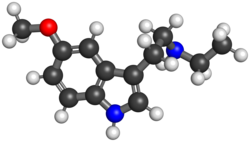
5-MeO-NET, also known as 5-methoxy-N-ethyltryptamine, is a serotonin receptor agonist and serotonin releasing agent of the tryptamine family.123
Use and effects
5-MeO-NET was not included nor mentioned in Alexander Shulgin's book TiHKAL (Tryptamines I Have Known and Loved).4
Pharmacology
Pharmacodynamics
5-MeO-NET is a potent full agonist or near-full agonist of the serotonin 5-HT1A, 5-HT2A, 5-HT2B, and 5-HT2C receptors.12 The drug is a relatively weak serotonin releasing agent.2
It does not produce the head-twitch response (HTR), a behavioral proxy of psychedelic effects, in rodents, suggesting that it would not be hallucinogenic in humans.1 However, 5-MeO-NET does produce the HTR if it is coadministered with a serotonin 5-HT1A receptor antagonist like WAY-100635, suggesting that its serotonin 5-HT1A receptor agonism masks or blocks its own serotonin 5-HT2A receptor-mediated HTR induction.1
Chemistry
5-MeO-NET, chemically known as 5-methoxy-N-ethyltryptamine, is a synthetic substituted tryptamine and a N-Ethyltryptamine derivative.
Analogues
Analogues of 5-MeO-NET include N-Ethyltryptamine (NET), 4-HO-NET, 4-AcO-NET, αET, 4-HO-αET, 5-MeO-αET, 5-chloro-αMT (PAL-542), 5-fluoro-αET (PAL-545), 5-MeO-MET, 5-MeO-DMT, 5-MeO-DET, 5-MeO-MPT, 5-MeO-EPT, 5-MeO-MALT, and 5-MeO-MiPT, among others.1
History
5-MeO-NET was first described in the scientific literature by at least 1994.3 Research on 5-MeO-NET since the early 2000s has primarily focused on its interactions with serotonin receptors and other targets, as well as behavioral effects in rodent models.12
References
References
- Glatfelter GC, Clark AA, Cavalco NG, Landavazo A, Partilla JS, Naeem M, et al. (December 2024). "Serotonin 1A Receptors Modulate Serotonin 2A Receptor-Mediated Behavioral Effects of 5-Methoxy-N,N-dimethyltryptamine Analogs in Mice". ACS Chem Neurosci. 15 (24): 4458–4477. doi:10.1021/acschemneuro.4c00513. PMID 39636099.
- Blough BE, Landavazo A, Decker AM, Partilla JS, Baumann MH, Rothman RB (October 2014). "Interaction of psychoactive tryptamines with biogenic amine transporters and serotonin receptor subtypes". Psychopharmacology (Berl). 231 (21): 4135–4144. doi:10.1007/s00213-014-3557-7. PMC 4194234. PMID 24800892.
- Glennon RA, Dukat M, el-Bermawy M, Law H, De los Angeles J, Teitler M, et al. (June 1994). "Influence of amine substituents on 5-HT2A versus 5-HT2C binding of phenylalkyl- and indolylalkylamines". Journal of Medicinal Chemistry. 37 (13): 1929–1935. doi:10.1021/jm00039a004. PMID 8027974.
- Alexander T. Shulgin, Ann Shulgin (1997). TiHKAL: The Continuation (1st ed.). Berkeley, CA: Transform Press. ISBN 978-0-9630096-9-2. OCLC 38503252. Retrieved 30 January 2025.