  | |
| Observation data Epoch J2000 Equinox J2000 | |
|---|---|
| Constellation | Perseus |
| Right ascension | 03h 29m 22.05019s1 |
| Declination | +49° 30′ 32.2114″1 |
| Apparent magnitude (V) | 4.672 (4.76 + 7.18)3 |
| Characteristics | |
| Evolutionary stage | Main sequence |
| Spectral type | B3V4 |
| U−B color index | −0.575 |
| B−V color index | −0.095 |
| Astrometry | |
| Radial velocity (Rv) | −3.506 km/s |
| Proper motion (μ) | RA: +22.201 mas/yr Dec.: −29.491 mas/yr |
| Parallax (π) | 6.05±0.36 mas1 |
| Distance | 540 ± 30 ly (165 ± 10 pc) |
| Absolute magnitude (MV) | −1.622 |
| Details | |
| 32 Per A | |
| Mass | 6.9±0.17 M☉ |
| Radius | 3.18 R☉ |
| Luminosity | 6712 L☉ |
| Surface gravity (log g) | 4.0769 cgs |
| Temperature | 16,4219 K |
| Rotational velocity (v sin i) | 2009 km/s |
| Age | 29.3±3.47 Myr |
| Other designations | |
| 34 Per, BD+49°945, FK5 1549, GC 4133, HD 21428, HIP 16244, HR 1044, SAO 38872, CCDM J03294+4931AB, WDS J03294+4931AB10 | |
| Database references | |
| SIMBAD | data |
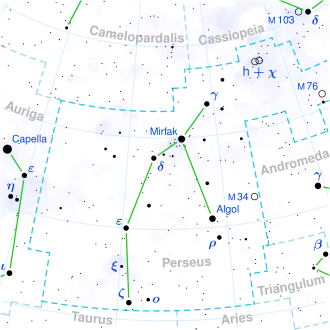
34 Persei is a binary star3 system in the northern constellation of Perseus. It is visible to the naked eye as a faint, blue-white hued point of light with a combined apparent visual magnitude of 4.67.2 The system is located approximately 540 light years away from the Sun based on parallax,1 but it is drifting closer with a radial velocity of −3.5 km/s.6 It is a likely member of the Alpha Persei Cluster.11
The primary member, designated component A, is a B-type main-sequence star with a stellar classification of B3V4 and visual magnitude 4.76.3 It is an estimated 297 million years old with a high rate of spin, showing a projected rotational velocity of 200 km/s.9 The star has 6.97 times the mass of the Sun and about 3.18 times the Sun's radius. It is radiating 6712 times the Sun's luminosity from its photosphere at an effective temperature of 16,421 K.9
The secondary companion, component B, has an angular separation of 0.6″ from the primary and visual magnitude of 7.34.12
References
References
- Van Leeuwen, F. (2007). "Validation of the new Hipparcos reduction". Astronomy and Astrophysics. 474 (2): 653–664. arXiv:0708.1752. Bibcode:2007A&A...474..653V. doi:10.1051/0004-6361:20078357. S2CID 18759600. Vizier catalog entry
- Anderson, E.; Francis, Ch. (2012). "XHIP: An extended hipparcos compilation". Astronomy Letters. 38 (5): 331. arXiv:1108.4971. Bibcode:2012AstL...38..331A. doi:10.1134/S1063773712050015. S2CID 119257644. Vizier catalog entry
- Eggleton, P. P.; Tokovinin, A. A. (September 2008). "A catalogue of multiplicity among bright stellar systems". Monthly Notices of the Royal Astronomical Society. 389 (2): 869–879. arXiv:0806.2878. Bibcode:2008MNRAS.389..869E. doi:10.1111/j.1365-2966.2008.13596.x. S2CID 14878976.
- Hoffleit, D.; Warren, W. H. (1995). "Bright Star Catalogue". VizieR On-line Data Catalog: V/50. Originally Published in: 1964BS....C......0H. 5050 (5th Revised ed.). Bibcode:1995yCat.5050....0H.
- Mallama, A. (2014). "Sloan Magnitudes for the Brightest Stars". The Journal of the American Association of Variable Star Observers. 42 (2): 443. Bibcode:2014JAVSO..42..443M.Vizier catalog entry
- Gontcharov, G. A. (2006). "Pulkovo Compilation of Radial Velocities for 35 495 Hipparcos stars in a common system". Astronomy Letters. 32 (11): 759–771. arXiv:1606.08053. Bibcode:2006AstL...32..759G. doi:10.1134/S1063773706110065. S2CID 119231169.
- Tetzlaff, N.; et al. (January 2011). "A catalogue of young runaway Hipparcos stars within 3 kpc from the Sun". Monthly Notices of the Royal Astronomical Society. 410 (1): 190–200. arXiv:1007.4883. Bibcode:2011MNRAS.410..190T. doi:10.1111/j.1365-2966.2010.17434.x. S2CID 118629873.
- Pasinetti Fracassini, L. E.; et al. (February 2001), "Catalogue of Apparent Diameters and Absolute Radii of Stars (CADARS)", Astronomy and Astrophysics, 367 (2) (Third ed.): 521–524, arXiv:astro-ph/0012289, Bibcode:2001A&A...367..521P, doi:10.1051/0004-6361:20000451, S2CID 425754
- David, Trevor J.; Hillenbrand, Lynne A. (2015). "The Ages of Early-Type Stars: Strömgren Photometric Methods Calibrated, Validated, Tested, and Applied to Hosts and Prospective Hosts of Directly Imaged Exoplanets". The Astrophysical Journal. 804 (2): 146. arXiv:1501.03154. Bibcode:2015ApJ...804..146D. doi:10.1088/0004-637X/804/2/146. S2CID 33401607.
- "34 Per". SIMBAD. Centre de données astronomiques de Strasbourg. Retrieved 2019-07-12.
- Zuckerman, B.; et al. (June 2012). "Stellar Membership and Dusty Debris Disks in the α Persei Cluster". The Astrophysical Journal. 752 (1): 12. arXiv:1204.3950. Bibcode:2012ApJ...752...58Z. doi:10.1088/0004-637X/752/1/58. S2CID 119207634. 58.
- Mason, Brian D.; et al. (2001). "The 2001 US Naval Observatory Double Star CD-ROM. I. The Washington Double Star Catalog". The Astronomical Journal. 122 (6): 3466. Bibcode:2001AJ....122.3466M. doi:10.1086/323920. Vizier catalog entry