  | |
| Observation data Epoch J2000.0 Equinox J2000.0 | |
|---|---|
| Constellation | Libra |
| Right ascension | 15h 29m 34.7424s1 |
| Declination | −17° 26′ 27.378″1 |
| Apparent magnitude (V) | 6.66 - 6.712 |
| Characteristics | |
| Evolutionary stage | main sequence1 |
| Spectral type | F0VspEuGdSr3 |
| Variable type | roAp2 |
| Astrometry | |
| Proper motion (μ) | RA: −68.387 mas/yr1 Dec.: +7.364 mas/yr1 |
| Parallax (π) | 12.6122±0.0334 mas1 |
| Distance | 258.6 ± 0.7 ly (79.3 ± 0.2 pc) |
| Details | |
| Mass | 1.71 M☉ |
| Radius | 1.81 R☉ |
| Luminosity | 9.71 L☉ |
| Surface gravity (log g) | 4.151 cgs |
| Temperature | 7,5431 K |
| Metallicity [Fe/H] | 0.391 dex |
| Age | 9771 Myr |
| Other designations | |
| 33 Librae, GZ Librae, HD 137949, HIP 75848, 2MASS J15293475-1726274, BD-16 4093, GSC 06188-01530, SAO 159292, TYC 6188-1520-1, WDS J15296-1726A | |
| Database references | |
| SIMBAD | data |
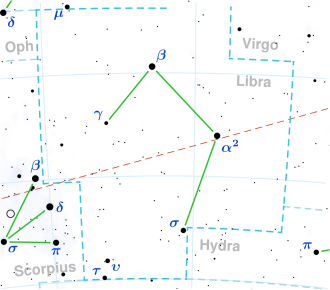
ζ2 Librae (abbreviated Zeta2 Librae, Zeta2 Lib, ζ2 Lib), also known as 33 Librae, is a variable star in the constellation Libra. It is approximately 260 light-years away from the Sun.1
Zeta2 Librae does not have an HR number, although it is included in the Bright Star Catalogue Supplement.45
Characteristics

33 Librae is an F-type main sequence star, and show abundance of europium, gadolinium and strontium in the spectrum.3 It is a rapidly oscillating Ap star.2 It bears the variable star designation GZ Librae.
References
References
- Vallenari, A.; et al. (Gaia collaboration) (2023). "Gaia Data Release 3. Summary of the content and survey properties". Astronomy and Astrophysics. 674: A1. arXiv:2208.00211. Bibcode:2023A&A...674A...1G. doi:10.1051/0004-6361/202243940. S2CID 244398875. Gaia DR3 record for this source at VizieR.
- Samus', N. N.; Kazarovets, E. V.; Durlevich, O. V.; Kireeva, N. N.; Pastukhova, E. N. (2017). "General catalogue of variable stars: Version GCVS 5.1". Astronomy Reports. 61 (1): 80. Bibcode:2017ARep...61...80S. doi:10.1134/S1063772917010085.
- Abt, H. A.; Brodzik, D.; Schaefer, B. (1979). "Spectral types of stars with unusual photometric indices". Publications of the Astronomical Society of the Pacific. 91: 176. Bibcode:1979PASP...91..176A. doi:10.1086/130467.
- Hoffleit, D.; Warren, W. H. (1995). "VizieR Online Data Catalog: Bright Star Catalogue, 5th Revised Ed. (Hoffleit+, 1991)". VizieR On-line Data Catalog: V/50. Originally Published in: 1964BS....C......0H. 5050. Bibcode:1995yCat.5050....0H.
- Hoffleit, D.; Jaschek, C. (1982). "The Bright Star Catalogue. Fourth revised edition. (Containing data compiled through 1979)". The Bright Star Catalogue. Fourth Revised Edition. (Containing Data Compiled Through 1979). Bibcode:1982bsc..book.....H.
- Wraight, K. T.; Fossati, L.; Netopil, M.; Paunzen, E.; Rode-Paunzen, M.; Bewsher, D.; Norton, A. J.; White, Glenn J. (February 2012). "A photometric study of chemically peculiar stars with the STEREO satellites - I. Magnetic chemically peculiar stars". Monthly Notices of the Royal Astronomical Society. 420 (1): 757–772. arXiv:1110.6283. Bibcode:2012MNRAS.420..757W. doi:10.1111/j.1365-2966.2011.20090.x.