  | |
| Observation data Epoch J2000 Equinox J2000 | |
|---|---|
| Constellation | Perseus1 |
| Right ascension | 03h 19m 07.63923s2 |
| Declination | 50° 05′ 41.8898″2 |
| Apparent magnitude (V) | 5.051 |
| Characteristics | |
| Evolutionary stage | main sequence2 |
| Spectral type | B5V3 |
| U−B color index | −0.534 |
| B−V color index | −0.064 |
| Astrometry | |
| Radial velocity (Rv) | −1.605 km/s |
| Proper motion (μ) | RA: +22.7562 mas/yr Dec.: −24.4462 mas/yr |
| Parallax (π) | 5.7653±0.0892 mas2 |
| Distance | 566 ± 9 ly (173 ± 3 pc) |
| Absolute magnitude (MV) | −1.446 |
| Details | |
| Mass | 4.6477 M☉ |
| Radius | 3.48 R☉ |
| Luminosity | 9506 L☉ |
| Temperature | 15,3016 K |
| Metallicity [Fe/H] | 0.009 dex |
| Rotational velocity (v sin i) | 26010 km/s |
| Age | 23411 Myr |
| Other designations | |
| 31 Per, BD+49°902, GC 3945, HD 20418, HIP 15444, HR 989, SAO 3871412 | |
| Database references | |
| SIMBAD | data |
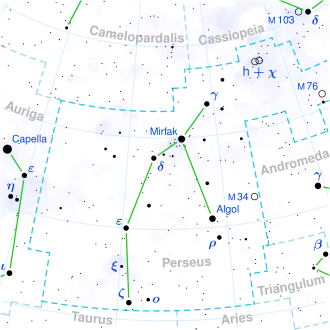
31 Persei is a single13 star in the northern constellation of Perseus. It is visible to the naked eye as a dim, blue-white hued point of light with an apparent visual magnitude of 5.05.1 This star is located around 172 parsecs (560 ly) away from the Sun,14 and it is drifting closer with a radial velocity of −1.6 km/s.5 It is likely a member of the Alpha Persei Cluster.15
This object is a massive B-type main-sequence star with a stellar classification of B5V3 and it is currently generating energy through hydrogen fusion at its core. It is around 2349 million years old and is spinning rapidly with a projected rotational velocity of 260 km/s.10 The star has 4.67 times the mass of the Sun and about 3.48 times the radius of the Sun. It is radiating 9506 times the luminosity of the Sun from its photosphere at an effective temperature of 15,301 K.6
References
References
- Anderson, E.; Francis, Ch. (2012). "XHIP: An extended hipparcos compilation". Astronomy Letters. 38 (5): 331. arXiv:1108.4971. Bibcode:2012AstL...38..331A. doi:10.1134/S1063773712050015. XHIP record for this object at VizieR.
- Vallenari, A.; et al. (Gaia collaboration) (2023). "Gaia Data Release 3. Summary of the content and survey properties". Astronomy and Astrophysics. 674: A1. arXiv:2208.00211. Bibcode:2023A&A...674A...1G. doi:10.1051/0004-6361/202243940. S2CID 244398875. Gaia DR3 record for this source at VizieR.
- Hoffleit, D.; Warren, W. H. (1995). "VizieR Online Data Catalog: Bright Star Catalogue, 5th Revised Ed. (Hoffleit+, 1991)". VizieR On-line Data Catalog: V/50. Originally Published in: 1964BS....C......0H. 5050. Bibcode:1995yCat.5050....0H.
- Mallama, A. (2014). "Sloan Magnitudes for the Brightest Stars". The Journal of the American Association of Variable Star Observers. 42 (2): 443. Bibcode:2014JAVSO..42..443M.Vizier catalog entry
- Gontcharov, G. A. (2006). "Pulkovo Compilation of Radial Velocities for 35 495 Hipparcos stars in a common system". Astronomy Letters. 32 (11): 759–771. arXiv:1606.08053. Bibcode:2006AstL...32..759G. doi:10.1134/S1063773706110065. S2CID 119231169.
- Silaj, J.; Landstreet, J. D. (2014). "Accurate age determinations of several nearby open clusters containing magnetic Ap stars". Astronomy & Astrophysics. 566: A132. arXiv:1407.4531. Bibcode:2014A&A...566A.132S. doi:10.1051/0004-6361/201321468. S2CID 53370832.
- Sheikhi, Najmeh; et al. (March 2016). "The binary fraction and mass segregation in Alpha Persei open cluster". Monthly Notices of the Royal Astronomical Society. 457 (1): 1028–1036. arXiv:1601.02186. Bibcode:2016MNRAS.457.1028S. doi:10.1093/mnras/stw059.
- Pasinetti Fracassini, L. E.; et al. (February 2001). "Catalogue of Apparent Diameters and Absolute Radii of Stars (CADARS)". Astronomy and Astrophysics. 367 (2) (Third ed.): 521–524. arXiv:astro-ph/0012289. Bibcode:2001A&A...367..521P. doi:10.1051/0004-6361:20000451. S2CID 425754.
- Gontcharov, G. A. (2012). "Dependence of kinematics on the age of stars in the solar neighborhood". Astronomy Letters. 38 (12): 771–782. arXiv:1606.08814. Bibcode:2012AstL...38..771G. doi:10.1134/S1063773712120031. S2CID 118345778. Vizier catalog entry
- Abt, Helmut A.; et al. (2002). "Rotational Velocities of B Stars". The Astrophysical Journal. 573 (1): 359–365. Bibcode:2002ApJ...573..359A. doi:10.1086/340590.
- Gontcharov, G. A. (November 2012). "Spatial distribution and kinematics of OB stars". Astronomy Letters. 38 (11): 694–706. arXiv:1606.09028. Bibcode:2012AstL...38..694G. doi:10.1134/S1063773712110035. S2CID 119108982.
- "31 Per". SIMBAD. Centre de données astronomiques de Strasbourg. Retrieved 2019-07-13.
- Eggleton, P. P.; Tokovinin, A. A. (September 2008). "A catalogue of multiplicity among bright stellar systems". Monthly Notices of the Royal Astronomical Society. 389 (2): 869–879. arXiv:0806.2878. Bibcode:2008MNRAS.389..869E. doi:10.1111/j.1365-2966.2008.13596.x. S2CID 14878976.
- Van Leeuwen, F. (2007). "Validation of the new Hipparcos reduction". Astronomy and Astrophysics. 474 (2): 653–664. arXiv:0708.1752. Bibcode:2007A&A...474..653V. doi:10.1051/0004-6361:20078357. S2CID 18759600. Vizier catalog entry
- Zuckerman, B.; et al. (June 2012). "Stellar Membership and Dusty Debris Disks in the α Persei Cluster". The Astrophysical Journal. 752 (1): 12. arXiv:1204.3950. Bibcode:2012ApJ...752...58Z. doi:10.1088/0004-637X/752/1/58. S2CID 119207634. 58.