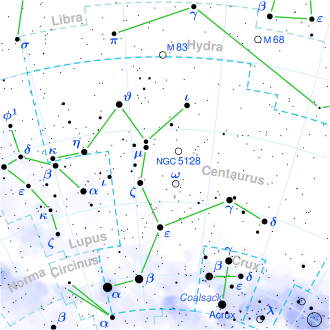
  | |
| Observation data Epoch J2000.0 Equinox J2000.0 | |
|---|---|
| Constellation | Centaurus |
| Right ascension | 13h 49m 26.72175s1 |
| Declination | −34° 27′ 02.7929″1 |
| Apparent magnitude (V) | 4.16–4.262 |
| Characteristics | |
| Evolutionary stage | AGB3 |
| Spectral type | M5 III4 |
| U−B color index | +1.445 |
| B−V color index | +1.495 |
| Variable type | SRb2 |
| Astrometry | |
| Radial velocity (Rv) | +40.7±0.76 km/s |
| Proper motion (μ) | RA: −41.68±0.231 mas/yr Dec.: −59.77±0.181 mas/yr |
| Parallax (π) | 17.82±0.21 mas1 |
| Distance | 183 ± 2 ly (56.1 ± 0.7 pc) |
| Absolute magnitude (MV) | +0.517 |
| Details | |
| Mass | 1.08 M☉ |
| Radius | 82.49 R☉ |
| Luminosity | 7678 L☉ |
| Surface gravity (log g) | 0.658 cgs |
| Temperature | 3,4388 K |
| Other designations | |
| g Centauri, 2 Cen, V806 Cen, CD−33°9358, GC 18666, HD 120323, HIP 67457, HR 5192, SAO 20487510 | |
| Database references | |
| SIMBAD | data |
2 Centauri is a single11 star in the southern constellation of Centaurus, located approximately 183 light-years from Earth.1 It has the Bayer designation g Centauri;10 2 Centauri is the Flamsteed designation. This object is visible to the naked eye as faint, red-hued star with an apparent visual magnitude of about 4.2. It is moving away from the Earth with a heliocentric radial velocity of +41 km/s.6 The star is a member of the HR 1614 supercluster.12

This is an evolved red giant star with a stellar classification of M5 III.4 In 1951, Alan William James Cousins announced that the star, then called g Centauri, is a variable star.15 It was given its variable star designation, V806 Centauri, in 1978.16 It is classified as a semiregular variable star and its brightness varies from magnitude +4.16 to +4.262 with a period of 12.57 days.17 The star has around 82 times the Sun's radius and is radiating 767 times the Sun's luminosity from its enlarged photosphere at an effective temperature of 3,438 K.
References
References
- van Leeuwen, F. (2007). "Validation of the new Hipparcos reduction". Astronomy and Astrophysics. 474 (2): 653–664. arXiv:0708.1752. Bibcode:2007A&A...474..653V. doi:10.1051/0004-6361:20078357. S2CID 18759600. Vizier catalog entry
- Samus, N. N.; Durlevich, O. V.; et al. (2009). "VizieR Online Data Catalog: General Catalogue of Variable Stars (Samus+ 2007-2013)". VizieR On-line Data Catalog: B/GCVS. Originally Published in: 2009yCat....102025S. 1. Bibcode:2009yCat....102025S.
- Eggen, Olin J. (1992). "Asymptotic Giant Branch Stars Near the Sun". The Astronomical Journal. 104: 275. Bibcode:1992AJ....104..275E. doi:10.1086/116239.
- Houk, N.; Swift, C. (1999). "Michigan catalogue of two-dimensional spectral types for the HD Stars, Vol. 5". Michigan Spectral Survey. 5. Bibcode:1999MSS...C05....0H.
- Mermilliod, J.-C. (1986). "Compilation of Eggen's UBV data, transformed to UBV (unpublished)". Catalogue of Eggen's UBV Data. Bibcode:1986EgUBV........0M.
- Gontcharov, G. A. (2006). "Pulkovo Compilation of Radial Velocities for 35 495 Hipparcos stars in a common system". Astronomy Letters. 32 (11): 759–771. arXiv:1606.08053. Bibcode:2006AstL...32..759G. doi:10.1134/S1063773706110065. S2CID 119231169.
- Cardini, D. (January 2005), "Mg II chromospheric radiative loss rates in cool active and quiet stars", Astronomy and Astrophysics, 430: 303–311, arXiv:astro-ph/0409683, Bibcode:2005A&A...430..303C, doi:10.1051/0004-6361:20041440, S2CID 12136256.
- Ayres, Thomas (2023). "In the Trenches of the Solar-Stellar Connection. VII. Wilson-Bappu 2022". The Astrophysical Journal Supplement Series. 266 (1): 6. Bibcode:2023ApJS..266....6A. doi:10.3847/1538-4365/acb535.
- Wood, Brian E.; Harper, Graham M.; Müller, Hans-Reinhard (May 2024). "Resolving Red Giant Winds with the Hubble Space Telescope*". The Astrophysical Journal. 967 (2): 120. arXiv:2404.15086. doi:10.3847/1538-4357/ad401f. ISSN 0004-637X.
- "2 Cen". SIMBAD. Centre de données astronomiques de Strasbourg. Retrieved 2019-04-06.
- Eggleton, P. P.; Tokovinin, A. A. (September 2008). "A catalogue of multiplicity among bright stellar systems". Monthly Notices of the Royal Astronomical Society. 389 (2): 869–879. arXiv:0806.2878. Bibcode:2008MNRAS.389..869E. doi:10.1111/j.1365-2966.2008.13596.x. S2CID 14878976.
- Eggen, Olin J. (June 1998). "The HR 1614 Group and HIPPARCOS Astrometry". The Astronomical Journal. 115 (6): 2453–2458. Bibcode:1998AJ....115.2453E. doi:10.1086/300380.
- "Hipparcos Tools Interactive Data Access". Hipparcos. ESA. Retrieved 8 December 2021.
- Tabur, V.; Bedding, T. R.; Kiss, L. L.; Moon, T. T.; Szeidl, B.; Kjeldsen, H. (2009). "Long-term photometry and periods for 261 nearby pulsating M giants". Monthly Notices of the Royal Astronomical Society. 400 (4): 1945–1961. arXiv:0908.3228. Bibcode:2009MNRAS.400.1945T. doi:10.1111/j.1365-2966.2009.15588.x.
- Cousins, A. W. J. (October 1951). "Photographic magnitudes of the brightest stars". The Observatory. 71: 201–202. Bibcode:1951Obs....71..201C. Retrieved 16 January 2025.
- Kholopov, P. N.; Kukarkina, N. P.; Perova, N. B. (April 1978). "63rd Name-List of Variable Stars" (PDF). Information Bulletin on Variable Stars. 1414: 1–10. Bibcode:1978IBVS.1414....1K. Retrieved 16 January 2025.
- Ruban, E. V.; Arkharov, A. A.; Hagen-Thorn, E. I.; Novikov, V. V. (September 2009). "Physical parameters of the semiregular variable red giant 2 Cen". Astrophysics. 52 (3): 383–394. Bibcode:2009Ap.....52..383R. doi:10.1007/s10511-009-9075-3. S2CID 121256121.